
• Lists of Stale Words Have Become Kind of Stale. I Say We Do Away With Them.


    Andrew Sullivan links today to an interview with Robert Silvers, editor of the New York Review of Books:

    I know from sometimes-painful experience how particular you are about certain tired words. Massive, for example, is strictly forbidden. Or framework.

    Framework could rightly refer to the supporting structure of a house, or a wooden construction for holding roses or hollyhocks in a garden, but now the word is used to refer to any system of thought, or any arrangement of ideas. And it really means nothing.

    The most heretical thing we do is try to avoid context. Context has an original, useful meaning, now generally lost: the actual language surrounding a particular text—con, meaning “with,” and text—and now it’s used for every set of surrounding circumstances or state of things, and it gets worse with contextualize, sometimes used to mean some sort of justification.

    ….Then there is the constant movement of every kind of issue—war, treaty, or political feud—on or off “the table.” The question of an independent Palestinian state is on the table! Or is it off the table? It’s become a way of avoiding a more precise account of just what’s happening.

    This is one of my pet peeves. Why on earth is framework off limits? As Silvers says, it’s obviously analogous to the framework of a house, and its meaning, far from being “nothing,” is quite plain. Ditto for context. It’s a perfectly good word which, as Silvers himself points out, means “a set of surrounding circumstances.” What’s the problem? And ditto yet again for off the table.

    Obviously any of these words and phrases can be misused or overused. But what is it that makes editors mistake their idiosyncratic dislikes for a cosmic rule of good taste? If you hire a good writer, and she wants to use framework to refer to an arrangement of ideas, then let her. It’s her byline on the piece, not yours. And it’s not her problem that you have some weird aversion to the word.

    I think we all agree that editors should watch out for faddish usages that become overworked, and recommend replacements where it truly seems advisable. But that’s it. In fact, I have a proposal. I’ve noticed that it’s become rather faddish lately for publications to have (sometimes quite long) lists of banned words. Unfortunately, this has gotten hackneyed and stale. How about if we do away with them?

    Except for contextualize. That can stay on the list. It really is hideous, isn’t it?
  • An Update on Peak Oil


    If you’ve been reading this blog regularly, you already know the basics about peak oil:

    • It’s not a kooky conspiracy theory. The obsessively mainstream International Energy Agency, which refused to even acknowledge the possibility of peak oil for years, officially admitted it was real three years ago. Not only that, they even put a date on peak production of conventional oil: 2006. In other words, it’s already happened.
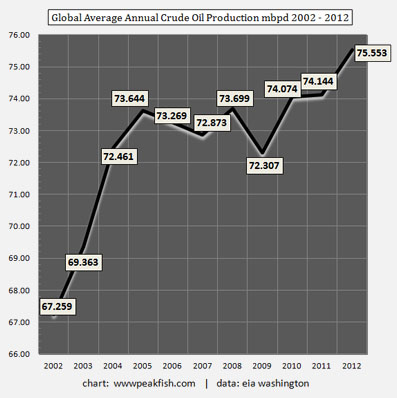
    • The peak in conventional oil will be offset by new “unconventional” production: shale oil, tar sands, deepwater oil, and so forth. But that oil is both expensive and in limited supply. Shale oil has gotten immense publicity, but it’s unlikely to ever get much above a production rate of 1 million barrels per day. That’s 1 million out of a current global production of about 85 million (75 million barrels of crude oil and about 10 million barrels of petroleum liquids).
    • Other unconventional sources will add more to this, but unless there’s some huge discovery of unconventional oil that we know nothing about, it’s likely that we’re already at or close to peak oil right now. New production of unconventional oil is only barely replacing declines in older, more mature fields, and decline rates in older fields are only going to get worse in the future.

    Over at Wonkblog, Brad Plumer interviews energy analyst Chris Nelder about peak oil, and Nelder has this to say about unconventional oil:

    BP: So what we’re seeing is that the world can no longer increase its production of “easy” oil — many of those older fields are stagnant or declining. Instead, we’re spending a lot of money to eke out additional production from hard, expensive sources like Alberta’s tar sands or tight oil in North Dakota.

    CN: Right, and that’s entirely consistent with peak oil predictions, which said that extraction would plateau, that the decline in conventional oil fields would have to be made up by expensive unconventional oil. Right now, we’re struggling to keep up with declines in mature oil fields — and that pace of decline is accelerating.

    Mature OPEC fields are now declining at 5 to 6 percent per year, and non-OPEC fields are declining at 8 to 9 percent per year. Unconventional oil can’t compensate for that decline rate for very long.

    Even all the growth in U.S. tight oil from fracking, which has produced about 1 million barrels per day, hasn’t been enough to overcome declines elsewhere outside of OPEC. Non-OPEC oil has been on a bumpy plateau since 2004.

    There’s more oil out there. But it’s hard to find; expensive to extract; declines quickly; and is usually disappointing in volume (Nelder: “Anticipated production growth for tar sands has consistently failed to meet expectations, year after year after year. Ten years ago, tar sands production today was expected to be twice what it actually is.”). We may or may not be quite at peak oil yet, but we’re either there already or else very, very close. And either way, production costs of unconventional oil make it unlikely that oil will ever get much below $100 per barrel again. This makes it a significant restraint on global economic growth, and unless and until we make a huge switch to renewable energy, this will continue permanently. Any time you see a medium or long-term forecast of global growth that doesn’t mention oil constraints, you should probably take it with a big grain of salt.

  • Quote of the Day: Happy Days Are Here Again


    From Kelly Hamon, who recently bid $47,000 over the asking price to beat out five other buyers for a cream-colored North Hollywood home:

    I am going to have to tighten the budget. Maybe not get TV right away — just Netflix.

    The backstory here is the return of the housing bubble to Los Angeles:

    The once-in-a-lifetime mentality, fueled by a shortage of for-sale homes, is driving the Los Angeles area from recovery to frenzy, according to real estate agents and experts….Out of all homes sold in March, 91% of [Redfin’s] deals involved a bidding war. And about 10% were investors flipping a property at a profit after buying it just a short time before.

    ….While cash offers may have proliferated in 2012, this year has ushered in stronger competition in the mortgage market, said Guy Cecala, publisher of Inside Mortgage Finance Publications….[Banks] are setting their sights on new home buyers by loosening their underwriting standards and accepting lower down payments. Some lenders have even begun offering piggyback loans — which enable buyers to take multiple mortgages to avoid putting any money down, Cecala said.

    “It is mostly something that started in the last month or two,” he said. “The good news for borrowers is that they are starting to see looser underwriting, but it is not looser underwriting across the board.”

    ….Leo Nordine, a real estate agent in Manhattan Beach, said he recently listed a one-bedroom home in South Los Angeles and got 49 offers….”Everybody I know is trying to do flips right now. It’s like the day trading of the 1990s,” Nordine said. “We went straight from Armageddon to speculation; there was nothing in between this time.”

    I’m sure there’s nothing to worry about, though. Los Angeles is unique, after all. And things are different this time. Right?

  • Friday Cat Blogging – 12 April 2013


    I only got one photograph of Domino this week. That’s because, as usual, as soon as she saw the camera she immediately perked up and walked over. Luckily, it was a pretty good picture, so I didn’t need any more.

    This morning we got our carpet cleaned. Two hours later, it’s covered by multiple trails of cat paw prints. It’s like we have a blanket of fresh snow in the house.

  • Rand Paul, Fainthearted Truth Avoider


    There’s no question that Rand Paul has the knack of staging political theater that gets the media’s attention. But Adam Serwer argues that he really doesn’t deserve any credit for his speech yesterday defending the Republican Party’s civil rights record:

    Also strange is the presumption that somehow Paul was doing something risky or brave by speaking at a historically black college. Howard University is not a Greyhound Bus station at midnight. It is way past time for pundits to retire the notion that white politicians deserve extra credit for being willing to talk to a room full of black people. This is, as one Republican once put it, the soft bigotry of low expectations. The history of Republican politics and the conservative movement means that a black audience has every right to be skeptical of the GOP, and that the burden is rightfully on that party to reconcile with black voters. Politicians are supposed to reach out to voters, not the other way around. No more gold stars for attendance.
    In fairness, politicians often get a little extra credit for speaking in front of a hostile audience. But Adam is right: there was really nothing especially brave about what Paul did. I mean, he spoke for about half an hour and then answered questions for half an hour. Hell, I can’t count the number of half hours I’ve spent fielding caustic questions from resellers who were pissed off about my latest marketing brainstorm—and I’ll bet they were a lot less polite than the Howard students. But I didn’t especially feel like I’d been through combat or anything. It’s just something you do.

    In any case, I’m genuinely stumped about the particular conservative meme that Paul was promoting to the Howard students. His story, basically, is that Republicans were really good on civil rights and Democrats were really bad during the century after the Civil War. And sure, there’s a certain amount of truth to that. Enough for a political schtick, anyway.

    But what’s the point of saying this? Everyone knows it. And everyone knows that Democrats very bravely destroyed their own electoral coalition in the 60s by repudiating racism and losing the South. It’s one of the party’s finest moments. And everyone—except Republicans, who consistently refuse to acknowledge this—knows that the GOP very cynically and deliberately hoovered up as much of that racist vote as they could after Democrats abandoned it. This is not rocket science. It’s recent history, and everyone knows it. It’s why blacks vote against the Republican Party at 90+ percent levels.

    If you don’t want to address that recent history, fine. Who can blame you? But what’s the point of addressing your party’s civil rights history at all if you don’t also address its history after 1965? You can’t possibly think it will get you anywhere, can you? On the contrary: it just makes you look cynical and smug. I don’t get it.

  • Kermit Gosnell About to Become Right-Wing’s Pet Rock for April


    Last night I was browsing through The Corner, and it was basically wall-to-wall coverage of the Kermit Gosnell case. This is a pretty grisly trial of a Philadelphia doctor who performed late-term abortions and killed the fetuses if they were delivered alive; conducted his business on a cash basis amid filthy conditions; spread disease among his patients; and caused the deaths of at least two of them. There’s also a political angle: Gosnell was able to continue his practice only because of a massive breakdown among state and local oversight agencies that failed to shut him down. Conor Friedersdorf has a ton of detail here if you want to read more.

    As grisly as this is, however, the really big story on the right is the fact that Gosnell isn’t getting 24/7 coverage from the national media. Peter Kirsanow, in particular, believes the national media would normally be all over this story since most of Gosnell’s patients were poor and black, and doesn’t the national media love stories about people who abuse poor blacks?

    In almost every other circumstance race is never irrelevant to the very same people who are maintaining complete radio silence on the Gosnell case. There’s a reason why the parody headline, “World Ends, Minorities and Women Hardest Hit” resonates. The elite media are rarely at a loss for highlighting racial disparities, whether real or imagined, in any story. But it’s hard to highlight racial disparities when you refuse to cover the story at all.

    Also missing are the usual suspects who would rail against the responsible oversight authorities for their indifference to the plight of minorities. These usual suspects would normally ask — in this case perhaps justifiably — whether what allegedly happened in Gosnell’s clinic would be allowed to happen in a clinic largely patronized by whites. But again, as with the elite media, utter silence.

    A hierarchy of priorities is thus revealed.

    Obviously, conservatives believe the media is ignoring this story because it’s about abortion, and the lefties who run our media empires hate stories that put abortion in a bad light. Alternatively, it could be because it’s a Philadelphia story, and the national media doesn’t usually give a lot of time to local cases like this. Frankly, I don’t know—though I’ll note that even the conservative media didn’t give it a huge amount of coverage until fairly recently, when Gosnell’s trial started.

    But if the motivations of the mainstream press are hazy, the motivations of the conservative press are crystal clear: they want this case to get a lot of attention because it highlights a rogue abortion doctor. That’s it. They wouldn’t give it the time of day if it were merely a story of regulatory failure that caused the deaths of a few poor people in, say, a rogue inner city dentist’s office.

    Which is fine. If it were a rogue banker, I’d want to highlight it too. But that wouldn’t mean the rest of the media would somehow be implicated in a conspiracy if they didn’t follow my lead.

    In any case, a reader emailed me a few minutes ago to make a prediction: “This story is about to bloom in a big way.” Probably so. The conservative echo chamber is now pounding on this big time, and when that happens the mainstream media usually isn’t far behind. It’s likely, in fact, that this is about to become The Most Important Story In The World. Fasten your seat belts.

  • Paper vs. E-Books: Science Answers All Your Questions


    Ferris Jabr writes in Scientific American this month about the difference between reading a paper book and reading an e-book. The overall gist is that comprehension seems to be a bit lower on e-books, though only by a little. Here’s one piece from the article:

    “The implicit feel of where you are in a physical book turns out to be more important than we realized,” says Abigail Sellen of Microsoft Research Cambridge in England and co-author of The Myth of the Paperless Office. “Only when you get an e-book do you start to miss it. I don’t think e-book manufacturers have thought enough about how you might visualize where you are in a book.

    ….Supporting this research, surveys indicate that screens and e-readers interfere with two other important aspects of navigating texts: serendipity and a sense of control. People report that they enjoy flipping to a previous section of a paper book when a sentence surfaces a memory of something they read earlier, for example, or quickly scanning ahead on a whim. People also like to have as much control over a text as possible—to highlight with chemical ink, easily write notes to themselves in the margins as well as deform the paper however they choose.

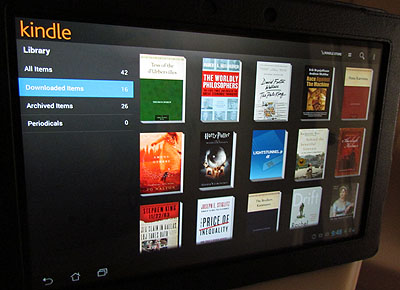
    Yep. I love reading e-books using the Kindle app on my tablet even though I didn’t like it on the Kindle device I bought a few years ago. Why? The larger screen and faster response time made all the difference. It doesn’t sound like much, but it was like night and day for me.

    Likewise, on the tactile front, it makes a big difference to me that my tablet is inside a leather (or leather-like, anyway) cover. Obviously, the basic purpose of the cover is to protect the tablet in case I drop it or something, but it also makes it far more pleasant to read. Without the cover, it feels slick, metallic, and cold. I don’t like it. With the cover, it feels slightly tacky, organic, and warm—traits that I associate with books.

    However, I do like to know how far along I am in a book, and I like being able to flip back and forth easily. Both are less automatic on e-books than with paper books. Last night, for example, I was 60 percent done with a book I was reading and figured I had plenty left to go. Then, suddenly, it ended. Partly that’s because my Kindle app inexplicably failed basic arithmetic (if I’d looked at the page count I would have seen that I was 320 pages into a 360-page book), but mostly because the book had a long index and lots of endnotes. Those are things I would have known immediately with a paper book, but which take a conscious effort to find out with an e-book.

    But that’s a small thing. By far, the biggest drawback to e-books is the inability to casually flip back and forth and find things. The search function makes that easier in some respects—though I’m mightily perplexed that the last update to the Android Kindle app slowed down searching by about 10x—and bookmarks can take the place of dog-eared pages. Still, it’s not as quick or easy to simply flip back a couple dozen (or a couple hundred) pages while holding your current place. Perhaps this is different for younger readers who grew up using reading apps and keep bookmarks and notes as instinctively as I underline passages or turn down the corners of pages.

    But anyway, yes: the next frontier for e-books is some nifty and intuitive way to make them as easy to navigate as paper books. Is anyone working on this?

  • Fun and Games in the Bluegrass State


    As we all know, a few days ago MoJo’s David Corn scored yet another scoop based on a secret recording when he published a story about an oppo meeting held by Sen. Mitch McConnell’s staff back when Ashley Judd was considering running against him. As it happens, the meeting wasn’t really a big bombshell unless you’ve been living in a serious state of innocence about how politics is conducted in America—the participants mostly talked about using material from Judd’s own autobiography against her—but it created a firestorm among McConnell and his supporters, who immediately charged that someone had bugged their campaign headquarters.

    (QUICK DISCLAIMER: I know nothing more about this stuff than you do. The first time I learned about it was when it appeared on the MoJo website, and I haven’t spoken to anyone at MoJo about it since.)

    Anyway, it turns out that the recording was apparently made by one or two (it’s not entirely clear) guys from ProgressKY—a “heaping pile of uselessness,” in Dave Weigel’s words—who stood outside the door of the meeting room and recorded the conversation. Or maybe they stuck their iPhones down near a vent. Or something. It’s not totally clear yet. But they were ratted out by a Democratic Party operative who didn’t want to be tarred by their amateur-hour theatrics, and the two guys have now apparently turned on each other. It’s a real soap opera, and Ed Kilgore makes an interesting comment:

    It’s illuminating, of course, to see liberals in and beyond Kentucky distancing themselves from the would-be guerillas of Progress Kentucky; you rarely see conservatives do that when a Breitbart-inspired stunt backfires. Some people on the left see that as a sign of weakness. But I’d say it’s better understood as a sign of understanding that what you get from skullduggery is rarely as effective as publicizing the outrages committed by people like McConnell every day, in public, as proud examples of everything they believe in and represent.

    True dat. Conservatives love them some James O’ Keefe-style guerrilla warfare, but liberals more often seem vaguely embarrassed about it. Not always, though: certainly there was nothing but praise for the Romney 47% video last year. Still, there’s definitely a difference. Whether it’s a sign of weakness or something else is your call.

  • The Rock and the Hard Place of Future Economic Growth


    Responding to Lane Kenworthy, who thinks that the Fed is unlikely to pursue full employment policies anytime in the near future, Jared Bernstein pushes back:

    I’ve often stressed that progressives cannot give up on the “primary distribution”—market outcomes—and hope to fix everything with redistribution. Not only is that an incredibly hard lift, but as market outcomes continuously deteriorate from the perspective of the middle class and the poor, we’ll have to continuously ratchet up the redistributive function. Good luck with that.
    This is one of the key economic questions—maybe the key economic question—for liberals these days. On the one hand, it’s plain that the best way to raise middle class wages is to engineer a tight labor market. It’s best for the workers themselves, who would prefer to earn wages rather than receive handouts, and it’s best for the economy, since it keeps our productive capacity at its peak. But over the past 30 years, we’ve only managed to engineer an unemployment rate under 5 percent twice—both times during bubbles, and both times for only a couple of years. There’s very little reason to think we know how to do this on a sustainable basis going forward absent some kind of massive change in our fundamental approach to economic policy. That level of change is pretty unlikely on its own merits, and when you factor in the headwinds from steadily improving automation, it’s all but inconceivable.

    On the other hand, the prospect of simply accepting that (a) full employment is no longer a policy goal, (b) median wages will therefore be stagnant for the forseeable future, and (c) we should therefore massively ramp up redistribution—well, as Bernstein says, good luck with that.

    But those are the alternatives. There is a third alternative, of course: shrug our shoulders and decide that stagnant or falling living standards for the working and middle classes is just one of those things that we can’t do anything about. This is Paul Ryan’s alternative, and I assume it has no takers among my readership.

    So that leaves us with two choices: figure out how to engineer full employment (unlikely) or figure out how to persuade the top 20 percent to subsidize the rest of the country on an ever increasing basis. Anyone have any good ideas on this score?

  • Regulatory Arbitrage Once Again a Growth Industry


    A Wells Fargo analyst says that investors remain wary of big banks:

    So-called universal banks such as Bank of America Corp., Citigroup Inc. (C) and JPMorgan Chase & Co. (JPM) are trading at a 25 percent to 30 percent discount to more-focused competitors, analysts led by Matthew H. Burnell wrote in a research report today.

    ….“Given the challenges posed by increasing regulation, higher capital requirements, and well-publicized trading/market challenges, it’s not surprising that investors remain reluctant to assign a ‘full’ valuation to the universal banks,” the analysts wrote. “If regulators and/or legislators don’t demand it, shareholders could also intensify demands to ‘break up the banks.’ ”

    As capital requirements become more stringent, big banks need to do something to improve their capital ratios. One way to do this is to accumulate more capital. Alternatively, since the ratio in question is capital / assets, you can reduce your asset base. And since safer assets require less capital, one way to do this is to sell off your risky assets and replace them with safer assets.

    Unfortunately, as the Wells Fargo report points out, this reduces your potential profits and makes investors sad. So instead of actually improving the safety of your asset base, maybe it would be better if you could just pretend to improve the safety of your asset base? In other words, why not engage in some good old-fashioned regulatory arbitrage instead? Here’s the New York Times today:

    Banks have been shedding risky assets to show regulators that they are not as vulnerable as they were during the financial crisis. In some cases, however, the assets don’t actually move — the bank just shifts the risk to another institution.

    This trading sleight of hand has been around Wall Street for a while. But as regulators press for banks to be safer, demand for these maneuvers — known as capital relief trades or regulatory capital trades — has been growing, especially in Europe.

    ….The buyers are typically hedge funds, whose investors are often pensions that manage the life savings of schoolteachers and city workers. The buyers agree to cover a percentage of losses on these assets for a fee, sometimes 15 percent a year or more.

    ….Some regulators say they are concerned that in some instances these transactions are not actually taking risk off bank balance sheets….Critics point to other reasons to worry. Most of these trades are structured as credit-default swaps, a derivative that resembles insurance. These kinds of swaps pushed the insurance giant American International Group to the brink of collapse in September 2008. Another red flag is that banks often use special-purpose vehicles located abroad, frequently in the Cayman Islands, to structure these trades.

    What a great idea! Just package up a bunch of risky assets, wrap them around a credit default swap, and voila! AAA rated, baby. What could go wrong?

