• A Lesson in Pension Return Math


    CalPERS, the giant California state pension fund, says it expects future investment returns of 7.5 percent on its holdings. Andy Kessler says this is “fiction.” He figures 3 percent is more like it. Dean Baker brings the math:

    This is a case where Mr. Arithmetic can provide a big hand. Pension funds like Calpers typically invest around 70 percent of their assets in equities, including the money invested in private equity. The expected return on stock is equal to the rate of the economy’s growth, plus the payouts in dividends and share buybacks.

    ….The long-term growth of nominal GDP is projected at around 4.8 percent, 2.3 percent real growth and 2.5 percent inflation….Companies typically pay out about two-thirds of their earnings as either dividends or share buybacks. With a current ratio of price to trend earnings, the yield is around 7 percent. Two thirds of this yield gives us a payout of 4.7 percent. Adding the two together we get 4.8 + 4.7 = 9.5 percent.

    The problem, as near as I can tell, is that Kessler is unaware (?) that pension funds don’t invest their money entirely in treasury bonds and other fixed-income securities. They invest lots of it in equities, which have a higher return. And indeed, if you get Baker’s 9.5 percent return on 70 percent of your holdings and Kessler’s 3 percent on the rest, your average return is….

    7.5 percent.

    It wouldn’t surprise me in the least if CalPERS is being a wee bit optimistic in its forecasts. Maybe they really ought to be assuming 7.25 percent or something like that. But 3 percent? Give me a break.

  • Update on the Manchin-Toomey Background Check Bill


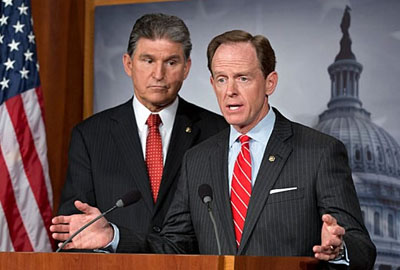
    Ed Kilgore on the prospect for passage of the Manchin-Toomey background check amendment:

    I’ve gotten a bit of flack from a progressive friend or two who think I’ve been insufficiently enthusiastic about Manchin-Toomey. To be clear, I think if it were actually to become law, it would indeed be an important step forward towards sane gun regulation, particularly given the stranglehold the NRA has possessed on the issue for so long. But surviving a filibuster on the motion to proceed to a debate in the Senate is at the very most a baby step, so we don’t know yet whether Manchin-Toomey represents a breakthrough or just another compromise on a road to ultimate defeat.

    Hey, I’ve gotten a bit of flack too! Maybe we have the same friend?

    I should probably update my post of yesterday on this subject. At the time I wrote it, there were few precise details available about what Manchin-Toomey does, and these kinds of compromise deals are really, really sensitive to the actual legislative language that’s agreed on. That’s still not available, but the fact sheet released later in the day put a bit more meat on the bare bones that were outlined at the press conference. In particular, it clears up their approach to the infamous “gun show loophole”:

    Under current law, if you buy a gun at a gun show from a licensed dealer, you have to undergo a background check by that dealer. But you can go to a nondealer table at the gun show, or into the parking lot, and buy a gun without a background check. Our bill ensures that anyone buying a gun at a gun show has to undergo a background check by a licensed dealer.

    Manchin-Toomey also extends background checks to online sales within a state (interstate sales already require a background check). However, private sales are exempted:

    As under current law, transfers between family, friends, and neighbors do not require background checks. You can give or sell a gun to your brother, your neighbor, your coworker without a background check. You can post a gun for sale on the cork bulletin board at your church or your job without a background check.

    This represents progress. Instead of going out to the parking lot of a gun show, you’ll have to go a bit further—or maybe agree to meet the next day somewhere else. That’s an extra hurdle, and that will make it a little less convenient for felons and the mentally ill to get hold of guns. However, it only make it a little bit less convenient, and the data is decidedly mixed on just how much effect this will have in the real world.

    Bottom line: I’m a little more bullish on this than I was yesterday, but only a little. This is a baby step indeed. And it’s telling that despite its very modest ambitions—and despite the fact that it offers up several goodies for gun owners to make up for expanded background checks—the NRA has announced that they’re officially opposed to Manchin-Toomey and that this will be a scorable bill. If you vote for it, your NRA report card will suffer. This makes it worth supporting just for the symbolic value of demonstrating the NRA’s extremism, but it also makes it a lot less likely that even this baby step will ever see the light of day.

  • Raw Data: The Deficit is Shri-i-i-i-nking


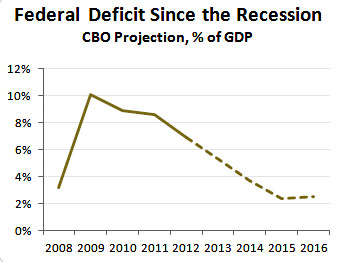
    Over at Calculated Risk, Bill McBride quotes a Goldman Sachs analyst about the rapidly shrinking federal deficit—down from 10.1 percent to 5.7 percent last year, and then down again to 4.5 percent following the fiscal cliff deal—and notes that this hasn’t gotten much attention:

    It shocks people when I tell them the deficit as a percent of GDP is already close to being cut in half (this doesn’t seem to ever make headlines). As Hatzius notes, the deficit is currently running under half the peak of the fiscal 2009 budget and will probably decline further over the next few years with no additional policy changes.

    It’s true that this doesn’t get much attention. So how about a simple chart instead? This isn’t from a Goldman Sachs report that only a select few have access to, it’s from the most recent CBO budget outlook. Anyone who cares just needs to click the link to see it. Pass this along to your friends when they ask you about the monstrous federal deficit and how we’re bankrupting our children.

  • Republicans Now Officially Opposed to Confirming Any Democratic Nominees for the DC Circuit Court


    Last week I mentioned that I had once dug into the subject of filling vacancies on the DC Circuit Court. I wanted to find out what the official objection to Obama’s nominees was:

    The party-line answer, it turned out, was pretty straightforward: The DC Circuit doesn’t really have a very heavy caseload, so it doesn’t need any more judges. As you can imagine, this is a very handy argument indeed, since it means that Republicans don’t really need to cast around for a pretend reason to oppose Srinivasan or any of Obama’s other nominees. They can just oppose them all.

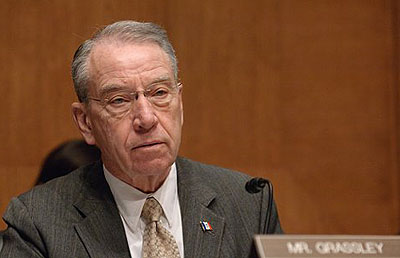
    But that was a couple of years ago. Is it still the official party line? Yes! Ian Millhiser reports today that Sen. Chuck Grassley (R–IA) has introduced a bill that would simply slash the number of seats on the DC Circuit and put a stop to any further Obama nominees completely. Here’s Grassley:

    As most of my colleagues know, the D.C. Circuit is the least busy circuit in the country. In fact, it ranks last or almost last in nearly every category that measures workload….Given this imbalance in workload, today I am introducing the Court Efficiency Act. A number of my colleagues are co-sponsoring the legislation, including Senators Hatch, Sessions, Graham, Cornyn, Lee, Cruz and Flake.

    This legislation is straightforward. It would add a seat to the Second and the Eleventh Circuits. At the same time, it would reduce the number of authorized judgeships for the D.C. Circuit from 11 to 8.

    So there you go! Just cut the size of the court from 11 to 8 and there’s no need to confirm any more pesky Democratic nominees. The court can continue handing off its overflow caseload to its retired senior judges, almost all of whom are safely Republican.

    You can (and should) go read Millhiser for more detail about the reality of the DC court’s caseload and why Grassley and his little gang of cosponsors are full of shit. Or you can just accept the obvious: this has no basis in fact or policy. It’s simply another transparent Republican power play designed to maintain their stranglehold on the federal bureaucracy.

    But I think it does answer a question. It’s possible that Republicans will agree to confirm Sri Srinivasan to the DC Circuit. He’d be the eighth judge, and he’s practically a gift to them anyway. But after that they haven’t the slightest intention of allowing any further vacancies to be filled. Not by Obama, anyway.

  • Immigration Reform About to Finish First Mile of Marathon


    The big sticking point in the Gang of 8 negotiations over immigration reform has been border enforcement. Hardliners want some kind of firm metric that demonstrates a sharp drop in illegal immigration before anyone currently in the country is allowed to apply for citizenship. Reformers generally consider this a trap, and want to legislate a softer set of goals. The New York Times reports today that the Gang’s “delicate compromise” avoids specific measurements:

    Instead, the bill allows a period of 10 years for the Department of Homeland Security to make plans and use resources to fortify enforcement at the borders and elsewhere within the country before it sets several broader hurdles that could derail the immigrants’ progress toward citizenship if they are not achieved.

    During the first decade after passage, the bill sets ambitious goals for border authorities — including continuous surveillance of 100 percent of the United States border and 90 percent effectiveness of enforcement in several high-risk sectors — and for other workplace and visa enforcement measures. It provides at least $3 billion for Homeland Security officials to meet those goals during the first five years, with a possibility of additional financing.

    That all sounds fine, and it’s probably the best that can be done if we want to get a bill started through the legislative process. But there’s no way that any kind of delicate compromise will survive the crucible of debate. It’s going to get amended to death almost instantly, and that might or might not kill the entire bill.

    In other words: it’s a nice start. But we’re only about 10 percent of the way there. Immigration reform still has a helluva long way to go.

  • Obama’s Chained CPI Offer is a Bad Idea


    This is a bit of an obvious point, but I want to make it anyway: pretty much every liberal, even those who generally support the idea of adopting chained CPI as a more accurate measure of inflation, should be opposed to President Obama’s proposal to adopt chained CPI.

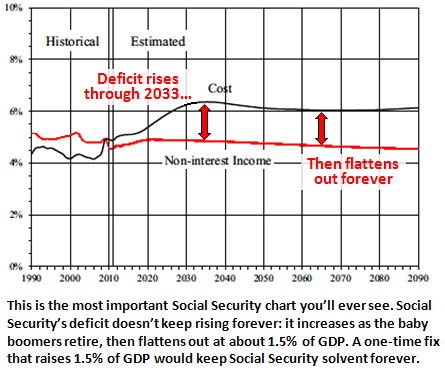
    The reason is simple: chained CPI represents a cut in the growth rate of Social Security benefits. It’s arguably something that’s worth accepting as part of a larger bargain that would cut benefits a bit and raise taxes a bit in order to improve Social Security’s finances, but it makes no sense on its own. Social Security is separate from the rest of the federal budget, and its benefits should never be horse-traded away for miscellaneous changes elsewhere.

    If Republicans are ever in a mood to consider a serious Social Security deal that’s designed to improve its solvency in a balanced way, that’s fine. I’m ready to listen. But that’s not on the table. Until it is, chained CPI shouldn’t be on the table either.

  • Hold on to Your Bitwallets, Folks


    The Guardian reports on the latest Bitcoin follies:

    Bitcoin, the digital currency, lost more than $160 (£104) in value on Wednesday, just hours after hitting a record high. The currency hit a new high of $266 before falling to $105 and then bouncing back to $130. The fall is unlikely to put off speculators. Two months ago, a Bitcoin was worth $20.

    ….Wednesday’s wild ride came as someone gave away thousands of dollars worth of Bitcoins on Reddit, the social news site. News blog Business Insider calculated a Reddit user under the name “Bitcoinbillionaire” had given away $13,627.69896 worth of Bitcoins to Reddit users over the day. The mystery donor signed off with a quote from Ron Paul, libertarian politician and one-time would-be presidential candidate: “It’s no coincidence that the century of total war coincided with the century of central banking.”

    So the monetary base of the Bitcoin empire dropped by about a billion dollars because someone gave away $13,000 on Reddit. And this is something we’re supposed to take seriously as the future of money? Seems a wee bit fragile, no?

    For more on the techno-idiocy that is Bitcoin, Adam Serwer and Dana Liebelson answer all your questions here.

  • Paul Ryan Ducks Yet Again on Social Security Reform


    Andrew Stiles reports that Paul Ryan is willing to “take a look” at President Obama’s proposal to adopt chained CPI as a way of reducing the growth of Social Security benefits:

    Ryan, however, is not endorsing the proposal, noting that House Republicans have favored an approach that would fundamentally reform entitlement programs without affecting current seniors, unlike Obama’s plan. “It’s statistical reform,” he told reporters at National Review’s office in Washington, D.C. “You can’t claim it’s great entitlement reform.”

    I’ve got a few comments on this. First, this is pretty rich coming from a guy who recently released a 91-page budget plan with the following as the sum total of his proposal to reform Social Security:

    In a shared call for leadership, this budget calls for action on Social Security by requiring both the President and Congress to put forward specific ideas and legislation to ensure the sustainable solvency of this critical program. Both parties must work together to chart a path forward on common-sense reforms, and this budget provides the nation’s leaders with the tools to get there.

    What a bold truth teller! Ryan himself is unwilling to put his name squarely behind a plan, but nonetheless sniffs at Obama’s proposal as mere “statistical reform.” I’m not sure how to read this as anything other than a complaint that, sure, Obama is cutting benefits, but he’s not being gleeful enough about it.

    Second, it’s pretty clear that Ryan wants Obama to own this proposal. He isn’t willing to endorse it himself because he wants to make sure that seniors blame Obama for trying to cut their benefits, not Republicans.

    And third, there’s the perennial pandering about reforming entitlements “without affecting current seniors.” I find this loathsome. If you truly believe that Social Security is too expensive and needs to be reined in, why shouldn’t everyone pitch in? Why exempt the very group—baby boomers—that’s responsible for the increased cost of the program in the first place?

    The fact that chained CPI affects everyone is a feature, not a bug. If you truly believe that sacrifices need to be made, then everyone should share in the sacrifice. And if you’re gung ho on cutting benefits, you should be willing to suck it up and bravely tell current seniors that they’re going to have to help out too. Ryan has always been wholly unwilling to do that.

  • Needed: Dave Weigel’s Latest Take on the Obamaphone


    In the Washington Post today, Karen Tumulty writes about the latest conservative pet rock: Obamaphones. The actual name for the program in question is “Lifeline,” which uses fees added to telephone bills to provide discounts on phone service for poor people. It began in 1984 under Reagan, was expanded to cover cell phones in 1996 under Clinton, and was expanded yet again to cover prepaid cell service in 2008 under George Bush. A year later it entered kooky conspiracy theory land:
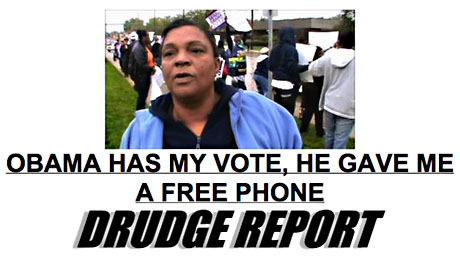
    Lifeline made its way onto the radar screens of the right with an anonymous e-mail, which began circulating in 2009. It warned that free “Obama phones” were being given to welfare recipients, along with 70 minutes of service a month. “The very foundations that this country was built on are being shaken,” the e-mailer wrote.

    From there, the conspiracy theories sprouted. Conservative talk radio last year was abuzz with speculation that “Obama phones” had become a means for the president’s tech-savvy reelection campaign to get poor people and minorities to vote.

    Some of it was fueled by a video of an Obama supporter that went viral about six weeks before the election and has been viewed almost 8 million times. “Everybody in Cleveland, low minority got Obama phone,” a woman yells on the video. “Keep Obama in president, you know? He gave us a phone.”

    That narrative has lived on for some Obama critics as an allegory that explains the president’s worldview. “The president offers you free stuff, but his policies keep you poor,” Sen. Rand Paul (R-Ky.) said in the tea party response to Obama’s State of the Union address. “For those who are struggling, we want to you to have something infinitely more valuable than a free phone.”

    And it has become woven into the current fiscal arguments. House Speaker John A. Boehner (R-Ohio) tweeted on Feb. 19: “Nobody should be talking about tax hikes when govt is spending taxpayer dollars on free cell phones.”

    What I really want is the Dave Weigel version of this story. The whole Obamaphone thing has been circulating practically since Obama took office. So why is it that it suddenly got legs just last year? Is it purely an election-related thing? But if that’s the case, why did it continue to have legs after the election, finally getting mainstream attention from the likes of Rand Paul and John Boehner?

    One possibility is that it’s mostly advertising-driven. Not political ads, but aggressive marketing from cell phone companies making a buck off the Lifeline service:

    TracFone was the first carrier the FCC approved to offer free cell service, instead of just discounted service, as the Associated Press reported on August 15, 2008….Soon, a whole bunch of other wireless carriers got in on the program — by 2010, Virgin Mobile, Verizon, Sprint, i-Wireless, Head Start, Consumer Cellular, Midwestern Telecom, Allied Wireless, and others had free phone plans. That’s why you can find all these “free cell phone” websites that look kind of shady, like Obamaphone.net or FreeGovernmentCellPhones.net.

    ….TracFone spokesman Jose Fuentes told Bloomberg in February, “We’ve had a lot of fly-by-night companies come in.” Fuentes estimated that more than 1,700 wireless companies were part of Lifeline. Between 2008 and 2012, the number of people with Lifeline phones grew from 7.1 million to 12.5 million. These companies may be fly-by-night at providing cell phone service, but they are pretty good at marketing, and as the rush of merchandise tied to his inauguration showed, Obama’s name seems to move product. But they could have chosen another hook. Reaganfreedomphone.com is still available if you want to try to reach out to the Fox News demo.

    I guess the chronology makes sense. TracFone starts the prepaid gold rush in 2008, and in 2009 the weirdo conspiracy theories sprout up. The aggressive marketing, however, begins around 2011 and into 2012, and that’s when people really start to notice. Ironically, it’s also exactly the time when the FCC started up an investigation designed to rein in fraud in the Lifeline program. But irony isn’t a highly prized commodity in Washington DC, and politicians make hay with whatever’s at hand. So Obamaphones got a second lease on life.

    I guess. But I still want to hear Dave Weigel’s take on this.