• Deal Reached on Guns, But It Looks Fairly Weak


    Apparently we have a deal on background checks:

    A bipartisan group of senators has struck a deal to expand gun background checks to all commercial sales — whether at gun shows, via the Internet or in any circumstance involving paid advertising, according to Senate aides familiar with the talks. The amendment to the guns legislation already proposed in the Senate would not cover private transactions between individuals, unless there was advertising or an online service involved.

    ….Under the terms of the Manchin-Toomey deal all background checks would be conducted by federally licensed gun firearm dealers, who would need to verify the validity of a purchaser’s gun license and record that a check was performed. Background checks would need to be completed within three days, except at gun shows, where they would have to be completed within two days for the next four years, and then within 24 hours. In order to avoid processing delays, the FBI would be required to complete background checks requested at gun shows before those requested elsewhere.

    ….Under the Manchin-Toomey deal, records of the newly covered transactions would be kept by federally licensed arms dealers, according to a person familiar with the agreement. Currently, licensed arms dealers keep records of gun sales that take place in gun stores.

    On the bright side, the deal seems to require that records of background checks be maintained in the same way as current background checks. This is a key provision, since without recordkeeping the law is essentially worthless. On the not-so-bright side, the exemption for private transactions seems to be pretty broad. This goes well beyond the limited exemption for family members previously under consideration, and would cover anyone using, say, Craigslist to sell a gun.

    I suspect that this is a very modest step forward, since the loopholes still seem to be big enough to cover pretty much anyone who wants to sell a gun without doing a check. But I’ll wait for more knowledgeable folks to weigh in on this before I say more.

    UPDATE: Apparently Craigslist doesn’t allow sales of guns, so that was a bad example. However, the general point stands.

  • Social Security is Probably Pretty Safe For Now


    The White House has officially released its 2014 budget proposal, and it’s pretty much what everyone expected. In particular, it cuts the growth of Social Security benefits by adopting chained CPI and raises taxes on the wealthy by reducing the size of their tax deductions. So does this mean that Social Security is in danger? Ezra Klein comments:

    As the White House sees it, there are two possible outcomes to this budget. One is that it actually leads to a grand bargain, either now or in a couple of months. Another is that it proves to the press and the public that Republican intransigence is what’s standing in the way of a grand bargain.

    We’ll see. But I’ll put my marker on the table right now: the answer is behind Door #2. There will be no grand bargain, not now and not in a couple of months. In fact, as time passes, a grand bargain gets less and less likely. There was a brief period after the election when it seemed as if the adults in the Republican Party might exert a little control over the tea party wing and try to reach a deal with Obama. But that moment passed, the tax jihadists have reasserted their dominance, and there’s zero chance that they’ll agree to any kind of tax hikes. So: no grand bargain, and no cuts to Social Security.

    Obviously I could be wrong. But anyone who thinks so had better be prepared to explain just how and why I’m wrong—and if you point feebly to Obama’s “outreach” dinners for those Republican senators, you might as well just concede the point now. They’ll eat dinner with Obama, but they aren’t going to vote for any tax increases, and even if they do, the House won’t follow their lead. So take your pick: either the modern GOP really is as intractable and deranged as we keep saying it is, or Social Security is in danger of being cut. It’s hard to have it both ways.

    For what it’s worth, this is why I’m comfortable taking a fairly academic approach to the whole issue of chained CPI. I don’t doubt that Obama’s offer is sincere, but it doesn’t matter. Republicans aren’t going to take it. Obama will get his proof that Republicans simply aren’t willing to negotiate seriously, and who knows? Maybe it will do him some good. But that’s all he’ll get.

  • Let’s Spend Some Money and Find Out Once and for All Whether Chained CPI Cheats the Elderly


    Measuring inflation is really hard. Products sprout new features, quality goes up and down, and consumer tastes change. A banana today might be the same as a banana ten years ago, but if you buy a car, a computer, or an iPod, how do you even begin to compare it to a basket of goods you might have purchased ten years ago? At times, it’s a question that becomes almost metaphysical.

    The boffins at the BLS spend a lot of time trying to figure this stuff out, and some time ago they decided that their classic CPI measurement probably wasn’t accurate. It was overstating actual inflation because it didn’t properly account for the fact that people change their buying habits when prices go up. If beef gets more expensive, for example, people buy more chicken. So if you just blindly plug the increased price of beef into your spreadsheet, you’ll end up generating an inflation number that doesn’t accurately reflect the actual consumption patterns of ordinary consumers.

    To fix this, about a decade ago the BLS began tracking a measure called chained CPI. But there’s yet another problem with measuring inflation: it’s different for different groups of people. If you’re a child and you spend half your income on comic books, a rise in the price of comic books represents a gigantic increase in the inflation rate. For adults, not so much.

    So if we switch to a new measure of CPI, it’s likely to affect different groups of people differently. In particular, although adopting chained CPI as the new official measure of inflation would more accurately reflect inflation for consumers who have a lot of freedom to change their buying patterns, it might be less accurate for consumers who are more constrained. One example of a group that’s more constrained is the elderly. Bob Greenstein acknowledges this in a short note that tots up the pros and cons of adopting chained CPI:

    Most analysts who have studied the issue have concluded that the chained CPI — which has risen about one-quarter of a percentage point more slowly per year than the regular CPI over the last ten years — more accurately measures overall inflation than the regular CPI. But that judgment applies to the population as a whole. The chained CPI probably does not more accurately measure inflation for the elderly; in fact, it may well be less accurate.

    This was a long windup to get to a simple question: Why only “probably”? Why don’t we know whether chained CPI is more accurate for the elderly? This has been a significant issue for years, since it directly impacts annual COLA increases for Social Security recipients. If chained CPI is more accurate even for the elderly, there’s good reason to adopt it. If it’s less accurate—because seniors spend a big chunk of their income on housing and medical care, and have little freedom to change that—then it would effectively produce COLA increases that didn’t keep up with inflation as experienced by seniors.

    So why don’t we know? The BLS has an experimental measure called CPI-E that tries to measure consumer prices for the elderly, but it has a number of flaws and shows inconclusive results. And anyway, it reflects only the different buying patterns of the elderly, not whether chaining would unfairly assume that those buying patterns are more variable than they really are.

    I assume it would cost a few million dollars to conduct a full-scale study of the effect of chained CPI on the elderly. But the effect on the elderly amounts to hundreds of billions of dollars. So what’s stopping us from putting in the time and money it would take to find out for sure?

  • Conservatives Part Ways on Sequester Cuts


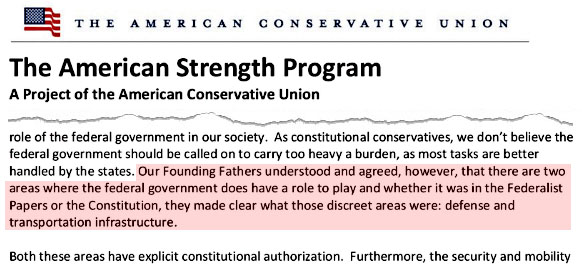
    The American Conservative Union thinks the federal government spends too much. Still, there are business lobbies out there that are unhappy with some of the sequester cuts, and that represents a fundraising opportunity. So to the dismay of tea partiers everywhere, the ACU is now pitching a new program to defense and transportation lobbyists, called the American Strength Program, to fight cuts in programs these lobbyists support. That’s not the official pitch, of course. The official pitch is that defense and roadbuilding are explicitly mentioned in the Constitution, so constitutional conservatives should be happy to shovel as much money as possible into those areas.

    Anything for a buck, I guess. Nick Confessore has the full story here. On the bright side, at least the ACU is planning to be discreet about the whole thing.

  • One Reason That We All Love Lists


    Paul Waldman notes today that on virtually every website, lists are routinely among the most popular pieces:

    So what’s the lesson here? Lists are magic. Buzzfeed has built its spectacular success on that principle (just look), there are other web sites who have similar success, (see, for example, Cracked, which on the web is something very different and more successful than its print roots as a Mad magazine rip-off), and it’s something every magazine and website editor knows. The next time you’re at a newsstand, look at the magazine covers, and see how many are using lists to grab your attention. “9 Moves That’ll Drive Him Wild.” “8 Exercises to Burn Fat And Rip Those Abs.” “12 Strategies For Achieving Financial Security.” “14 Celebrity Bikini Nightmares.” But the question is, why?

    OK, I’ll take a crack at this. First off, let’s dispose of the old-school list, which is usually a “best of” compilation. Ten Best Movies of the Year. The Hundred Best Albums of All Time. Most Influential Presidents of the United States.

    Why do these lists suck us in? Because we like to argue about this stuff. London Calling didn’t make the top ten?!? Clinton ranks higher than Eisenhower? Those idiots! Etc.

    Fine. But what about the kinds of lists that have taken over our lives these days, the kind that Waldman mentions above? Those are different. Here’s my guess:

    1. They hold out the promise of something concrete. Not a couple thousand words of blah blah blah that are hard to make sense of—and, even when you do take the time to make sense of, often don’t provide much in the way of real advice. But a list! There’s no blah blah blah there! There are, as promised, nine concrete suggestions for driving him wild, and it won’t require a lot of mental energy to figure out what they are.

    I’m fond of lists myself, because I happen to think they’re (a) often a good way for writers to discipline themselves to deliver the goods without rambling too much, and (b) a good tool that allows readers to follow complex topics. The first piece I wrote for MoJo was “10 Things You Should Know About Cap-And-Trade,” sort of a nerd’s version of the BuzzFeed style of list. Since then, oddly enough, I’ve deliberately avoided writing magazine pieces in that style. I’m not quite sure why. It seemed….immature, maybe? And I suppose it is. And yet, I suspect that for most readers it’s a pretty good organizing tool.

    Of course, there are other effective ways to accomplish the same thing. My favorite is the Q&A, which I find a very effective way to organize a complex topic into bite-size chunks. As a writer, it forces you to make sure that the flow of information makes sense, with baseline concepts always getting explained before more complex concepts. As a reader—assuming it’s done well—the Q&A format provides a motivation for why you should read each successive chunk. In a good Q&A, you’re genuinely left with a question in your mind at the end of each answer, and the next one answers it.

    I dunno. Maybe I should do another piece in list format for the magazine. Any ideas?

  • Guess Who Waits Longest to Vote?


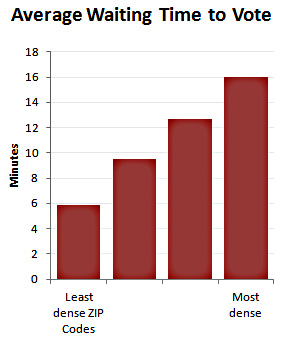
    Via Steve Benen, I see that we have a new study from MIT political science professor Charles Stewart about waiting times to vote in the 2012 election. Two factors seem to play the biggest roles in wait times: where you live and where you live. Of the ten places with the longest waits, nine are southern or border states.1 And within states, areas with dense populations have the highest wait times. Here’s the net result:

    At the individual level, the factor that stands out is race. Viewed nationally, African Americans waited an average of 23 minutes to vote, compared to 12 minutes for whites; Hispanics waited 19 minutes.

    While there are other individual-level demographic difference present in the responses, none stands out as much as race. For instance, the average wait time among those with household incomes less than $30,000 was 12 minutes, compared to 14 minutes for those in households with incomes greater than $100,000. Strong Democrats waited an average of 16 minutes, compared to an average of 11 minutes for strong Republicans.

    Is this racial disparity deliberate? It’s impossible to say. But it’s there; it’s been there for a long time; and no one seems to be in much of a hurry to fix it. I report, you decide.

    1Tennessee, Louisiana, Georgia, Oklahoma, Michigan, South Carolina, Virginia, Washington DC, Maryland, and Florida. And yes, I know that Washington DC isn’t actually a state.

  • Left and Right Team Up to Propose New Bank Regulations


    As we all know—because what could be more fascinating than reading about statutory capital requirements for systemically important banks?—one of the best ways of insuring that big banks are less likely to fail is to require them to hold more capital. The more capital they hold, the bigger the losses they can suffer without going belly up and destroying the global financial system.

    After our most recent brush with financial death in 2008, the world’s central bankers all started beavering away on new capital requirements. They eventually produced Basel III, hoping that it would do a better job of ensuring bank safety than the ill-fated Basel II. Unfortunately, although there are some good ideas in Basel III, the capital requirements are only modestly more stringent than the old standards, which proved to be so catastrophically inadequate during the Great Meltdown.

    So lefty senator Sherrod Brown and right-wing senator David Vitter have teamed up to propose tighter capital requirements for U.S. banks. Under their bill, all banks would have a minimum capital requirement of 10 percent, and big banks would have even higher requirements. Hooray! But Mike Konczal reports that it’s not all roses:

    It is interesting that the Brown-Vitter bill would replace, rather than supplement or modify, Basel III. Basel III has a leverage requirement that does similar work to the extra equity requirements Brown-Vitter recommends. That rule is only set at 4 percent, instead of 10 percent, but could be raised while keeping the rest of the Basel rules intact.

    ….Basel III isn’t just capital ratios, though. Another important element is its new liquidity requirements. Liquidity here refers to the ability of banks to have enough funding to make payments in the short term, especially if there’s a crisis. Basel III includes a “liquidity coverage ratio,” which requires banks to keep enough liquid funding to survive a crisis.

    Financial institutions have been lobbying against an aggressive implementation of Basel IIl’s liquidity requirements. They saw a small victory when some of the requirements were pulled back in the final rule in January. Brown-Vitter would remove them entirely — a remarkable win for the financial sector if the proposal passes.

    Basel III is a floor, not a ceiling. National regulators all have the authority to require higher capital ratios, or to tighten up the quality of capital banks are required to hold. In fact, doing that would be, by far, the easiest way to deal with bank safety.

    So why throw out the whole framework? For one thing, capital ratios are calculated as capital / assets, and Brown-Vitter raises the ratio by requiring more capital and by changing the way assets are valued. Maybe that’s a good thing. There’s a lot of justifiable suspicion that “risk weighting” of assets just allows banks to play complicated regulatory games to meet their capital requirements. It might be a good idea to do away with that completely, rather than simply reforming it, as Basel III does.

    I probably need to noodle on this some more, but my insta-reaction is that we’d be better off leaving Basel III alone, risk weighting and all, and simply raising the capital ratios. My instinct tells me that global finance is simply too complex these days to pretend that all assets are created equal. We should let Basel III play out on that front and see how it does. We should also keep Basel III’s liquidity requirements, since liquidity problems were a core part of the bank failures of 2008.

    So: Just raise the ratios and demand that banks hold more high-quality capital. That’s simple and effective. Better to do that than to try to rewrite Basel III from scratch.

    POSTSCRIPT: There’s an easy metric that should give us a pretty reliable idea of whether the Brown-Vitter approach is a good one. Just wait for reaction from banks. If they’re cautiously supportive, it’s a bad idea. If they attack it, then maybe it’s a good idea. Wait and see.


  • Quote of the Day: Big Brother Loves You


    From Tracy Hurley, dean of the school of business at Texas A&M:

    It’s Big Brother, sort of, but with a good intent.

    It always is, isn’t it? In this case, he’s referring to software that tracks whether students are actually doing their required reading.