

• Obama Proposes Making Food Aid Less Insane


    Jonathan Zasloff writes today about the insane rules governing U.S. food aid overseas. Suppose, says Zasloff, there’s a famine in Ethiopia:

    The quickest and most effective thing to do would be to find some farmer or group of farmers in other parts of the country, or in neighboring countries, buy their food and get it to the stricken area. After all, one key cause of famine is the lack of money, not lack of crops. But under current law, USAID is basically forbidden from doing that. Instead, it must buy grain in the United States and ship it several thousand miles to the famine area. You can imagine the amount of time that that takes; sometimes, several weeks. it’s a logistic nightmare. In the meantime, thousands die, usually the weakest such as children and the elderly.

    But it’s worse than that.

    If the food needs to be shipped, then that means that the shipping must be paid for. And it sure is: according to a study done by AJWS and Oxfam, nearly 55% of the cost of American international food aid goes not to food, but to shipping costs. That’s what your tax dollars are going to.

    But it’s worse than that.

    There are three more repetitions of “it’s worse than that” after those two, so read the whole post to see just how bad things are. Needless to say, the reason for this grim state of affairs is that instead of treating food aid as a way to help people who are starving, it’s basically treated as a big slush bucket for American farmers. But it would be far more sensible to buy food near the point of famine when possible, so the White House has proposed doing just that. The New York Times reports the unsurprising results:

    An Obama administration plan to change the way the United States distributes its international food aid has touched off an intense lobbying campaign by a coalition of shipping companies, agribusiness and charitable groups who say the change will harm the nation’s economy and hamper efforts to fight global hunger.

    ….Twenty-one senators from farm states also wrote to the Obama administration last month, after being lobbied by the groups, asking that the food aid program be kept in its current form.

    As Zasloff points out, even the executive director of the American Maritime Congress, who can probably be trusted to exaggerate the figures as much as possible, claims only that the proposed changes would cost “hundreds” of jobs. Hundreds! As for actual charities, only one is quoted opposing the changes in the Times article, and its opposition is based solely on the fear that Congress would lose interest in overseas charity completely if most of the money were actually used for aid instead of paying off special interests.

    In theory, this should be a bipartisan winner. The Bush administration wanted to do it, and now the Obama administration wants to do it. It would be a far more efficient use of taxpayer dollars, and it would allow U.S. aid to help far more people. It’s a slam dunk. Call your congress critter today and tell them, for once in their benighted careers, to just suck it up and do the right thing.

  • Can We Talk About the Global Investment Drought, Please?


    The topic of the day in the econosphere is interest rates. Why are they so low? How long will they stay low? Ryan Avent comments:

    The most common explanation for the drop in real interest rates (one advanced by Ben Bernanke) is the global savings glut. In a sense, the explanation is almost tautological; if a price is falling, a glut (or excess of supply relative to demand) is almost by definition the cause. The more interesting issue is the source of the imbalance. Mr Bernanke points, among other things, to reserve accumulation by emerging markets. More recently, he has also noted that a shortage of safe assets could be contributing to the problem.

    For these dynamics to work, there should be an insensitivity, somewhere along the line, to interest rates. The glut occurs when there is too much desired saving relative to desired borrowing, and the interest rate falls in order to bring the two into balance.

    I wish I understood this better, because that bolded sentence has always seemed like the key insight to me. In theory, as Avent says, if the savings level is high, then interest rates will go down until it’s once again attractive to borrow all that money to invest in real-world production of goods and services. But that hasn’t happened, which means the real problem we’re facing is the mirror image of a global savings glut: namely, a global investment drought. For more than a decade now, no matter how low interest rates have gone, the appetite for real-world investment has remained anemic. During the aughts, this problem was partly masked by the flow of money into property and related derivatives, but after that blew up nothing was left. Capital is still sloshing around the system and is available at ever more attractive rates, but it goes begging nevertheless.

    So forget the savings glut. The real question is why, over the past decade, the world has gotten so bearish on real-world investment opportunities. The answer, almost by definition, is that confidence in future economic growth has waned. But why?

  • Republicans Embrace Listicles as Key to 21st Century Success


    Republican Party chairman Reince Priebus released an “autopsy” a couple of weeks ago that suggested the party’s woes were mostly due to poor optics and weak use of technology. Apparently the NRCC, the committee that funds Republican House races, agrees.

    Yep: they’re doing the thing that every flailing organization does when they can’t think of anything actually constructive to do: redesigning their website. In this case, they’ve decided that cat videos and mindless listicles are the key to political success:

    “BuzzFeed’s eating everyone’s lunch,” said NRCC spokesman Gerrit Lansing. “They’re making people want to read and be cognizant of politics in a different way.”….The NRCC’s redesign includes a list of recent and popular posts. Other changes include shorter posts, fewer menu items and a heavy helping of what now passes for social currency on the Web: snark.

    The new site comes a few months into the beginning of a broader strategy to capture more of the social Web’s attention. To that end, the NRCC has begun dropping blog posts with headlines like “13 Animals That Are Really Bummed on Obamacare’s Third Birthday.” A recent image macro the NRCC posted on Facebook featured a photo of President Obama laughing below a caption mocking voters for believing his claims about health insurance premiums.

    Well, who knows? It might work. They suckered me into writing about it, after all. Still, I have to say that the screenshots of the new site don’t really look all that BuzzFeedy to my professionally trained eye. In honor of the new site, then, I think we should come up with a list of listicles for the NRCC to try out. I’ll get us started:

    • 12 Ways That A Capital Gains Cut Will Benefit You
    • 10 Best Tea Party Costumes From CPAC
    • VIDEO: Republicans Promote Cat, Dog Adoption as “Antidote to Partisan Bickering”
    • 7 Heartbreaking Letters To Obama From Schoolchildren Asking Him Not To Destroy Their Future
    • GALLERY: Five Gruesome Abortion Photos
    • 17 Ways That Obama Has Made America Less Safe

    Your turn. Give the NRCC your best ideas.

  • Can Computers Teach Students to Write Better?


    I’ve been fascinated for a long time by the prospect of grading school essays by computer. Just to put my own beliefs firmly on the table, I think it’s surprisingly accurate already; is going to get a lot more accurate very, very soon; and the folks fighting it are basically dinosaurs.

    This is not, oddly enough, because I think computer grading is all that great. We’re still a long way from true AI. It’s because I think that most human grading is far more formulaic and pedestrian than we usually give it credit for. That’s why I appreciated this comment from Mark Shermis, a professor at the University of Akron, which came at the end of a New York Times piece about critics of using machine feedback to help students write better essays:

    “Often they come from very prestigious institutions where, in fact, they do a much better job of providing feedback than a machine ever could,” Dr. Shermis said. “There seems to be a lack of appreciation of what is actually going on in the real world.”

    Roger that. There’s no question that a good reader, given sufficient time, will do a far better job of grading and feedback than any machine. That may change someday, but it’s certainly true today.

    But the vast majority of grading isn’t done by top notch readers given plenty of time. It’s done by harried, mediocre readers. Can machines do as well or better than they do? Probably.

    In any case, I found the article pretty interesting for its focus on feedback, not just grading:

    Anant Agarwal, an electrical engineer who is president of EdX, predicted that the instant-grading software would be a useful pedagogical tool, enabling students to take tests and write essays over and over and improve the quality of their answers….There is a huge value in learning with instant feedback,” Mr. Agarwal said. “Students are telling us they learn much better with instant feedback.”

    ….Two start-ups, Coursera and Udacity, recently founded by Stanford faculty members to create massively open online courses, or MOOCs, are also committed to automated assessment systems because of the value of instant feedback. “It allows students to get immediate feedback on their work, so that learning turns into a game, with students naturally gravitating toward resubmitting the work until they get it right,” said Daphne Koller, a computer scientist and a founder of Coursera.

    Anyone who teaches writing will tell you about the value of having students write often and with quick feedback. Every day if possible. The problem is that, practically speaking, it’s not usually possible. So if an automated system can handle short student essays and provide decent—not great, but decent—feedback immediately, that has huge potential. This software may not be 100 percent ready for prime time yet, but it’s getting there. And it could be a game changer.

  • Christian Roots of School Voucher Movement Still Pretty Obvious


    The hits just keep coming from the Tennessee legislature. This time it’s the sudden realization that if you provide state money to religious schools, you can’t just limit it to Christian schools:

    In Tennessee, [] a plan to transfer taxpayer money to religious academies is running into trouble as GOP lawmakers slowly realize that all religions will be eligible for public funds.

    ….For voucher proponents, the first thought tends to be, “Never mind the separation of church and state; let’s use taxpayer money to finance religious education.” Which is then followed by a second thought: “Wait, you mean religions I don’t like might get my money?”


    Conservative intellectuals like to make the case that they support school vouchers because the free market will produce better educational outcomes, especially for inner-city kids stuck in terrible schools. And I suppose that maybe conservative intellectuals really do support vouchers for that reason. The problem is that those of us who are over the age of 40 and have three-digit IQs remember where this all started: with segregated Christian schools in the South who were denied tax-exempt status in the 70s. This was one of the formative protest issues for the Christian right, and led directly to their campaigns for state and federally funded vouchers for parents who sent their kids to Christian academies.

    Have times changed? Sure. There are now more respectable reasons to support school choice. But as Tennessee and other states have shown, the explicitly Christian roots of this movement are still plainly visible to anyone who doesn’t deliberately avert their gaze. Outside of the think tanks, the primary motivation for vouchers isn’t to help inner-city kids or improve America’s STEM pipeline, it’s to funnel money into Christian schools.

    Demands to denounce your allies are tiresome. I get that. But if voucher proponents want to be taken seriously on their own terms, they need to be far more active about publicly denouncing the kind of shenanigans that are going on in Tennessee and other states. Intellectuals on the right insist that promoting conservative Christianity isn’t the real reason for supporting school vouchers. If that’s the case, they need to walk the walk, not just talk the talk.

  • Needed: Clever Economists to Study Benefits of Marrying Early


    Which is better, getting married early or getting married late? Beats me. My mother got married at 21 and everything turned out pretty well. I got married at 32, and that turned out pretty well too. So I have no nifty anecdotal data to share on this. But how about some nifty statistical data instead? Dylan Matthews throws out a caution:

    First, some throat-clearing. None of the data we have on marriage are definitively causal. That’s a good thing. To have rock-solid evidence that marriage causes anything, we’d need to randomly require some people to marry at one age and others to marry at another age and then compare the results (and even that study design would have plenty of problems). Human Subjects Committees generally consider such studies unethical and don’t let them happen.

    This is just begging for one of those clever natural experiments so beloved of economists these days. I’m not clever enough to think of one, but somewhere there has to be something. Like, say, a huge natural disaster somewhere that delayed lots of marriages by a year while everyone was busy rebuilding their towns, while two counties away everyone got married at the usual rate. Or a law that lowered the marriage age in one place but not in a similar state a few hundred miles away. There’s gotta be something like that around, doesn’t there? Where’s freakonomics when you need it?

  • Women Are Dying at Higher Rates in Nearly Half of All Counties


    I don’t have access to the original article, but Bill Gardner, a psychologist who studies the mental health service system for children, links today to a map of female mortality published this month in Health Affairs. It turns out that male mortality mostly improved or stayed the same from the mid-90s to the mid-aughts, but female mortality increased in 43 percent of all counties:

    The counties are mapped below: red means that female mortality worsened. You can see a strong regional pattern: just about every county showed had worsened female mortality in several southern states, while no county showed such decline in New England. There are many questions about what explains this pattern. For example, did healthier women migrate out of the south from 1992 to 2006? Nevertheless, the map depicts a shocking pattern of female hardship, primarily in the southeast and midwest.

    When I look at the graph, however, I am concerned not just about the women, but also about their children. The mental and physical health of mothers is a key determinant in children’s growth and development. What the map shows is that America has regions of communities with high concentrations of women experiencing substantial hardship. When women are not able to maintain their own health, how well can they nurture their children?

    The map is below.

  • Japan Vows to Give the Expectations Channel a Workout


    Japan has been suffering from deflation for most of the past decade, and prime minister Shinzo Abe ran last year on a platform of turning this around. Today, the incoming head of the Bank of Japan announced its new monetary policy:
    Following his inaugural policy board meeting, Haruhiko Kuroda said the central bank is pulling out all the stops to get the economy out of deflation, referring to the nine-member panel’s unanimous decision to vastly expand government bond purchases, including buying longer-term debt. The BOJ also tossed aside some self-imposed limits that previous leadership had stuck to.

    I will not use my fighting power in an incremental manner,” Mr. Kuroda told a news conference following the two-day meeting, one of the most closely watched in the central bank’s recent history. “Our stance is to take all the policy measures imaginable at this point to achieve the 2% price stability target in two years.”

    ….”I’d give it a 100 on a scale of one to 100, or actually 120,” said Dai Sato, a senior dealer at Mizuho Corporate Bank. “In all aspects, the BOJ exceeded our expectations,” he said.

    There’s more in this vein, but the bottom line is simple: Kuroda has made it absolutely clear that BOJ is willing to do anything, and for as long as it takes, to get inflation back up to 2 percent. He’s committed to doubling the money supply, and will do even more if that’s not enough.

    This is a fascinating experiment. One of the cornerstones of the market monetarists who believe the Fed should target NGDP levels—i.e., that it should commit to keeping nominal GDP growing at a preset rate, and should play catch-up if it doesn’t—is that the simple act of making that commitment will raise inflation. This is the “expectations channel” of monetary policy.

    Well, BOJ has now put the expectations channel into play in about the most dramatic way possible. Its announcement was surprisingly strong, it was unequivocal, it was credible, and it clearly has strong political support. If it doesn’t work, it will demonstrate serious limitations for managing monetary policy via expectations. If it does work, it will give a boost to the NGDP crowd. It won’t be a decisive demonstration either way, since there’s more going on than just expectations, but it will definitely be a strong data point. It should be interesting to watch.

    UPDATE: Sorry. My brain abandoned me this morning and I wrote “MMT theorists who believe the Fed should target NGDP levels.” I meant “market monetarists who believe the Fed should target NGDP levels.” I’ve fixed this in the text.

  • Our Math Deficit Doesn’t Add Up


    Here’s a story you’ve probably heard before: General Plastics Manufacturing of Tacoma, Washington, needs factory workers to make foam products. So they give all their applicants a math test that asks them to convert inches to feet, calculate the density of a block of foam, and a few other things:

    Basic middle school math, right?

    But what troubles General Plastics executive Eric Hahn is that although the company considers only prospective workers who have a high school education, only one in 10 who take the test pass. And that’s not just bad luck at a single factory or in a single industry.

    Hahn, vice president of organizational development, said that the poor scores on his company’s math test have been evident for the past six years. He also sits on an aerospace workforce training committee and said that most other Washington state suppliers in his industry have been seeing the same problem.

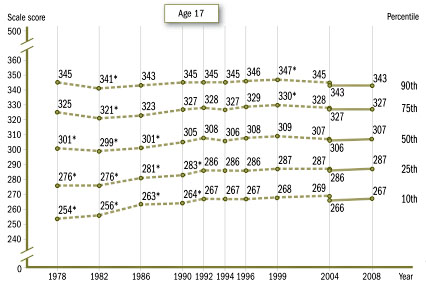
    OK, now look at the chart on the right. It shows results from the NAEP math test—a national assessment that’s generally considered highly reliable—for 17-year-olds. And basically, it shows nothing. If you take a look at the 25th and 50th percentiles, which is where most factory workers come from, scores have been pretty flat for the past two decades. If anything, they’re up slightly.

    So how do we square this with Eric Hahn’s contention that General Plastics has had trouble over the past few years finding qualified workers? I can think of a few possibilities:

    1. Hahn is just wrong. He remembers the past as rosier than it was.
    2. Jobs at General Plastics require higher skills than in the past, but they’re refusing to pay any more than they used to. So they’re not getting suitable applicants.
    3. Ever since the NCLB “test ’em til they drop” era started, kids have been learning rote math that’s good for getting high test scores but not so good for solving actual real-world problems.
    4. Scores have fallen off a cliff over the past five years, but we don’t see it in the chart because it only goes up to 2008.
    5. Washington is doing worse than other states.

    There’s evidence that #3 isn’t the answer. To the extent that kids are taught to the test, they’re taught to state tests, since those are the ones used to measure performance. The NAEP is a federal test that nobody teaches to because (a) it doesn’t count for anything, and (b) it’s given to only a tiny fraction of students nationwide (less than 1 percent of all K-12 students). What’s more, the long-term NAEP, which is what I showed above, has been carefully constructed to stay the same from year to year. It’s testing exactly the same thing today that it tested in 1978.

    There’s also evidence that #4 isn’t the answer. We don’t have national results for 17-year olds that are more recent than 2008, but we do have results for 8th graders on the main NAEP. Their math scores rose between 2007 and 2011. A sudden and unprecedented collapse between 8th and 12th grades seems unlikely.

    There’s also evidence that #5 isn’t the answer. In fact, Washington has done a bit better than the national average over the past decade.

    I might have missed a possibility. For now, though, my money is on #2.

  • We Don’t Need No Stinkin’ Democrats on the DC Circuit Court


    As we all know, Republicans filibustered President Obama’s nomination of Caitlin Halligan to the DC Circuit Court last month, so now we’re moving on to the second of his nominees to fill one of the court’s vacancies: Sri Srinivasan, an attorney who’s not just respected by both liberals and conservatives, but even worked in the George W. Bush administration. That didn’t do him any good when he was first nominated in 2012, but he’s back now, and getting a lot of love from right-wingers. Sahil Kapur reports:

    Their support would normally bode well for a key judicial pick by a Democratic president. But Senate Republicans have indicated a desire to maintain the court’s notoriously high vacancy rate — at least as long as Obama’s president. Earlier this year, they filibustered a different, widely respected Obama nominee to the same court. And so the broad ideological consensus behind Srinivasan makes it harder for Republicans to oppose his nomination without appearing as though they’re abusing their advise and consent power for partisan purposes.

    Harder? Sure. Impossible? No! A while back I was digging into this subject a little bit, trying to find out what the official objection to Obama’s nominees was. The party-line answer, it turned out, was pretty straightforward: The DC Circuit doesn’t really have a very heavy caseload, so it doesn’t need any more judges. As you can imagine, this is a very handy argument indeed, since it means that Republicans don’t really need to cast around for a pretend reason to oppose Srinivasan or any of Obama’s other nominees. They can just oppose them all.

    Now that David Sentelle has retired and the court has four vacancies, maybe this argument won’t fly any longer. Then again, maybe it will. Stay tuned.

