• The Antichrist Is Always With Us


    Ed Kilgore comments on the news that 13 percent of voters think Barack Obama is the antichrist:

    Extrapolated to the national electorate, it suggests that over 13 million Americans believe the President of the United States is a demonic supernatural being sent into the world to set up an infernal kingdom until it’s all washed away by the End of Days.

    This reminds me of something that I sort of accidentally got involved in a couple of decades ago. I’ll skip the details, but I ended up learning that among at least a subset of evangelical Christians, there’s always an antichrist. For a while it was Muammar Qaddafi. Then it was Saddam Hussein. I assume Osama bin Laden took on the role after 9/11. So the fact that some of them now pin that tag on Obama isn’t super surprising. The antichrist is out there somewhere, and with the usual suspects now mostly dead, why not Obama?

  • Atlanta’s Kids Have Done Pretty Well in School Over the Past Decade


    Former Atlanta superintendent of schools Beverly Hall is now the poster child for cheating on standardized tests. But Hall claims that Atlanta schools really did perform better under her leadership, and as evidence she points to gains on the national NAEP test, widely considered to be reliable and not easily gamed. Dana Goldstein comments:

    Although NAEP security procedures are generally considered more stringent than those used in state and district-level testing, there are reasons to be skeptical of Atlanta’s gains on the national exam as well. Between 2002 and 2009, the demographics of Atlanta NAEP test-takers changed considerably; the number of white students taking the test doubled, and the number of Hispanic students also went up. In Atlanta, white and Hispanic children tend to score higher than black children, which led Professor Mark Musick, a former NAEP chairman, to estimate that as much as 40 percent of Atlanta’s gains could be due to changes in which students sat for the exam.

    I don’t quite get this. Why not just look at the NAEP results for black, white, and Hispanic kids separately and see how they did? I don’t feel like doing that for every combination of kids and tests, but a quick look tells me that reading scores for black 8th graders increased from 233 to 249 during Hall’s tenure, and math scores increased from 241 to 262. That’s no defense of Hall, but it seems pretty straightforward to figure out how Atlanta’s kids did and how that compares to other big cities. Why estimate?

  • A Brief Morning Whine


    I’ve got a problem. I figure nearly everyone is just going to laugh at me for this—though for different reasons on left and right—so I’m a little hesitant to even bother whining about it. But here it is.

    I like snark. I’m perfectly happy to trade elbows with the opposition. But really, my preference is to spend most of my time talking seriously (or semi-seriously) about policy, and that means engaging with conservatives. The problem is that it’s just flatly hard to see the point of doing that these days. When I read even supposedly serious conservative policy proposals, I find them so egregiously empty that I feel like I’d be demonstrating terminal naivete by even taking them in good faith. So I don’t.

    Yesterday, for example, I wrote about the Ponnuru/Levin proposal for healthcare. “Wrote” is giving myself too much credit, though. Basically I just sighed. Today, Ezra Klein, who’s a nicer guy than me, summarizes it as “less spending on health insurance for poor people, stingier health coverage for middle-class people, and lower taxes for rich people.” He then goes on to write a couple thousand words about a similar proposal, which quite plainly wouldn’t work, and wouldn’t broaden health coverage even if it did.

    So which approach is better? My better angels tell me I should assume good faith and spend the time it takes to write a long explanation of why this stuff won’t work. But why bother? Does anyone really think that the people who write these plans are unaware of the grade-school level problems with their proposals? Of course they are. They’ve been pointed out a hundred times, and they keep writing up the exact same proposals anyway. They barely even bother to change the wording.

    Or take yesterday. I caught a few minutes of Chris Hayes’ new show, and he was talking with his panel about why South Carolina conservatives are apparently willing to forgive Mark “Appalachian Trail” Sanford. Everyone took the question seriously and offered serious ideas. As a result, they all tap danced around the real reason: conservatives are willing to forgive pretty much any conservative who goes through the whole Christian repentance kabuki. So which is better? To be serious, or to simply state the obvious truth and be taken for a partisan shill?

    There are hundreds of examples like this. The annual Paul Ryan budget fest is probably the most obvious one. Every year we comb through his budget and produce lots of charts and tables and trendlines, and every year the bottom line is exactly the same: Paul Ryan wants to cut taxes on the rich and cut spending on the poor. That’s it. That’s what he wants. That’s why his budget never changes, even after hundreds of detailed analyses showing exactly what it would mean for domestic spending. It’s because slashing spending on the poor is the whole point of the plan, not merely a bug of some kind that maybe Ryan doesn’t quite get.

    So which is better? All the charts and tables and trendlines? Or refusing to even pretend to take it seriously?

    I don’t know. I swing back and forth, depending on my mood and the subject matter. Hell, I’m not even sure why I’m writing about this. I guess I just needed to get it off my chest or something. Regularly scheduled programming will now resume.

  • Our Brave New World of Employment Background Checks


    With unemployment stubbornly high, even a small problem can be enough to keep you from getting a job. And thanks to modern technology, employers are a lot more likely to be aware of these problems. Obviously a prison record has always made it hard to find a job. A poor credit report can blackball you these days. And today the New York Times reports on a new breed of databases that track retail employees accused of stealing:

    Retailers “don’t want to take a chance on hiring somebody that they might have a problem with,” said Richard Mellor, the [National Retail Federation’s] vice president for loss prevention.

    But the databases, which are legal, are facing scrutiny from labor lawyers and federal regulators, who worry they are so sweeping that innocent employees can be harmed. The lawyers say workers are often coerced into confessing, sometimes when they have done nothing wrong, without understanding that they will be branded as thieves.

    ….For Keesha Goode, $34.97 in missing merchandise was enough to destroy her future in retailing….She received a letter from Dollar General alerting her that she had been turned down for a job partly because of her listing in Esteem, and a copy of the report showed that she had a “verified admission” for “theft of merchandise.” She wrote LexisNexis, “I was accused of not reporting on a former employee who was stealing merchandise, but I did not steal anything myself.”

    The company responded that it had reinvestigated and “verified” the accuracy of the information. Ms. Goode, who now works at a halfway house, has a lawsuit pending against LexisNexis, accusing the company of violating the Fair Credit Reporting Act.

    Sure they reinvestigated. They probably pinged the original retailer and asked if the charge was true. The retailer sent back a routine confirmation and that was that.

    It’s pretty easy to understand the retail industry’s interest in something like this. If I ran a store, I’d be pretty interested. But these private databases are springing up everywhere; there are no rules to ensure any kind of accuracy; most people don’t even know they’re in them; and there’s usually no effective way to appeal a black mark if you do find out. It’s like being caught in TSA hell.

    The increasing reach of computer and network technology is making this increasingly widespread. Mistakes are rampant, coercion is likely common, and even where the charges are true, this brave new world means that a lot of people are being effectively shut out of the labor market for minor offenses that they could have put behind themselves in the past. I’m not sure what the answer is, but this stuff is growing like a weed. It needs some rules of the road before it gets entirely out of hand.

  • NAF Proposes Big Expansion of Social Security


    It’s time for liberals to fight back on Social Security! Today, the New America Foundation released a plan that not only declines to endorse any kind of compromise on Social Security that would cut benefits, but proposes that we add a brand new benefit:

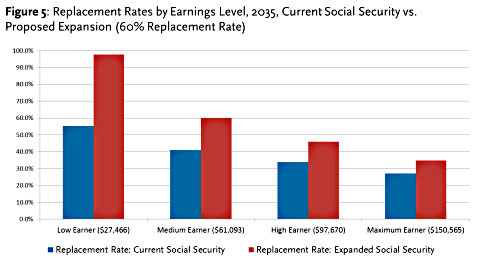
    We propose to replace most of the country’s current, inadequate, hybrid public and private retirement system with a two-part, wholly public system called Expanded Social Security. Expanded Social Security would have two distinct parts. The first part, Social Security A, would be similar to the current Social Security Old Age and Survivors Insurance (OASI) program, which provides a retirement benefit related to earnings. The second part of Expanded Social Security would be a new universal flat benefit, Social Security B, to supplement the traditional earnings-related benefit that would continue to be provided by Social Security A.

    ….If we assume that Social Security benefits are maintained at current levels and that there are no additional cuts to the program, we propose to set Social Security B at $11,669 per year for all elderly earners.
    How much would this cost? A little over 1 percent of GDP to fully fund current Social Security with no benefits cuts, and about 3.7 percent of GDP to fund the new Social Security B. Altogether, call it about 5 percent of GDP. That’s….a lot. The authors suggest that current Social Security would be fully funded via higher payroll taxes, while Social Security B would be funded by “either general revenues or a new dedicated tax or taxes, which might include portions of a federal value-added tax (VAT).” The chart on the right compares the benefits under current Social Security vs. the NAF plan.

    The basic contention here is that old-style corporate pensions are pretty much gone, and 401(k)-style programs are a disaster. So we should just ditch them entirely and beef up Social Security so that it’s a sufficient retirement program all by itself. I still haven’t been able to quite convince myself that 401(k)s are the disaster area that a lot of people say they are, but the evidence on this score is certainly fairly hazy. It’s quite possible that 401(k)s really are failures.

    In any case, this is the first serious shot across the bow from the forces who not only don’t want to compromise on Social Security, but want to expand it. I expect to hear a lot more along these lines in the near future.

  • “Illegal Immigrant” Is Now Out, But AP Doesn’t Tell Us What’s In


    The Associated Press has announced that it will no longer use the phrase “illegal immigrant” in its stories. Here’s the new entry in the AP Stylebook:

    Except in direct quotes essential to the story, use illegal only to refer to an action, not a person: illegal immigration, but not illegal immigrant. Acceptable variations include living in or entering a country illegally or without legal permission.
    Except in direct quotations, do not use the terms illegal alien, an illegal, illegals or undocumented.

    AP’s announcement explains that they’ve been “ridding the Stylebook of labels,” and that “this discussion about labeling people, instead of behavior, led us back to ‘illegal immigrant’ again. We concluded that to be consistent, we needed to change our guidance.”

    I’ve used “illegal immigrant” before, and I’ve always had a hard time buying the argument that it’s an inherently insulting term. But times change, and I generally adhere to AP style since that’s what I learned many decades ago. Cranky stubbornness aside, I certainly don’t have any reason to make an exception here, so I won’t. Illegal immigrant is now out.

    But I do still have a problem. AP apparently now feels that there’s no acceptable way to refer to people who are in the country illegally. Neither “undocumented immigrant” nor “unauthorized immigrant,” is acceptable, and neither is anything else. Labels are flatly not allowed, despite the fact that we label people all the time. Kevin Drum is a blogger. Barack Obama is a politician. Etc.

    This leaves us with constructions like “John Doe is a person who immigrated to the United States illegally.” Or: “A bill pending in Congress would bar immigrants who are in the country illegally from receiving Medicaid.” Clunkiness aside, I guess we can all get used to that, but I’m not sure how it especially serves the cause of accuracy.

    Jose Antonio Vargas, who has been at the forefront of this battle, apparently thinks that “undocumented immigrant” is fine. Other campaigners against “illegal immigrant” seem to agree. I’ve never been too keen on that formulation, but I can live with it. Unless I get further guidance from the MoJo copy desk, that will probably be my usual descriptive phrase in the future.

  • Procreation and Gay Marriage: A Followup


    I generally dislike back-and-forth exchanges in the blogosphere because they inevitably—and surprisingly quickly!—degrade into tedious semantic quibbling. Once both sides have had their say, I figure it’s best to call it quits and just let readers decide for themselves who they believe.

    But I think I really do need to respond to Ross Douthat today. Douthat originally wrote that for the past ten years, the liberal side in the gay marriage debate has been “pressing the case that modern marriage has nothing to do with the way human beings reproduce themselves.” I objected that the procreation argument had been originally injected into the debate by conservatives, not liberals. Here’s Douthat today:

    The notion that nobody would have entertained what Drum later calls the “esoteric” idea that marriage has an essential link to the way that human beings procreate if desperate social conservatives hadn’t grasped at it is apparently quite a popular view, judging by the fact that other writers raised it on Twitter over the weekend, and its popularity testifies to the way that the gay marriage debate has encouraged a strange historical amnesia about the origins of marriage law.

    If gay marriage opponents had essentially invented a procreative foundation for marriage in order to justify opposing same-sex wedlock, it would indeed be telling evidence of a movement groping for reasons to justify its bigotry. But of course that essential connection was assumed in Western law and culture long before gay marriage emerged as a controversy or a cause.

    The reason I’m responding is that I think there’s just a misunderstanding here. There’s no question that marriage has been associated with procreation and child rearing for thousands of years, and I don’t think anyone would argue otherwise. I certainly wouldn’t.

    But I wasn’t talking about thousands of years in my post, and neither was Douthat in his original column. We were talking about the past ten years. And I wasn’t talking about the general connection of marriage with procreation, I was talking specifically about the notion that permitting gay marriage might cause straight couples to view the procreative functions of their own marriages differently.

    My contention is that (a) this is indeed a fairly esoteric argument that few people would contrive on their own, and (b) it was indeed injected into the debate by the right. Liberals never mentioned it unless it was first brought up by a conservative as an argument against gay marriage. And while Douthat is certainly right that it didn’t spring out of nowhere, it wasn’t common to hear it in the 90s outside of activist circles. By the aughts, as other arguments began to lose their force, it started to become more mainstream.

    I might be wrong about this, of course. But that’s all I’m saying. I just wanted to clear that up before it becomes conventional wisdom that Kevin Drum is a nitwit who denies that marriage has ever had anything to do with procreation. (For example, here and here.)

    I do have some other issues with Douthat’s response, especially as it relates to the legal view of marriage, but if I indulge them I’ll just be proving my point about back-and-forth arguments drifting quickly into tedious extraneous issues that few people care about. So I’ll just shut up instead.

  • Is Demand for High-Skill Workers Declining?


    I’ve written before about my belief that something happened to the economy around the year 2000. A whole bunch of different measures seem to have inflected right around then, and although the subsequent declines were partly masked by the housing bubble of the aughts, they were happening all along. When the Great Recession hit, a decade’s worth of decline was telescoped into a couple of years.

    Via Arnold Kling, a trio of researchers have a new paper out that points to yet another thing that appears to have suddenly inflected right around 2000: the demand for high-skill workers. Here’s their key finding:

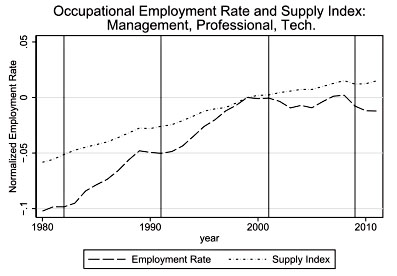
    In Figure 12 we plot the fraction of individuals aged 18-65 employed in occupations that require substantial cognitive skills….This ratio increased substantially from 1980 to 2000, and then it appears to reach a plateau over the period 2000-2010. On this ?gure, we also report a (per capita) supply index for cognitive occupations.

    ….There are two key features of Figure 12 that we wish to highlight. First, from 1980 to about 2000, employment in cognitive jobs grew faster than the supply index, suggesting that demand for cognitive tasks outstripped supply. In contrast, after 2000, the supply index continued to grow at a similar rate as in the pre-2000 period, but cognitive employment stalled. We interpret these trends as suggesting that demand for cognitive jobs likely decreased over this second period.

    The authors explain that the college premium for workers remains high regardless of this, because educated workers are simply getting pushed down the employment ladder, where they’re performing more routine jobs. But many routine jobs are disappearing too, so workers in these occupations are getting pushed down too. A degree may not be as valuable as it once was, but relative to not having a degree, it’s still pretty valuable.

    But back to the original point: what happened starting around 2000 that could have dampened our previously growing demand for high-skill workers? The authors don’t try to guess, but I will: steadily improving automation. More on this later.

  • Solar and Fracking: They Go Together Like Ham and Eggs


    David Roberts has an interesting post today summarizing a new report from Citi Research about renewable power and natural gas. Basically, it turns out they go together like ham and eggs.

    Here’s the nickel summary: Renewable energy tends to be sporadic (solar only during the day, wind only when it’s windy, etc.), so if you rely heavily on renewable energy you need a secondary source that can be brought online and offline quickly to provide “peaking power.” It turns out that gas-fired plants fill this bill nicely. What’s more, as renewables expand even more, they start to eat into baseload power, and since baseload plants can’t switch on and off off quickly, they’ll no longer be economically viable and will get retired. That means even more natural gas.

    The bad news here is that this means an ever expanding role for natural gas fracking. The good news is that it will mostly be replacing coal, so it’s a net benefit. What’s more, in the longer term, as renewables get ever cheaper and finally reach critical mass, there are ways to eliminate even most of the gas-fired plants:

    The need for natural gas to play these two supporting roles [i.e., baseload and peak power] could be reduced and eliminated through a combination of wide geographic dispersion of renewables, a more robust grid, more energy storage, and more non-intermittent renewables like geothermal or biogas. But given how fast renewables are ramping up, and how far those other pieces are from being in place, natural-gas peakers are likely to play a key role for several decades to come.

    ….The message here is simple: take heart. Shale gas will not swamp and displace renewables, it will help them. Renewables will become cheaper than fossil fuels in the medium- to long-term. It’s happening now in some places, it will happen in others soon. Obviously the rise of renewables could be accelerated by policy, and should be. It won’t happen fast enough to avert the worst of climate change without a policy boost.

    But it will happen. History is on the side of clean energy.

    There’s much more detail at the link. It’s worth a read, because if this analysis is correct, it’s going to provide some major heartburn for environmentalists. Fracking, for all its dangers, may turn out to be the least of our various fossil fuel evils.