• Why Air Strikes Against Syria Probably Won’t Work

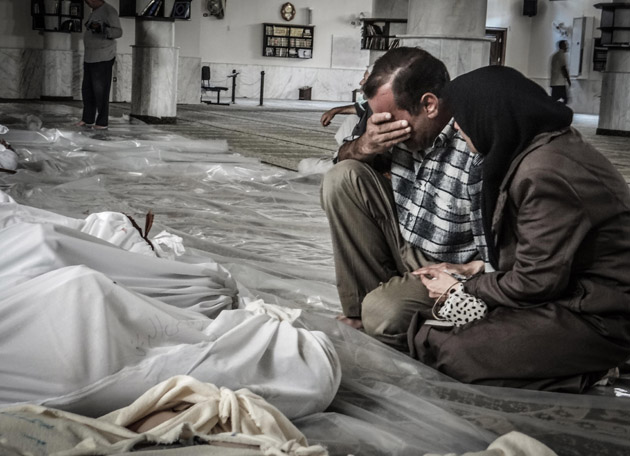
    A mother and father weep over their child's body who was killed in a suspected chemical weapons attack on the Damascus suburb of Ghouta on August 21, 2013.Erbin News/ZUMA


    Over at WorldViews, Max Fisher provides the nickel arguments for and against air strikes against Syria. The case against is pretty straightforward: Air strikes won’t change much of anything; there will be civilian casualties; and it’s almost certain to lead to escalation. That’s a pretty good case! So what’s the case for strikes? Here it is:

    1) A “punishment” strike against Assad’s forces for this month’s suspected chemical weapons attack would make him think twice before doing it again….2) The international norm against chemical weapons matters for more than just Syria….When the next civilian or military leader locked in a difficult war looks back on what happened in Syria, we want him to conclude that using chemical weapons would not be worth the risk. 3) Even just the (apparently earnest) threat of U.S. strikes could change Assad’s behavior.

    This is basically a single argument dressed up three different ways: air strikes will deter future chemical attacks. The problem is that I don’t believe it unless the strikes are absolutely devastating. Assad is plainly in a fight for his existence, and under circumstances like that nothing is likely to stop him except the certain knowledge that US retaliation would make his position worse than if he had done nothing in the first place. Air strikes might be defensible if we’re willing to act on a scale that large, but make no mistake: we’d basically be committing ourselves to full-scale war against Assad.

    It’s possible that enforcing international norms against chemical attacks is important enough to make that worth it. But that’s the question we should be asking ourselves. A “punishment” air strike is a joke, little more than a symbol of helplessness to be laughed off as the nuisance it is. If we want to change Assad’s behavior, we’ll have to declare war against him.
  • Report Says Russians Knew Edward Snowden Was Headed for Moscow


    The Washington Post passes along a report that the arrival of NSA leaker Edward Snowden in Moscow a couple of months ago didn’t come as a surprise to Russian officials, as they claimed at the time. In fact, they helped set up his travel while Snowden was still in Hong Kong, expecting that he’d quickly catch a connecting flight to Havana:

    The article in Kommersant, based on accounts from several unnamed sources, did not state clearly when Snowden decided to seek Russian help in leaving Hong Kong, where he was in hiding in order to evade arrest by U.S. authorities on charges that he leaked top-secret documents about U.S. surveillance programs.

    ….Kommersant reported Monday that Snowden purchased a ticket June 21 to travel on Aeroflot, Russia’s national airline, from Hong Kong to Havana, through Moscow. He planned to fly onward from Havana to Ecuador or some other Latin American country….Kommersant quoted unnamed Russian officials as saying the Cubans decided to refuse Snowden entry under U.S. pressure, leaving him stranded. That version stands in contrast to widespread speculation that the Russians never intended to let the former CIA employee travel onward.

    The article implies that Snowden’s decision to seek Russian help came after he was joined in Hong Kong by Sarah Harrison, a WikiLeaks staffer who became his adviser and later flew to Moscow with him. Harrison, the article suggests, had a role in the making the plans. The article noted a statement released by WikiLeaks on June 23, shortly after the Aeroflot flight left Chinese airspace, which said Snowden was heading to a destination where his safety could be guaranteed.

    This may or may not be true, so keep an open mind about it for now. It’s just the latest in Snowden gossip.

  • Graphene: The 21st-Century Miracle Cure for Out-of-Work Lawyers


    Graphene is an exceptionally thin, strong, and transparent material that’s a good conductor of heat and electricity. Andre Geim and Konstantin Novoselov won a Nobel Prize in 2010 for its discovery. Today, the Wall Street Journal reports on what this means:
    “As soon as I find something, boom! I file a patent for it,” says James Tour, a graphene expert at Rice University in Houston.

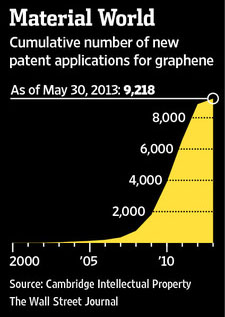
    Apple has filed to patent graphene “heat dissipators” for mobile devices. Saab has filed to patent graphene heating circuits for deicing airplane wings. Lockheed Martin this year was granted a U.S. patent on a graphene membrane that filters salt from seawater using microscopic pores.

    ….”It’s a land grab,” says Mr. Tannock of Cambridge Intellectual. By trying to patent just about every finding, “you have the option for suing your competitors later and stopping them.” Many graphene patent filings appear legitimate, but some seem speculative and others may be decoys to mislead rivals, he says.

    Perhaps one of graphene’s other miracle properties will turn out to be the ability to end the horrible job market currently faced by law school graduates.

  • Here’s Why You Don’t Know When Your Team Is Playing This Season


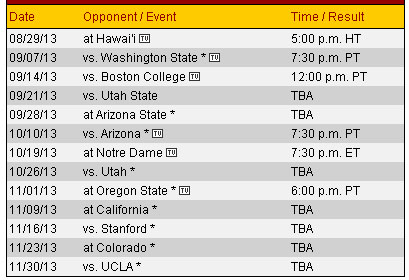
    Up until a few years ago, figuring out your college football team’s schedule was easy. A week—or a month—before the season started, you’d just look it up. But then things changed. These days, if you’re looking for something to stick on your refrigerator door before the start of the season, you’ll find the schedule still in flux, with no kickoff time and no TV station listed for half the games. So what happened? The New York Times explains today:
    The extent of ESPN’s influence over college football is literally displayed on the face of your ticket to next week’s game. Tickets to most games are printed with the date and the opponent’s name, but something is missing: the kickoff time. That is because ESPN, under its contracts with conferences, has the right to set kickoff times and wait until 12 days before game day, or in some cases only six, to inform universities.

    Every Monday morning during the season, ESPN’s football brain trust meets in a war room in Building 12 on the network’s sprawling campus in Bristol, Conn., to consider options for upcoming games and make sure the hottest teams get the choicest time slots on each of its channels. After decisions are made, calls go out across the country, setting off a scramble on dozens of campuses as universities arrange everything from parking to security to team transportation.

    ….One of the most powerful people in the business of college football is a boyish, unassuming graduate of the University of Southern California named Ilan Ben-Hanan. His title is vice president of programming and acquisitions for college football at ESPN. What he really is, though, is the network’s master scheduler….Much of the schedule, of course, is determined by the colleges and conferences themselves. What’s more, ESPN’s contracts with conferences contain a variety of scheduling stipulations. Even so, the billions of dollars that ESPN pays for television rights allow it, in some cases, to decide what time games are played and to have a say in who plays whom and when.

    Mr. Ben-Hanan’s mission, which embodies one of the central alchemies of ESPN, is to take all that information, what is set in stone and what is not, and create on-screen events as the season approaches and then unspools, week after week…..The network’s right to wait until as few as six days in advance before announcing which games it will show, and at what times, encompasses all but the first three weeks of the season, when game times are set far in advance.

    So there you have it. The reason I don’t know the kickoff time for all of USC’s games this season is because of a USC graduate. And money, of course. Always money.

    BY THE WAY: If you consider college football little better than satanic mills for the 21st century, consider this your thread to vent. Lately, I’m starting to agree with you anyway.

  • Friday Cat Blogging – 23 August 2013


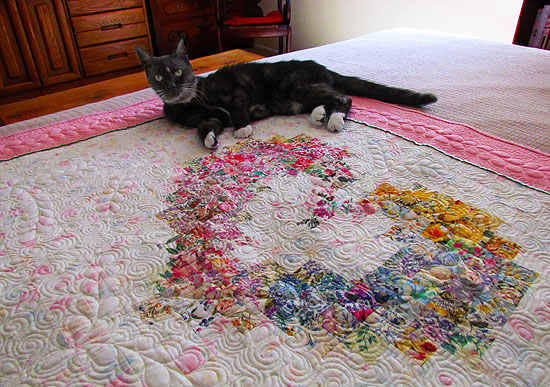
    Today’s catblogging features one of Marian’s favorites, “Sweetheart Watercolor Quilt #1.” (It’s numbered like a Jackson Pollock painting because there’s also a Sweetheart Watercolor Quilt #2. You’ll see that one later in the year.)

    This quilt is machine pieced and machine quilted. The quilting, which includes stippling and feathers, was done by the fabulous Janna, our family’s go-to quilter. It’s designed to be a wall hanging or a small lap quilt. But there’s more! According to Marian, “it’s not exactly an I Spy quilt,” but it does feature a duck, a chick, a butterfly, a bunny, and a bird, if you can find them—which you probably can’t since the resolution of this photo is too low. However, if you or a small child of your acquaintance would like to find all the hidden critters, just click here for a larger photo. The answer key is here.

  • Here’s How Europe’s Woes Are Continuing to Haunt America


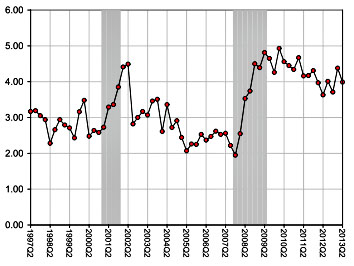
    The great and good are all gathered this week at Jackson Hole, sort of a Davos for powerful nerds that’s run by the Kansas City Federal Reserve. Neil Irwin reports that Robert Hall of Stanford presented an assessment of “why the housing crash and financial crisis caused such sharp and prolonged economic pain,” which prompted a comment from Hyun Song Shin of Princeton. You may recall Shin as the ideal median economist, but in this case he’s pointing out that one big problem with the economy is that bank credit has been anemic for the past few years. As the chart on the right shows, banks normally lend at about 2.5 percentage points above the Fed’s target interest rate, but ever since 2009 they’ve been lending at about 4 points above the Fed’s target. This isn’t a huge problem for big companies, which mostly rely on bonds to finance themselves, but it is a big problem for small companies, which rely more on mortgages and bank loans.
    This reminded me of something Shin predicted a couple of years ago. During the housing bubble years, he said, European banks were indirectly providing about $5 trillion in credit to U.S. borrowers, nearly as much as American banks provided. But after the financial crisis, as European banks were forced to delever, that funding dried up. This is one way that America is suffering from Europe’s woes: Credit remains very tight, and as a result, interest rates on ordinary bank loans remain stubbornly high. Shin’s latest set of charts seem to suggest that he was right—or at least partly right—two years ago when he wrote about the malign effect of European delevering on American finance. We’re not immune just because we’re an ocean away.

  • Yep, Britain Is Spying on the Middle East


    Here’s the latest on high-tech surveillance among Western intelligence agencies:

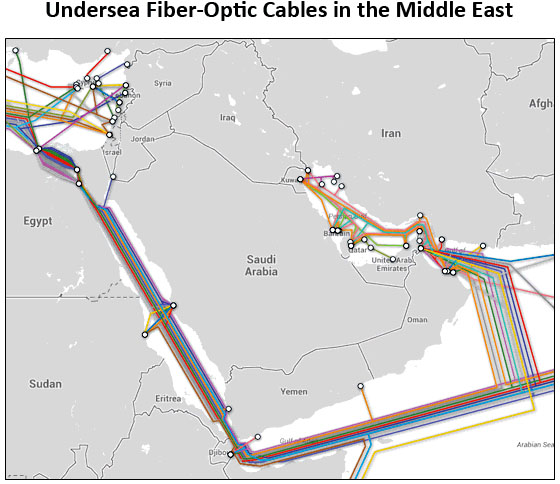
    Britain runs a secret internet-monitoring station in the Middle East to intercept and process vast quantities of emails, telephone calls and web traffic on behalf of Western intelligence agencies, The Independent has learnt.

    ….The Independent is not revealing the precise location of the station but information on its activities was contained in the leaked documents obtained from the NSA by Edward Snowden….Information about the project was contained in 50,000 GCHQ documents that Mr Snowden downloaded during 2012. Many of them came from an internal Wikipedia-style information site called GC-Wiki. Unlike the public Wikipedia, GCHQ’s wiki was generally classified Top Secret or above.

    ….The data-gathering operation is part of a £1bn internet project still being assembled by GCHQ. It is part of the surveillance and monitoring system, code-named “Tempora”, whose wider aim is the global interception of digital communications, such as emails and text messages. Across three sites, communications — including telephone calls — are tracked both by satellite dishes and by tapping into underwater fibre-optic cables.

    This isn’t all that interesting at the level of pure substance. After all, most of us probably already figured that Middle East fiber-optic cables were being tapped by someone. The fact that it’s GCHQ rather than NSA is an intriguing tidbit, but that’s about all.

    But it does raise some other questions. How did the Independent get hold of some of Snowden’s documents? There are a limited number of sources, after all. And is this exposure truly in the public interest, or should it have been kept secret since it doesn’t really hint at either wrongdoing or even a broader scope of surveillance than anyone expected? Comments?

    UPDATE: Snowden denies that he was the source; Glenn Greenwald denies that he was the source (and is skeptical that any other journalist working with Snowden was the source); and the Independent seems to deny that the British government was the source. Very strange.

  • Here’s Hoping That Obamacare Is Better Than That Appalling Obamacare


    A few days ago I mused on the possibility that when Obamacare finally hits the streets, the actual state programs that implement it will refer to it as the “Affordable Care Act” and all the folks who hate Obamacare might not even recognize it. It turned out that Jonathan Bernstein has been making this same point for a while—great minds think alike and all that—but today Sarah Kliff passes along the perfect anecdote to support this. It comes from HuffPo’s Jason Cherkis, and what I’d forgotten is that the state programs don’t even call it ACA. They all have their own names:

    A middle-aged man in a red golf shirt shuffles up to a small folding table with gold trim, in a booth adorned with a flotilla of helium balloons, where government workers at the Kentucky State Fair are hawking the virtues of Kynect, the state’s health benefit exchange established by Obamacare.

    The man is impressed. “This beats Obamacare I hope,” he mutters to one of the workers.

    “Do I burst his bubble?” wonders Reina Diaz-Dempsey, overseeing the operation. She doesn’t. If he signs up, it’s a win-win, whether he knows he’s been ensnared by Obamacare or not.

    This is officially too good to check, but I checked anyway. If you go to the Kynect website, you can look far and wide and never get a clue that it has anything at all to do with Obamacare or ACA or even the federal government. “kynect is here to help you find the right coverage,” the fact sheet says cheerily. “It’s a new kind of health insurance marketplace — convenient and easy to use. With one application, kynect will check your eligibility for programs that can help you pay for health insurance for yourself, your family or your employees.” Roger that.

  • all right we are two nations


    From John Dos Passos, in The Big Money, on the execution of Sacco and Vanzetti:

        they have clubbed us off the streets     they are stronger     they are rich     they hire and fire the politicians the newspapereditors the old judges the small men with reputations the collegepresidents the wardheelers (listen businessmen collegepresidents judges     America will not forget her betrayers)     they hire the men with guns     the uniforms the policecars the patrolwagons

        all right you have won     you will kill the brave men our friends tonight

        there is nothing left to do     we are beaten

        ….they have built the electricchair and hired the executioners to throw the switch

        all right we are two nations

        America our nation has been beaten by strangers who have bought the laws and fenced off the meadows and cut down the woods for pulp and turned our pleasant cities into slums and sweated the wealth out of our people and when they want to they hire the executioner to throw the switch

    I’m reading the U.S.A. trilogy and by chance I happened to read that passage last night. Today, Ed Kilgore tells me, is the 86th anniversary of the execution, so I thought it might be appropriate. Everything old is new again.