• Rescinding the Cuts to Veterans’ Pensions Was In the Cards From the Start


    December’s budget deal between Paul Ryan and Patty Murray included a bit of relief from the 2011 sequestration cuts, with the relief split evenly between domestic and military budgets. That even split was one of the guiding principles of the deal. But part of the military relief was paid for by $7 billion in cuts to veterans’ pensions, something that immediately prompted a storm of protest and, eventually, a move to rescind the cuts. Jared Bernstein comments:

    True, that’s not huge bucks in the scheme of things. But the violation of this budget principle should not be taken lightly. A key point of the budget machinations that brought us to where we are today is that automatic spending cuts should be split between evenly between defense and non-defense (forget for a moment, that it’s not the discretionary side of the budget that’s responsible for our longer term fiscal challenges anyway). If Congress starts stealing from domestic programs to boost defense, it will unfairly and unwisely exacerbate already unsustainable pressures on domestic spending.

    I’d take a slightly different lesson from this: Democrats got snookered. Only a little bit, and they knew they were being played, but they still got snookered. It was obvious from the start that cuts to veterans’ benefits would be unpopular and unlikely to stand, but Democrats agreed to them anyway in order to get the budget deal across the finish line. Maybe that was the right thing to do, but it was no accident. They did it with their eyes wide open.

  • The Right to Vote Is Too Important to Be Denied to Ex-Felons


    Roger Clegg is seriously unhappy about Eric Holder’s call for the restoration of voting rights to felons who have served their sentences:

    He conveniently ignores the reason for felon disenfranchisement, namely that if you aren’t willing to follow the law, then you can hardly claim a role in making the law for everyone else, which is what you do when you vote….The right to vote can be restored, but it should be done carefully, on a case-by-case basis, once a person has shown that he or she has really turned over a new leaf. The high recidivism rates that Mr. Holder acknowledges in his speech just show why that new leaf cannot be presumed simply because someone has walked out of prison; he’ll probably be walking back in, alas. A better approach to the re-integration that Mr. Holder wants is to wait some period of time, review the felon’s record and, if he has shown he is now a positive part of his community, then have a formal ceremony — rather like a naturalization ceremony — in which his rights are restored.

    Let’s concede the obvious up front: Released felons are more likely to vote for Democrats than Republicans, so there’s an obvious partisan motivation on both sides of this debate.

    That said, I favor restoring voting rights to felons, and I’m willing to meet Clegg halfway. I’d be OK with waiting some reasonable period of time1 before restoring voting rights, but I think restoration should be the default after that time has elapsed. That is, after, say, five years, you automatically get your voting rights back unless there’s some specific reason you don’t qualify. And those reasons should be very clear and spelled out via statute.
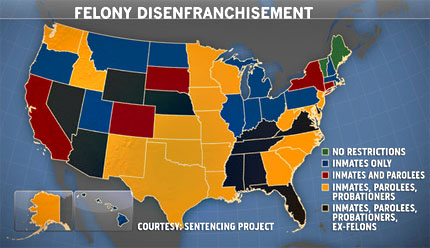
    My position here is based on a simple—perhaps simplistic—view of political freedom. I believe that liberal democracies require three minimum rules of law: free speech, the right to a fair trial, and universal suffrage. At the risk of stating the obvious, this doesn’t mean that nothing else is important.2 But I do mean that if you have these three things, then the odds are very strong that you qualify as a free country. Countries that enforce these rights differ considerably on a wide variety of other metrics and still strike us as mostly free. But I can’t think of a country that fails on any of them that we’d consider mostly free.

    In other words, I believe the right to vote is on the same level as free speech and fair trials. And no one suggests that released felons should be denied either of those. In fact, they can’t be, because those rights are enshrined in the Constitution. Voting would be on that list too if it weren’t for an accident of history: namely that we adopted democracy a long time ago, when the mere fact of voting at all was a revolutionary idea, let alone the idea of letting everyone vote. But that accident doesn’t make the right to vote any less important.

    A probationary period of some kind is probably reasonable. But once you’re released from prison and you’ve finished your parole, you’re assumed to have paid your debt to society. That means you’re innocent until proven guilty, and competent to protect your political interests in the voting booth unless proven otherwise. No free society should assume anything different.3

    1What’s reasonable? Let’s just leave that for another day, OK?

    2No, really, I mean that. There’s other important stuff. Honest. But these are the big three. Even freedom of religion can vary a lot within liberal democracies, with a minimum floor set by the fact that most religious expression is protected as free speech. Other important rights—including property rights—can largely be protected as long as majorities can freely express their views and freely elect representatives who agree with them.

    3This is doubly true in a country like ours, where incarceration is so rampant and so racially unbalanced.


  • Figure Skating Is Hopelessly Corrupt


    Which sport is more corrupt, ski jumping or figure skating? Normally, my rule of thumb is that the higher up the world ladder you go (local vs. national vs. international) the more corrupt a sport becomes. Thus, I would have guessed that a sport in which the international federation chooses judges would be more corrupt than one in which national federations choose judges. But no! Eric Zitzewitz has compared two sports and finds just the opposite:

    Ski jumping has its international federation select the judges for competitions like the Olympics, and I find that they select the least biased judges.  Figure skating lets its national federations select the judges, and my research showed that they select the most biased judges.

    This creates different incentives for judges. Ski jumping judges display less nationalism in lower-level competitions — it appears they keep their nationalism under wraps in less important contests to avoid missing their chance at judging the Olympics. Figure skating judges are actually more biased in the lesser contests; they may actually be more biased than they would like to be due to pressure from their federations.

    It turns out that ski jumping judges are biased, but the other judges are mostly biased in the other direction, so everything ends up even. Having an American judge doesn’t help American jumpers. Figure skating is just the opposite. Not only are national judges biased, the other judges all go along. If an American judge is on the panel, American skaters get higher marks from the American judge and also get higher marks from all the other judges:

    Of all these results, I am most intrigued by the contrast between the ski jumping judges undoing each other’s biases and the figure skating judges reinforcing them. When we make decisions in a group at work, we often encounter individuals with strong biases — say to hire a particular type of job candidate. When we do, we have a choice. We can act like a ski jumping judge, and resist the bias, in an effort to keep things fair. Or we can act like a figure skating judge and say “hiring this guy really seems important to Joe, I wonder what he’ll give me in return if I go along.” We have probably all seen examples of both in our lives.

    There’s a small mountain of other evidence that figure skating is hopelessly corrupt, and has aggressively protected that corruption ever since the judging scandals of 1998 and 2002. Zitzewitz has the evidence if you read his entire post.

    But corruption can only go so far. That 15-year-old Russian figure skater, Julia Lipnitskaia, is so good that even I could tell how good she was when she skated in the team competition. All the corruption in the world couldn’t have robbed her of the top score.

  • The Tea Party Is Dead. Long Live the Tea Party.


    Does yesterday’s vote for a clean debt ceiling increase mean that the Republican Party is finally coming to its senses? Ed Kilgore doubts it:

    You will forgive me for an enduring skepticism on this latest “proof” that “the fever” (as the president calls radical conservatism) has broken, the Tea Party has been domesticated, the grownups are back in control, and the storms that convulsed our political system in 2009 have finally passed away. We’ve been hearing these assurances metronomically from the moment “the fever” first appeared.

    ….[But] it is not all that clear just yet that the GOP back-benchers racing to get out of Washington before a winter storm are satisfied with how the deal went down. Their level of equanimity will not improve after puzzled conservative constituents grill them on this “surrender,” and after they are congratulated by everyone else on the political spectrum for their abandonment of “conservative principles.”

    In other words, it’s once again premature to read into this development a sea-change in contemporary conservatism or the GOP. Best I can tell from reading conservative media the last few weeks, the reluctance of GOPers to engineer another high-level fiscal confrontation owed less to the public repudiation of last autumn’s apocalypse than to the belief that Republicans are on the brink of a historic midterm victory accompanied by a decisive negative referendum on Obamacare. If that’s “pragmatism,” it’s of a very narrow sort.

    Yes indeedy. For all practical purposes, the tea party is moribund as an independent force, but only because it’s been fully incorporated into the Republican Party itself. Sure, there are still groups out there with “tea party” in their name, but the funding and energy are mostly coming from the Koch brothers, the Club for Growth, ATR, and other right-wing pressure groups that have been around forever.

    The difference between previous fluorescences of the nutball right and this one is simple: previous ones either died out in failure or else succeeded only in moving the GOP to the right a bit. The tea party fluorescence has finally captured the party for good. But this doesn’t mean that every single political confrontation is going to turn into a scorched-earth campaign. Even fanatics can tell when a particular tactic has stopped working, and even fanatics like to win elections. But that doesn’t mean they’ve lost their influence. They’ve learned a bit, and perhaps decided to become a bit more sophisticated about their opposition tactics, but they still control the Republican Party. Make no mistake about that.

  • Chart of the Day: A High School Diploma Ain’t What It Used to Be


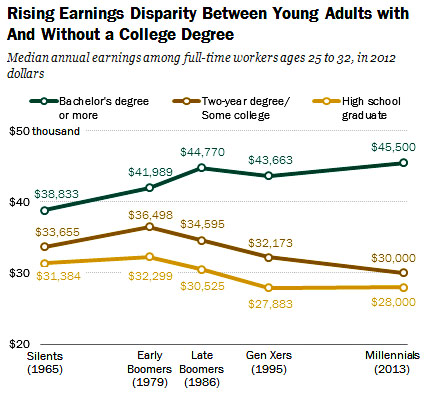
    As we all know, the biggest driving force behind rising income inequality has been the skyrocketing earnings of the top 1 percent. But although that might account for most of the story, it doesn’t account for all of it. There’s also a growing disparity between the earnings of college grads and the earnings of high school grads.

    The chart below, from Pew Research, tells the story. In 1965, high school grads earned 19 percent less than college grads. Since then, the earnings of college grads have gone up (though slowly over the past two decades), while the earnings of high school grads have plummeted. As a result, high school grads today earn a whopping 39 percent less than college grads. Life for the 47 percent of Americans who have high school diplomas but no more is an increasingly parlous one.

  • The Fed Chairman Wore Sensible Shoes Today


    Elizabeth Williamson of Real Time Economics, the home for “economic insight and analysis from the Wall Street Journal,” analyzes Janet Yellen’s first appearance before Congress today:

    She took her seat at 10:01 a.m., clad in a monochrome suit and sensible shoes, carrying a black vinyl binder with rainbow-colored tabs. Once chided by an uncharitable commentator for wearing the same black dress twice in a row, Ms. Yellen hadn’t bought a new suit for the occasion, her spokeswoman, Michelle Smith, confided to a reporter. “I’ll try to come up with some color for you,” she whispered.

    Seriously?

  • Paul Ryan Votes Against the Debt Ceiling Increase


    With John Boehner finally crying uncle over the debt ceiling and dumping the whole thing on Democrats, the only suspense left was which members of the Republican leadership would suck it in and vote yes to get the bill over the finish line. Here’s the answer:

    Speaker John Boehner, Majority Leader Eric Cantor, and Majority Whip Kevin McCarthy voted for the increase. House Budget Chairman Paul Ryan, on the other hand, voted against the bill.

    There you go. Even Eric Cantor gritted his teeth and voted for the increase, but Paul Ryan didn’t. Kinda makes you think he might still be keeping a presidential run in the back of his mind, doesn’t it?

  • Will Democrats Kill the Filibuster Entirely Next Year?


    After the 2000 election, with the Senate divided 50-50, Democrats demanded a power-sharing agreement in which both parties would have the same number of committee members and the same budget. Even though Dick Cheney provided the tiebreaking vote in favor of Republican control, Democrats got their way by threatening to filibuster the organization of the Senate.

    So what if this happens again after the 2014 election? Joe Biden will provide the tiebreaking vote this time, but Republicans will threaten to filibuster unless they get equal representation. Richard Arenberg thinks this could lead to the end of the filibuster:

    Here’s the interesting question. Last November the Democratic majority used the so-called “nuclear option” to eliminate the filibuster for presidential nominations (with the exception of the Supreme Court). This established the principle or at least demonstrated the means by which any rule could be changed at any time by a simple majority. In the wake of a hard-fought election to determine control of the Senate, would the temptation to eliminate the filibuster in order to gain clear control using the simple majority (with the vice president’s vote) be irresistible?  Would the Democratic base tolerate any less?

    I have long argued that the use of the nuclear option would place the Senate on a slippery slope. I believe that the elimination of the filibuster on legislative matter is close to inevitable.

    A tied Senate could be the test.

    Maybe! But I’m not sure that either party has much motivation to kill the filibuster entirely at this point, regardless of what their bases demand. Let’s examine the two parties separately.

    Democrats: Killing the filibuster for presidential nominees made sense because nominations require only Senate approval. But what’s the value of killing the filibuster for legislation? With the House under Republican control, it wouldn’t do them much good. Nor would it be worth it just to avoid power-sharing during the last two years of Obama’s term, when little is likely to be accomplished anyway. That simply isn’t a big enough deal. And as unlikely as it seems, Democrats do need to be concerned with the possibility of complete Republican control after 2016. It’s a slim possibility, but it’s a possibility. If that happens, why hand over the rope to hang themselves?

    Republicans: Suppose Republicans win the Senate outright in 2014. A lot of liberals take it as an article of faith that they’ll immediately kill the filibuster completely. But why? With Obama still in office, it wouldn’t do them any good. And they have to be deeply concerned about complete Democratic control after the 2016 election. It’s not just a slim possibility, it’s a very real possibility. If that happens, why hand over the rope to hang themselves?

    Bottom line: There’s nothing new about the procedure Harry Reid used to kill the filibuster for nominations. It’s always been available, and everyone has always known it. But it hasn’t been used before because both parties have always been afraid of what the other party would do in a filibuster-less world. That fear would continue to far outweigh the negligible benefits of killing the filibuster while government remains divided.

    But what about after 2016? What if one of the parties wins total control of Congress and the presidency? That’s harder to predict. I still think that fear of what the other party could do without a filibuster runs deep, and may well prevent either party from axing it. But I wouldn’t bet on it. Both Republicans and Democrats will be chomping at the bit to break the grinding deadlock of the post-2010 era, and either party might decide to finally take the plunge.

    But if it happens, it will be after 2016. The benefit of killing the filibuster after the 2014 election is just too slim to make it worthwhile.

  • Google Reads My Mind (And My Web Searches) Once Again


    I realize this is old news, just part of the modern world, etc. etc., but it still seems sort of creepy to me. A few minutes ago I got the email on the right asking, “Why are the charging cables so short?”
    And you know what? That’s a good question! In fact, I was asking myself that just a few days ago. As a result, I spent a bit of time googling around for cheap USB power cables, and of course I clicked on cables of various lengths. Because, you know, those 3-foot cables really are kind of dinky.

    Anyway, I know that Google knows all and sees all, but this is just a little too specific for comfort. It’s like it was reading my mind and sending advertisers my way. Which it was. And I suppose some people would consider this pretty cool. I’m getting ads not for the usual junk, but for something I’m actually interested in. And yet, it still seems a little creepy. Maybe I should start using private browsing tabs a little more often.

  • The Hillary Papers: Yet Another Conservative Bombshell That Strikes Out


    Jonah Goldberg watched the NBC Nightly News last night and was unhappy that they didn’t devote more time to Obama’s delay of the employer mandate. There’s a reason for that, of course: it’s not really very important and most people don’t care about it. Sure, all of us partisan junkies care about it, but that’s about it. To everyone else it’s a minor administrative rule change.

    But he was also unhappy with another segment:

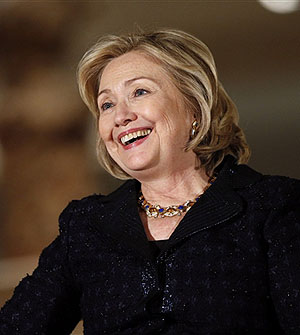
    The highlight of the night was Andrea Mitchell’s “report” on the Washington Free Beacon’s big take-out on the “Hillary Papers.” Her discomfort was palpable. She assured viewers that the “inflammatory excerpts” weren’t necessarily in context (Mitchell the Chief Foreign Affairs Correspondent for NBC who spent much of the last year covering Sarah Palin is a great stickler for context and eschews anything inflammatory). Hillary Clinton, the front runner for her party’s presidential nomination was treated like the victim. Thank goodness she didn’t joke about putting traffic cones up on the George Washington bridge!

    By chance, I happened to see that segment. What struck me was less Andrea Mitchell’s “discomfort” than the fact that this supposed bombshell seemed like a total nothingburger. When it was over, I sort of shrugged and wondered what the point was. Here’s a bit of the transcript from Mitchell’s report about the Diane Blair papers:

    Tonight, the once-private papers of the woman Hillary Clinton has previously described as her closest friend are getting a lot of attention….Thanksgiving, 1996, Blair quotes Clinton saying “I’m a proud woman. I’m not stupid. I know I should do more to suck up to the press. I know it confuses people when I change my hairdos. I know I should pretend not to have any opinions, but I am just not going to. I’m used to winning and I intend to win on my own terms.”

    ….September 9, 1998, Bill Clinton had finally admitted his relationship with Lewinsky. Blair writes of Hillary, “she is not trying to excuse him; it was a huge personal lapse.” But she says to his credit, he tried to break it off, tried to pull away.” Blair did not survive to provide context for her diary. Now Republicans say her notes are fair game.

    Um, OK. Is that supposed to be damaging? The entire Beacon story is here, and I guess there are some outtakes that can be spun as unflattering toward Hillary, but that’s about it. It’s a bit of tittle tattle about who Hillary was annoyed with at various points in time, and not much more. And even that depends for its power on just how accurately Blair represented Hillary’s views.

    Maybe I’m demonstrating a lack of imagination here, but I’m having a hard time seeing this as especially damaging or bombshellish. For the most part, it strikes me as confirming that Hillary was pretty much who we thought she was: tough-minded, goal-oriented, sometimes defensive, and not always sure how to handle the tsunami of invective that beset the Clinton presidency. If you’re a Hillary hater, it will be yet more evidence that she’s Satan incarnate, but for the rest of us, I’m not sure what’s really new here.

