• We Shouldn’t Denigrate the Diginity of Work, Even Accidentally


    Paul Krugman writes today about the Republican insistence that when they oppose safety net programs, they’re doing it because they really care about the poor. Paul Ryan, for example, says that Obamacare is bad because it reduces incentives to work: “Inducing a person not to work who is on the low-income scale, not to get on the ladder of life, to begin working, getting the dignity of work, getting more opportunities, rising their income, joining the middle class, this means fewer people will do that.” Here’s Krugman:

    Let’s talk, in particular, about dignity.

    It’s all very well to talk vaguely about the dignity of work; but the idea that all workers can regard themselves as equal in dignity despite huge disparities in income is just foolish. When you’re in a world where 40 money managers make as much as 300,000 high school teachers, it’s just silly to imagine that there will be any sense, on either side, of equal dignity in work.

    ….Now, one way to enhance the dignity of ordinary workers is through, yes, entitlements: make it part of their birthright, as American citizens, that they get certain basics such as a minimal income in retirement, support in times of unemployment, and essential health care.

    But the Republican position is that none of these things should be provided, and that if somehow they do get provided, they should come only at the price of massive government intrusion into the recipient’s personal lives — making sure that you don’t take advantage of health reform to work less, requiring that you undergo drug tests to receive unemployment benefits or food stamps, and so on.

    In short, while conservatives may preach the dignity of work, their actual agenda is to deny lower-income workers as much dignity — and personal freedom — as possible.

    There’s so much here that I agree with. Massive levels of inequality are indeed corrosive to both dignity and a basic sense of fair play. Making certain entitlements universal is indeed a way of enhancing dignity. And the endless Republican efforts to shame the poor are simply loathsome.

    And yet….I really hate to see liberals disparage the value of work, even if it’s only implicit, as it is here. Even people who hate their jobs take satisfaction in the knowledge that they’re paying their way and providing for their families. People who lose their jobs usually report intense stress and feelings of inadequacy even if money per se isn’t an imminent problem (perhaps because a spouse works, perhaps because they’re drawing an unemployment check). Most people want to work, and most people also want to believe that their fellow citizens are working. It’s part of the social contract. As corrosive as inequality can be, a sense of other people living off the dole can be equally corrosive.

    I know, I know: Krugman wasn’t trying to advocate a life of government-supported sloth. I’m not trying to pretend he was. And yet….we should be careful about this stuff. Work is important for dignity, both at a personal level and a broader societal level. We all acknowledge this when we talk about economic policy, making it clear that our goal is to attack high unemployment and create an economy that provides a job for everyone. We should acknowledge it just as much when the talk gets more personal.
  • Boehner Gives In, Introduces Clean Debt Ceiling Bill


    John Boehner has surrendered completely on the debt ceiling. None of his proposals managed to attract majority support among Republicans, so now he plans to introduce a clean bill and leave it up to Democrats to pass it:

    “House Republican leaders told members this morning that it is clear the paid-for military COLA provision will not attract enough support, so we will be bringing up a ‘clean’ debt limit bill tomorrow,” a Republican official said, referring to a plan on veterans’ benefits. “Boehner made clear the G.O.P. would provide the requisite number of Republican votes for the measure but that Democrats will be expected to carry the vote.”

    …Mr. Boehner explained the decision to go forward with a “clean” debt ceiling bill as a reflection of the political reality that he simply did not have enough Republican votes to pass anything more ambitious.

    “It’s the fact that we don’t have 218 votes,” he said after meeting with House Republicans, “and when you don’t have 218 votes, you have nothing.” He added that he expected almost all of the House Democrats to vote to pass the bill, though he said he would still need to muster about 18 Republican votes to get the legislation over the finish line. “We’ll have to find them,” Mr. Boehner said. “I’ll be one.”

    So whom did Boehner surrender to? That’s actually a little fuzzy. Democrats were willing to support his previous plan, which would have tied the debt limit increase to a restoration of full benefits for veterans, but it was the tea party that rebelled against that plan. So in a way, this was basically a surrender to the tea party.

    In any case, that’s that. Boehner has decided (probably wisely) to take one for the team and get a bill passed so that Republicans can move on. In a way, this is the best choice he could have made. He gets the debt limit off the table, which is good for the party, since it means no more public debacles getting in the way of their election-year messages. At the same time, he’s allowing virtually the entire Republican caucus to vote against it, which is also good for the party, since it allows individual candidates to rail against it and attack big-spending Democrats. And who loses? No one, really. Boehner himself will take some flack as a sellout, but he’s been taking it anyway.

    So will Eric Cantor and Paul Ryan vote for the debt ceiling increase? How about Kevin McCarthy, who will theoretically be the guy in charge of rounding up those 18 votes? Good question. Wait and see.

  • Study: Health Care Reform Likely to Reduce Bankruptcy and Catastrophic Debt


    Today’s email brings word of an interesting new paper from Bhashkar Mazumder of the Chicago Fed and Sarah Miller of Notre Dame. They set out to measure the effect of the Massachusetts health care reform on bankruptcy and personal debt, a subject that’s topical for a number of reasons:

    • The Massachusetts plan is quite similar to Obamacare, so results from this study are suggestive of the impact that Obamacare will eventually have.
    • One of the primary purposes of universal health insurance is to relieve the financial stress of large unpaid medical bills.
    • Massachusetts is a good case study because its reform affected everyone, not just those below the poverty line.

    The authors take advantage of the fact that health care reform had bigger effects on some groups than others. Most middle-aged people, for example, were already insured, so the Massachusetts reform affected them only modestly. Conversely, young people had relatively low insurance rates, so they were more heavily affected. Ditto for counties, some of which had higher initial rates of uninsurance than others.

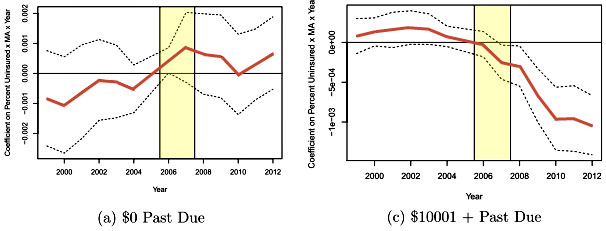
    The study exploits a very large data set of consumer finance based on reporting from credit bureaus, which provided a sample of nearly 400,000 individuals to look at. Its conclusion is unsurprising:

    We find that the reform significantly improved credit scores, reduced the total amount past due, reduced the fraction of debt past due, and reduced the probability of personal bankruptcy. We find particularly pronounced reductions in the probability of having a large delinquency of over $5,000. These effects tend to be larger among individuals whose credit scores were low at the time of the reform, suggesting that the greatest gains in financial security occurred among those who were already struggling financially.

    The charts below, excerpted from the study, illustrate the effect of health care reform, which was implemented in the period shown by the yellow bars. Despite the severe recession that followed, the amount of current debt stayed pretty flat while the amount of debt more than $10,000 past due declined sharply. Obamacare is not as universal as the Massachusetts reform, so its effects will probably be less pronounced. Nonetheless, it will not only provide routine health care for millions of Americans who aren’t currently getting it, it will also make their lives far less financially precarious. That sounds like a win to me.

  • Here’s How Democrats and Republicans Could End Up Agreeing on a Compromise Replacement for Obamacare


    Now that the Coburn-Burr-Hatch health care proposal is on the table, it’s safe to say that the GOP has finally started inching away from its obsession with repealing Obamacare and leaving only a smoking husk in its place. Even if CBH goes nowhere, it’s a sign that at least some Republicans are starting to grapple with the reality that their only option now is to offer up an alternative that’s based on reforming Obamacare, not killing it outright.

    So what options are realistically on the table? Andrew Sprung talked with a couple of moderate liberals and one moderate conservative to see how much common ground there might be around a proposal that uses Obamacare as a base but makes substantial changes to it. Here is Yevgeniy Feyman of the Manhattan Institute, our designated conservative:

    Feyman enthusiastically embraces CBH as a vehicle for more thoroughgoing reform. Paradoxically, he sees the possibilities for conservative redesign widening, not because supporters of the ACA have been weakened, but because the Tea Party has. The CBH rollout signals that some Republicans at least are ready to deal.

    “We’ve seen the hardliners lose a good deal of influence since the shutdown,” Feyman said. “If they don’t gain more seats and influence, I imagine that a bill like this could pass.”  Feyman is most excited by the prospect of maintaining subsidies for private insurance but ending the state exchanges’ monopoly of subsidized plans….”In the employer market,” Feyman said, “exchanges are doing a great job directing employees into best locations for care,”  providing cost and quality information and incentives to chose the cheapest and best. He would like to see states encourage private exchanges in the individual market, and innovate in other ways, such as providing services that help consumers track their spending or set up HSAs.

    The whole piece is longish, but worth a read if you want to dive into the details of possible Obamacare compromises. In my mind, the big question that underlies this is: Why should Democrats even think about making a deal? After all, Obamacare is safe at least through 2016, and almost certainly longer. Even in the unlikely event of a Republican sweep in 2016, they’d still have to deal with two things: Democratic filibusters in the Senate and enormous institutional resistance to changing a program that’s been in place for years. Nobody in the health care industry is going to support big changes after spending half a decade massively modifying their businesses to comply with Obamacare.

    The answer, probably, is twofold. First, a compromise would represent a peace of sorts and would truly solidify Obamacare’s survival. Second, Democrats might get some things they want. Donald Taylor, for example, wants to see Obamacare and Medicaid expansion accepted in the South:

    For Taylor, a lifelong southerner, the imperative to expand health insurance access in the South is personal….“If I were to argue for negotiation from a pro-ACA perspective,” Taylor said, “I’d be most worried about the uneven rollout, with the South left out. I’d look to come up with some way to make the South willing to expand insurance coverage.”

    ….”Medicaid expansion is not that consequential in California or Massachusetts [where eligibility was already extensive pre-ACA], but in North Carolina, you could cover a half million people in a year, and that’s a huge change. You can leverage $4.1 billion in federal money in 2016 alone. It’s painful to watch that deal go begging.”

    I’m not especially optimistic about any of this happening anytime soon. Or even anytime not so soon. On the Republican side there’s just too much tea party energy dedicated to the idea that any compromise is a sellout, and on the Democratic side it’s hard to imagine a compromise deal that would provide enough benefits to make up for Republican demands. But it’s not completely out of the question. If you read Sprung’s piece you’ll know enough to make up your own mind.

  • Can You Ever Have Too Many Choco Pies?


    Tyler Cowen points today to a story from a few months back about cuts in benefits to workers at North Korea’s Kaesong Industrial Complex:

    Due to financial difficulties at Kaesong caused by the complex’s five-month halt in operations…the number of Choco Pies distributed will be reduced and North Korean workers — known to resell Choco Pies on the black market for a considerable profit — will have a major source of income cut.

    Before the closure of the complex, those working in chemical and heat treatment factories would receive five to 10 Choco Pies a day and those working night shifts would receive up to 20. Choco Pies would then be resold on the black market for 500 to 600 North Korean won each. However with the new regulations restricting each worker to $0.20 worth of snacks a day, the workers will receive a maximum of two Choco Pies.

    Choco Pies. Can anyone explain Choco Pies to me?1 Here in Irvine we have lots of Asian supermarkets, and every one of them features enormous floor stacks of Choco Pies. Not just during certain holidays, and not just during special promotions. All the supermarkets. All the time. And judging from the selection of other sweets in these stores, Choco Pies must account for upwards of half of their sweet sales.

    There’s no American equivalent I can think of. It would be as if every supermarket greeted its customers with a gigantic display of, say, Snickers bars, which accounted for 50 percent of all candy bar sales.

    I bought a box of Choco Pies once. They were OK, but it was hard to see anything special about them. So what’s up? Is this just one of those particular cultural things for which there’s no real explanation? Or is there some fascinating historical reason for the immense popularity of Choco Pies among Koreans? Anyone know?

    1Not among North Koreans, of course. That’s just a hook for this post. Their black market value in a place like North Korea is pretty obvious.

  • Job 1 for GOP: Pretending Not to Be Crazy


    Last month, we1 told you about the crackpot congressional candidacy of Virginia’s Dick Black. A week later we told you he had dropped out of the race. That didn’t take long! Black tried to put a heroic spin on his withdrawal (it was to prevent Democrats from gaining a majority in the Virginia state senate), but the truth was more prosaic: everyone was against him. The Chamber of Commerce. The party leadership. Even the Koch Brothers.

    In other words, it wasn’t just the Republican “establishment” that was opposed to Black. It was also tea-partyish groups like the Koch-funded American for Prosperity. But why? Dave Weigel explains:

    Why did [AFP] join the blanket party against Black? Because Black was going to make social conservative gaffes. And that element of the party, not a huge problem in office, causes problems during campaigns.

    That’s what “stopping the next Todd Akin” means. It doesn’t mean crushing the Tea Party or electing moderates. Akin was not the Tea Party candidate in Missouri’s 2012 primary—national Tea Party groups endorsed either the former state treasurer or a businessman who was making his first ever political run. Akin was a social conservative who went on to bungle his abortion views in an easy interview. And everyone on the right, from the RNC to the pro-life Susan B. Anthony List, has been working to train Republicans to avoid sounding like Akin. Not changing what they stand for.

    The Republican Party isn’t trying to move to the center. It’s just trying to prevent abject idiots from running for Congress, especially in red hot media markets like Northern Virginia, which command the attention of every political reporter in the country. When you start babbling about spousal rape in a town hall in West Bumcluck, you might pull it off with no one noticing. But if you do it in NoVa, it won’t just be Mother Jones that notices. Everyone will notice. And let’s face it: Republicans have no greater challenge these days than fooling moderates into thinking that the party isn’t controlled by a flock of raging fanatics. Getting rid of embarrassments like Dick Black is all part of the plan.

    1Meaning Mother Jones. It was Molly Redden who reported these stories, not me.

  • New Supermarket, New Eating Habits? Not So Fast….


    A team of researchers recently carried out a study of two food deserts in poor Philadelphia neighborhoods. One of the neighborhoods got a new supermarket and the other didn’t. Here’s the good news:

    Respondents perceived grocer choice and quality and fruit and vegetable choice and quality to have improved, and the cost of fruit and vegetables was perceived to have decreased.

    And here’s the bad news:

    Few residents adopted the new supermarket as their main food store, and exposure to the new supermarket had no statistically significant impact on BMI and daily fruit and vegetable intake at six months….At the planning and consultation stages, members of the community indicated their preference for having a new supermarket instead of selling the land for residential development. This suggested their readiness to use the new store and the lowering of barriers to change. However, few residents chose to shop at the store once it was open.

    ….Our findings suggest that simply building new food retail stores may not be sufficient to promote behavior change related to diet….The development of new food retail stores should be combined with initiatives focused on price and availability that could help bridge the gap between improvements in people’s perceptions of accessibility and behavior change. Such initiatives might be supported by local departments of health, which could provide targeted neighborhood-based health promotion programs in conjunction with supermarket developers to increase their effectiveness.

    All the usual caveats apply. This is one study of one store in one neighborhood. And it’s possible that it takes more time to change behavior. A follow-up done six months after the new store opened may simply have been too soon.

    Nonetheless, it adds to an increasing set of data suggesting that food deserts per se aren’t the reason for obesity and poor nutrition in low-income neighborhoods. There’s much more going on, and it’s especially discouraging that residents plainly knew about the new supermarket but still didn’t shop there. Even a highly publicized grand opening featuring a visit from Michelle Obama wasn’t enough. It was a struggle just to get local residents to change their shopping habits, which is almost certain to be a lot easier than getting broad-based changes in actual eating habits.

    Aaron Carroll has more here. There’s no real way to spin this as anything but fairly bleak news, though.

  • In the Republican Party, the Yahoo Wing is Winning


    Thanks to massive internal disarray, Republicans are unable to agree on any kind of immigration reform plan. They can’t say that, though, so they’re blaming it on the fact that President Obama is a rogue despot who can’t be trusted to enforce the law no matter what it is. He’ll implement the parts he likes and ignore the rest, just as he’s been doing for years with his sun-king presidency. So no immigration reform.

    Also thanks to massive internal disarray, Republicans are unable to agree on a plan to raise the debt limit. Plan A was to demand the end of risk corridors in Obamacare (aka the “insurer bailout”), but that went nowhere. Plan B was to repeal the benefit cut for veterans that was enacted last month, which might have gone somewhere since Democrats are probably willing to go along with that in any case. But that didn’t make the cut either because it would have made it tough for tea partiers to vote against the bill. Plan C is to “wrap several popular, must-pass items around a provision to extend the federal government’s borrowing authority beyond the November midterm elections.” But even this plan is looking shaky.

    The common thread here is that the Republican Party is unable to get its act together enough to look beyond next week. Both immigration reform and a quiet debt limit increase would benefit the GOP in the long term. But both would also infuriate the yahoo wing of the party in the short term. So far, the yahoo wing is winning.

  • NFL Apprehensive About Its First Openly Gay Player


    Michael Sam, a defensive end who was projected to be a mid-round choice in the NFL draft this year, announced today that he’s gay. So how did the league react?

    “I don’t think football is ready for [an openly gay player] just yet,” said an NFL player personnel assistant. “In the coming decade or two, it’s going to be acceptable, but at this point in time it’s still a man’s-man game. To call somebody a [gay slur] is still so commonplace. It’d chemically imbalance an NFL locker room and meeting room.”

    All the NFL personnel members interviewed believed that Sam’s announcement will cause him to drop in the draft. He was projected between the third and seventh rounds prior to the announcement. The question is: How far will he fall?

    “I just know with this going on this is going to drop him down,” said a veteran NFL scout. “There’s no question about it. It’s human nature. Do you want to be the team to quote-unquote ‘break that barrier?'”

    ….The potential distraction of his presence — both in the media and the locker room — could prevent him from being selected. “That will break a tie against that player,” the former general manager said. “Every time. Unless he’s Superman. Why? Not that they’re against gay people. It’s more that some players are going to look at you upside down. Every Tom, Dick and Harry in the media is going to show up, from Good Housekeeping to the Today show. A general manager is going to ask, ‘Why are we going to do that to ourselves?'”

    The former general manager said that it would take an NFL franchise with a strong owner, savvy general manager and veteran coach to make drafting Sam work. He rattled off franchises like Pittsburgh, Green Bay, San Francisco, Baltimore and Indianapolis as potential destinations. The former general manager added that a team with a rookie head coach would not be an ideal landing spot.

    Moral of the story: Yes, we’ve made progress. But we still have a ways to go.

  • The Fifth Ring: How Conspiracy Theories are Born


    As we all know, there was a glitch in the Olympic opening ceremonies yesterday. But not everyone saw it:

    Somehow it seemed fitting when a set of floating snowflakes suddenly transformed themselves into Olympic rings — but only four of them. The fifth snowflake never changed.

    Russian television viewers, however, saw all five rings, as the show’s producer Konstantin Ernst recognized the malfunction shortly before it occurred and immediately ordered an image from rehearsals to be transmitted in its place. “It would be ridiculous to focus on the ring that would not open,” said Ernst later. “It would be silly.”

    That’s quick thinking! But I suspect it’s going to give birth to a thousand conspiracy theories. After all, millions of Russians saw all five rings, so why are all the Americans and Europeans saying there were only four? It must be Photoshop trickery from Westerners designed to make Russia the butt of jokes. Right?