

• Hospitals Report Big Drop in Uninsured Admissions in Blue States


    Jason Millman has been listening in on earnings calls for publicly traded hospital chains, and he says they all report a big difference in admissions between states that expanded Medicaid and those that didn’t:

    The Hospital Corporation of America…saw a 22.3 percent growth in Medicaid admissions, compared to a 1.3 percent decline in non-expansion states. The company also had a 29 percent decline in uninsured admissions in the expansion states, while non-expansion states experienced 5.9 percent growth in uninsured admissions, chief financial officer William Rutherford said.

    Community Health Systems, with facilities in 29 states, also noticed an expansion gap. In expansion states it serves, CHS said it saw self-pay [i.e., uninsured] admissions drop 28 percent while Medicaid admissions increased by 4 percent. Self-pay emergency room visits decreased 16 percent in expansion states, but they increased in non-expansion states, the company said in its earnings call last week.

    Tenet Healthcare reported last week that it had a 17 percent increase in Medicaid inpatient visits while uninsured visits decreased 33 percent in the four expansion states where it operates. In non-expansion states, Medicaid admissions dropped 1 percent as uninsured care rose 2 percent.

    This is why hospitals support Medicaid expansion so strongly. Medicaid may not pay a lot, but on average it pays a lot better than uninsured patients. A drop of around 30 percent in uninsured admissions is a big win for the patients, but it’s also a big win for the hospitals.

    Normally, of course, that would be enough to gain Republican support all by itself, but not in the world of Obamacare. The fact that Medicaid expansion benefits the poor, benefits hospitals, probably benefits state finances, and is all but free to participating states—well, it’s just not enough. Demonstrating their tribal opposition to all things Obama is far more important.

  • Quote of the Day: FCC Chair Pretends to Change Course on Net Neutrality


    From an anonymous FCC official:

    There is a wide feeling on the eighth floor that this is a debacle and I think people would like to see a change of course. We may not agree on the course, but we agree the road we’re on is to disaster.

    The debacle in question is the proposal by FCC chair Tom Wheeler that would gut net neutrality by allowing big companies to pay ISPs for faster internet service. Wheeler’s proposal has provoked a massive backlash, and he’s now promising revisions:

    The new language by FCC Chairman Tom Wheeler to be circulated as early as Monday is an attempt to address criticism of his proposal….In the new draft, Mr. Wheeler is sticking to the same basic approach but will include language that would make clear that the FCC will scrutinize the deals to make sure that the broadband providers don’t unfairly put nonpaying companies’ content at a disadvantage, according to an agency official.

    ….[An agency] official said the draft would also seek comment on whether such agreements, called “paid prioritization,” should be banned outright, and look to prohibit the big broadband companies, such as Comcast Corp. and AT&T Inc., from doing deals with some content companies on terms that they aren’t offering to others.

    Mr. Wheeler’s language will also invite comments on whether broadband Internet service should be considered a public utility, which would subject it to greater regulation. The FCC has so far not reclassified broadband as a utility, and providers have fiercely opposed such a move, saying it would cause innovation and investment to collapse.

    Color me unimpressed. A promise that the FCC will “scrutinize” deals is basically worthless, and inviting comments on reclassifying broadband internet service will lead nowhere if Wheeler himself doesn’t support it—which he doesn’t. This looks mostly like smoke and mirrors to me.

  • Liberals Fight Back Against Obama Court Nominees


    Democrats may have done away with the filibuster for judicial nominees, but the infamous blue-slip procedure remains alive and well. This means that Republican senators can still block nominees unless President Obama cuts some kind of deal with them. That’s exactly what Georgia’s Saxby Chambliss and Johnny Isakson have done for the past several years, so in 2013 the White House negotiated a compromise with them. They agreed to approve several of Obama’s judicial nominees in return for getting their way on one of them. Now liberals are pissed:

    Liberals are incensed that the administration is pushing hard for Michael Boggs, a judge on Georgia’s state Court of Appeals, to join the federal bench in Georgia. Boggs, a conservative Democrat, voted while in the state Legislature to reinstate a version of the Confederate flag as the state flag, opposed same-sex marriage and took positions on abortion that critics say would have limited women’s rights.

    ….As that fight plays out, prominent senators from both parties, backed by the American Civil Liberties Union, are trying to block, or at least delay, a planned vote on Harvard law professor David Barron, whom Obama has nominated to be a judge on the 1st Circuit Court of Appeals, which hears cases from New England. As a Justice Department lawyer, Barron wrote at least one memo that provided the legal justification for the targeted killing of Anwar Awlaki, a U.S. citizen who was slain by a drone strike in Yemen in 2011.

    In one sense, it’s hard to know what liberals expect here. Boggs is obviously not a good nominee, but it’s not as if Obama is in love with the guy. He just agreed to swallow hard and nominate him in return for getting support for four others. Since there’s nothing Obama can do about the blue-slip rule, he didn’t have much choice about it. As for Barron, it’s hard to be too shocked over his nomination. Obama himself approved the killing of Awlaki and has vigorously defended it. Of course he supports Barron.

    But in another sense, it’s good to see liberals fighting back. Maybe it won’t do any immediate good, just as it doesn’t always do any good for tea partiers to harass mainstream Republicans. But if the fight is rough enough, it sets boundaries for future nominations. That’s probably the main benefit of opposition in this case: Both of these nominees might be approved anyway, but at least the White House will know they’ve been in a scrap. Maybe next time they’ll think twice.

  • Obamacare Saves Lives, But That’s Not Really Its Big Benefit


    Ed Kilgore points me to a recent piece by Harold Pollack that takes a look at the recent study of Romneycare in Massachusetts and tries to extrapolate what it means about Obamacare:

    The Massachusetts estimates imply that the ACA will prevent something in the neighborhood of 24,096 deaths every year (simply: 20 million divided by 830). That’s more than twice the number of Americans killed in gun homicides. It’s considerably more than the number of Americans who die from HIV/AIDS.

    The Cato Institute’s Michael Cannon rightly notes that these mortality reductions won’t come cheap. My own faux-precise back-of-the-envelope calculation suggests that the cost per averted death is about $3.3 million. That seems like a lot of money—and it is. Yet it actually compares favorably in cost-effectiveness with other widely accepted medical, public health, product safety and workplace interventions….And of course this $3.3 million only captures the impact of health reform on reducing mortality rates. It doesn’t count so many other important health, financial and personal benefits of health coverage, from regular preventative care to peace of mind.

    I’d very strongly emphasize that last sentence. The effect of Obamacare on mortality is always going to be contentious. The Massachusetts study might be wrong. Medicaid might be less effective than private insurance. And there’s no telling how long these medical interventions delay death. Six months? Six years? More?

    But nobody should hang too much on these results. Obviously, preventing death is important, but it’s by no means the primary value of health insurance, especially in the non-elderly population. The primary value is (a) financial and (b) the ability to get routine health care that improves your life even if it doesn’t prolong it. Knee surgery. Hip replacements. Antidepressant prescriptions. Pain management. Diabetes control. And on and on. The vast majority of the non-elderly rarely receive life-saving health care. But so what? Even if health insurance had zero impact on mortality, we’d still want it. It provides us with medical care that makes life more livable and it prevents us from living with the constant fear that we’re one expensive treatment away from bankruptcy. That’s the real benefit of Obamacare. Obsessing about mortality misses the point.

  • Friday Cat Blogging – 9 May 2014


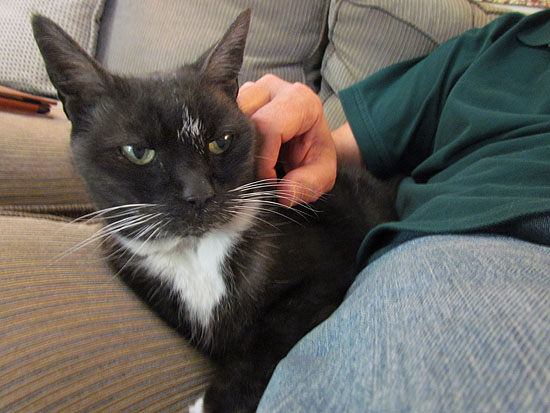
    Domino heard recently that selfies are all the rage among celebrities, so she decided she wanted to take a selfie for this week’s cat blogging. Naturally, she didn’t deign to actually take the selfie herself, but instead commanded one of her servants to take it. Her servant, as it happens, found this more challenging than he expected, partly because he had to do it left-handed. Still, it’s not wise to disappoint the queen, so this week a selfie is what we get. Perhaps I should put it on Twitter and see if I can beat Ellen’s record.

  • Quote of the Day: Billionaires Insist that Billionaire-Friendly Policies Don’t Actually Benefit Billionaires


    Americans for Prosperity, the Koch-fueled political advocacy group, is doubling down this year after its failure to move the needle much in 2012. Politico’s Kenneth Vogel got hold of an internal strategy memo that outlines what they think went wrong in the last election:

    To remedy the messaging disadvantage, AFP developed “a sophisticated new media message-testing strategy to target specific demographics in specific locations we need to move on our issues,” according to the memo….“If the presidential election told us anything, it’s that Americans place a great importance on taking care of those in need and avoiding harm to the weak,” reads the AFP memo….“We consistently see that Americans in general are concerned that free-market policy — and its advocates — benefit the rich and powerful more than the most vulnerable of society….We must correct this misconception.”

    And what better way to correct this misconception than to collect hundreds of millions of dollars from America’s crankiest right-wing billionaires in order to fund the election of people dedicated to slashing every possible program that protects the weak and takes care of those in need? It’s hard to understand why America’s poor and working class are so obstinately misguided about what America’s moneyed class really wants.

    UPDATE: I originally referred to AFP as a super-PAC. This is incorrect. It’s a 501c(3) and 501c(4) organization.

  • Idaho Has Surprising Progressive Traffic Laws for Bicycles


    I’ve heard of the “California stop”—I live in California, after all—but I had no idea there was such a thing as an Idaho stop. But there is! It’s for bicycles:
    Idaho’s rule is pretty straightforward. If a cyclist approaches a stop sign, he or she needs to slow down and look for traffic. If there’s already a car or another bike there, then the other vehicle has the right of way. If there’s no traffic, however, the cyclist can slowly proceed. Basically, for bikers, a stop sign is a yield sign.

    If a cyclist approaches a red light, meanwhile, he or she needs to stop fully. Again, if there’s any oncoming traffic, it has the right of way. If there’s not, the cyclist can proceed cautiously through the intersection. Put simply, red light is a stop sign.

    This doesn’t mean that a cyclist is allowed to blast through an intersection at full speed — which is dangerous for pedestrians, the cyclist, and pretty much everyone involved. This isn’t allowed in Idaho, and it’s a terrible idea everywhere.

    How about that? This comes from Joseph Stromberg, who says that Science™ is on Idaho’s side:

    If all this sounds far-fetched to you, look at the data. Public health researcher Jason Meggs found that after Idaho started allowing bikers to do this in 1982, injuries resulting from bicycle accidents dropped. When he compared recent census data from Boise to Bakersfield and Sacramento, California — relatively similar-sized cities with comparable percentages of bikers, topographies, precipitation patterns, and street layouts — he found that Boise had 30.5 percent fewer accidents per bike commuter than Sacramento and 150 percent fewer than Bakersfield.

    I’m convinced. This actually sounds like a perfectly sensible rule to me. Blowing through intersections at top speed is obviously dumb, and you deserve every ticket you get if you do it. But bicycles are a lot slower than cars; a lot less dangerous than cars; and have a way better field of vision than cars. Allowing them to slow down but not stop for stop signs when no one is around makes perfect sense.

    On the potato thing, though, Idaho needs to stand down. Let’s all leave the nutritionists alone, OK?

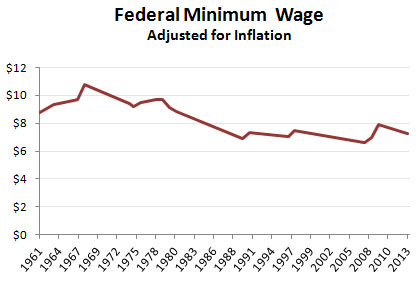
  • Republicans Who Don’t Actually Vote Favor a Minimum Wage Increase


    This is sort of interesting:

    Former Massachusetts Gov. Mitt Romney on Thursday morning said he supports an increase in the minimum wage, breaking with many Republicans who have stood against it….Romney’s comments come after Senate Republicans rejected a vote on a Senate bill that would have increased the minimum wage to $10.10. Recently, though, former Minnesota Gov. Tim Pawlenty and former Pennsylvania Sen. Rick Santorum, both of whom also ran for the Republican nomination in 2012, said they supported some increase in the minimum wage.

    I say “sort of” because it’s no coincidence that none of these folks has to brave the wrath of the tea party to cast a vote on this issue. In the actual existing United States Congress, a grand total of zero House Republicans and one (1) Senate Republican voted to approve a minimum wage increase when a bill was brought forward. You see, it doesn’t do to coddle the moochers and takers, even the ones that work for a living. Pay ’em ten bucks an hour and they’ll have no incentive to better themselves anymore. They’ll just live high on the hog on their Obamaphones and their Obamasteaks. Far better to keep them desperate and cringing.

  • Obama’s Foreign Policy Paradox


    Fareed Zakaria is the latest columnist to acknowledge that although President Obama’s foreign policy decisions have been largely correct, they’ve been sadly unaccompanied by any magic powers:

    President Obama has not made a major mistake. He has done a skillful job steering the United States out of the muddy waters he inherited — Iraq, Afghanistan — and resisted plunging the country into another major conflict.

    ….Obama’s strategy of putting pressure on Moscow, using targeted sanctions and rallying support in Europe is the right one — and might even be showing some signs of paying off.

    ….From the Asia pivot to new trade deals to Russian sanctions, Obama has put forward an agenda that is ambitious and important, but he approaches it cautiously, as if his heart is not in it, seemingly pulled along by events rather than shaping them. Once more, with feeling, Mr. President!

    I’ll concede that as a political partisan, maybe I’m cutting Obama too much slack. But I still wonder what all these critics want. I don’t mean the Bill Kristols and John McCains of the world. I know what they want: maximum confrontation, maximum bluster, and maximum military intervention. But what about the others? Like Zakaria, they sort of grudgingly recognize that Obama’s actual foreign policy actions have been about as good as they could have been, and yet they’re still unhappy. They want inspiration, dammit! They want the rest of the world to fall immediately into line. They want victory! That’s how it happens in the movies, after all. The president gives a big speech, and everyone swoons.

    I wonder: Has any president in history been so widely criticized for doing everything right but not crowing loudly enough about it? I mean, it’s nice to think that a silver tongue would have gotten congressional Republicans to support intervention in Syria and Germans to approve harsher sanctions against Russia, but it’s just not so. I think everyone knows this perfectly well, but we find it so frustrating that we blame Obama for it anyway. It’s as if we’re all five-year-olds.

    Which, come to think of it, maybe we are. We want this circle squared—triumph on every front but without any actual exercise of military power—and when we don’t get it we demand someone to blame, logic be damned. Before long we’re going to be holding Obama responsible for the fact that pi doesn’t equal three.

