• Republicans Drink Their Own Kool-Aid, End Up Looking Like Idiots


    Jonathan Bernstein makes a telling point today about the Fox News bubble that so many Republicans are trapped in. As you may recall, last week House Republicans released a survey suggesting that only 67 percent of Obamacare enrollees had paid their premiums. It was a laughably dumb survey, and it prompted the usual question: stupid or mendacious? Did Republicans really believe this nonsense, or were they just tossing out lies to muddy the waters?

    Bernstein says the Republican follow-up to the survey demonstrates that they really believed their own spin:

    This could be just a story of ineptitude. The House Energy and Commerce Committee wouldn’t be the first to construct a survey poorly….But yesterday, a House subcommittee invited insurance company executives to testify and, according to the Hill, Republicans on the panel were “visibly exasperated, as insurers failed to confirm certain claims about ObamaCare, such as the committee’s allegation that one-third of federal exchange enrollees have not paid their first premium.”

    We don’t have to rely on reporter interpretations (here’s another one). It made no sense to hold the hearing unless Republicans were (foolishly) confident that the testimony would support their talking point, instead of undermining it.

    The only plausible explanation is that closed feedback loop. Either members of the committee managed not to be aware of the criticisms of their survey, or they mistakenly wrote off the criticism as partisan backbiting.

    Good catch! Obviously Republicans were caught off guard at yesterday’s hearing, and that could only happen if they really and truly believed their own flawed survey. And that, in turn, could only happen if they get pretty much all their information from Fox News and don’t bother with anything else. After all, the flaw in their survey was obvious. You didn’t have to be a brain surgeon to know that it would never stand up to scrutiny.

    Welcome to the alternate universe of movement conservatism. Sometimes it bites you in the ass.

  • Eastern Ukrainians Dislike EU and US, But They Dislike Russia Even More


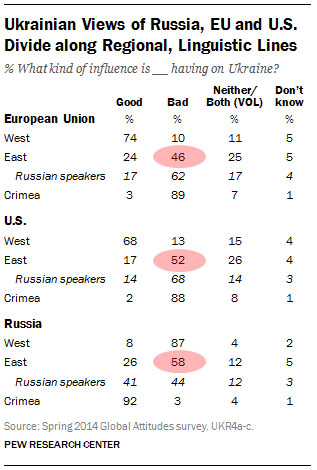
    I don’t have a lot to add to this, but I thought this recent poll result from Pew was sort of fascinating. It’s part of a survey of Ukrainian attitudes toward governance, and the main takeaway is that Ukrainians from both east and west are strongly in favor of remaining united. Even in the east, only 18 percent favor allowing regions to secede.

    That’s a surprisingly high number, but the question on the right was even more interesting. It turns out that eastern Ukrainians don’t really think very highly of any of the foreign actors currently meddling in Ukrainian politics. Unsurprisingly, 46 percent don’t like the EU and 52 percent don’t like the US, but an even higher number, 58 percent, don’t like Russia either. Even among Russian speakers, a small plurality dislike Russia.

    If these poll results are accurate, there’s little appetite for secession in eastern Ukraine, and little appetite for Russian intervention. That should be food for thought for Vladimir Putin.

  • Price Tag for California Bullet Train Rises Yet Again


    I imagine that most of you are tired of my endless linking to news articles reporting that the California bullet train will cost ever more, more, more. Some of you are tired of it because you don’t live in California and don’t care. The rest of you care, but are dismayed at the sight of a fellow liberal who opposes the bullet train.

    I hear you. But I can’t help myself. Here’s the latest from an engineering firm hired by the state:

    The estimated cost of building a key Central Valley segment of the California bullet train has increased by nearly $1 billion from the original estimate, based on figures in an environmental impact statement approved by the rail agency Wednesday….The lowest cost estimate for the 114-mile segment in a 2011 environmental report was $6.19 billion. The comparable figure increased 15% to $7.13 billion in the new report.

    The California High Speed Rail Authority said in a statement that it believes the cost will be lower than URS is projecting.

    Well, I’m willing to bet that the cost will be higher than URS is projecting. Most construction costs rise after actual construction begins, after all, and so far the rail authority hasn’t laid a single mile of track.

    There have been all sorts of disputes between rail supporters and URS, so it’s pretty easy to ignore their estimates if you’re inclined to. As for me, I’m sticking to my prediction that the bullet train will end up costing at least $100 billion in 2011 dollars, assuming it gets built at all. I don’t think anyone has been willing to take me up on that bet yet.

  • It’s Time to Place Bets on Trey Gowdy


    A friend of mine who follows these things more closely than me has suggested that maybe, just maybe, Trey Gowdy won’t be quite the lunatic I think he is once he revs up the Benghazi select committee. Sure, Gowdy is a tea party true believer, but she thinks he actually has a smidgenof fair-mindedness about him, and looks at this committee as a way of gaining some respectability:

    I don’t think Gowdy is into the more bizarre conspiracy theories. He’s not entirely convinced the military did all they could have, he thinks the administration hasn’t played straight in the way they handled the PR — and of course is beside himself with outrage about not having gotten that Rhodes email pre FOIA court case — and he thinks State bungled security overall. He’s right on the third point, the second is a matter of perspective, and a couple one-to-ones between him and General Ham or whoever would almost certainly deal with his remaining doubts on that score.

    Maybe! But Dana Milbank isn’t so sure:

    Asked by MSNBC’s Joe Scarborough about the possibility that his panel’s work would continue into the 2016 election campaign, Gowdy replied that “if an administration is slow-walking document production, I can’t end a trial simply because the defense won’t cooperate.”

    A trial? And the Obama administration is the defense? So much for that “serious investigation” House Speaker John Boehner (R-Ohio) promised….But [Gowdy’s] honesty is refreshing, and it confirms what seemed implicit in Boehner’s selection of the second-term South Carolinian to head the panel over more experienced and less combative colleagues.

    It’s true that Gowdy is not a Jason Chaffetz kind of character: a slick, soulless young pol who wants to climb the greasy pole and is willing to adopt whatever views will get him to the top fastest. He’s a little more genuine than that. Still, he’s also a tea party nutball, and I doubt he’ll be able to rein in those instincts for long. He’s doing his best to seem sober and responsible right now (doing an interview with Charlie Rose!), but my guess is that he can’t keep it up. He’ll be in Dan Burton territory before long.


  • House Committee Votes Unanimously to Rein In the NSA


    It’s pretty hard to find non-depressing news out of Washington DC these days, but this genuinely qualifies:

    The House Judiciary Committee on Wednesday voted 32-0 to approve an amended version of the USA Freedom Act, a bill that would require the National Security Agency to get case-by-case approval from the Foreign Intelligence Surveillance Court before collecting the telephone or business records of a U.S. resident.

    ….The USA Freedom Act, introduced last October, would prohibit bulk collection under the business-records provision of the Patriot Act, the law cited by NSA and Department of Justice officials as giving them authority for the telephone records collection program exposed by leaks from former NSA contractor Edward Snowden.

    The bill would also prohibit bulk collection targeting U.S. residents in parts of another statute, the Foreign Intelligence Surveillance Act, which the NSA has used largely to target overseas communications. The bill would take the phone records database out of NSA control and leave the records with carriers.

    Remarkably, support for this bill has stayed bipartisan despite the fact that President Obama supports it. And although it’s true that several provisions have been watered down a bit recently, the heart of the bill has stayed intact: a ban on bulk collection of phone records by the NSA. This is a pretty big deal, and it’s supported by Democrats, Republicans, and the president.

    This represents the first time in decades that the national security establishment has been restrained in any significant way. And no matter what else you think of Edward Snowden, this never would have happened without him.

  • Conservative Pro-Growth Policies Don’t Actually Produce Any Growth


    Michael Hiltzik draws my attention to something I missed when it first appeared a few weeks ago. Menzie Chinn decided to check out whether conservative pro-growth policies actually led to high growth, and the chart on the right shows the results. Chinn compared scores on the ALEC-Laffer “Economic Outlook” ranking to actual growth in 2013-14 and looked for a trend. There wasn’t one. “If there is any evidence,” he concludes after a more detailed look at the data, “it suggests that a higher ALEC-Laffer Economic Outlook score is associated with a worse economic performance.”

    However, although a high ALEC-Laffer ranking may not stimulate any actual growth, Hiltzik points out that it does correspond to reduced taxes on the wealthy and slashed spending on state services that benefit the poor and working class. In other words, it may not affect growth, but it sure is a good deal for the rich. And that’s what counts, isn’t it?

  • Test Scores Are Up! (Except In the One Place It Actually Matters)


    I periodically try to remind everyone that test scores for American students have not, in fact, plummeted over the past few decades. In fact, they’re up. To the extent that standardized tests can measure learning, American kids simply aren’t doing any worse than kids in the past. They’re doing better.

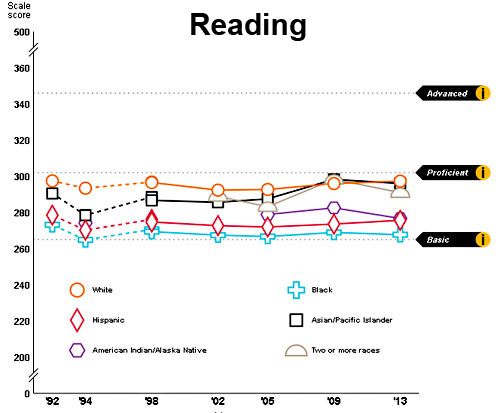
    But there’s always been a caveat: this is only for grade school and middle school kids. All those test score gains wash out in high school, and today brings the latest evidence of this. Scores from the 2013 NAEP—widely considered the most reliable national measure of student achievement—are now available for 12th graders, and they confirm what we’ve known for a while. In reading, scores have been basically flat since 1992, and the scores for every racial subgroup have been pretty flat too. Math has only been tested since 2005, and scores have risen a few points since then. But not enough to demonstrate any kind of trend.

    There are technical issues with testing 12th graders that can affect these scores. As dropout rates go down, for example, the test population becomes less proficient. And senioritis can affect how much effort kids put into these tests. Still, the best evidence indicates that we’re making pretty good progress improving the proficiency of students all the way through middle school, but we still haven’t cracked the code for high school. And in the end, that’s all that matters. It’s great that fourth graders are doing better, but if all those gains wash away in the final three years of high school, we’re not ending up any better than before.

    UPDATE: Actually, math has been tested since 1990, but the test was revised in 2005 and scores before then aren’t comparable to current scores. A crude comparison suggests that scores actually have increased for 12th graders since 1990, perhaps by as much as ten points, though this is in direct contradiction to the long-term NAEP, which shows no gains at all for 17-year-olds. My own guess, based on both of these results, is that math scores have increased slightly since 1990, but probably not enough to really be noticeable.

  • The Tea Party Won Its Final Victory Last Night


    The victory of Thom Tillis in the Republican Senate primary in North Carolina last night is sure to prompt a lot of pieces about the death of the tea party. The establishment guy won! The tea party loon got whomped! The adults are back in charge. But Ed Kilgore gets it right:

    For one thing, the “Establishment” did not have a great night in House races in NC. But even if all you do is to focus on Tillis’ win, it came at the sort of price that I suspect “Establishment” candidates are going to be willing to pay all over the country this year: abject surrender to party extremists on every key issues.

    As it stands, Thom Tillis will be entering the general election campaign against Kay Hagan having proudly and redundantly branded himself as a “conservative revolutionary” leading battles against education funding and abortion rights and voting rights in a state that is ambivalent at best about its shiny new right-wing government. And if there were any doubts about perceptions of Tillis, I’d say publicity about the 2011 “divide and conquer” video will take care of them eventually. Any “move to the center” by Tillis will be very, very difficult.

    The tea party basically took over the GOP four years ago. Sure, there are still candidates who are more or less conservative than others, but even the “establishment” candidates these days are creatures of the tea party. As Dave Weigel says, there’s really not much contest left. The tea party has already won:

    In 2014, the biggest target of the year so far was Thom Tillis, the leader of the ultra-conservative North Carolina legislature, which was elected with the help of Americans for Prosperity’s Art Pope — who, following the 2012 elections, is now the state’s budget director. The “Tea Party,” as seen in the movement’s best-funded national organization, had already won in North Carolina and made it a test kitchen for ALEC model legislation. Where, as I asked last week, was the space to the right? There wasn’t any. This is why Democrats, who quietly gave up hope of a Republican runoff over the last week, have been trying to remind people that Tillis is perfectly right-wing.

    If Tillis is the best example you can find of an “establishment” candidate, then the conservative establishment is well and truly toast. These days, the tea party is triumphant everywhere. The only thing that’s changed is its name. It’s now called the Republican Party.


  • America Does Not Really Have a Big Aging Problem


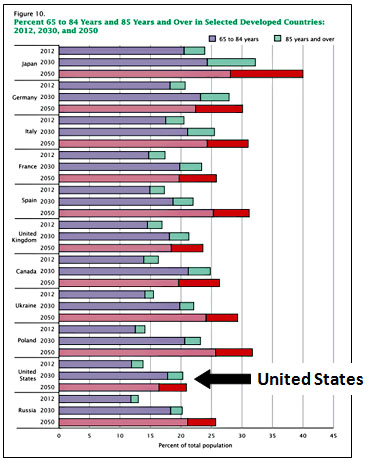
    This isn’t exactly breaking news, but the Census Bureau released a report on America’s aging population today, and the basic takeaway is something we already know: as the Baby Boomers age, our population is going to get steadily older. However, what’s less widely recognized is that this is only true for the next couple of decades. After 2030, our elderly population stabilizes at about one-third the size of the working-age population.

    In other words, all the Sturm und Drang over Social Security aside, our demographic problem isn’t really that bad. What’s more, compared to other countries, our outlook is positively sunny. Take a look at the red bars in the chart on the right. They show the projected size of the elderly population in various developed countries in 2050, and the United States is in by far the best shape. Our elderly population stabilizes in 2030 at about 21 percent of the total population, a number that’s significantly lower than even the second-best country (Britain, at 24 percent). Most other countries not only have elderly populations that are far larger, but their elderly populations are growing. These countries have demographic problems.

    It’s worth driving this point home: America doesn’t really have a huge aging problem. We have a very moderate aging problem, which could be handled in the federal budget with fairly modest changes to Social Security and Medicare. What we do have is a health care problem. But that’s a problem for us all.