• Kill the Penny, Save the Economy!


    Ryan Cooper is annoyed by coins. They’re too much trouble, and they just pile up in the penny jar at home. I used to feel that way, but now that my local supermarket has a Coinstar machine, I don’t care anymore. I throw my coins into the machine every few months, and within a minute I get an Amazon gift card or something for the full value of the change. No muss, no fuss, no more rolling up coins.

    Still, Cooper thinks we could do better if we not only got rid of the penny, but got rid of all our other small change too:

    Here’s my solution: multiply the face value of every U.S. coin by 10. A penny will be worth 10 cents, a nickel 50 cents, a dime one dollar, a quarter $2.50, and a dollar coin 10 bucks. (We could also reinvent the half-dollar, which is barely produced now, as a nice $5 coin.)

    This will have several beneficial effects: first, it will make change real money again….Second, it will be easy to accomplish. We won’t have to have a big fight with the zinc lobby or Abraham Lincoln fans over whether to stop production of a particular coin, or rebuild all the vending machines around differently-shaped coins.

    ….Third — and this might be the most contentious part of this proposal — changing coins could be a nice piece of badly-needed economic stimulus. Effectively, we’d be printing up a bunch of new money and handing it to whoever has coins on hand. We’d have to think carefully about the details, but the idea would be to allow people who have old coins to hand them in for fresh new versions worth 10 times as much….How much money are we talking about? According to the Federal Reserve, as of 2010 there was about $40 billion worth of coins in circulation, which constituted 4.3 percent of the U.S. currency stock. We’d be increasing that by $360 billion at a stroke, which would actually be a pretty powerful economic stimulus.

    I like this kind of out-of-the-box thinking! Unfortunately, I suspect the biggest beneficiaries wouldn’t be coin hoarders, but banks, which probably own about 90 percent of all circulating coins. (I’m just guessing about that.) Plus, you’d better do this in secret. If you don’t, you’re going to have the damnedest run on Sacagawea dollars ever. You can sign me up for a ton or two right now.
  • Obamacare Now Widely Accepted As Here to Stay


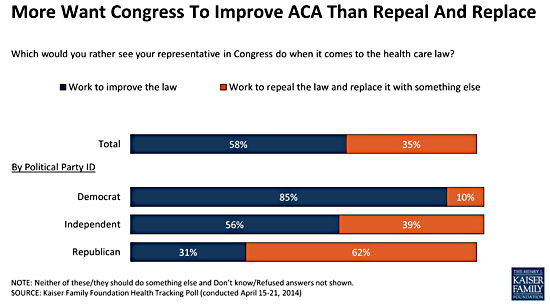
    The latest Kaiser tracking poll on Obamacare is out, and there hasn’t been a lot of movement since last month. Unsurprisingly, most people believe the rollout was botched; that enrollment failed to meet expectations; and that the law isn’t working as planned. I expect that these attitudes will soften over time as horror stories start to recede and evidence of Obamacare’s success begins to percolate into the public consciousness—though, needless to say, that might happen slowly while the Kochs and their allies are pouring hundreds of millions of dollars into their campaigns to persuade voters of exactly the opposite.

    However, attitudes have already softened in one key area: repeal. In December, sentiment for keeping the law was slim: keeping and improving Obamacare beat out repeal by only 43 to 42 percent. Today, Obamacare commands substantial support, 58 to 35 percent. The public may still harbor some doubts, but they’re increasingly tired of the debate and accept that the answer to Obamacare’s problems is to improve it, not to burn it to the ground.

  • People Trust Democrats, But That Doesn’t Mean They’ll Vote for Democrats


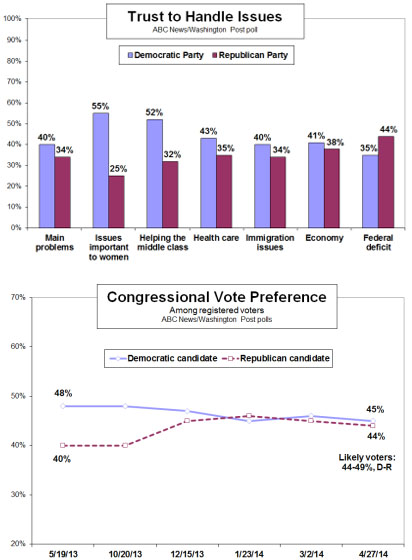
    The latest ABC News/Washington Post poll shows a precipitous drop in President Obama’s job approval rating. That’s likely to prove a bit of an outlier, but it’s still not good news for Democrats. And it gets worse. The pair of charts below shows the Democrats’ real problem. On virtually every issue, voters prefer the Democrats, sometimes by wide margins. And not just on small issues, either. When it comes to helping the middle class, voters trust Democrats over Republicans by a whopping margin of 52 to 32 percent.

    As usual, though, this does them no good. As the bottom chart shows, Democrats are in a dead heat with Republicans in congressional vote preference. People may say they trust Democrats, but that doesn’t mean they plan to vote for them.

  • The Annual Medicare Doc Fix: Not as Bad as You Think!


    Here’s a bit of contrarianism for you today: Austin Frakt says that the much-maligned Medicare “doc fix” actually works pretty well. This is Congress’s annual charade in which it overrides the formula for Medicare reimbursements to doctors, resulting in doctors getting paid more—but without ever changing the formula itself. (Why? Because changing the formula would cost money, and they’d have to figure out how to pay for it. Better to just kick the can down the road each year.)
    So from one point of view, the formula is just a joke. However:

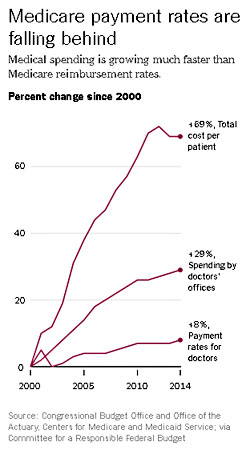
    From another point of view, the formula — as flawed as it is — has helped keep Medicare spending lower than it might otherwise have been. Instead of cutting physician payments by the large amount the S.G.R. demands, Congress has increased payment rates, but typically by only tiny amounts — at an annual rate of just 0.7 percent. That pace does not keep up with the typical cost of care.

    The gap can be seen in the chart below. The bottom line illustrates how Congress has permitted Medicare physician payments to grow. The middle line shows an index of medical spending — spending at a typical physician’s practice over time — that is a proxy for the change in price for a typical, or average, medical treatment.

    ….The relatively gentle increases in Medicare payment rates makes clear that the formula is not the problem. I think that the formula has actually helped Congress be more fiscally responsible than it otherwise might have been. To physicians who fear a double-digit decrease in payment rates called for by the formula, a 0.5 percent or a 1.5 percent increase that Congress passes looks like a great deal.

    So there you go. Two cheers for the Sustainable Growth Formula!

  • Anti-Obamacare Hysteria Almost Killed Dean Angstadt


    Robert Calandra of the Philadelphia Inquirer tells the story today of Dean Angstadt, a guy who listened to Republican hysteria about Obamacare and almost paid for it with his life:

    “I don’t read what the Democrats have to say about it because I think they’re full of it,” he told his friend Bob Leinhauser, who suggested he sign up….From time to time, Leinhauser would urge Angstadt to buy a plan through the ACA marketplace. And each time, Angstadt refused. “We argued about it for months,” Angstadt said. “I didn’t trust this Obamacare. One of the big reasons is it sounded too good to be true.”

    January came, and Angstadt’s health continued to decline. His doctor made it clear he urgently needed valve-replacement surgery. Leinhauser had seen enough and insisted his friend get insured….Leinhauser went to Angstadt’s house, and in less than an hour, the duo had done the application. A day later, Angstadt signed up for the Highmark Blue Cross silver PPO plan and paid his first monthly premium: $26.11.

    All of a sudden, I’m getting notification from Highmark, and I got my card, and it was actually all legitimate,” he said. “I could have done backflips if I was in better shape.” Angstadt’s plan kicked in on March 1. It was just in time. Surgery couldn’t be put off any longer. On March 31, Angstadt had life-saving valve-replacement surgery.

    Roger Ailes must be so proud.

  • Quote of the Day: If We Don’t Like Your Gun, You Should Not Be Allowed to Sell It to Anyone


    From Lawrence Keane, general counsel of the National Shooting Sports Foundation, the trade association for gun manufacturers:

    They tried to put the product on the market, and the market reacted.

    I know that “Orwellian” is overused, but what else can you call this? The product in question is a “smart gun,” which can only be fired by its registered owner. A company called Armatix put one on the market—you know, the market, a place where people can voluntarily buy or decline to buy products depending on whether they want them—and the gun lobby went ballistic:

    Belinda Padilla does not pick up unknown calls anymore, not since someone posted her cellphone number on an online forum for gun enthusiasts. A few fuming-mad voice mail messages and heavy breathers were all it took. Then someone snapped pictures of the address where she has a P.O. box and put those online, too. In a crude, cartoonish scrawl, this person drew an arrow to the blurred image of a woman passing through the photo frame. “Belinda?” the person wrote. “Is that you?”

    Her offense? Trying to market and sell a new .22-caliber handgun that uses a radio frequency-enabled stopwatch to identify the authorized user so no one else can fire it. Ms. Padilla and the manufacturer she works for, Armatix, intended to make the weapon the first “smart gun” for sale in the United States.

    ….The National Rifle Association, in an article published on the blog of its political arm, wrote that “smart guns,” a term it mocks as a misnomer, have the potential “to mesh with the anti-gunner’s agenda, opening the door to a ban on all guns that do not possess the government-required technology.”

    According to Keane, this is the market “reacting.” It’s certainly heartwarming to see such dedication to free enterprise.


  • Forget the Enthusiasm Gap, It’s All About the Money Gap


    As we all know (don’t we?), Democrats have a big problem in midterm elections. The core Democratic constituencies—minorities, low-income workers, and the young—vote fairly reliably during presidential elections but tend not to bother during midterms. Republican voters, conversely, tend to be habitual voters who cast ballots in every election.

    Sasha Issenberg, who is our generation’s Boswell of what science tells us about voter turnout, says there’s an answer for Democrats. But although the details may be interesting and fresh, it turns out the fundamental solution is still the oldest one imaginable:

    Field operations have been transformed from busywork for volunteers into the most rigorously scientized corner of the trade. All the research suggests that the most effective form of outreach is also the most seemingly old-fashioned: a conversation on a doorstep between a potential voter and a well-trained volunteer….Few candidates, however, inspire volunteer corps large enough to sustain such an ideal mobilization campaign, and many voters live behind doors that are simply not reachable….The solution has been direct mail, a relic of twentieth-century electioneering whose economics nonetheless match twenty-first century imperatives.

    ….Experiment after experiment has since confirmed the effectiveness of subtle prods that trigger what Rogers has called a citizen’s “basic need for belonging.”….Added together in a single nonpartisan get-out-the-vote letter, the messages can boost an individual’s likelihood of voting by about one-third of a percentage point without increasing costs. Factoring in printing and postage, new votes can be created this way for $71 each.

    ….In 2010, the America Votes consortium planned to send 800,000 pieces of mail in targeted congressional districts. Rogers, working with his colleague John Ternovski, randomized those letters so that half featured the proven language and half included that message plus an additional sentence in the upper right-hand corner: “You may be called after the election to discuss your experience at the polls.” (A control group received no mail at all.) Rogers and Ternovski were testing the potential of a new concept—self-integrity—by threatening accountability for potential voters who valued civic engagement. Their simple adjustment increased the letter’s impact by more than 50 percent and generated about 1,500 votes across the experiment. The cost of a new vote dropped to $47.

    Such results undercut the popular belief that Unreliable voters are driven to the polls by passion….For Unreliable voters, specifically, it often takes a psychologically potent encounter to jolt them out of complacency.

    If Democrats fail to see midterms as sufficiently sexy, the problem may lie not with the party’s rank-and-file but with its donors and activists….It’s not intensity scores on polls but rather the bustle of field offices and the sums on fund-raising reports that are the best guide to the Democrats’ midterm prospects….For a party populated with Unreliable voters, the midterm imperative is clear: Raise the dollars and secure the volunteer commitments. Then go and turn out those who are already on your side but won’t show up without a friendly nudge.

    So there you go: raise the dollars and secure the volunteer commitments. It’s true that you have to be smart about how you spend the money, but at bottom, it’s money you need. Go forth and fundraise, my children.


  • Meet the Tea Party Grassroots, Same As the Old Grassroots


    “Grassroots” fundraising in the conservative world has long been full of shady operators who raise lots of money but don’t actually spend much of it on actual political activities. The tea party, of course, was supposed to be different. It was a real grassroots rebellion. Honest. This time was going to be different as the tea partiers gave the Washington establishment hell.

    Except, um, not so much. The Washington Post reports that if the tea party movement was ever truly a grassroots crusade in the first place (a subject on which you should retain a healthy skepticism), it rather quickly morphed into the usual opportunity to rake in big bucks for the folks at the top:

    Out of the $37.5 million spent so far by the PACs of six major tea party organizations, less than $7 million has been devoted to directly helping candidates, according to the analysis, which was based on campaign finance data provided by the Sunlight Foundation….Three well-known groups — the Tea Party Patriots, the Tea Party Express and the Madison Project — have spent 5 percent or less of their money directly on election-related activity during this election cycle….On average, super PACs had spent 64 percent of their funds on directly helping candidates by roughly this stage in the 2012 election cycle, according to Federal Election Commission data.

    ….The donation page on the Web site of the Tea Party Patriots Citizens Fund pleads with potential donors to “make the most generous contribution possible” to help fund “the ads, the get-out-the-vote campaigns, the research and the volunteer training sessions we need to take the fight to the big-spending incumbents!”….But of the $7.4 million that the Georgia-based group’s super PAC has spent since the beginning of 2013, just $184,505 has gone to boost candidates, The Post found.

    ….[Jenny Beth] Martin, the super PAC’s chairwoman, oversees all its expenditures, according to Broughton, meaning she sets her own $15,000 monthly fee for strategic consulting — payments that have totaled $120,000 since July. She also draws a salary as president of the Tea Party Patriots’ nonprofit arm — getting more than $272,000 in the 2012 fiscal year, according to the group’s most recent tax filing.

    Her twin salaries put her on track to make more than $450,000 this year, a dramatic change in lifestyle for the tea party activist, who had filed for bankruptcy in 2008 and then cleaned homes for a period of time to bring in extra money….Martin’s cousin, Kevin Mooneyhan, is also on the payroll as a strategic consultant.

    I guess you might as well take the money while the taking is good. But no worries. When the tea party schtick finally goes south, there are always gold coins and reverse mortgages to sell to credulous retirees.

  • Flipping Burgers is the New Black


    From Annie Lowrey of the New York Times:

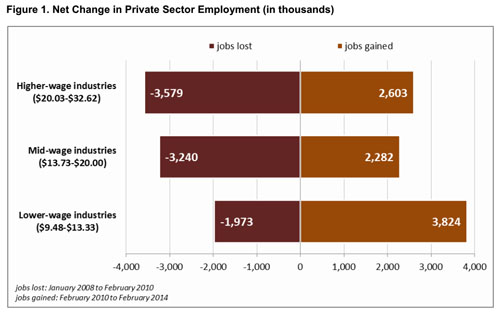
    The deep recession wiped out primarily high-wage and middle-wage jobs. Yet the strongest employment growth during the sluggish recovery has been in low-wage work, at places like strip malls and fast-food restaurants.

    In essence, the poor economy has replaced good jobs with bad ones. That is the conclusion of a new report from the National Employment Law Project, a research and advocacy group, analyzing employment trends four years into the recovery. “Fast food is driving the bulk of the job growth at the low end — the job gains there are absolutely phenomenal,” said Michael Evangelist, the report’s author.

    The basic chart is below. Welcome to the new normal. The full report is here.

  • Donald Sterling is a Creepy Egomaniac


    I don’t have much to add about the whole Donald Sterling affair. The appalling nature of his comments is pretty obvious, after all. But for those of you who don’t live in Los Angeles, I thought I could at least acquaint you with a tiny tidbit about the guy’s titanic level of egotism that you might find fascinating. Sterling is a major advertiser in the LA Times. I don’t mean Sterling’s companies. I mean Sterling, himself. He gives away lots of money, and when he does he makes sure everyone knows about it. Ads thanking Sterling for his good deeds simply litter the Times.

    The one below, from today’s paper, is typical. They’re all the same: they have terrible, amateur production values; they all use the exact same cutout portrait of Sterling; and they all feature photos of the people honoring Sterling that look like they were taken with a 60s-era Instamatic. These ads appear multiple times a week. Sometimes multiple times a day. Sterling is constantly being honored for something or other, and every single honor is an occasion for him to advertise the fact in the LA Times. And always with the exact same cutout photo of himself. It’s kind of creepy.

    Sterling’s vanity ad today happens to be on a page facing an ad that features Kobe Bryant pitching Turkish Airlines. The irony was amusing enough that I figured I’d share.

    UPDATE: More here from Franklin Avenue, who’s been tracking Sterling’s ads for years.