• Our ISIS Problem Is That Everybody Wants Someone Else to Take Out ISIS


    Michael Knights writes today about why it’s so damn hard to destroy ISIS, even though they’re not really all that formidable a force. Basically, it’s because everyone except the United States has bigger fish to fry:

    All of our allies and rivals have far more complex goals than degrading and defeating the Islamic State. For them, the current battle is really a game of positioning for the truly decisive action that will begin as soon as the Islamic State is defeated.

    The first priority of most actors is consolidating their control on the ground. The Kurds in Syria and Iraq are staking out their long-term territorial claims. Iranian-backed groups like Badr are carving out principalities in Iraqi areas like Diyala and Tuz Khurmatu. Abu Mahdi al-Muhadis, the most senior Iranian proxy in Iraq and a U.S.-designated terrorist involved in the deaths of U.S. and British troops, is seeking to quickly build the Popular Mobilization Units (PMU) into a new permanent institution akin to a ministry.

    ….The Assad regime in Syria is integrating with the Russian military machine….Syrian Sunni groups are tightening military ties to Saudi Arabia, Qatar, and Turkey. Iranian-backed groups in Iraq continue to deepen their ties with Russia and Iran….The Baghdad Operations Command continues to hold around half of the offensive-capable Iraqi military units in reserve in the capital despite the declining risk of an Islamic State attack on Baghdad. Why? To offset the risk posed by the Shia militias.

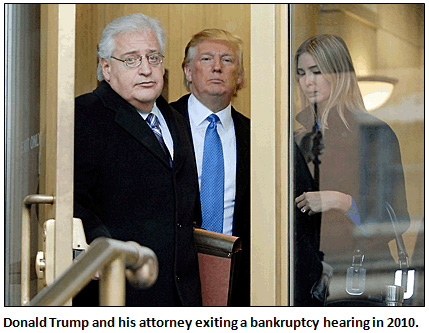
    The whole thing is worth a read, even if, in the end, it boils down to our old friends Team Sunni vs. Team Shia. Basically, everyone is willing to give lip service to fighting ISIS, but for most of the actors in the Middle East it’s not really a high priority. They’d rather keep their powder dry for the main event. In that respect, ISIS is sort of like Donald Trump. All the other Republicans want to get rid of him, but they don’t want to spend a lot of their own energy doing it. They want someone else to do it, so that it will be someone else who’s too worn out to win the actual nomination fight.

    More generally, Knights is concerned that the US has no good post-ISIS strategy. We simply have too many allies who hate each others’ guts, and we’re not willing to just take a side in the Sunni-Shia civil war and let the chips fall. “Though Washington may seek to play the role of the balancer between these camps, the U.S. government is faced with impossible choices between traditional Sunni allies and the up-and-coming Shia actors who are critical players in the war against the Islamic State.”

    Personally, I’m not convinced there’s a workable answer, which means we need to maintain a pretty light touch in the region and not get sucked into its endless sectarian feuds. But who knows? Maybe President Trump will be able to thread this delicate needle after his landslide victory next November.

  • It’s Time for TV Critics to Become a Little More Critical


    I hate to pick on TV critic Todd VanDerWerff, but today he really encapsulates a pet peeve of mine:

    There’s so much out there! This year, there were more than 400 scripted dramas and comedies just in primetime….So when you see that the list below starts at 35, and then see that I’ve thrown in an additional 25 runners-up, know that I’m choosing only a small fraction of a fraction of the shows I wanted to include. (My initial list of programs to either consider or catch up on ran nearly 175 titles in total)….While the number 10 is largely an arbitrary one, there is some value to conciseness, so I’ve also ranked everything. If you just want to know my top 10, you can scroll down to that point. And if your favorite show isn’t on this list, I probably just didn’t watch it.
    I am absolutely drowned in stories these days about the best show on TV. Or the best show nobody watches. Or the best show on cable. Or the best show not on cable. Or the most criminally underrated show. Or the best show ever about prison. Or the best show ever about the military. Or the best show ever about the transgendered. Or the funniest show. Or the most heartbreaking show. Or the funniest show you’ve ever watched about a trangendered Marine Corps officer who ends up in prison.

    We don’t live in the golden age of television. We don’t even live in the platinum age of television. Apparently we live in the unobtanium age of television.

    Enough. This has become a joke. Theodore Sturgeon said 90 percent of everything is crap. He was being generous. Even so, this means that maybe 2 or 3 percent of everything is truly outstanding. If you think 60 TV shows out of 400 are must watch—and it was hard to narrow it down to that number from 175—you’re just not being critical enough.

    I get that TV spent a long time as the bastard stepchild of the critical world, routinely mocked for its boob-tube idiocy. And when genuinely great shows like The Wire and The Sopranos came along, it was something of a revelation. But this doesn’t mean that a decade later upwards of half of all TV shows are brilliant. Critics do their readers no favors when they gush about so much stuff that their recommendations no longer even seem meaningful.

    I don’t begrudge anyone their favorites. As much as I’m tired of the endless parade of shows being described as brilliant, I’m equally tired of TV (and music and art and fashion) being used as cultural bludgeons against the less sophisticated. If you like NCIS, that’s fine. It’s a perfectly decent procedural. If you didn’t like Mad Men, that’s fine too. A show that spends seven years focusing on a faux mysterious protagonist and a relentlessly predictable affair of the week just isn’t everyone’s cup of tea. You shouldn’t think you have a penetrating intellect because you hate the former and love the latter.

    But now I’m just ranting. Feel free to rant back, since I started this. But I will stick to my guns on one thing: There are not dozens or hundreds of great shows on TV, and being a critic is not the same as being a fanboy. If you like virtually everything you watch—and an awful lot of TV critics seem to—you really need to be more critical.

  • New Paper Suggests More Smog = More Crime


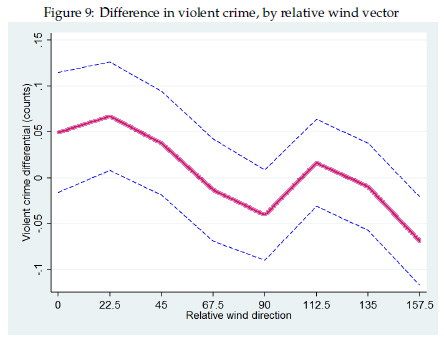
    A reader draws my attention to some “@kdrum bait” by Chris Mooney in the Washington Post today. Mooney writes about a new study that investigates violent crime upwind and downwind of interstate highways in Chicago. The study’s conclusion: higher rates of tailpipe pollution (measured via carbon monoxide levels) lead to higher violent crime rates:

    Moving from the median CO day to the 90th percentile (0.5 ppb increase) is associated with nearly 5% more violent crime. The analogous effect on property crime is statistically insignificant and small. This discrepancy across crime types may suggest that the primary mechanism is physiological; that is, the pollution might make people more irritable and impulsive, thus leading to more violent crime. As a point of comparison, the 5% increase in violent crime from a high-CO day is comparable to the estimated effect of moving from the 25-30°C (77-86°F) maximum temperature bin to the 30-35°C (86-95°F) bin (7% increase in violent crime). That is, the increase in violent crime when moving from a typical CO day to a high-CO day is comparable to the increase associated with moving from a warm day to a hot day.

    ….We estimate that the downwind side of interstates experience 2.2 percent more violent crimes than when the wind is blowing in the opposite direction. Although we estimate that the effect of pollution on crime is modest in magnitude, our conservative back-of-the-envelope calculations suggest that the cost of mobile pollution-induced crime in the United States is on the order of $100-200 million annually.

    Of course, this isn’t really Kevin bait. Needless to say, I would expect higher crime rates downwind of urban highways because of lead emissions. However, this is an effect over the very long term. If you were born in a high-emission area during the era between 1950-1980 or so, you’re likely to suffer from lead poisoning that leads to a greater propensity for crime when you grow up. This explains the long-term rise and fall of violent crime over the past five or six decades.

    However, this paper literally looks at violent crime rates from day to day. The authors conclude that, just as crime goes up during hot weather, it also goes up when pollution levels are higher. If this is true, it suggests that exposure to tailpipe pollutants has some kind of immediate, transient effect.

    Why? The authors suggest several mechanisms. Pollution may have a direct effect on brain chemistry. Or it may simply be unpleasant and annoying, which can trigger aggressive behavior. Or it may have an effect on how many people are outdoors, which might indirectly affect the crime rate in some way. Since this is a brand new finding, it’s hard to say. Obviously it needs to be confirmed, and more research is needed before we understand the causal mechanism.

    But interesting nonetheless.

  • State of the Race: Ben Carson is Doomed


    There is truly nothing much to blog about today. So to keep everyone up to date, here are the latest Pollster averages for the GOP primary race. Ben Carson is pretty obviously playing the Cain/Gingrich/Santorum role in this year’s election. Rubio needs to get his act together or else he’ll end up as a mini-Cain/Gingrich/Santorum. And the two most hated men in the race, Trump and Cruz, are doing great. I’m not sure I can tell you what the “Republican establishment” is—a bunch of guys smoking fat cigars while their faithful lobbyists serve them snifters of brandy?—but whoever they are, they must be booking tickets to the Cayman Islands right about now to pick up their stashes of Krugerrands so they can be prepared to flee the country.

  • President Obama Adopts Bold, New Policy Toward Islamic State


    According to the New York Times, President Obama said this in an NPR radio interview:

    “This is a serious challenge — ISIS is a virulent, nasty organization that has gained a foothold in ungoverned spaces effectively in Syria and parts of western Iraq,” Mr. Obama said, referring to attacks the group organized in Paris and apparently inspired in San Bernardino. “But it is also important for us to keep things in perspective, and this is not an organization that can destroy the United States.”

    Seriously? He called it ISIS instead of ISIL? Hallelujah! Can someone please confirm this?

    UPDATE: The interview is here. Obama really did say ISIS. Once. He said ISIL the other 22 times he referred to them. But it’s a start!

  • Why Were Last Night’s Debaters Cut Off When They Actually Started to Debate?


    Rebecca Traister, along with practically everyone on the left, is dumbfounded that the Democratic National Committee has gone out of its way to reduce viewership for its debates. The first two were both held on Saturdays, and yesterday’s debate was on the Saturday before Christmas. Do they really want to lower the profile of the party that badly? It’s a wonder anyone tuned in at all. But there’s more:

    The DNC’s poor choices pale in comparison to the choices of Saturday night’s ABC News moderators, the usually terrific Raddatz and her colleague, World News anchor Muir. They did fine for the first hour, but as the candidates began to actually debate each other in compelling and important ways, Muir especially began to talk over them in an effort to cut them off and adhere to the rules. That precision reffing may be necessary when it comes to shutting down an offensive monologue from Donald Trump, or halting a candidate’s whine about not getting enough time. But when, as on Saturday, the top contenders for the nomination are engaging each other seriously about tax policy, drowning them out and preventing the audience from hearing what they have to say doesn’t do anyone any favors.

    For what it’s worth, Twitter opinion on Martha Raddatz shifted so fast it almost gave me a neck sprain last night. At first everyone thought she was great. By the second hour, she was the worst moderator ever. Mostly, I think, this was because she spent too much time interrupting the candidates when she didn’t happen to like their answers. This was especially annoying since, for the most part, they didn’t really dodge or tap dance very much. They mostly provided substantive answers.

    As for the “precision reffing” that cut off a potentially interesting argument, I suspect that Martin O’Malley is the person to blame here. O’Malley may be a vanity candidate at this point, but he’s still a candidate, and that means he’s supposed to get equal time in the debates. If the moderators allow Sanders and Clinton to get into long arguments, it takes away from O’Malley’s time and there’s really no way to entirely make that up. So the moderators apply the rules strictly and demand that Sanders and Clinton shut up and allow them to ask O’Malley a question.

    This is one among many reasons that O’Malley needs to grow up and get out of the race. He’s polling at 3 percent in a 3-person race, and he’s doing himself no favors by stubbornly staying in. It makes him look like a sore loser, not a serious politician.

  • Here’s a Better Answer to Donald Trump’s Supporters


    Tonight’s Democratic debate featured a short exchange about Donald Trump:

    MUIR: You have weighed in already on Donald Trump….What would you say to the millions of Americans watching tonight who agree with him? Are they wrong?

    HILLARY CLINTON: Well I think a lot of people are understandably reacting out of fear and anxiety about what they’re seeing….Mr. Trump has a great capacity to use bluster and bigotry to inflame people and to make think there are easy answers to very complex questions.

    I suppose this is the “right” answer in some sense, but if you take seriously the framing of the question—what would you say to Trump’s supporters?—it’s condescending and offensive. You’re telling them that they only support Trump because they’re scared, not because they have legitimate beefs. That’s not likely to win many converts.
    I’m a little surprised that no one has taken the approach toward Trump that strikes me as having a better chance of success. Basically it has two parts:

    #1: Trump is a mediocre businessman. He talks big about his golf resorts, but they don’t make a lot of money. His casinos in Atlantic City went bankrupt because he managed them poorly and didn’t understand the business. He doesn’t have a lavish property empire. He’s built or renovated half a dozen major buildings, and they’ve done OK but nothing more than that. There’s no evidence that he negotiates especially great deals, just fairly routine ones. He’s thin-skinned and goes to court—or threatens to—over every perceived slight. Basically, Trump inherited a lot of wealth and hasn’t done all that much with it. Someone should ask him to show us financial statements for his development business. Not licensing and TV. Just development. How much have earnings increased over the past decade? What’s his return on equity? Return on investment? Etc.

    #2: Trump is a blowhard, and we all know blowhards, right? They BS constantly because they don’t know squat. They talk big and they never deliver. That’s Trump. What makes anyone think he’ll deliver on all the BS he’s ladling out right now?

    Trump has built two successful businesses based on being a blowhard. He has a nice licensing business, and he made a nice chunk of change from The Apprentice. That’s about it. In every business that required him to actually deliver something concrete, he’s been average or worse.

    Trump has built his campaign on the proposition that he’s a great builder and a great negotiator, and for some reason his opponents have all let that slide. I don’t really understand why. Take away his mouth and he’s just another guy who inherited a bunch of money from his father and used it to build a middling business. It’s nothing to be ashamed of, but it hardly makes him a dazzling executive, either.

  • No Debate Liveblogging Tonight


    Sorry. I’m debated out. If anything interesting happens, I’ll write about it afterward. In the meantime, consider this an open debate thread.

    POST-DEBATE UPDATE: There’s just not much to say about how it turned out. Hillary Clinton did fine, and she was obviously positioning herself for the general election, not really participating in a Democratic primary debate. Sanders did fine too, and O’Malley reached peak annoyance. It’s time to face reality and hang up your spurs, Martin.

    (On a related note, it was interesting that Sanders and Clinton were pretty buddy-buddy during the breaks even after they’d been slagging each other a few minutes before. Neither one of them wanted anything to do with O’Malley, though. He left early too. Apparently no one in the crowd even wanted to shake his hand.)

    The dynamics of the race weren’t changed at all. Hillary will win and Sanders will get a healthy chunk of the vote.

  • Here’s What Actually Happened in the Great Sanders-Clinton Data Theft


    I haven’t yet written anything about the great Clinton vs. Sanders vs. DNC battle over whether the Sanders campaign downloaded a bunch of information from the Clinton campaign during a short glitch that allowed them access they shouldn’t have had. There are a couple of reasons for this:

    • Everything I’ve read has pretty clearly been written by either Clinton or Sanders loyalists, who have put their own spin on what happened, most of it faintly ridiculous.
    • To truly understand what happened, you need to know the technical details of how the NGPVAN database and front-end search tools are set up. I don’t know this, and apparently nobody I’ve read knows it either.

    Today, however, David Atkins has weighed in [see update below], and he does know how the software is set up. I don’t know his loyalties in the presidential race, but he nonetheless seems to have a pretty solid take on the whole thing:

    [An] important piece of information to note is the difference between a “saved search” and a “saved list.”…You really only want to pull a static list if you’re doing something specific like creating a list for a targeted mail piece—or if you want a quick snapshot in time of a raw voter list.

    ….However, the access logs do show that Sanders staff pulled not one but multiple lists—not searches, but lists—a fact that shows intent to export and use. And the lists were highly sensitive material. News reports have indicated that the data was “sent to personal folders” of the campaign staffers—but those refer to personal folders within NGPVAN, which are near useless without the ability to export the data locally….Even without being to export, however, merely seeing the topline numbers of, say, how many voters the Clinton campaign had managed to bank as “strong yes” votes would be a valuable piece of oppo.

    …This doesn’t mean that Wasserman-Schultz hasn’t, in David Axelrod’s words, been putting her thumb on the scale on behalf of the Clinton campaign….Still, the Sanders camp’s reactions have been laughable. It was their team that unethically breached Clinton’s data. It was their comms people who spoke falsely about what happened. The Sanders campaign wasn’t honeypotted into doing it—their people did it of their own accord…. What’s very clear is that the Clinton camp did nothing wrong in any of this. Sanders campaign operatives did, and then Wasserman-Schultz compounded it by overreacting. And in the end, the right thing ended up happening: the lead staffer in question was fired, and the campaign got its data access back.

    Read the whole thing for more detail. Overall, though, this gibes with my tentative view of the matter. The DNC may have overreacted, and maybe NGPVAN is incompetent. I’m agnostic on those issues. But there’s not much question that the Sanders campaign acted badly here, and then tried to pretend that they were merely “testing” the system’s security—which is, as Atkins says, laughable. They pulled dozens of lists from the Clinton campaign and, according to news reports, never notified anyone they had done it.

    This was stupid, and Sanders has been ill-served by his team. He’s rightfully fired the guy who did it, and probably ought to fire the subordinates who joined in. And that should be the end of it.

    UPDATE: I mistook David Atkins for his brother Dante in the original post. Apologies for that. I’ve corrected the post and removed the reference to Atkins’ “boss.”

  • Friday Cat Blogging – 18 December 2015


    A couple of months ago, Kendrick Brinson came over to take pictures of me for the current issue of MoJo. Kendrick is a cat person, so while she was snapping away she snapped some pictures of the cats as well. She very nicely told me I was welcome to use one for catblogging, so today you get a first: the first professional photograph ever featured on Friday Catblogging. Isn’t Hilbert handsome?

    But what about Hopper? Well, she mostly ran away, so we have no pictures of her. Hilbert, by contrast, followed us around the house and preened for the camera like a pro. This is his reward.