Get your news from a source that’s not owned and controlled by oligarchs. Sign up for the free Mother Jones Daily.


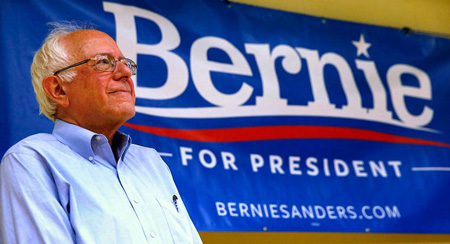
Last night I wrote that Bernie Sanders’ universal health care plan was “pretty good.” Over at Vox, Ezra Klein says it’s vague and unrealistic. Who’s right?

Both of us, I’d say. The Sanders plan is mostly a sketch of how he’d fund universal health care, and at that level I’d say it was pretty good if you evaluate it as a campaign document rather than a Brookings white paper. His numbers mostly added up, and from my point of view, his funding sources were roughly appropriate. Half or more of the funding comes from the middle class, with the rest coming from the rich. I’m OK with that.

But how about the actual mechanics of providing health care? Klein is pretty scathing about Sanders’ promise that his plan will cover everything with no copays or deductibles:

The implication to most people, I think, is that claim denials will be a thing of the past….What makes that so irresponsible is that it stands in flagrant contradiction to the way single-payer plans actually work….The real way single-payer systems save money isn’t through cutting administrative costs. It’s through cutting reimbursements to doctors, hospitals, drug companies, and device companies.

….But to get those savings, the government needs to be willing to say no when doctors, hospitals, drug companies, and device companies refuse to meet their prices, and that means the government needs to be willing to say no to people who want those treatments. If the government can’t do that — if Sanders is going to stick to the spirit of “no more fighting with insurance companies when they fail to pay for charges” — then it won’t be able to control costs.

The issue of how often the government says no leads to all sorts of other key questions — questions Sanders is silent on. For instance, who decides when the government says no? Will there be a cost-effectiveness council, like Britain’s National Institute for Health and Care Excellence? Or will the government basically have to cover every treatment that can be proven beneficial, as is true for Medicare now? What will the appeals process be like?

This might sound technical, but it’s absolutely critical.

Klein is right that the mechanics of the plan are critical, and I probably should have done more than shrug that off as something that we’d get to later. Still, I think his criticism goes way too far. This is a campaign document. It’s obviously aspirational, and asking a presidential candidate to go into deep detail about the drawbacks of his policy is a little much. I can’t recall ever seeing that in my life. In a campaign, you sell the high points and then let critics take their shots.

That’s not to say that Sanders couldn’t have done more than he did. He could have and probably should have. In particular, he should have provided at least an outline of how his plan would work: who it covers, who employs doctors, what drives the cost savings, and so forth.

But my take is that Sanders was trying to accomplish something specific: he wanted to show that universal health care was affordable, and he wanted to stake out a position that Democrats should at least be dedicated to the idea of universal health care. I’d say he accomplished that in credible style. It’s fine to hold Sanders to a high standard, but it’s unfair to hold him to an Olympian standard that no presidential candidate in history has ever met. We health care wonks may be disappointed not to have more to chew on, but that’s life. We’ll get it eventually.


From the desk of Mother Jones CEO, Monika Bauerlein...

Newsrooms can be funded in many ways. One of the most controversial (and volatile) ways is by a for-profit corporation or a billionaire owner. We see it across the headlines on a weekly basis: the claw backs in public media, the gutting of The Washington Post, the bending over backwards to appeal to Trump and his allies.

But not here.

When Mother Jones first started publishing 50 years ago, our founders made a critical decision: to be a reader-supported nonprofit. They knew that no corporate owner would be interested in a muckraking newsroom; they also knew that no muckraking newsroom would be interested in following the agenda of a corporate owner.

And so, we’ve been reader-funded for half a century. We rely on contributions from our readers—readers like you—whether it’s $50, or $15 a month, or whatever fits your budget. People give what they can, and every donation makes a difference for our newsroom, which has grown tremendously—in size and reach and renown—since its inception in 1976.

You may be wondering: What does it take to publish an investigation? And what does my donation actually fund? The answers are one and the same: It takes people, resources, and time. And that’s what your donation funds directly.

Every donation Mother Jones receives from readers fortifies our newsroom, whether we’re covering underreported scandals out of Washington, DC, or the most important news of the day. And right now, each donation will be doubled because of our $50,000 match. So when you make a donation—$5, $50, any amount—it’ll go twice as far.

Your support keeps us going. If you’re able, donate today.

Thanks for reading.

—Monika

From the desk of Mother Jones CEO, Monika Bauerlein...

Newsrooms can be funded in many ways. One of the most controversial (and volatile) ways is by a for-profit corporation or a billionaire owner. We see it across the headlines on a weekly basis: the claw backs in public media, the gutting of The Washington Post, the bending over backwards to appeal to Trump and his allies.

But not here.

When Mother Jones first started publishing 50 years ago, our founders made a critical decision: to be a reader-supported nonprofit. They knew that no corporate owner would be interested in a muckraking newsroom; they also knew that no muckraking newsroom would be interested in following the agenda of a corporate owner.

And so, we’ve been reader-funded for half a century. We rely on contributions from our readers—readers like you—whether it’s $50, or $15 a month, or whatever fits your budget. People give what they can, and every donation makes a difference for our newsroom, which has grown tremendously—in size and reach and renown—since its inception in 1976.

You may be wondering: What does it take to publish an investigation? And what does my donation actually fund? The answers are one and the same: It takes people, resources, and time. And that’s what your donation funds directly.

Every donation Mother Jones receives from readers fortifies our newsroom, whether we’re covering underreported scandals out of Washington, DC, or the most important news of the day. And right now, each donation will be doubled because of our $50,000 match. So when you make a donation—$5, $50, any amount—it’ll go twice as far.

Your support keeps us going. If you’re able, donate today.

Thanks for reading.

—Monika

We Recommend

Latest

Sign up for our free newsletter

Subscribe to the Mother Jones Daily to have our top stories delivered directly to your inbox.

Get our award-winning magazine

Save big on a full year of investigations, ideas, and insights.

Subscribe

INDEPENDENT. BECAUSE OF YOU.

Mother Jones has no billionaires calling the shots—just readers like you making fearless reporting possible

Donate