
• Supreme Court Conservatives Hate Obamacare But Have No Idea How It Actually Works


    In the Hobby Lobby case a couple of years ago, the Supreme Court ruled that Obamacare could not force all employer health insurance plans to cover contraception. This went too far, Samuel Alito wrote. The government might have an interest in providing women with contraceptives, but any requirement it imposes on employers with religious objections must be the least restrictive possible. For example: “HHS has already established an accommodation for nonprofit organizations with religious objections. Under that accommodation, the organization can self-certify that it opposes providing coverage for particular contraceptive services.”

    That sounds great! All we have to do is put in place the HHS accommodation and we’re all set. Organizations can certify that they oppose paying for contraception and their health care provider will then split apart contraceptive coverage from the overall insurance plan and set up separate payments.

    At least, this sounded great at first. But three days after seemingly endorsing this solution, the court issued another ruling saying that the HHS accommodation might not be adequate after all. Technically, you see, the Hobby Lobby opinion merely said that HHS had created an accommodation, not that the court majority necessarily approved of it. And now they weren’t sure they did. It had all just been a trick.

    So today the court heard arguments in yet another case involving religious objections to providing contraceptive coverage. Following up on the court’s U-turn, the Little Sisters of the Poor are arguing that they object to even registering an objection. After all, that would set in motion a process that would eventually end with employees gaining access to contraceptives, which would make the nuns nominally complicit in something they consider wrong. It’s all Thomist enough to make your teeth ache.

    But here we are. The question is, just how much of a burden can the government place on religious objectors? And how much burden can they place on women who want contraception? Those might be thorny issues at the best of times, but they become even thornier when the conservative men on the court apparently have no idea how either contraception or insurance coverage actually work. Tierney Sneed reports:

    “What type a burden does that impose? Is it because these exchanges are so unworkable, even with the help of a navigator, that a woman who wants to get free contraceptive coverage simply has to sign up for that on one of the exchanges?” Justice Samuel Alito asked, snarkily, about the Obamacare health insurance exchanges used by those without employer-based health care plans.

    [Solicitor General Donald Verrilli] pointed out that those sort of contraceptive-only policies don’t even exist on the exchanges….“She’d have to go out and buy the separate plan, find a doctor who is willing to take the separate plan,” Verrilli said.

    ….“If it’s so easy to provide, if it’s so free, why can’t they just get it through another plan?” [Anthony] Kennedy asked Verrilli later on in the arguments. Chief Justice John Roberts jumped in: “So it comes down to a question of who has to do the paperwork? If it’s the employee that has to do it, that’s no good. If it’s the religious organization that has to do it, that’s okay?” he said.

    As Roberts continued to insist that women could simply get contraceptive coverage on the exchanges, the liberal justices finally had enough with the idea. “They’re not on the exchanges,” Justice Sonia Sotomayor interjected. “That’s a falsehood. The exchanges require full-service health insurance policies with minimum coverages that are set forth that are very comprehensive. We’re creating a new program.”

    This is really beyond comprehension. These justices have already heard two major cases on Obamacare, and they’ve presumably read the briefs for this one. But they still seem unable to grasp the concept that you can’t just go out to the exchange and buy a “contraceptive policy.” Nor do they seem to care that even if you could, it would mean not being able to get contraceptives from your regular doctor, which for some women would cause real problems with continuity of care.

    Nobody expects judges to be subject matter experts on every case that comes before them. But this is kindergarten-level stuff. How can they possibly pretend to produce a reasoned opinion if they literally have no idea how health insurance under Obamacare works in the first place?
  • Task Force: Most of the Blame for the Flint Water Crisis Belongs to the State and City, Not the EPA


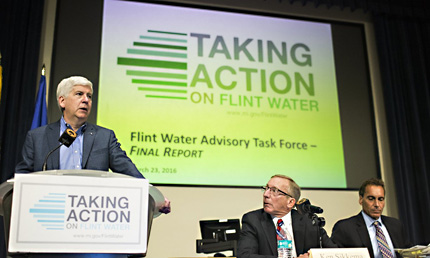
    A task force appointed by Michigan Governor Rick Snyder has issued its final report on the Flint water crisis. Here’s the executive summary:
    The Flint water crisis is a story of government failure, intransigence, unpreparedness, delay, inaction, and environmental injustice. The Michigan Department of Environmental Quality (MDEQ) failed in its fundamental responsibility to effectively enforce drinking water regulations. The Michigan Department of Health and Human Services (MDHHS) failed to adequately and promptly act to protect public health. Both agencies, but principally the MDEQ, stubbornly worked to discredit and dismiss others’ attempts to bring the issues of unsafe water, lead contamination, and increased cases of Legionellosis (Legionnaires’ disease) to light. With the City of Flint under emergency management, the Flint Water Department rushed unprepared into full-time operation of the Flint Water Treatment Plant, drawing water from a highly corrosive source without the use of corrosion control.

    Though MDEQ was delegated primacy (authority to enforce federal law), the United States Environmental Protection Agency (EPA) delayed enforcement of the Safe Drinking Water Act (SDWA) and Lead and Copper Rule (LCR), thereby prolonging the calamity. Neither the Governor nor the Governor’s office took steps to reverse poor decisions by MDEQ and state-appointed  emergency managers until October 2015, in spite of mounting problems and suggestions to do so by senior staff members in the Governor’s office, in part because of continued reassurances from MDEQ that the water was safe. The significant consequences of these failures for Flint will be long-lasting. They have deeply affected Flint’s public health, its economic future, and residents’ trust in government.

    The Flint water crisis occurred when state-appointed emergency managers replaced local representative decision-making in Flint, removing the checks and balances and public accountability that come with public decision-making. Emergency managers made key decisions that contributed to the crisis, from the use of the Flint River to delays in reconnecting to DWSD once water quality problems were encountered. Given the  demographics of Flint, the implications for environmental injustice cannot be ignored or dismissed.

    The report contains 36 findings, three of which relate to the EPA:

    • EPA failed to properly exercise its authority prior to January 2016. EPA’s conduct casts doubt on its willingness to aggressively pursue enforcement (in the absence of widespread public outrage). EPA could have exercised its powers under Section 1414 and Section 1431 of the SDWA or under the LCR, 40 CFR 141.82(i).
    • EPA was hesitant and slow to insist on proper corrosion control measures in Flint. MDEQ misinformation notwithstanding, EPA’s deference to MDEQ, the state primacy agency, delayed appropriate intervention and remedial measures.
    • EPA tolerated MDEQ’s intransigence and issued, on November 3, 2015, a clarification memo on the LCR when no such clarification was needed.

    Based on what I’ve read, this strikes me as fair. The vast bulk of the report’s findings relate to failures of the state and local agencies that had primary responsibility for Flint’s water, but the EPA probably deserves 5-10 percent of the blame. As the report suggests, they showed too much deference to MDEQ and tolerated its “intransigence” more than they had to.

    For the most part, I think EPA chief Gina McCarthy was right when she said that EPA’s actions were constrained by law—laws explicitly written by Congress to devolve most enforcement power to the states. At the same time, I think we all know that rules can be bent when the need is urgent enough, and that should have been the case here. Bottom line: EPA shares some of the blame for the water crisis in Flint, but the vast majority of the blame belongs to the state of Michigan and the city of Flint.

  • Donald Trump’s Greatest Hits With the Washington Post Editorial Board

    I’ve had Donald Trump’s interview with the Washington Post editorial board open in a browser tab for several days now, and I suppose I should either close it or do something with it. The key takeaway from this exercise in freestyle presidential rapping is just how incoherent Trump was. “It literally makes Sarah Palin seem like an intellectual,” a friend remarked. But that’s hard to capture unless you bite the bullet and read the whole thing. Instead, here are a few greatest hits. And now the tab gets closed. Enjoy.

    On how he would have negotiated with the Iranians:

    We should have had our prisoners before the negotiations started. We should have doubled up the sanctions. We should have gone in and said, “release our prisoners,” they would have said “no,” and we would have said, “double up the sanctions,” and within a short period of time we would have had our prisoners back.

    On whether there are racial disparities in law enforcement:

    I’ve read where there are and I’ve read where there aren’t. I mean, I’ve read both. And, you know, I have no opinion on that.

    On racial disparities in incarceration:

    That would concern me, Ruth. It would concern me.

    On how he’d address racial problems:

    There’s a racial division that’s incredible actually in the country…And you know there’s a lack of spirit. I actually think I’d be a great cheerleader—beyond other things, the other things that I’d do—I actually think I’d be a great cheerleader for the country.

    On South Korea not paying its fair share of defense costs:

    You know, South Korea is very rich. Great industrial country. And yet we’re not reimbursed fairly for what we do. We’re constantly, you know, sending our ships, sending our planes, doing our war games, doing other. We’re reimbursed a fraction of what this is all costing.

    I think this is on public record, it’s basically 50 percent of the non-personnel cost is paid by South Korea and Japan.

    50 percent?

    Yeah.

    Why isn’t it 100 percent?

    On what he means when he says the Ricketts family in Chicago had “better watch out”:

    Well, it means that I’ll start spending on them. I’ll start taking ads telling them all what a rotten job they’re doing with the Chicago Cubs. I mean, they are spending on me. I mean, so am I allowed to say that? I’ll start doing ads about their baseball team. That it’s not properly run or that they haven’t done a good job in the brokerage business lately.

    On his hands:

    This was Rubio that said, “He has small hands and you know what that means.” Okay? So, he started it…I had 50 people…Is that a correct statement? I mean people were writing, “How are Mr. Trump’s hands?” My hands are fine. You know, my hands are normal. Slightly large, actually. In fact, I buy a slightly smaller than large glove, okay? No, but I did this because everybody was saying to me, “Oh, your hands are very nice. They are normal.” So Rubio, in a debate, said, because he had nothing else to say…now I was hitting him pretty hard. He wanted to do his Don Rickles stuff and it didn’t work out. Obviously, it didn’t work too well. But one of the things he said was, “He has small hands and therefore, you know what that means, he has small something else.” You can look it up. I didn’t say it.

    …I don’t want people to go around thinking that I have a problem. I’m telling you, Ruth, I had so many people. I would say 25, 30 people would tell me…every time I’d shake people’s hand, “Oh, you have nice hands.” Why shouldn’t I?…I even held up my hands, and said, “Look, take a look at that hand.”…And by saying that, I solved the problem. Nobody questions. Everyone held my hand. I said look. Take a look at that hand.

    On using nukes against ISIS:

    I don’t want to start the process of nuclear. Remember the one thing that everybody has said, I’m a counterpuncher. Rubio hit me. Bush hit me…

    This is about ISIS. You would not use a tactical nuclear weapon against ISIS?

    I’ll tell you one thing, this is a very good-looking group of people here. Could I just go around so I know who the hell I’m talking to?

    On intelligence, winning, and the war in Iraq:

    Right now, look, you know, I went to a great school, I was a good student and all. I am an intelligent person. My uncle, I would say my uncle was one of the brilliant people. He was at MIT for 35 years. As a great scientist and engineer, actually more than anything else. Dr. John Trump, a great guy.

    I’m an intelligent person. I understand what is going on. Right now, I had 17 people who started out. They are almost all gone. If I were going to do that in a different fashion I think I probably wouldn’t be sitting here. You would be interviewing somebody else. But it is hard to act presidential when you are being…I mean, actually I think it is presidential because it is winning. And winning is a pretty good thing for this country because we don’t win any more. And I say it all the time. We do not win any more. This country doesn’t win. We don’t win with trade. We don’t win with…We can’t even beat ISIS.

    And by the way, just to answer the rest of that question, I would knock the hell out of ISIS in some form. I would rather not do it with our troops, you understand that. Very important. Because I think saying that is very important because I was against the war in Iraq, although they found a clip talking to Howard Stern, I said, “Well…” It was very unenthusiastic. Before they want in, I was totally against the war. I was against it for years. I actually had a delegation sent from the White House to talk to me because I guess I get a disproportionate amount of publicity. I was just against the war. I thought it would destabilize the Middle East, and it did. But we have to knock out ISIS. We are living like in medieval times. Who ever heard of the heads chopped off?

  • Was the Great Ad Blocker Freakout of 2015 Justified?


    Six months ago, after years of power surfers happily using ad blockers with no real problems, Apple decided to ruin things for everyone by supporting ad blocking in its products. Since everything Apple does is, by definition, the most pivotal event ever in the tech world—if you happen to work in the online journalism biz, anyway—this caused instant panic in the online journalism biz. Suddenly you could hardly click your mouse without running into a site nagging you about your ad blocker, or even flatly refusing to allow you in unless you turned the blocker off.

    It’s time to take stock. Was this panic justified? The use of ad-blocking apps has certainly grown over the past few years, but has it specifically skyrocketed since Apple’s announcement? I’m unable to find any reliable data on this score, and my gut tells me that the panic over this was probably unjustified, as panic usually is.

    Needless to say, though, my gut is not infallible. I’d prefer actual evidence. With the benefit of several months for tempers to calm, I think it’s time for someone to examine this and tell us what’s really happened. Who out there has the data to do this?

  • Paul Ryan Says He Regrets Calling the Poor “Takers.” That Isn’t Enough.


    Here is Speaker Paul Ryan today in an address to a group of House interns:

    Instead of playing to your anxieties, we can appeal to your aspirations…We don’t resort to scaring you, we dare to inspire you…We question each other’s ideas—vigorously—but we don’t question each other’s motives…People with different ideas are not traitors. They are not our enemies. They are our neighbors, our coworkers, our fellow citizens.
    …I’m certainly not going to stand here and tell you I have always met this standard. There was a time when I would talk about a difference between “makers” and “takers” in our country, referring to people who accepted government benefits. But as I spent more time listening, and really learning the root causes of poverty, I realized I was wrong…So I stopped thinking about it that way—and talking about it that way.

    The obvious pushback is that while Ryan may have stopped talking about “makers and takers,” his policies are exactly the same as they’ve always been. After all that time spent listening, he changed his rhetoric but apparently none of his substantive views.

    Which is true enough. If all Ryan is doing is telling a bunch of interns that they can get more done if they watch their language and hide their true intentions, then there’s nothing much to applaud here. At the same time, it’s still good to say this stuff out loud, regardless of how sincere it is. Not many people do anymore. Now, how about doing it again in front of a more important audience and with a few explicit references to Donald Trump thrown in?

  • Republican Frontrunners All Favor Treating Muslims Like Drug Gangs


    Ted Cruz took a lot of flak yesterday for his proposal to “patrol and secure” Muslim neighborhoods, so he decided to explain it further last night:

    “It is standard law enforcement — it is good law enforcement to focus on where threats are emanating from, and anywhere where there is a locus of radicalization, where there is an expanding presence of radical Islamic terrorism,” Cruz told reporters on Tuesday evening in Manhattan. “We need law enforcement resources directed there, national security resources directed there.”

    ….Ibrahim Hooper, spokesman for the Council on American-Islamic Relations (CAIR), compared Cruz’s proposition to “the dark days of the 1930s” in Europe and “the interment of Japanese-Americans” in the 1940s, calling it “a very frightening image.”

    Cruz repudiated the comparison at the press conference, saying: “I understand that there are those who seek political advantage and try to raise a scary specter.” He instead compared it to ridding neighborhoods of gang activity and law enforcement’s efforts “to take them off the street.”

    And what did Donald Trump think of all this? He supports Cruz’s plan “100 percent.” Naturally.

  • GOP Primary Contest Continues to Resemble Third-Grade Playground


    Liz Mair was anti-Trump before being anti-Trump was cool. After being let go from the Scott Walker campaign last March, she spent months during the summer and fall trying to get conservatives to take the threat of Trump seriously. In December she started up a super PAC dedicated to defeating him. But Mair also has a sense of humor—something that’s gotten her in trouble before. Her super PAC was called Make America Awesome.

    Anyway, Mair decided to run a Facebook ad in Utah that featured Trump’s wife, Melania, from a nude photoshoot she did many years ago.


    Naturally Trump shot back:

    And then Cruz returned fire:

    Ladies and gentlemen, this is your Republican presidential primary. Slut shaming, schoolyard threats, and puerile taunts all carried out in full public view on Twitter. Are you feeling sorry for the demise of the smoke-filled room yet?


  • Why Don’t Millennials Vote?


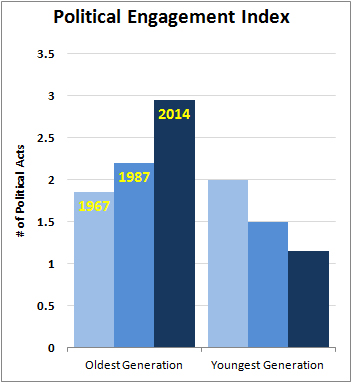
    Let’s scold the millennials today, shall we? Russell Dalton put together some data on political engagement among various age groups over the past few decades, and sure enough, he concludes that young ‘uns just aren’t as engaged as they used to be. Conversely, old folks are much more engaged.

    Millennials in 2016 are significantly less likely to vote or try to influence others vote than were the ’80s generation in the 1987 survey, or the first wave of postwar baby boomers in 1967. But millennials display about the same level of political interest as the youngest generation did in 1987….At the same time, a widening age gap in participation occurs at both ends of the life cycle….Older Americans in the two later surveys are significantly more active than seniors were in 1967.
    The chart on the right shows this pretty dramatically. In 1967 there was very little difference between the youngest and oldest voters. By 1987 a gap had opened up, and by 2014 that gap had become a chasm. Millennials are still interested in politics, and they still work with others on political issues. They just don’t vote. Dalton tries to put the rosiest possible spin on this:

    The widening participation gap between the less involved youth and the very involved elders in 2014 might not mean that millennials — or “kids these days” — don’t care. Rather, it could be that the long slope of differences by life stage is getting steeper, with less involvement in youth and more involvement in later life. And even this widening participation gap is largely based on millennials reluctance to vote, while remaining engaged in other ways.

    ….Lower youth turnout is not a sign of a broad malaise. Millennials are about as interested in politics as youth in prior generations, and about as politically active outside elections….If we look at the full range of political activity, millennials are good democratic citizens — at least as much as their elders were in their youth.

    I dunno. I think Dalton protests too much. The political engagement gap is genuinely huge, regardless of whether millennials say they’re interested in politics. And no argle bargle about the “long slope of difference by life stage” explains this. Voting isn’t all that big a chore, and if millennials don’t do it, it means either that their political engagement really is low or that they simply don’t believe that voting makes any difference. But which is it?

  • There’s Still Slack in the Labor Market—But Not a Lot


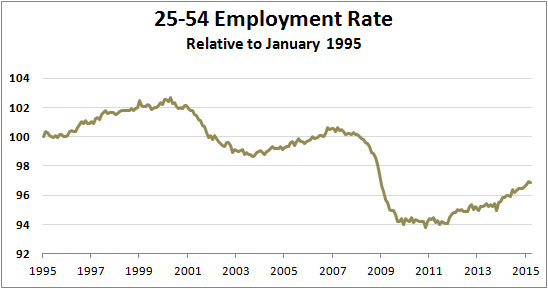
    Brad DeLong looks at a chart showing the employment rate of prime-age workers (ages 25-54) compared to January 2000 and says:

    Without nominal wage growth of 4%/year or significantly rising inflation, no way I am going to believe that the U.S. economy is in any sense at “full employment” with an essentially zero output gap right now.

    It’s not that I disagree, but I think that choosing January 2000 stacks the deck. That’s the absolute peak of the dotcom boom, and there’s no reason to think we’re going to replicate that anytime soon. A better comparison would be the mid-90s, when the economy was strong and growing but not at the peak of a bubble. Here’s what that looks like:

    We’re still not at full employment. But we’re getting there: the unemployment rate is low; the expanded unemployment rate is getting close to low; and wages are increasing a bit. Additional inflationary pressure would be yet another sign of a tight labor market, but we haven’t seen that yet.

    We still have work to do to get to full employment—and it’s possible we’ll never get back to 1990s levels. That depends a lot on precisely who’s dropped out of the workforce and why. But we’re getting close.

  • Ted Cruz Calls For Massive Police Presence in Muslim Neighborhoods


    One of the odd Republican obsessions of the moment is their outrage over liberal refusal to “call radical Islam by its name.” In the wake of today’s Brussels bombing, Ted Cruz naturally says this kind of namby-pamby political correctness is at an end. But that’s not all:

    We need to immediately halt the flow of refugees from countries with a significant al Qaida or ISIS presence. We need to empower law enforcement to patrol and secure Muslim neighborhoods before they become radicalized. We need to secure the southern border to prevent terrorist infiltration.

    “Patrol and secure.” That has an ominous sound to it, especially the “secure” part. Apparently Cruz is trying to out-Trump Trump before Trump even has a chance to say something stupid. This is some campaign these guys are running.

