• Why Did NY Rep. Chris Collins Endorse Donald Trump?


    Do you remember Carl Paladino? Sure you do. He’s the wealthy developer and racist jackass who somehow managed to win the Republican nomination for New York governor in 2010 and proceeded to run a campaign drenched in almost fetid ugliness. He hasn’t changed much in the intervening years and he is—unsurprisingly—supporting Donald Trump for president. A few days ago he sent a message to his email list:

    We haven’t heard from you following my last memo. The press said I was trying to bully you; obviously that is a misnomer. After all, you are the duly elected representative of your constituents and you know what is best for them. Don’t you?

    ….This is our last request that you join Trump for President and try to preserve what’s left of your pathetic careers in government. Whatever you do, staying neutral is not an option. Pick a horse in the race and you may salvage some of your constituents’ respect for you. Not choosing paints you as a coward. The bus is leaving the station very soon. Get on, or you’ll be left behind.

    Charming, no? But typically Paladino. And he promised more to come: “This is the beginning,” he had said of an earlier email blast. It’s going to get worse for those that continue to hold out. I’m being nice. I’ll up the ante a little bit more in the next one I send….People like to read what their representatives are doing.”

    Anyway, a couple of weeks before this email went out, Rep. Chris Collins had announced his endorsement of Trump. That was unexpected, since Collins is a moderate guy who had previously endorsed Jeb Bush. Had Paladino threatened to run a challenger against him in the primary, as he’s done with other Republicans he dislikes? The Huffington Post’s Matt Fuller makes the case:

    In an interview with The Huffington Post this week, Collins denied he was “pressured” into supporting Trump, saying he endorsed the GOP front-runner without speaking to Paladino about it.

    But pressed on whether the two had discussed an endorsement, he backtracked:

    “Uh, so — I mean, Carl and I know each other,” Collins said.

    Yeah, they know each other. Collins is the biggest recipient of Paladino campaign donations in all of western New York. He certainly knows how generous Paladino can be if he likes you, and how merciless he can be if he doesn’t.
  • Moving Kids Out of Bad Neighborhoods Is a Big Deal


    Justin Wolfers points us today to a paper by Eric Chyn, one of his PhD students, that investigates the benefits to children of moving away from bad neighborhoods. In order to avoid contaminating effects, Chyn followed children whose families had been forced out of public housing projects when the buildings they lived in were demolished. Then he compared them to families who stayed put.

    This is a genuinely random selection since some families were forced to move, and others weren’t, based solely on whether their building happened to be scheduled for demolition. Chyn found a substantial effect: when they grew up, children who moved were 9 percent more likely to be employed and had average annual earnings 16 percent higher than children who stayed.

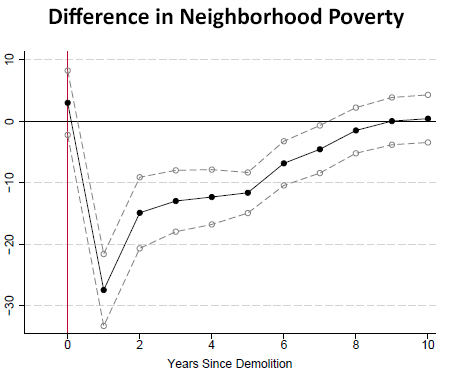
    But there are a couple of interesting charts in his paper that bear further study. The first one shows the level of neighborhood poverty for movers compared to stayers:

    Immediately after moving, families end up in neighborhoods with considerably less poverty than the housing projects they came from. But within five years the effect is nearly gone, and after eight years it’s completely gone. In one sense, this is bad news: it means that even families that move to better neighborhoods eventually just drift back into high-poverty areas. But in another sense it’s good news: the effect on kids is substantial even though they typically spend only about five years in a better neighborhood.

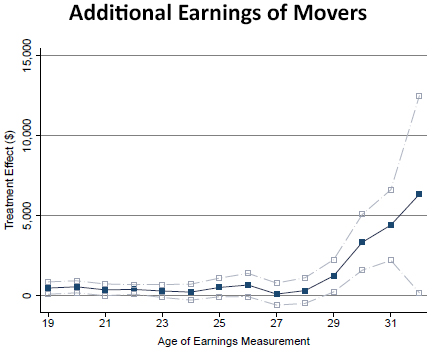
    Next up is a chart that shows the adult earnings of children who moved out of bad neighborhoods:

    The odd thing here is that there’s essentially zero effect up through age 28. Then there’s a sudden uptick, and by age 32 the movers are earning upwards of $5,000 more than stayers. But why? A higher starting point, or a steady increase, would be understandable. But why a sudden and dramatic change right at age 28? If this is really true, and not just an artifact of sample size or study design, it deserves further study.

  • ISIS Appears to Be Close to Collapse


    Liz Sly of the Washington Post has an unusually optimistic report about the fight against ISIS today. She reports that both Palmyra and a string of villages in northern Iraq are being overrun by US-backed forces:

    These are just two of the many fronts in both countries where the militants are being squeezed, stretched and pushed back….Front-line commanders no longer speak of a scarily formidable foe but of Islamic State defenses that crumble within days and fighters who flee at the first sign they are under attack.
    ….Most of the advances [] are being made by the assortment of loosely allied forces, backed to varying degrees by the United States, that are ranged along the vast perimeter of the Islamic State’s territories. They include the Kurdish People’s Protection Units, or YPG, in northeastern Syria; the Kurdish peshmerga in northern Iraq; the Iraqi army, which has revived considerably since its disastrous collapse in 2014; and Shiite militias in Iraq, which are not directly aligned with the United States but are fighting on the same side.

    The U.S. military estimated earlier this year that the Islamic State had lost 40 percent of the territory it controlled at its peak in 2014, a figure that excludes the most recent advances.

    ….In eastern Syria, the seizure late last month of the town of Shadadi by the Kurdish YPG — aided by U.S. Special Forces — was accompanied by the capture of nearly 1,000 square miles of territory….The operation was planned to take place over weeks. Instead, the town fell within days, said a senior U.S. administration official, who spoke on the condition of anonymity to talk candidly.

    “Shadadi was going to be a major six-week operation,” he said. “The ISIS guys had dug trenches and everything. Instead, they completely collapsed. They’re collapsing town by town.”

    This could just be happy talk, of course. It wouldn’t be the first time. Or maybe ISIS is regrouping for an epic last stand. But if this reporting is true, it represents a self-sustaining dynamic: rumors of ISIS collapse inspire Iraqi forces to fight harder, which in turn contributes to ISIS collapse. At this point, Sly reports, the issues in the way of further progress are as much diplomatic as military: “We could probably liberate Mosul tomorrow, but we would have a real mess on our hands if we did,” says Michael Knights of the Washington Institute for Near East Policy.

    I wonder what Republicans will do if ISIS is truly on the run by the time campaign season starts in the fall? Whine that they could have done it even faster? Complain that we didn’t steal all the oil while we were at it? They’re barely going to know what to do with themselves if the weak-kneed appeaser Barack Obama first kills bin Laden and then takes out ISIS.

  • The GOP Plan to Wreck Government Is Doing Great, Thanks Very Much


    Good news! If you call the IRS, they’ll probably answer this year. The bad news is that this is purely temporary:

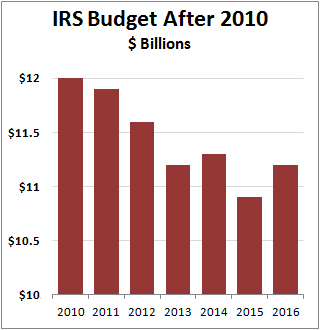
    The reduced wait times during tax-filing season, which ends April 18, were possible because of a cash infusion from Congress, but they only temporarily obscure continued problems at the U.S. tax agency. Audits are down. Identity theft is persistent. Tax lawyers gripe about the lack of published rules….“I can certainly understand the displeasure that Congress has,” said Fred Goldberg, who ran the IRS under President George H.W. Bush. “You can shoot at the IRS, but the issue is collateral damage, and the collateral damage on taxpayers is huge.”

    ….The IRS is trying to crack down on tax fraud, but with fewer workers. The agency had 17,208 employees doing tax enforcement in 2015, down 24% from 2010….In fiscal 2017, the IRS wants $12.3 billion to get back above the 2010 peak funding level. Congressional Republicans have already declared that a non-starter, which means reduced audits and longer wait times will continue.

    Republicans would like to do away with the IRS. That’s what they keep saying, anyway. They want all your taxes on a postcard, or a 3-page tax code, or an abolition of income taxes entirely.

    Failing that, their goal is twofold: First, starve the agency of funding so that it operates poorly and the public gets pissed off at it. Second, starve the agency of funding so that it can’t do as many audits of rich people. In real terms, the IRS budget is down 14 percent since 2010, despite a notable lack of either (a) fewer people paying taxes or (b) fewer rich people trying to cheat on their taxes.

    But this all works out well anyway. The bigger picture looks like this:

    1. Reduce IRS budget.
    2. IRS service tanks.
    3. Hold outraged congressional hearing about lousy IRS service.
    4. Public convinced that IRS bureaucracy is bloated and inefficient.
    5. Reduce IRS budget to cheers of public.
    6. Rinse, repeat.

    This works for lots of other agencies too. Basically, you do everything you can to gum things up, then use this as evidence that government is incompetent. But it works especially well for agencies like the IRS, which no one likes in the first place. The fact that it helps out corporations and rich people is just a nice cherry on top.

  • Hansel and Gretel Finally Get the Stopping Power They’ve Always Deserved


    It appears that Hansel and Gretel have been updated for the 21st century:

    “Let’s go a little deeper into the forest,” Hansel said….Before long, they heard a rustling in the leaves, and slowly turned to see a magnificent 10-point buck drinking from a stream. Gretel readied her rifle and fired. Her training had paid off, for she was able to bring the buck down instantly with a single shot. She and Hansel quickly field-dressed the deer and packed up to head back home, hardly believing their luck.
    Wait. Wasn’t there a witch and a boiling pot and a gingerbread cottage? No worries: that stuff is still there.

    ”Help us!” the whisper said, as Hansel and Gretel looked to see who it was. “We’re in the gingerbread cottage.”…“We’re going to get you out of here,” Hansel told the boy….The hinges gave a groan and the sound of the witch’s snoring stopped, the silence filling the room as they looked at each other in panic. Gretel got her rifle ready, but lowered it again when the snoring resumed.

    ….After reuniting the boys with their parents, it was time to take on the witch…and get some hunting done in the meantime. Villagers, prepared with rifles and pistols, headed into the forest, Hansel and Gretel leading the way. When they came upon the witch’s cottage, the sheriff locked her into the cage in which the boys had been locked just the night before, to be taken away so she could never harm another child.

    That’s not much of a witch if all it takes is a few villagers with rifles to take her down. Still, at least everyone else lives happily ever after, thanks to our constitutionally guaranteed right to keep and bear arms.

  • Watching Television Makes You Only Slightly Happier Than Commuting


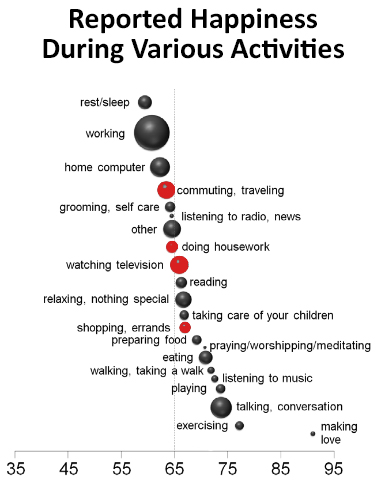
    Over at the Atlantic, Paul Bloom writes that we’re generally less happy when our minds are wandering. He bases this mostly on a bit of research published a few years ago in which people with iPhones were pinged periodically and asked to report their current level of happiness:

    Multilevel regression revealed that people were less happy when their minds were wandering than when they were not, and this was true during all activities….Although negative moods are known to cause mind wandering, time-lag analyses strongly suggested that mind wandering in our sample was generally the cause, and not merely the consequence, of unhappiness….What people were thinking was a better predictor of their happiness than was what they were doing. The nature of people’s activities explained 4.6% of the within-person variance in happiness…but mind wandering explained 10.8% of within-person variance in happiness.

    Interesting! But I was actually a little more taken by the chart showing reported happiness during various kinds of activities. There’s surprisingly little variation between stuff usually considered horrible and stuff usually considered enjoyable. Take a look at the red circles. Commuting produces only slightly less happiness than average. Housework is dead average. Watching television is only slightly better than housework and commuting.

    Among common activities, rest and working are the worst, while playing and talking are the best. Working on a home computer is worse than commuting—which I probably could have guessed. But who knows? Maybe computers have gotten more enjoyable since 2010.

  • Marriage Is Declining Because Men Are Pigs


    Over at the Washington Monthly, Anne Kim muses on the spectacular decline in marriage over the past few decades:

    The seeming decline of marriage includes one major caveat: educated elites. When it comes to marriage, divorce, and single motherhood, the 1950s never ended for college-educated Americans, and for college-educated women in particular….The share of young college-graduate white women who were married in 2010 was a little over 70 percent—almost exactly the same as it was in 1950.

    ….It’s also seemingly only Americans with four-year degrees or better who appear immune to the broader cultural and social forces eroding marriage. In 1950, white women with “some college,” such as an associate’s degree, were actually more likely to be married than their better-educated sisters. Today, it’s the opposite. Though women with a high school diploma or less have seen the sharpest drop in marriage rates, the decline has been almost as severe—and ongoing—for women just one short rung down the education ladder, regardless of race.

    Why has marriage declined in America? Here’s my dorm room bull theory: it’s because men are pigs.

    I know, I know: #NotAllMen blah blah blah. That said, let’s unpack this a bit. Basically, an awful lot of men are—and always have been—volatile and unreliable. They drink, they get abusive, and they do stupid stuff. They’re bad with money, they don’t help with the kids, and they don’t help around the house. They demand subservience. They demand sex. And even on the one dimension they’re supposedly good for—being breadwinners—they frequently tend to screw up and get fired.

    In other words, marriage has been a bad deal for women pretty much forever. But they’ve been forced into it by cultural mores and economic imperatives, and that’s the only reason it’s been nearly universal in the past.

    Nothing has changed much about that. It’s still a bad deal for an awful lot of women, but cultural mores and economic imperatives have changed, and that means more women can afford to do what’s right for themselves and stay unmarried these days.

    But there’s one exception to this: the college educated. Well-educated men are fairly reliable; they have good earning power; they generally aren’t abusive; and they’ve been willing—slowly but steadily—to change their habits and help out with kids and housework. For college-educated women, then, marriage is a relatively good deal. For everyone else, not so much.

    And that’s why marriage is declining among all groups except the college educated. For an awful lot of women, it’s just a lousy deal. They’re tired of putting up with all the crap they get from men, and so they’re opting out. They’ll opt back in when men start to pull their own weight. There’s no telling when that’s going to start happening.

  • Trump Protesters Don’t Have Much Public Support


    A few days ago I suggested that a key question about the protests at Trump rallies was who the public blamed for the violence. Well, Vox conducted a survey recently asking exactly that, and it turns out that Trump is winning that contest too. Overall, respondents thought that protesters were responsible for the violence in Chicago by a margin of 54-28 percent.
    That’s a pretty big margin. The crosstabs show that the biggest differences are by partisan leaning and age: Romney voters and senior citizens overwhelming think the protesters were responsible. Obama voters and the young think protesters weren’t responsible—though not by huge margins. Interestingly, responses were about the same between blue-collar and white-collar workers; between all education and income levels; and between workers and the unemployed. There was no regional variation at all, nor was there any difference between tea partiers and mainstream Republicans.

    Bottom line: Only committed partisans and (barely) young voters are taking the protesters’ side on this. Seems like maybe they need a new strategy..

  • Do We Panic Too Much? (Spoiler: Yes We Do)


    I’m not sure what brought this on—oh, who am I kidding? I know exactly what brought this on. Anyway, I was thinking about recent public panics and started listing a few of them in my mind. This is just off the top of my head:

    • Crack babies
    • Super predators
    • Lehmann/AIG/Countrywide etc.
    • Mad cow
    • Deepwater Horizon
    • Daycare child molesters
    • Ebola
    • ISIS/Syrian refugees

    I’m not saying that none of these were justified. Big oil spills are no joke. Ebola was certainly a big deal in Africa. The financial collapse of 2008 wasn’t mere panic.

    And yet, generally speaking it seems as if public panics are either completely unjustified or else wildly overwrought. Am I missing any recent examples where there was a huge panic and it turned out to be wholly justified? HIV would have been justified in the early 80s, but of course we famously didn’t panic over that—other than to worry about getting AIDS from toilet seats. Help me out here, hive mind.

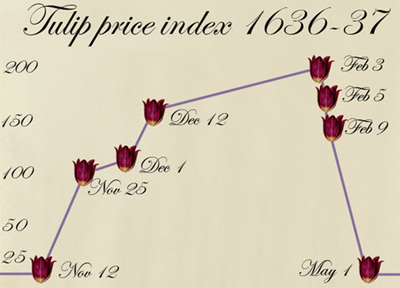
    POSTSCRIPT: I should mention that despite my choice of illustration, I’ve never really blamed anyone for the tulip panic. Personally, I think tulips are worth going crazy over.