• No, America Is Not a Poor Country


    When Donald Trump says America is a loser, apparently he’s dead serious. Judging by some of his answers during his interview with the Washington Post editorial board yesterday, he genuinely thinks we’ve all but slipped into third-world status these days. Here he is on American support for NATO:

    NATO was set up at a different time. NATO was set up when we were a richer country. We’re not a rich country. We’re borrowing, we’re borrowing all of this money.

    On South Korea:

    That’s a wealthy country. They make the ships, they make the televisions, they make the air conditioning. They make tremendous amounts of products….I think that we are not in the position that we used to be. I think we were a very powerful, very wealthy country. And we’re a poor country now. We’re a debtor nation.

    And on Saudi Arabia:

    If you look at Germany, if you look at Saudi Arabia, if you look at Japan, if you look at South Korea — I mean we spend billions of dollars on Saudi Arabia, and they have nothing but money. And I say, why?…We pay billions— hundreds of billions of dollars to supporting other countries that are in theory wealthier than we are….I mean we spend billions of dollars on Saudi Arabia, and they have nothing but money. And I say, why?

    “We’re a poor country now.” I wonder how many people believe that just because Donald Trump keeps saying it? In case anyone cares, the actual truth is in the chart on the right. There’s not a single country in the world bigger than 10 million people that’s as rich as the US.

  • Donald Trump Has No Clue Where Iraq’s Oil Is


    I know this is just spitting into the wind, but you really have to read Donald Trump’s interview with the Washington Post editorial board to believe it. Here’s one little excerpt about Iraq, American troops, and oil:

    DIEHL: And could I ask you about ISIS, speaking of making commitments, because you talked recently about possibly sending 20 or 30,000 troops and—

    TRUMP: No I didn’t, oh no no no, okay, I know what you’re saying….I didn’t say send 20,000. I said, well the generals are saying you’d need because they, what would it take to wipe out ISIS, I said pretty much exactly this, I said the generals, the military is saying you would need 20- to 30,000 troops, but I didn’t say that I would send them.

    DIEHL: If they said that, would you go along with that and send the troops?

    TRUMP: I find it hard to go along with—I mention that as an example because it’s so much….We should have never been in Iraq. It…was one of the worst decisions ever made in the history of our country. We then got out badly, then after we got out, I said, “Keep the oil. If we don’t keep it Iran’s going to get it.” And it turns out Iran and ISIS basically—

    HIATT: How do you keep it without troops, how do you defend the oil?

    TRUMP: You would… You would, well for that— for that, I would circle it. I would defend those areas.

    HIATT: With U.S. troops?

    TRUMP: Yeah, I would defend the areas with the oil.

    Trump seems to be under the impression that Iraq’s oil is in a region about the size of Central Park that he could just surround and protect. The map on the right—which has been printed in magazines and newspapers thousands of times over the past decade—shows where the oil really is: everywhere. Trump would need a Maginot Line about 1,500 miles long to “circle it.”

    But he doesn’t want to send over 20,000 troops. In fact, he suggests that’s obviously preposterous. 20,000 troops!

    I’m no military man, but I’m pretty sure a front 1,500 miles long would require a little more than 20,000 troops. Maybe Trump is planning to build a wall instead.

    BY THE WAY: This isn’t even the best part of the interview. I just chose it sort of at random. You can dive in pretty much anywhere and get stuff just as good. Trump’s extended riff on his hands is a good place to start.

  • Oh Wait—Donald Trump Decides He Has a Foreign Policy Team After All


    After finally telling us that he didn’t need a foreign policy team because he was his own team, Donald Trump made yet another U-turn today and announced his foreign policy team. It’s enough to make you dizzy. I’ll let Robert Costa introduce them:

    Keith Kellogg…executive vice president at CACI International, a Virginia-based intelligence and information technology consulting firm…. Joseph Schmitz…Blackwater Worldwide…. George Papadopoulos… international energy center at the London Center of International Law Practice…. Walid Phares…National Defense University and Daniel Morgan Academy in Washington…. Carter Page…managing partner of Global Energy Capital [and] longtime energy industry executive.

    This is quite a team. Kellogg was COO of the Coalition Provisional Authority in 2003-04 under Paul Bremer, and we all know how that turned out. Schmitz is the son of noted Southern California crackpot John Schmitz—which I suppose I can’t hold against him—and served as inspector general of the Defense Department under George Bush. He resigned in 2005 following charges that he “slowed or blocked investigations of senior Bush administration officials, spent taxpayer money on pet projects and accepted gifts that may have violated ethics guidelines.”

    Papadopoulos is on his second presidential campaign this year, having previously found a home with Ben Carson. Phares is well known to all Fox News viewers for his regular appearances there—and for his background during the 80s as a “high ranking political official in a sectarian religious militia responsible for massacres during Lebanon’s brutal, 15-year civil war.”

    Page I don’t know much about. Apparently he’s the head of an investment fund “focused on energy investments worldwide,” and that’s good enough for Trump.

    So….this is a helluva C-list crew Trump has assembled. A guy who worked for Paul Bremer; the son of John Schmitz; a former Ben Carson advisor; a Fox News talking head; and a Wall Street fund manager.

    As for Trump’s actual foreign policy, apparently it’s the same as always: he’s super militaristic, but he doesn’t want to actually use the American military for much of anything. He’d like other countries to start taking care of Ukraine and NATO and the South China Sea—or, if they insist on America doing it, he’d like them to pay us for it. Apparently Trump’s ambition is to sit at the head of a vast American tribute empire.

  • It’s Old People Who Have More Debt, Not the Young


    Ylan Mui points today to a February note from the New York Fed called “The Graying of American Debt.” Here’s the basic picture:

    The student debt story is about what you’d expect: young consumers have more of it, but their total debt load is lower than it was in 2003 because they have lower mortgage debt. Basically, they’re trading student debt for mortgage debt.

    But older age groups make up for it with higher debt than they had in 2003. This is especially true at age 65, where total debt is up by about a third over the past decade. So what does it all mean?

    The close relationship between credit score and age…reflects an average credit history that is considerably stronger among older borrowers….Further, older borrowers’ income streams are comparatively stable, and they have greater experience with credit. Survey of Consumer Finances data show that net worth levels for households with heads who are age 65 and older in 2013 are quite similar to their 2004-07 levels. This holds despite the evidence, seen in the second chart in this post, that consumers are holding substantially more per capita debt at age 65 and beyond. If history is any guide, then, we expect older borrowers to make more reliable payments. Indeed, our data show no clear trend toward higher delinquency at older ages as average balances at older ages have increased.

    Hence the aging of the American borrower bodes well for the stability of outstanding consumer loans. At the same time, the likely combination of muted credit access and lower demand for credit that we observe among our younger borrowers may well have consequences for growth. The graying of American debt that we observe between 2003 and 2015, then, might be interpreted as a shift toward greater balance sheet stability, and away from credit-fueled consumption growth.

    More stability, less growth. Just what old people want. But is it good for the country?

  • Three Cheers For a Contested Convention


    I guess a contested Republican convention has now made a full circle1 from “Spare me” to “I always said that”:

    In multiple television interviews Sunday, Reince Priebus, chairman of the RNC, raised the prospect of a protracted convention fight with multiple rounds of voting needed to determine the winner. “We’re preparing for that possibility,” Mr. Priebus said on ABC. That marks a shift from earlier this month, when Mr. Priebus told a gathering of conservatives that a contested convention was “highly, highly unlikely.”

    Sounds like fun. Seriously. Just think of all the free publicity this gives the Republican Party.

    1Half circle?

  • How Should We Talk About Flint’s Lead Problem?


    Dana Milbank writes about Friday’s congressional hearing on Flint’s water:

    In a hearing this week about the poisonous water in Flint, Mich., Rep. Earl L. “Buddy” Carter (R-Ga.) tried to blame the lead-tainted water on the Obama administration’s Environmental Protection Agency. EPA Administrator Gina McCarthy explained that, under the law Congress passed, states are in charge of enforcing drinking-water standards.

    “The law?” Carter replied, contemptuously. “The law? I don’t think anybody here cares about the law.”

    It was an awkward and inadvertent moment of truth. Congress has hamstrung the federal government, giving states the authority to enforce drinking-water standards and all but eliminating the EPA’s power tointervene….It’s a vicious cycle: Washington devolves power to the states. When states screw up, conservatives blame the federal government, worsening the public’s already shaky faith.
    ….In Flint’s case, an official appointed by Gov. Rick Snyder (R) decided in 2013 to save money by changing the water supply, with disastrous results. The EPA had no say….[Nonetheless] Republican members of the House Oversight and Government Reform Committee focused their ire on McCarthy.

    “I heard calls for resignation. I think you should be at the top of the list,” said Rep. John L. Mica (R-Fla.)….Rep. Scott DesJarlais (R-Tenn.) said McCarthy should “consider scrapping” other pending regulations because “it’s clear EPA cannot currently handle the issues on its plate.”

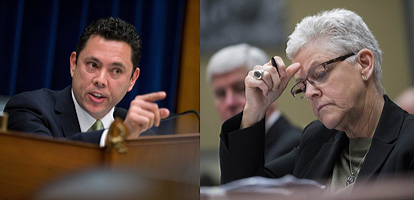
    ….Chaffetz, the chairman, joined this complaint. When McCarthy explained that, under the law, she had to provide elaborate documentation before overriding state officials, Chaffetz was livid. “Why do we even need an EPA? If you can’t do that?” he asked. “If you want to do the courageous thing,” he said, you “should resign.”

    I also wrote about this on Friday, with much the same disgusted tone as Milbank. This prompted an email from a regular reader:

    It has really been disappointing to read your pieces on Flint recently. You are dismissive of not only the lead problem, but also fail to acknowledge there was any other problem. Was Flint worse before? Yes, years ago, but lead is still detrimental to health when using untreated Flint river water. Are there other places worse? Yes, but now you are sounding like Steven Hayward at Power Line in dismissing Flint complaints because there are places worse….Put the statistics in perspective but do not give credence they are unworthy of notice or action.

    I think it’s worth posting my reply, complete and unedited, since I tend to self-censor a bit when I write about this on the blog:

    Here’s the problem: Virtually everyone is in hysteria over this. The only way to push back is to get people’s attention, and that means writing without too much nuance. Under the circumstances, I’ve actually been pretty restrained.

    I’ve repeatedly acknowledged that there were political/bureaucratic problems—though I’m not convinced the EPA had a big role in this. But on a technical basis, although the lead levels in Flint water were higher than they should have been, they were never wildly high even at the height of the crisis. Today, things seem very close to normal.
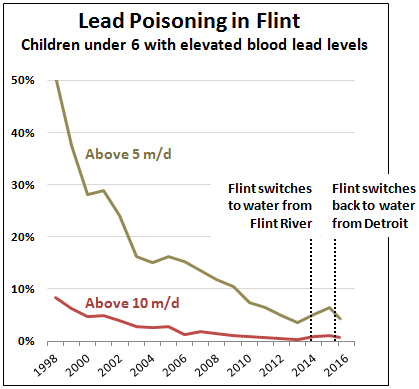
    Why go on about this? Because we’re at a point where the hysteria is doing real damage. Flint residents are still panicked, drinking bottled water and not taking showers. Aside from one or two dozen houses with very high levels, there’s just no reason for this. They can go back to normal lives, but no one will let them. I understand why everyone is responding this way (on both sides), but it’s genuinely damaging.

    One of the reasons I’ve written about this is because I have some cred on lead poisoning. I very clearly take lead seriously. But the truth is that you can go too far. The 5 m/d level is very conservative, and when you get to the point where there’s only 2-3% of kids above it, it just isn’t a huge problem. (It’s still a problem, and we should aim lower, but it’s not a huge problem.)

    My take: anyone who’s serious about lead should be applauding the improvement in Flint (though it’s perfectly fine to skewer the bureaucrats and politicians) and trying to focus the public’s attention on places where lead levels are still damagingly high. Otherwise we’ll spend a billion dollars replacing Flint’s pipes for no reason, clap ourselves on the back for a job well done, and then do nothing more.

    I don’t expect everyone to agree with this. I’m not sure I always agree with it myself. You can make a good case that generating hysteria is really the only way to get people’s attention for a problem as invisible as lead. And there’s no question that lead pipes are part of this problem (for example, here’s a Post story also from Friday about schools with contaminated drinking fountains).

    And yet….the truth is important too. When most families in Flint can go back to leading normal lives, they should be told so. When the bigger problem is contaminated soil and lead paint, people should be told so. When lots of other places have lead levels far higher than Flint all the time, people should be told so. When real progress is possible, people should be told so—and they should be told what real progress means, not fed a bunch of fairy tales.

    I understand that saying this stuff can sound dismissive sometimes. I try my best not to take that tone. But when a bandwagon starts picking up too much speed, sometimes you need to speak up and suggest that it change direction a bit.

  • In Praise of Feline Brains


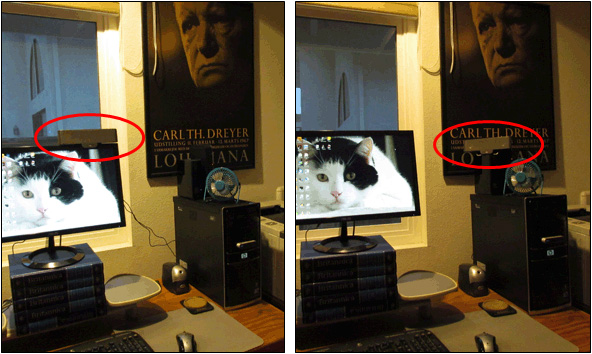
    Every cat owner knows this: whenever something new is brought into the house, your cats have to examine it carefully. Give it a sniff. Jump on top of it. Circle around from all sides. It’s standard feline behavior. But check this out. I’m temporarily using a little clip-on speaker on my PC, and on Friday I got tired of looking at the wires so I moved it a couple of feet and stuck it on top of my external hard drive.

    Thanks to the evil dex, I was sitting downstairs reading at 3 am when Hopper cruised in. She looked around a bit and then made a beeline for the speaker. She jumped up on the desk, got up on her hind legs and gave it a thorough sniffing. She circled around to the side to take another look. Then she went into the kitchen, hopped up on the counter and came up to it from behind to check it out some more. The whole operation took nearly five minutes.

    That’s really pretty impressive. This is a small, gray plastic box. Hopper doesn’t interact with it or sleep on it. It has no odor. It had only been moved two feet. And yet, her mental image of this room was so precise that she immediately noticed the change and spent quite a bit of time checking it out. If cats don’t always seem very bright, maybe it’s just because they’re filling their brains with precision maps of the world.

  • Dean Baker Needs Better Trade Comparisons


    Dean Baker is unimpressed with my argument that US trade deals treat doctors about the same as auto workers because both cars and doctors are required to meet American safety and consumer standards:

    The reason that cars overseas meet American standards is because we negotiated a set of standards for them to meet. In other words, that is what our trade negotiators were doing so that they could place U.S. autoworkers in direct competition with low paid workers in Mexico, China and elsewhere.

    Our trade negotiators could have been negotiating standards for foreign residency programs. (I know Donald Trump says they are stupid, but they can’t possibly be that stupid.) This would mean that other countries could establish residency programs that ensure that doctors in Germany, Canada, and hopefully many other countries were trained to a level where they were as good as U.S. trained doctors. The reason this didn’t happen is because doctors have much more political power than autoworkers.

    Dean is right that foreign doctors face considerable barriers if they want to work in the US. They have to perform their residency in the US, and visa preference is given to doctors willing to practice in “underserved areas”—which tend to be rural and poor. This is especially onerous for experienced doctors who have been practicing for years but aren’t allowed to practice in the US unless they repeat their 3-year residency here.

    That said, about 25 percent of US doctors are educated abroad, and about 15 percent of them are immigrants (the others are US citizens who went to med school overseas, typically in the Caribbean). Take a look at the chart on the right and you’ll see that this is slightly above average for rich countries—largely because other countries have similar requirements. The AMA is indeed well organized and powerful, but somehow foreign doctors manage to come to the US in pretty sizeable numbers anyway.

    Or how about another example? A friend writes to say this: “I work in Silicon Valley. Walk into any software development shop, any data center, any IT support shop, any solutions consultancy and try to find somebody who was born in the US, or even has a US passport. If you’re an American coder, you’re going to have to accept much lower wages than you would have unless you’re a real rock star. That’s because we import ’em by the pallet load.” Coders aren’t as well organized as doctors, but they’re still a lot better paid than blue collar auto workers. And yet an awful lot of foreign-born IT workers manage to make it into the country anyway.

    In fairness, I think the real problem here is just that Dean chose a bad example. When you’re talking about people rather than goods, you’re going to collide with immigration law, and that makes the comparison apples to oranges. Instead let’s compare goods to services. Think about it this way: for decades we’ve been signing trade deals that lower tariffs on various goods, including cars, and this directly impacts blue collar manufacturing workers. But what did we get in return? Certainly not nothing. In part, the answer is that we negotiated access to overseas financial markets, which benefited traders and executives on Wall Street—a group that’s considerably richer than doctors. This was an extended process, and when the final protocols were approved in 1997 the head of the WTO congratulated everyone involved for the “courage and commitment to pursue the policies of liberalization which are essential to economic stability, growth and development.”

    Ahem. That’s not exactly how things worked out. But Wall Street sure got rich in the process!

    There’s nothing much left to do on the financial front, so TPP focuses a lot of attention on IP law. This benefits large, patent-heavy corporations and large content providers like Disney. They probably can’t match Wall Street bankers for sheer riches, but they sure make a lot more money than all those poor doctors.

    So I still think Dean is wrong to single out doctors, but all he’d have to do is switch comparisons to make his point. A lot of this stuff would probably have happened regardless, but US trade policy sure helped it along. Generally speaking, manufacturing workers suffered while the rich donor class benefited. It’s hardly any wonder that unions and blue-collar workers aren’t very thrilled at continuing this process.

  • The Head of Jeb’s Super PAC Is Tired of the Endless Conservative Con


    Mike Murphy is a longtime Jeb Bush friend and loyalist, and he’s also the guy who ran Right to Rise, the Super PAC that blew through $100 million in an epically futile effort to sell Bush to the masses. So it’s understandable that he might be a little bitter about the success of Donald Trump, who almost single-handedly destroyed Bush.

    Keep that in mind when you read Matt Labash’s long debriefing of Murphy as he was cleaning up the last remnants of the Right to Rise offices a month ago. At the same time, Murphy is neither a rookie nor a naif, and that gives him a deep perspective on what’s changed over the years in the conservative movement. He acknowledges that Republican voters have grown angrier over the past decade, but he blames a lot of this on Republicans themselves, aided and abetted by a press that barely understands politics anymore and is eager to jack up its ratings by scaring the hell out of people:

    He says a lot of the anger is springing from people’s fears and hard realities — the middle class not getting a raise in a decade. Generally pessimistic older white voters see the demographic shifts and don’t like it. The media are incessantly “sticking red-hot thermometers in lukewarm water and saying, ‘Wow, that water’s pretty hot!’ “

    ….Still, Murphy adds, the problem with our current antiestablishment climate isn’t that people aren’t correctly identifying problems. It’s that the problem-solvers they’re turning to are bigger snake-oil hustlers than the ones they’re turning away from….Let’s think through Trump, Murphy says. “He doesn’t understand the presidency. You don’t call up the head of Mexico and say, ‘Hey, I’m going to build a fabulous wall with first-class gold toilets and you’re gonna pay for it.’…He has no understanding of presidential powers. He has no understanding of Congress. It’s like putting a chimp in the driver’s seat of a tractor.”

    ….”Then the problem becomes how are we the world’s reserve currency anymore? We get away with a lot of shit because people think we have a stable system….We borrow a lot of f — ing money. Because people think the number one safest instrument in the world is the U.S. Treasury bond. And if we start making reality-show clowns in charge? Run on the American bank. You think the pissed-off steelworker in Akron has trouble now? Wait until we have a financial collapse and they take 25 percent off the dollar. He’ll be serving hot dogs in an American restaurant in China.”

    ….Murphy starts waxing philosophic….Everything is so postmodern and meta that “nothing means anything, because everything is what the scam is….So many simpleton reporters — whose depth of knowledge extends to whatever they read in the Real Clear Politics polls average that morning. Fly-by-night pollsters feeding the media, which is creating news so that they can report on it.

    ….I suggest to Murphy that many of these things he’s decrying have been the tricks of his trade. He’s like a magician denouncing the false-bottomed top hat. “I don’t mind technique,” he says. “I can be shameless. I have a long career at this. But when everything is a short con, then there’s never another short con. Because you need trust, and you’ve destroyed it.“….

    ….The cable-news business establishment who are, whatever they insist, for Trump, since Trump equals ratings….But just as notable, he points out, is the antiestablishment establishment….”Like, Antiestablishment Inc.,” Murphy says. “You can find them at 123 Establishment Lane, Des Moines, Iowa. Often, they’re involved with the postage meter or credit card machine somewhere for small-dollar donations.

    ….Take, for instance, he says, the Tea Party — “a racket, though it’s supposed to be a nonracket,” full of faux four-star generals who say, ” ‘You’ve got to pay me because . . . I represent the Nebraska sub-Army 14 of the Tea Party.’ “…Murphy concedes there are lots of voters who “subscribe to a loose set of principles that D.C.’s broken. They’re tired of the establishment. Tired of people in the racket.” But there’s a racket of people sending them letters asking for money. “The poor old lady sends her $25 to defeat Nancy Pelosi, and $22 of it goes to ‘fundraising costs.’ “

    Rick Perlstein in particular has written a lot about how the modern conservative movement has largely turned into a machine for swindling people—especially the elderly. There’s Glenn Beck pitching gold as a hedge against nonexistent hyperinflation. Fred Thompson hawking reverse mortgages. The acolytes of direct-mail pioneer Richard Viguerie setting up operations that scare the bejeesus out of old people but use most of the money they raise to pay themselves and their consultants. The talk radio hosts who repeatedly insinuate that Hillary Clinton murdered Vince Foster—and then quickly break for a commercial. Mike Huckabee peddling diabetes cures and Ben Carson praising the glories of glyconutrients to their evangelical fans. The endless production of simpleminded right-wing books as a handy income stream, some of them with more than the usual whiff of corruption.

    Even some conservatives have finally started to recognize that the short con—which is elderly enough that it’s become a long con—is hurting the conservative cause. Mike Murphy is apparently one of them, and he considers the rise of Donald Trump little more than just desserts for a party that’s either tolerated or actively encouraged this behavior for decades. In the end, Trump took a look at the conservative movement and decided that they were amateurs. The big con needs more than talk radio or direct mail or scary ads. It needs national TV provided willingly and often—and Trump knew exactly how that game worked. He’s not running his con any differently than conservatives always have. He just knows how to pull it off way better than they do.