• Quote of the Day: The Middle Class Doesn’t Care If We Cut Taxes on the Rich


    From House Speaker Paul Ryan, talking about his view of tax reform:

    I do not like the idea of buying into these distributional tables.

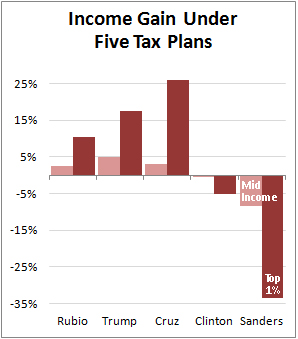
    “These distributional tables” are the ones that show Republican tax plans giving enormous cuts to the wealthy and nothing much at all to the middle class. Ryan calls them ridiculous because once you account for the economic boom of Republican tax cuts for the rich, everyone is going to be rolling in dough. Besides which, Ryan insists, “I think most people don’t think, ‘John’s success comes at my expense.'” Bottom line: distributional tables are for losers. “Bernie Sanders talks about that stuff. That’s not who we are.”

    On a more amusing note, Ryan says he’s not looking at how to fund a border wall. “Remember, we’re not going to pay for that, recall?” So true.

  • Trump Voters Are Not Angry About the Economy. Really.


    I’ve been periodically making the case that Americans aren’t really all that angry about the economy, which naturally implies that the economy isn’t the reason for Donald Trump’s success. This argument has taken several forms. First, in objective terms, the economy is in decent shape. Second, the number of people affected by globalization (lost jobs, reduced wages) isn’t that large in absolute terms. Third, polls indicate that concern about the economy isn’t especially high by historical standards. And fourth, polls also indicate that overall personal financial comfort is fairly strong.

    Over at National Review, Scott Winship makes yet another argument: exit polls don’t suggest that Trump is winning an outsize share of voters who say the economy is their #1 issue:

    Trump performed no better in states where the economy was the biggest issue than in other states….His average margin of victory was 7.8 points in states where the economy ranked second but just 6.9 points in states where the economy was the top issue….Trump also did worse among voters for whom the economy was a top issue than among other voters. He won voters who chose the economy as their top issue in 10 of 15 states, worse than his showing among voters over all, which he carried in 12 of 15.

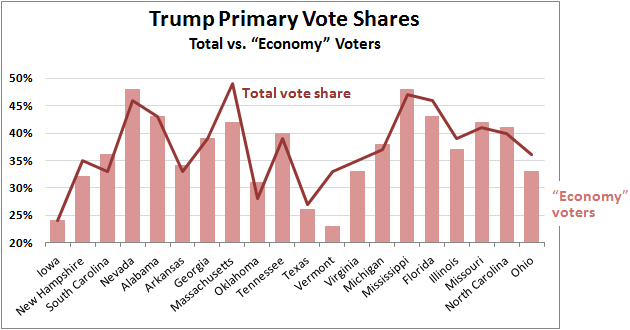
    Interesting! But there’s another way of looking at this: How did Trump do among “economy” voters compared to his overall performance in each state? If economic anxiety is really driving Trump’s ascent, you’d expect these voters to support him in large numbers. Here’s how that turned out:

    Trump actually does slightly worse with voters who are concerned with the economy than he does overall. This is yet more evidence that economic anxiety just isn’t a big factor driving Trump’s success. The bigger factor, by far, is immigration, and Winship argues persuasively that this is not primarily an economic concern. It’s a cultural concern:

    For many, it is about national security, as reflected in the draconian suggestion that Muslims be barred from coming to the United States. For others, immigration is simply about the rule of law….For a non-negligible subset of Trump voters, anti-immigration sentiment is about racism and nativism, plain and simple. Many more are uneasy about rapid cultural change….People value ways of life for understandable reasons; when their permanence is thrown in question, it is reasonable for them to be anxious about change.

    The rest of Winship’s piece is an argument about cultural traditionalists vs. “cultural cosmopolitans,” and your mileage may vary. I don’t really buy it, myself: culture-war issues have been front and center for a long time, and it’s not clear to me that cultural anxieties among conservatives are any more pronounced this year than in the past.

    Generally speaking, I don’t think any of the issues that pundits talk about are any more pronounced this year than in any other. People aren’t more angry, or more bigoted, or more scared than usual. It’s just that we didn’t have a guy like Trump fanning these flames quite so crudely in past elections. This year we do.

  • Obama’s Foreign Policy Explained: “Multilateralism Regulates Hubris”


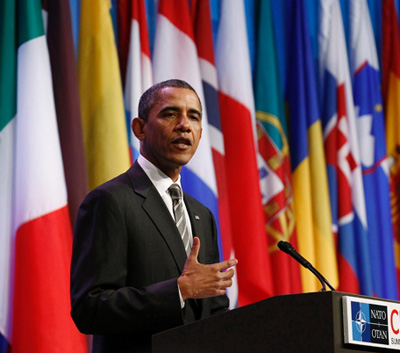
    Here’s one last excerpt from Jeffrey Goldberg’s essay on President Obama’s foreign policy worldview. Today’s subject is free riders:

    If Obama ever questioned whether America really is the world’s one indispensable nation, he no longer does so. But he is the rare president who seems at times to resent indispensability, rather than embrace it. “Free riders aggravate me,” he told me. Recently, Obama warned that Great Britain would no longer be able to claim a “special relationship” with the United States if it did not commit to spending at least 2 percent of its GDP on defense. “You have to pay your fair share,” Obama told David Cameron, who subsequently met the 2 percent threshold.

    Part of his mission as president, Obama explained, is to spur other countries to take action for themselves, rather than wait for the U.S. to lead….“We don’t have to always be the ones who are up front,” he told me. “Sometimes we’re going to get what we want precisely because we are sharing in the agenda.”

    ….The president also seems to believe that sharing leadership with other countries is a way to check America’s more unruly impulses. “One of the reasons I am so focused on taking action multilaterally where our direct interests are not at stake is that multilateralism regulates hubris,” he explained. He consistently invokes what he understands to be America’s past failures overseas as a means of checking American self-righteousness. “We have history,” he said. “We have history in Iran, we have history in Indonesia and Central America. So we have to be mindful of our history when we start talking about intervening, and understand the source of other people’s suspicions.”

    ….Why, given what seems to be the president’s natural reticence toward getting militarily ensnarled where American national security is not directly at stake, did he accept the recommendation of his more activist advisers to intervene [in Libya]?

    “The social order in Libya has broken down,” Obama said, explaining his thinking at the time….“At that point, you’ve got Europe and a number of Gulf countries who despise Qaddafi, or are concerned on a humanitarian basis, who are calling for action. But what has been a habit over the last several decades in these circumstances is people pushing us to act but then showing an unwillingness to put any skin in the game.

    “Free riders?,” I interjected.

    “Free riders,” he said, and continued. “So what I said at that point was, we should act as part of an international coalition. But because this is not at the core of our interests, we need to get a UN mandate; we need Europeans and Gulf countries to be actively involved in the coalition; we will apply the military capabilities that are unique to us, but we expect others to carry their weight.”

    The interesting part of this is not just that I agree with it—though that’s interesting to me!—but the fact that it confirms what both Obama’s admirers and his detractors think of him. Admirers appreciate the fact that he understands America’s limits and is focused on committing American power only when our national interests are powerfully at stake. Detractors will take one look at “Multilateralism regulates hubris” and fall off their chairs. It’s strong evidence that Obama really does believe that America is something of a bull in a china shop and needs to allow itself to be reined in by others.

    “Multilateralism regulates hubris” might be the ultimate Rorschach test of Obama’s foreign policy. Given our recent (and not-so-recent) history, it seems to me like a no-brainer. America really does make better decisions when it listens to its allies. To Obama’s critics, it’s an admission that he really is trying very deliberately to diminish American freedom of action and military superiority. As Marco Rubio kept saying, he knows exactly what he’s doing.

  • Health Update


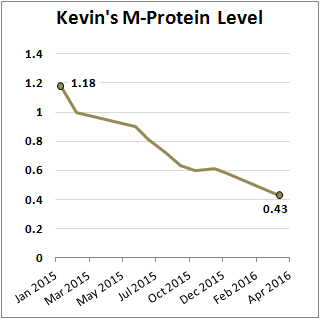
    Not much to report this month. My M-protein level—a proxy for the level of cancerous plasma cells in my bone marrow—is down from 0.48 in February to 0.43 in March. That’s not a big drop, but it’s a drop, and anything moving in the right direction is good news. Apparently the evil dex is reluctantly doing its job.

    FWIW, there are other markers besides M-protein that I haven’t been sharing because they’re all basically OK and haven’t changed much. For example, we routinely measure something call Kappa light chains, and it’s been at a nice low level ever since the first round of chemotherapy. Ditto for my IgG immunoglobulin levels. (There are three types of immunoglobulins corresponding to three different types of multiple myeloma. I have the G version.) This is all good news. If we can just get the basic level of cancerous cells down close to zero, I’ll be in pretty good shape. In fact, it’s even possible that the slow response of the M-protein level is a positive thing, since it would be expected if I have a very slow-moving version of multiple myeloma. That’s just speculation at this point since there’s no way of knowing, but it fits the evidence so far.

  • When Factories Shut Down, Why Don’t Workers Move?


    What’s been the impact of Chinese manufacturing on US employment? A recent paper by David Autor, David Dorn, and Gordon Hanson adds it up like this:

    Had import penetration from China not grown after 1999, there would have been 560 thousand fewer manufacturing jobs lost through the year 2011….Direct plus the indirect input-output measure of exposure increases estimates of trade-induced job losses for 1999 to 2011 to 985 thousand workers in manufacturing, and to 2.0 million workers in the entire economy….Net impact of aggregate demand and reallocation effects imply that import growth from China between 1999 and 2011 led to an employment reduction of 2.4 million workers.

    This amounts to direct effects of about half a million jobs, and total effects of 1 million manufacturing jobs and 2.4 million total jobs since 1999—a little less than 2 percent of all US jobs. This is a substantial number, but keep in mind that it was the result of a truly unprecedented explosion of Chinese activity: their share of global manufacturing activity skyrocketed from 5 percent to 25 percent in only 20 years. In the past half-century, no other change in bilateral trade has been even a fraction as significant.

    The authors suggest that there were two main causes of China’s manufacturing success. The first, of course, is that China had a large pool of low-cost workers. The second was the accession of China to the WTO in 2001, which had forced the Chinese government over the previous decade to enact changes that made their economy considerably more efficient. So “free trade” gets the blame in one sense, but not in the sense of a direct deal between the US and China. Basically, China had to adapt to the modern global trade regime, and this compelled a wide range of economic reforms that were, in the end, good for them.

    But there’s more to the story. The US labor market adjusted poorly to this competitive sea change, primarily for two reasons. The first was our decision to accommodate the Chinese manufacturing boom not with increased exports in other sectors, but with a growing trade deficit. The second was the apparent unwillingness of US workers to move when they lost their jobs:
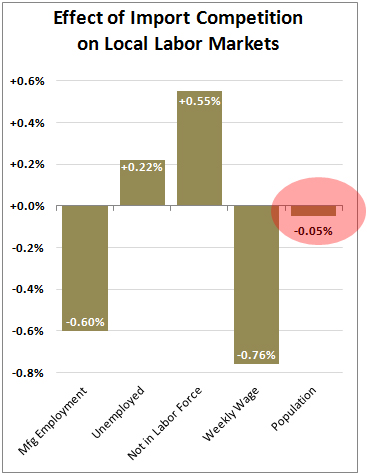
    Contrary to the canonical understanding of U.S. lab or markets as fluid and flexible, trade-induced manufacturing declines in [commuting zones] are not, over the course of a decade, largely offset by sectoral reallocation or labor mobility. Instead, overall CZ employment-to-population rates fall at least one-for-one with the decline in manufacturing employment, and generally by slightly more.

    The chart on the right tells the story. The effects of import competition are frequently local rather than national, and on average produce lower manufacturing employment and lower wages, along with higher unemployment. But out-migration from affected areas is nearly zero. Workers who are affected by an import shock stay where they are instead of moving to greener pastures.

    Why? It’s hard to know how to allocate blame here. On the one hand, you have the big macroeconomic effect of a growing trade deficit, which is outside the control of individual workers. On the other hand, you have an unwillingness to move when the local economy tanks, which is very much within the control of individual workers. Taken together, it’s almost a conspiracy to give up. At a national level, we shrug and simply accept a trade deficit. At an individual level, we shrug and accept that no jobs are available anywhere.

    It’s mostly a moot point now. The huge Chinese growth boom is largely over, and it’s unlikely anything similar is going to come along soon. New trade deals—regardless of whether you like them or hate them—simply don’t have a very big impact on anything. Their effects can be measured in tenths of a percentage point 20 years down the road. Still, it’s hard not to wonder why we collectively decided to do next to nothing to respond to the Chinese boom during the 90s and aughts.

  • Quote of the Day: “You Have to Admit That It Worked”

    Here is Ben Carson defending his endorsement of Donald Trump:

    Q: If someone like Mr. Trump can call you, an acclaimed and noted neurosurgeon, as someone who lacks intellect or is a child molester, doesn’t that alarm you as to how he can portray other people in this country as well, and use the same rhetoric?

    A: Well, you know, he said it was political, he was concerned about the fact that he couldn’t shake me. Look, I understand politics, particularly the politics of personal destruction. And you have to admit to some degree, that it did work. A lot of people believed him.

    First Christie, now Carson. What does Trump have on these people?

  • Merrick Garland Is Helping Obama Hide His Extremist Agenda From the American People


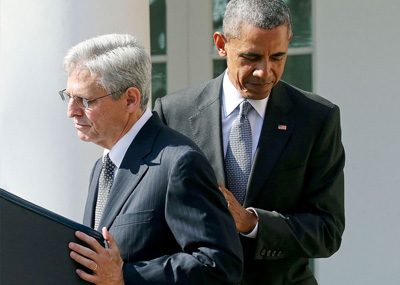
    President Obama has nominated aging white male Merrick Garland to the Supreme Court, and so far the kabuki is playing out as expected. I’ll leave commenting on that to others. Here’s what I’m curious about: assuming that we ever get to the point of arguing about Garland on the merits, what will be the primary attack from Republicans?
    The reason I ask is that I’ve been impressed in the past with their ability to come up with inventive smears that never would have occurred to me. Here’s my best shot at a conspiracy-theory-friendly attack aimed at firing up the tea-party base:

    AUGUST 30, 2013: The U.S. Court of Appeals for the D.C. Circuit ruled today that records of visitors to the White House were off limits to requests under the Freedom of Information Act (FOIA)….In today’s ruling, Chief Judge Merrick Garland wrote that Congress, in drafting the FOIA law and Presidential Records Act, didn’t intend for records such as the president’s appointment calendar to be subject to disclosure.

    ….Garland wrote that making the records subject to FOIA would raise separation-of-powers concerns, because it would force the president to either give up his right to secrecy about his choice of visitors…. “Construing the term ‘agency records’ to extend to White House visitor logs—regardless of whether they are in the possession of the White House or the Secret Service—could substantially affect the President’s ability to meet confidentially with foreign leaders, agency officials, or members of the public,” he wrote.

    The fix is in! Merrick Garland allows Obama to keep his appointment book secret, and Obama nominates him to the Supreme Court. Typical Chicago thuggery. Did you know Garland is from Chicago too? It figures, doesn’t it?

    Release Obama’s appointment book! Don’t allow left-wing extremist Merrick Garland to hide Obama’s meetings with Bill Ayers and George Soros!

  • Sexism, Journalism, and the Cult of Quotes


    Why are men quoted so much more often than women in news stories? Amanda Taub notes a couple of obvious points today: men tend to cite other men disproportionately, and there are way more men in senior positions than women. This makes it hard even for a well-meaning journalist to achieve anything close to gender balance in her reporting.
    But there’s another problem:

    Research shows that men tend to be more confident in their opinions and less worried about being publicly wrong….That’s a dynamic I’ve encountered in my own reporting again and again: Women I interview are much more cautious about hewing closely to their own research and area of expertise, and much more likely to insist on speaking off the record when making a controversial or critical argument. My male sources, on the other hand, are much more willing to freely hold forth on whatever I ask about, confident that whatever opinions they might have are useful enough to share with my readers.

    The result is often that female experts give me little information beyond what I already know from reading their published work — and that the men’s quotes are the ones that survive final edits.

    There are times when I think we could just replace the entire literature of gender politics with the simple phrase “Men are pigs,” and we probably wouldn’t lose much. But I suppose that’s unfair.

    For what it’s worth, though, I’ll offer a second take on this problem: journalists are way too addicted to colorful quotes. Hell, they’re too addicted to quotes, period. Sometimes quotes really do make complex subjects easier to understand, but most often they really don’t. They’re just colorful. And human. And they break up all the boring prose about some boring study or other that came to some boring conclusion about some boring problem.

    Journalists should use the quote crutch a lot less than they do. The fact that men are willing to spill forth volubly on whatever crosses their minds doesn’t mean you have to put it in print. Unless it offers something genuinely new, just skip it and write in your own words instead. This also forces you to decide what you really want in your own words, instead of dropping in a quote that happens to say what you wanted to say all along, but weren’t allowed to because it would constitute an opinion.

    If anything, I’m railing against an even more intractable problem than sexism. Journalism is aimed at people, and people like to hear what other people have to say. Beyond that, quotes demonstrate that you’ve been working the phones and doing real reporting. So there’s not much chance of reducing journalism’s love affair with quotes that do little except to provide color. But it’s worth a try.

    POSTSCRIPT: I shouldn’t have to say this, but I will anyway: I’m not talking about every kind of journalism here. If you’re writing a profile, you’re going to use lots of quotes. If you’re writing a man-in-the-street roundup, you’re going to use lots of quotes. There are plenty of times when quotes are useful and appropriate. I just suspect that it’s less often than most reporters think.

  • Let’s Give It a Rest on the Putin Worship


    Max Boot is decidedly impressed with Vladimir Putin—and equally unimpressed with President Obama:
    In his latest interview in the Atlantic with Jeffrey Goldberg, Obama tries to wave away what Putin has done in Syria and Ukraine: “The fact that he invades Crimea or is trying to prop up Assad doesn’t suddenly make him a player. You don’t see him in any of these meetings out here helping to shape the agenda. For that matter, there’s not a G20 meeting where the Russians set the agenda around any of the issues that are important.”

    It’s telling that Obama thinks that the only thing that matters is the agenda at international gab-fests. That’s because the president, like most European heads of state, lives in a 21st century, post-power world where international law is more meaningful than brute force. Putin, by contrast, inhabits a 19th century, Realpolitik world where strongmen act to advance their own interests with scant regard for the feelings of other states, much less of multilateral institutions such as the G20 or the United Nations. In the clash between these two incompatible visions of the world, there is no doubt which one is winning: From Crimea to Syria, Putin is rewriting the rules of the international game in his favor.

    This is such a tired cliche: Putin the 19th-century strongman, a modern-day Clausewitz who upends the world by simply taking charge and doing whatever he wants. Meanwhile, Obama mewls helplessly on the sidelines, issuing empty condemnations from the State Department but unable to stop the he-man who’s bullying him.

    Sigh. Can you imagine the conservative reaction if Obama announced a bombing campaign with limited objectives, and then withdrew after six months? It would be merciless. He’s abandoning our ally! He was never serious in the first place! Our enemies are laughing at us! We need to crush our enemies, not annoy them with pinpricks!

    But when Putin does this, he’s the reincarnation of a new world order, not a guy with a smallish military and a grand total of one (1) military base outside his own territory. Putin, like Donald Trump, is a helluva marketing genius, but that’s largely thanks to all the American conservatives who are in such thrall to him. To read Boot, you’d think Putin’s six-month air campaign around Aleppo was the most dazzling show of military brilliance since the landing at Inchon.

    The whole conservative approach to power is incoherent these days. Almost universally they agree that “America can’t be the policeman of the world.” But when America isn’t the policeman of the world we’re treated to endless sad scoldings about the fading of American power.

    Let it go, guys. Syria is a quagmire that no outside power can win. Obama knows this and has mostly stayed out. Putin knows this too, and exerted the minimal possible force to prevent the fall of his occasional ally Assad—and then got out as fast as he could. Frankly, they both show greater common sense than most American conservatives.

  • Inflation Slightly Up, But Still Pretty Subdued


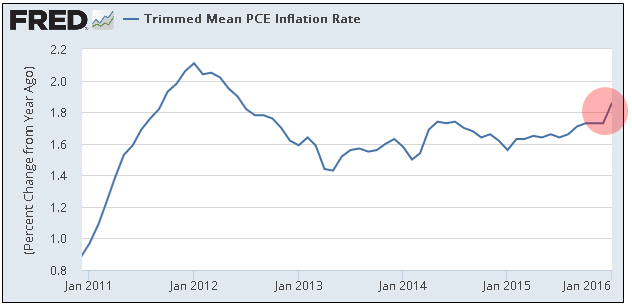
    Tyler Cowen notes this morning that core inflation is now running around 2.3 percent, its highest rate since 2008. “As I’ve been saying, I see very little chance of an aggregate demand-based recession this year, the Fed’s December interest rate hike was not an obvious mistake, and we are not in any operative way in a liquidity trap right now.”

    Perhaps so. But the Fed uses trimmed mean PCE as its preferred measure of inflation, and this hit 1.86 percent in January. True, it’s been drifting slightly upward for the past year, but so far the only sign of escalating inflation is a single month that’s about a tenth of a point higher than the average of the past couple of years. I’m happy to see the economy show signs of inflation, no matter how minuscule, but I’d probably wait a bit before drawing any conclusions from this. There’s no reason for the Fed to react in a panic every time inflation comes anywhere close to their target rate.