• Here’s the Secret of Being a Highly-Paid CEO: Have a Friend Set Your Salary


    What’s the secret to being a highly-paid CEO of a Fortune 500 company? Sales growth? Earnings growth? Impressive return to shareholders? Visionary leadership?

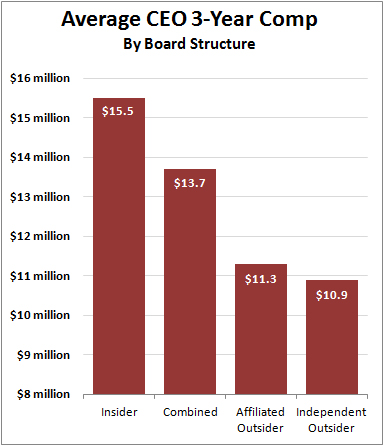
    According to a new study from Institutional Shareholder Services the real key is simpler: set your own pay. Or better yet, have a friend set it. According to ISS, in companies that have an insider as chairman of the board, CEOs earned a little over $15 million during the past three years. But in companies with an independent outsider as chairman, CEOs made only $11 million.

    Did anything else matter? Revenue did: bigger companies pay their CEOs more. But that was it. Shareholder return was insignificant, as were several other variables. Bottom line: if you want a big payday, run a big company and make sure an insider is setting your pay.

  • Obama Says He Would Have Bombed Iran


    Here’s another excerpt from Jeffrey Goldberg’s essay on President Obama’s foreign policy:

    One afternoon in late January, as I was leaving the Oval Office, I mentioned to Obama a moment from an interview in 2012 when he told me that he would not allow Iran to gain possession of a nuclear weapon. “You said, ‘I’m the president of the United States, I don’t bluff.’ ”

    He said, “I don’t.”

    Shortly after that interview four years ago, Ehud Barak, who was then the defense minister of Israel, asked me whether I thought Obama’s no-bluff promise was itself a bluff. I answered that I found it difficult to imagine that the leader of the United States would bluff about something so consequential. But Barak’s question had stayed with me. So as I stood in the doorway with the president, I asked: “Was it a bluff?” I told him that few people now believe he actually would have attacked Iran to keep it from getting a nuclear weapon.

    “That’s interesting,” he said, noncommittally.

    I started to talk: “Do you—”

    He interrupted. “I actually would have,” he said, meaning that he would have struck Iran’s nuclear facilities. “If I saw them break out.”

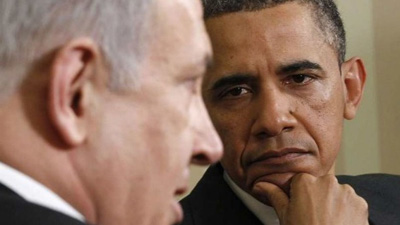
    He added, “Now, the argument that can’t be resolved, because it’s entirely situational, was what constitutes them getting” the bomb. “This was the argument I was having with Bibi Netanyahu.” Netanyahu wanted Obama to prevent Iran from being capable of building a bomb, not merely from possessing a bomb.

    “You were right to believe it,” the president said. And then he made his key point. “This was in the category of an American interest.”

    But is he bluffing even now? We’ll probably never know.

  • Donald Trump Is Basically Encouraging Violence Now


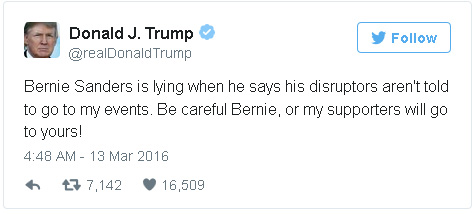
    Yesterday, following the disruption and melees at Trump rallies in St. Louis and Chicago, I wrote this: “Both sides have a point: Trump should be allowed to hold rallies, but he shouldn’t be allowed to pretend that he’s not consciously encouraging both the protests and the increasing violence.”

    I stand by that. At the same time, Trump is running for president. He’s running to be the leader of the nation, and he has a choice: he can try to de-escalate the tension or he can pour fuel on the flames, risking a serious outbreak of violence. He’s now clearly chosen the latter route. Here he is on Meet the Press, talking about the supporter who sucker punched a protester who was being led out of a Trump rally:

    CHUCK TODD: I’m just curious, do you plan on paying for the legal fees of this older gentleman in North Carolina who sucker punched the protester?

    DONALD TRUMP: Well, I’m not aware. I will say this. I do want to see what that young man was doing. Because he was very taunting. He was very loud, very disruptive. And from what I understand, he was sticking a certain finger up in the air. And that is a terrible thing to do in front of somebody that frankly wants to see America made great again.

    ….CHUCK TODD: And that condones a sucker punch though?

    DONALD TRUMP: No, as I told you before, nothing condones. But I want to see. The man got carried away, he was 78 years old, he obviously loves his country, and maybe he doesn’t like seeing what’s happening to the country.

    ….CHUCK TODD: It’s possible you could help him with legal fees, if this man needs it?

    DONALD TRUMP: I’ve actually instructed my people to look into it, yes.

    And here he is talking about a guy who tried to rush the stage at a rally on Saturday:

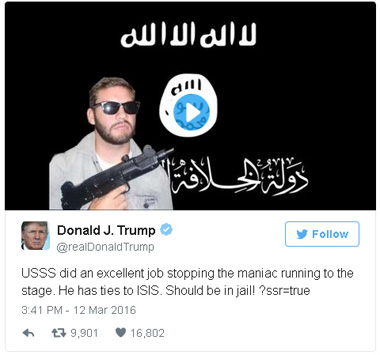
    CHUCK TODD: You praised the secret service, but then you said the man had ties to ISIS, that turned out to be a hoax. Did you go over the top there on that? Where did you get that—

    DONALD TRUMP: No, no, no, no. He was, if you look on the internet, if you look at clips….He was waving an American flag.

    CHUCK TODD: Well, it turned out to be a hoax. Somebody made that up, sir.

    ….DONALD TRUMP: Well, I don’t know what they made up. All I can do is play what’s there.

    ….CHUCK TODD: We’re playing the clip right now.

    DONALD TRUMP: No, excuse me, you didn’t see the clip….He was dragging the American flag on the ground like it was a piece of garbage, okay? I don’t like that….But you have to check it before you ask the question.

    CHUCK TODD: Well, I — no, we have checked it. That’s my point, sir. There’s no ties to ISIS for this man. No law enforcement official. And this video that you linked to appear to be a hoax.

    ….DONALD TRUMP: It looked like the same man to me….Now, I don’t know. What do I know about it? All I know is what’s on the internet.

    And finally this:

    CHUCK TODD: I want to button this up a little bit, because this violence on the campaign trail, it’s got a lot of people concerned. And I guess why won’t you go up on stage and ratchet it back?

    ….DONALD TRUMP: The reason there’s tension at my rallies is that these people are sick and tired of this country being run by incompetent people that don’t know what they’re doing on trade deals, where our jobs are being ripped out of our country….They’re not angry about something I’m saying. I’m just a messenger.

    ….CHUCK TODD: You will not call for ratcheting back the rhetoric? You will not call for it?

    ….DONALD TRUMP: What have I said that’s wrong?….The fact is, they’re really upset with the way our country is being run. It’s a disgrace.

    Yesterday I said that Trump had a right to hold rallies without having them disrupted so badly that he can’t speak. He’s not Hitler, after all. Today, I’m a lot less sure of that.

  • The Koch-Fueled Plot to Destroy the VA


    A ranking of the various kinds of American health care on a “socialized medicine” scale of 1 to 10 would look something like this:

    If you’re a hardcore libertarian, which program would you be most eager to privatize? The VA, of course, which is America’s only genuine example of purely socialized medicine. In the past, the VA’s status as health care provider to military vets has protected it from attack, but that’s changed over the past few years. Why? Because of a carefully orchestrated smear campaign by a Koch-funded activist group called Concerned Veterans for America. Over at the Washington Monthly, Alicia Mundy reports:

    Though the CVA’s incorporation papers don’t reveal its donors, Wayne Gable, former head of federal affairs for Koch Industries, is listed as a trustee. The group also hired Pete Hegseth as its CEO…a seasoned conservative activist, having been groomed at a series of organizations connected to—and often indirectly funded by—the Koch brothers.

    …Hegseth became a fixture on Fox and was a guest on Bill Maher’s show….By late 2013, Hegseth and the CVA were making the case that the VA needed “market-based” reform that provided vets with more “choice” to receive care from private doctors and hospitals.

    …Then, on April 9, 2014, at a hearing in the House Committee on Veterans’ Affairs, Representative [Jeff] Miller dropped the bomb. He announced that his staff had been quietly investigating the VA hospital in Phoenix and had made a shocking discovery: some local VA officials had altered or destroyed records to hide evidence of lengthy wait times for appointments. And worse, Miller claimed, as many as forty veterans could have died while waiting for care.

    This latter charge guaranteed screaming headlines from the likes of CNN, but was later shown to be unsubstantiated…In only twenty-eight out of the more than 3,000 patient cases examined by the inspector general was there any evidence of patient care being adversely affected by wait times…In most VA facilities, wait times for established patients to see a primary care doc or a specialist were in the range of two to four days…For the VA system as a whole, 96 percent of patients received appointments within thirty days.

    In short, there was no fundamental problem at the VA with wait times, in Phoenix or anywhere else.

    Bottom line: There were some problems in Phoenix, where employees had gamed the system for recording wait times. However, there was no evidence that this problem was widespread; there was no evidence that it caused any deaths; and there was no evidence that care had been compromised. In fact, a Rand study concluded that with the exception of patient communication with doctors and nurses, the VA performed as well as or better than private health care on nearly every measure:

    • VA outpatient care outperformed non-VA outpatient care on almost all quality measures.
    • VA hospitals performed the same as or better than non-VA hospitals on most inpatient quality measures, but worse on others.
    • VA performed significantly better, on average, on almost all 16 outpatient measures when compared with commercial, Medicare, and Medicaid HMOs.
    • On average, VA hospitals performed the same or significantly better than non-VA hospitals on 12 inpatient effectiveness measures, all six measures of inpatient safety, and all three inpatient mortality measures, but significantly worse than non-VA hospitals on two effectiveness measures and three readmission measures.
    • On most measures, Veteran-reported experiences of care in VA hospitals were worse than patient-reported experiences in non-VA hospitals.

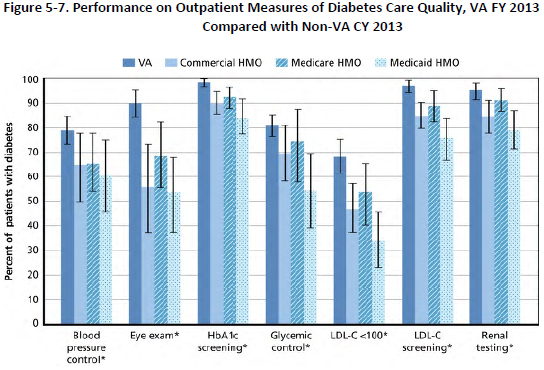
    For example, this chart shows how the VA compares on various measures of outpatient diabetes care:
    During the Clinton administration, the quality of VA care was dramatically improved by Dr. Kenneth Kizer. When George Bush took office, he slowly but steadily eroded Kizer’s work. Control was centralized in Washington; services were outsourced, leading to both higher cost and lower quality; VA eligibility standards were tightened, which resulted in time-consuming new processes to determine if new applicants were eligible for VA care; the Iraq War produced a flood of new patients; construction of new facilities was delayed; and all of this together caused wait lists for admission to the VA to skyrocket.

    Obama’s nominee to head the VA, Army General Eric Shinseki, quickly cut the backlog of unprocessed claims by 84 percent and instituted other reforms as well. But the scandal in Phoenix, with the fans flamed by Hegseth and the CVA, eventually forced Shinseki to resign. It also cracked open the door to privatizing the VA:

    Legislation that came to be known as the Veterans’ Access to Care through Choice, Accountability, and Transparency Act…called for the creation of a “Choice Card” system that was designed as a first step toward privatizing VA health care services. Under the statute, veterans who lived forty miles from a VA hospital or had to wait more than thirty days for a VA appointment were promised that they could use their Choice Card to receive care from a network of private providers, much like one would use a private health insurance card.

    The basic idea of the VA partnering more with private providers was not flawed in principle…Done right, closer collaboration between VA and non-VA providers could improve care for everyone in many areas. But the new legislation set in motion a “choice” program in which the government would be paying for bills submitted by private providers for care that was unmanaged, uncoordinated, and, to the extent that it replicated the performance of the private health care system, often unneeded. This is the very opposite of the integration and adherence to evidence-based protocols that has long made VA care a model of safety and effectiveness.

    Worse, implementation of the Choice Card was a disaster from every point of view. Congress gave the VA only ninety days to stand up the program. Largely because of that insane time line, the VA was able to attract bids from only two companies. Each of these has a sole contract that gives it a monopoly wherever it operates, and each put together networks that were so narrow and poorly administered that that for many months vets who received Choice Cards typically could not find a single doctor who would accept them.

    Everything is going according to plan! First, create a system that enriches private providers and is almost certain to make service worse. Then blame the crappy service on the old, bureaucratic VA and insist that only further privatization can fix it. Rinse and repeat. Eventually your donors are rich and the VA has been dismantled. Victory!

  • Donald Trump Is Right: We Don’t Win Anymore


    First they beat us at Tic-Tac-Toe and we laughed. It’s a kids’ game! Then checkers. Then chess. Then Jeopardy! Then the final domino fell: they crushed us at Go, the most complex game ever invented by the human mind. Now it’s the robots who are laughing.
    Donald Trump is right: we don’t win anymore. Our future silicon overlords have made us into perpetual losers, and it’s only going to get worse if we don’t do something about it. What is Trump going to do to make homo sapiens winners again?

  • Obama Has a Refreshingly Clear-Eyed View of “Allies” Like Saudi Arabia


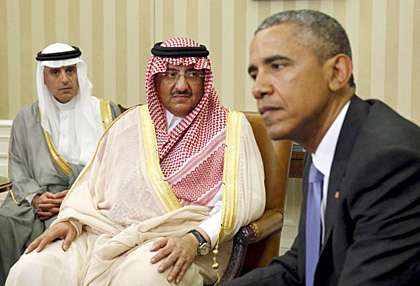
    I mentioned earlier that I’d probably write a few more posts about Jeffrey Goldberg’s essay on President Obama’s approach to foreign affairs. Here’s the first. It’s all about how Obama views Saudi Arabia:

    Though he has a reputation for prudence, he has also been eager to question some of the long-standing assumptions undergirding traditional U.S. foreign-policy thinking….He has [] questioned, often harshly, the role that America’s Sunni Arab allies play in fomenting anti-American terrorism. He is clearly irritated that foreign-policy orthodoxy compels him to treat Saudi Arabia as an ally….For Obama…the Middle East is a region to be avoided—one that, thanks to America’s energy revolution, will soon be of negligible relevance to the U.S. economy.
    ….Though he has argued, controversially, that the Middle East’s conflicts “date back millennia,” he also believes that the intensified Muslim fury of recent years was encouraged by countries considered friends of the U.S. In a meeting during APEC with Malcolm Turnbull, the new prime minister of Australia, Obama described how he has watched Indonesia gradually move from a relaxed, syncretistic Islam to a more fundamentalist, unforgiving interpretation; large numbers of Indonesian women, he observed, have now adopted the hijab, the Muslim head covering.

    Why, Turnbull asked, was this happening? Because, Obama answered, the Saudis and other Gulf Arabs have funneled money, and large numbers of imams and teachers, into the country. In the 1990s, the Saudis heavily funded Wahhabist madrassas, seminaries that teach the fundamentalist version of Islam favored by the Saudi ruling family, Obama told Turnbull. Today, Islam in Indonesia is much more Arab in orientation than it was when he lived there, he said.

    “Aren’t the Saudis your friends?,” Turnbull asked.

    Obama smiled. “It’s complicated,” he said.

    Obama’s patience with Saudi Arabia has always been limited….In the White House these days, one occasionally hears Obama’s National Security Council officials pointedly reminding visitors that the large majority of 9/11 hijackers were not Iranian, but Saudi—and Obama himself rails against Saudi Arabia’s state-sanctioned misogyny, arguing in private that “a country cannot function in the modern world when it is repressing half of its population.”

    ….Obama has come to a number of dovetailing conclusions about the world, and about America’s role in it. The first is that the Middle East is no longer terribly important to American interests. The second is that even if the Middle East were surpassingly important, there would still be little an American president could do to make it a better place.

    Oh man, do I love this guy. I understand why he can’t say stuff like this in public, but I sure wish he’d get drunk one night and blast it out as a tweetstorm. Goldberg acknowledges that the Saudis don’t trust Obama, and the reason is that they shouldn’t. Obama understands very clearly that their only real interest is in getting America to fight the kingdom’s tribal wars for it, all the while funding a brand of fundamentalist Islam that’s inherently unfriendly to the US and the West. America gets virtually nothing out of this relationship except a few military bases—which are only there to help us protect the Saudis.

    Obama is no isolationist—far from it, as Goldberg makes clear. And yes, his “Spockian” personality can sometimes make his assessments seem cold and distant. But he’s basically right. The Middle East is, in his words, a “shit show,” and that’s not going to change any time soon. It’s going to be the source of a lot of wars and a lot of innocent deaths over the next few decades. If there was anything we could do about this, intervention might be worthwhile on a pure humanitarian basis even if it did little for America’s interests.

    But we can’t. We failed in Lebanon. We failed in Iraq. We’re failing in Afghanistan. We failed in Libya. No matter how cold and distant it seems, there’s simply no reason for America to expend vast resources on an impossible task urged on us by a bunch of putative allies who are only interested in using us as a mercenary army. We should protect ourselves against the export of terrorism from the region—which might sometimes require a military solution—but that’s about it. It’s far past time to ratchet down our engagement in the region and let other countries take the lead if they really want to.

  • Trump Cancels Cincinnati Rally


    Donald Trump has canceled his rally in Cincinnati scheduled for Sunday afternoon:

    The Secret Service security supporting the GOP presidential front runner’s campaign could not complete its preparation work in time to hold the event at the Duke Energy Convention Center, said Eric Deters, a local spokesman for Trump’s campaign. “Trump wants to come here, and the campaign is still looking to find a location for either Sunday or Monday,” Deters said.

    Maybe this excuse is real, maybe it’s not. Who knows? I just thought you’d want to know.

  • Hillary Clinton’s Remark About Nancy Reagan and AIDS Was Completely Inexplicable


    On Friday afternoon, in an interview with Andrea Mitchell coinciding with Nancy Reagan’s funeral, Mitchell mentioned that Nancy Reagan had led efforts to fight gun violence and fund Alzheimer’s research. Here is the full context of Hillary Clinton’s reply:

    When something happens to you, like a good, dear friend James Brady being shot and suffering, your husband having Alzheimer’s, it can’t help but change your perspective, and I wish more people would pay attention to those who have gone through these issues.

    The other point that I wanted to make too is, it may be hard for your viewers to remember how difficult it was for people to talk about HIV/AIDS back in the 1980s. And because of both President and Mrs. Reagan — in particular Mrs. Reagan — we started a national conversation when before nobody would talk about it, nobody wanted to do anything about it. And that too is something that I really appreciate with her very effective, low-key advocacy. But it penetrated the public conscience and people began to say, “Hey, we have to do something about this too.”

    I wanted to present the full context of her remark so you could see what might have spurred it. Needless to say, it generated a tsunami of criticism, since Ronald Reagan was famously indifferent to AIDS and declined to mention it in a serious way until 1987. Within hours, Clinton offered an apology:

    This whole affair is completely inexplicable. Did Clinton forget about Reagan’s terrible legacy on AIDS? That’s hardly likely. She has a mind like a sponge, and the visceral gay hatred for Reagan’s legacy is very, very well known in the liberal community.

    Was she pandering? If so, it’s hard to figure out who she’s pandering to. Certainly not to liberals. And not even to centrists. Nor was she maneuvered into a position where she felt like she had to say something nice specifically about the Reagans and AIDS. She explicitly brought it up on her own.

    So what the hell happened? What’s the most sympathetic reading you can construct about this? It would go something like this:

    • In its early years, AIDS really didn’t get much attention outside of the medical and gay communities. That started to shift a bit in 1983, mostly leading to hysteria about catching it from toilet seats or handshakes from gay men.
    • Ronald Reagan at that time was a conservative in his 70s. It’s not surprising that he felt it was inappropriate for the president of the United States to talk about sexually-transmitted diseases in public. And he did go along with increases in research funding for AIDS during this period.
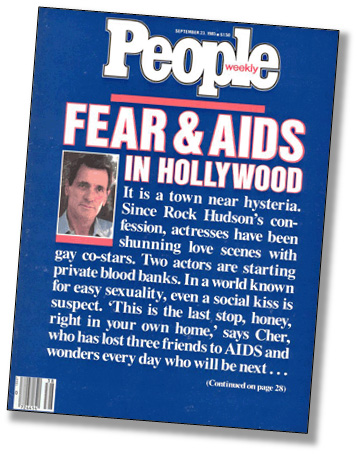
    • It’s really true that most people—and nearly all national politicians—had a hard time talking about AIDS during this period. America was nowhere near as gay-friendly in the early 80s as it is now. But there was a sea change in public perceptions in 1985. Ryan White, a charismatic teenager who acquired AIDS via a blood transfusion, was banned from school. Rock Hudson announced that he had AIDS. People magazine published its first cover story about AIDS and Time published only its second (the first was mainly about researchers trying to track down a cure). AIDS became a far more potent issue after these two events.
    • Clinton had earlier mentioned that when something happens to a person close to you it often has a galvanizing effect, and that prompted her to think of Rock Hudson, a friend of the Reagans from their Hollywood days. His announcement very clearly affected both of them deeply, and there’s evidence that around this time, Nancy started working behind the scenes to push her husband to take the AIDS epidemic more seriously.
    • And all this somehow spurred Clinton to momentarily lose both her historical sense and her political sense and produce the tone-deaf remark she did.

    I dunno. That’s the best I can do, and it’s not very persuasive. Clinton had just mentioned Alzheimer’s and very deliberately brought up AIDS as a distinct example of Nancy Reagan’s kindness. Her comment about AIDS was clear and coherent: it plainly referred to AIDS. It was no mistake. And even if Nancy Reagan was a bit more aroused about AIDS than her husband, it’s very common knowledge that her advocacy was still decidedly modest.

    Matt Yglesias suggests that Clinton’s gaffe is “revealing of her insider perspective on social change.” That is, Clinton thinks about these things from the top down, rather than the bottom up, and that prompts her to give more credit than she should to actors like the Reagans instead of to the activists who deserve it. I suppose that might be the answer—though Clinton, both by background and experience, sure seems pretty plugged into the power of grass-roots activism.

    So it’s a mystery. I can’t imagine why Clinton said something so dumb and inflammatory, and I can’t imagine she was pandering to anyone. What the hell caused her to momentarily lose her senses over this?

  • Remodelation Is a Terrible Inconvenience


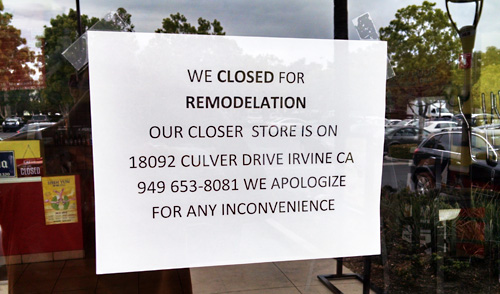
    Greetings, night owls! As your reward for reading my blog even in the wee hours of Saturday morning,1 here is your reward: my sign of the day, spotted at a local taco place. Enjoy.

    1On my end, thanks to the Friday effects of the evil dex.