• Who Will the Public Blame For Violence at Trump Rallies?

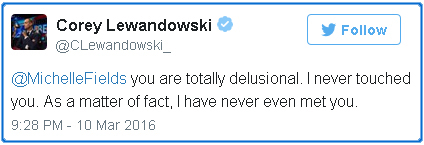
    Unless you just woke from a coma, you know what’s been going on at Donald Trump’s rallies over the past few days. After months of protesters interrupting his events and being treated with increasing ferocity, things have started boiling over. In Florida on Tuesday, a Breitbart reporter named Michelle Fields tried to ask a question about affirmative action, but Trump’s campaign manager grabbed her arm and nearly threw her to the ground—and then started up a Twitterstorm of smears claiming the incident never happened even though there was an eyewitness report, audio tape, and videotape of the incident.

    In North Carolina on Wednesday, a Trump supporter sucker punched a protester who was being led out by security guards. On Friday morning in St. Louis, a Trump rally erupted into clashes both inside and outside the arena, leading to dozens of arrests.

    Finally, on Friday evening in Chicago, thousands of Trump supporters and protesters engaged in verbal clashes and massive disruption hours before the rally was scheduled to start. A campaign spokesman said that after “meeting with law enforcement,” Trump decided to cancel the rally. The altercation then moved outside, where five people were arrested and a CBS reporter was detained covering the melee.

    So what was Trump’s response? “I don’t take responsibility,” he said. “Our freedom of speech has been violated totally.” Other Republicans agreed. Ted Cruz criticized the tone of Trump’s rallies, but said the real responsibility “lies with protesters who took violence into their own hands.” Marco Rubio said Trump needed to “own up” to his rhetoric, but “there are people that are protesting tonight that are part of organized efforts to disrupt this event.” Sean Hannity also defended Trump: “There’s no words that inspire people to hate.”

    And Trump himself delivered the bottom line: “This increases the vote for Trump.”

    Is Trump right? There’s no question that there’s an organized effort by protesters to disrupt Trump’s rallies. So far, though, they’ve been loud but peaceful. Does this mean the public will blame Trump, or will they conclude that the protesters are deliberately trying to stir up violence and they’re just getting what they asked for?

    Outside the right-wing press, the coverage of Trump’s rallies has been almost uniformly anti-Trump. But it’s obvious that Trump is reveling in this, and he has an animal cunning for finding the right angle to turn public opinion to his side. This is a delicate moment. Both sides have a point: Trump should be allowed to hold rallies, but he shouldn’t be allowed to pretend that he’s not consciously encouraging both the protests and the increasing violence. He obviously thinks it will help his cause in the end. Stay tuned.

  • Friday Cat Blogging – 11 March 2016


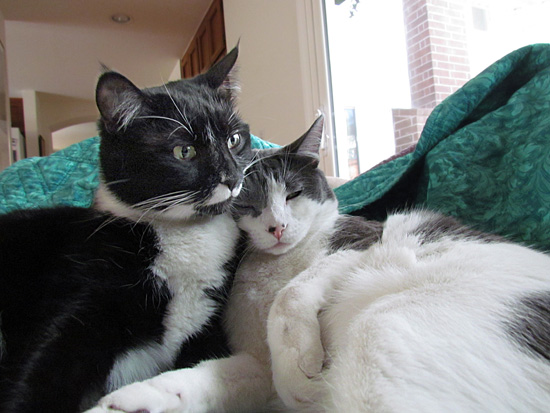
    Last week’s photo session with the cats was really great. I settled on the photo of Hilbert and his fabulous tongue because the timing was too good to pass up the joke, but that meant neglecting all the really good pictures they posed for that day. Here’s one of them. Aren’t they cute? Maybe I’ll use another one next week, though I suppose that depends on what the furballs do over the next few days. I bought a robot vacuum the other day, and there’s always the possibility that it will produce some amusing reactions. (So far, the only reaction has been deep suspicion.) In the meantime, enjoy this picture of domestic bliss, taken about a minute before the bliss dissolved.

    In other feline news, here’s a nice story about an autistic 6-year-old and her therapy cat.

  • Quote of the Day: Waste, Fraud, and Abuse Are Just a Con


    From David French, complaining about Donald Trump’s rather gleeful lack of policy knowledge:

    When a politician claims he’ll fix the budget by eliminating “waste, fraud, and abuse,” he’s appealing to don’t know/don’t cares.

    Sure, and Trump is more brazen and more stupid about this than most. But come on. Conservative politicians have been railing about the immense cost of waste, fraud, and abuse for decades. They do it because (a) it’s a good applause line, (b) its size is nice and vague, and (c) they’re afraid to propose major cuts to the big programs people actually care about (Social Security, Medicare, defense, etc.).

    During this time, the conservative intelligentsia has happily gone along with this charade. Now Trump is using it to great effect, and apparently the blame for this lies with lazy voters:

    The problem comes, however, when — during an election cycle — voters don’t even try. They ignore their responsibilities as citizens and become content with ignorance, happy to shortcut real evaluations with a number tried-and-true tricks. The identity of the speaker matters more than the content of the speech (We tune out the “establishment” or the “media” or “pundits.”) The tone matters more than substance (I’m not sure about Trump’s math, but he sure sounds presidential.) And narrative hovers over everything.

    It’s hard for a democracy to thrive without good leaders, but it can’t survive without good voters. And if you watch a debate without the slightest clue (or perhaps even concern) as to who’s telling the truth, you’re simply not doing your job.

    Donald Trump is so brain-dead ignorant that it beggars the imagination. But for decades conservatives have been training their followers to wallow in ignorance, tune out the media, and pay more attention to narrative than to basic arithmetic. And they’ve happily embraced the public faces of that ignorance, people like Rush Limbaugh, Sarah Palin, Glenn Beck, and Matt Drudge.

    The old WFA con has been part of this all along. But now the conservative movement’s leaders are complaining that the rubes didn’t realize all along that it was just a bit of cynical rabble-rousing never meant to be taken seriously? Give me a break.

    POSTSCRIPT: On the bright side, props to French for endorsing the Oxford comma.

  • Obama: “I’m Very Proud” Of Backing Off on Bombing Syria


    I’ve long believed that the attack on Libya was something of a watershed for President Obama. Before that, he may have been more skeptical of using American military power than most people, but he was still basically on board the consensus train. After that, he finally felt in his gut what he had long believed in his mind: American intervention, especially in the Middle East, just doesn’t work very well.

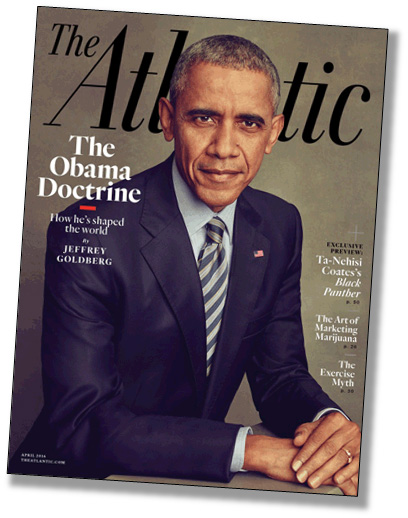
    But I might have the wrong war. In a fascinating cover story for the Atlantic, Jeffrey Goldberg suggests that the real turning point was Syria’s chemical weapons. Obama had famously drawn a “red line” on Syria in 2012: if the regime used chemical weapons, it could expect a ruthless American response. But a year later, when Bashar al-Assad’s army went ahead and used them anyway, Obama got cold feet.

    The fascinating part is this: if there’s a single foreign policy decision that’s earned him the most abuse, this is the one. But it turns out that Obama himself thinks it’s one of his finest moments:

    Given Obama’s reticence about intervention, the bright-red line he drew for Assad in the summer of 2012 was striking….It appeared as though Obama had drawn the conclusion that damage to American credibility in one region of the world would bleed into others, and that U.S. deterrent credibility was indeed at stake in Syria.

    ….Obama had already ordered the Pentagon to develop target lists. Five Arleigh Burke–class destroyers were in the Mediterranean, ready to fire cruise missiles at regime targets….But the president had grown queasy….The American people seemed unenthusiastic about a Syria intervention; so too did one of the few foreign leaders Obama respects, Angela Merkel, the German chancellor. She told him that her country would not participate in a Syria campaign. And in a stunning development, on Thursday, August 29, the British Parliament denied David Cameron its blessing for an attack. John Kerry later told me that when he heard that, “internally, I went, Oops.”

    ….Late on Friday afternoon, Obama determined that he was simply not prepared to authorize a strike….He was tired of watching Washington unthinkingly drift toward war in Muslim countries….The next few days were chaotic. The president asked Congress to authorize the use of force—the irrepressible Kerry served as chief lobbyist—and it quickly became apparent in the White House that Congress had little interest in a strike.

    ….“I’m very proud of this moment,” he told me. “The overwhelming weight of conventional wisdom and the machinery of our national-security apparatus had gone fairly far. The perception was that my credibility was at stake, that America’s credibility was at stake. And so for me to press the pause button at that moment, I knew, would cost me politically. And the fact that I was able to pull back from the immediate pressures and think through in my own mind what was in America’s interest, not only with respect to Syria but also with respect to our democracy, was as tough a decision as I’ve made—and I believe ultimately it was the right decision to make.”

    This was the moment the president believes he finally broke with what he calls, derisively, the “Washington playbook.”

    No wonder I like this guy so much. I’m going to miss him no matter who wins the election in November.

    Goldberg’s entire piece is long, but well worth a read—and I might have more to say about it later. But I found the Syria episode especially interesting. A couple of years ago I wrote that maintaining “credibility” was “perhaps the cause of more dumb wars than anything else in history,” and that fighting back against this notion was a “rare sign of wisdom in a president.” Basically, Obama made a mistake in setting out the red line in the first place, and eventually figured out that it was unwise to let our foreign policy be dictated by a brief, intemperate remark. That’s especially true when all the loudest hawks in Congress turn out to be a bunch of gutless armchair generals when you ask them to put their hawkishness to a roll-call vote.

    In any case: good for Obama. He’s correct that this decision cost him politically. He’s also correct that it was the right decision to make. Frankly, the mere fact that it pissed off so many of our Middle East allies—who plainly care about little except having America fight their tribal battles for them—is enough to convince me. American intervention in the Middle East has generally been pretty disastrous, and it’s long past time for everyone to figure that out. That very definitely includes all the folks who are actually in the Middle East.

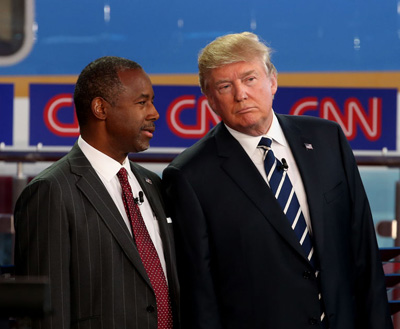
  • Ben Carson Had No Choice But To Endorse Donald Trump


    Quinn Hillyer is not pleased with Ben Carson’s endorsement of “moral monster” Donald Trump:

    Carson has spent an entire campaign pleading for honor and decency and decorum, only to endorse a man who is the crassest, most vulgar, most deceitful person in the race — a man who has repeatedly attacked in the most vicious ways, and lied about, every other candidate in the race. Trump is a man who has repeatedly incited violence at his rallies, saying that protesters should be punched out and carried away on a stretcher, and promising to pay the legal bills of those who throw the punches.

    ….Carson has talked about the need for a president to understand poverty, yet has endorsed a multi-million dollar inheritor who has spent his entire career leaving others impoverished by walking out on his debts, but refusing to pay full bills, and by trying to use to power of the state to seize their land. Worse, Carson is endorsing a man who has mocked his religion and who quite literally likened him to a child molester. In doing so, Dr. Carson has disgraced himself.

    Fair points! But Carson deserves a defense. Here it is:

    • Rubio is going to lose. Endorsing him wouldn’t benefit Carson in any way.
    • Carson hates Cruz’s guts.
    • Trump looks like he’s going to win.

    Oh, did you think I was going to defend Carson on moral grounds? So silly. Ben Carson has been grifting the conservative movement for years. He knows the main chance when he sees it, and right now Trump offers him the best prospect of staying in the spotlight and selling more books. I wonder if Trump will make him stand obediently behind him during his next rally, like he did with Chris Christie?

  • Is Anyone Still Defending Trade Deals These Days?


    I’m curious: is there anyone left who defends trade deals these days? Anyone who thinks NAFTA benefited the US; who thinks the WTO is a pretty good system; who thinks TPP is a good idea; and who supports all the smaller bilateral trade deals of the past couple of decades?

    Actually, let me rephrase that. I know there are lots of people who believe all this. But is there anyone left willing to say so in public? Literally every single presidential candidate has been flogging trade deals for the past few months, but no one seems to be fighting back. Is it just not worth it? Does everyone figure it’s nothing more than campaign posturing, and once the election is over we can go back to passing trade deals the same as we always have? Or what?

  • Kids Are Becoming Less Violent. Adults Not So Much.


    The lead-crime hypothesis is simple: lead poisoning in childhood affects the brain in ways that produce more violent crime later in life. If it’s true, then cohorts born after about 1980, when leaded gasoline started being phased out, will have a lower rate of violent crime. The flip side, unfortunately, is that cohorts born before 1980 are ruined for life. The brain damage is permanent and there’s no cure. So they’ll have a higher propensity for violence their entire lives.

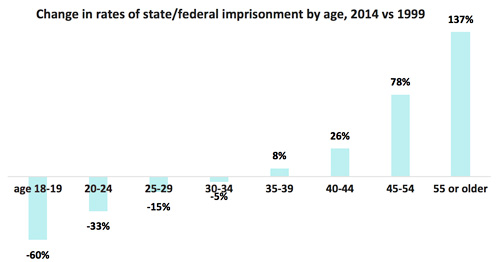
    In more concrete terms, the low-violence cohort is currently age 35 and under. The high-violence cohort is over age 35. Now, it turns out that cohort-level trends aren’t easy to sort out because the data on crime rates over time don’t include the age of the offender. But there are a few proxies that can give us a clue about whether different age cohorts are truly acting differently. Over at the Washington Monthly, Mike Males, a researcher at the Center on Juvenile and Criminal Justice, has one:

    Males comments on the stunning nature of these trends:

    These generational trends in imprisonment have occurred among non-Hispanic whites, blacks, and Hispanics alike….The massive declines in imprisonment of teenagers and young adults parallel large declines in juvenile arrests and incarcerations.

    ….The size of these generational trends is staggering. In 1994, criminal arrests of Americans under age 25 peaked at 6.7 million. Since then, their arrests have plummeted by 3.1 million through 2014 even as the teen and young-adult population increased by nine million. Meanwhile, arrests rose among Americans ages 25-39 (up 1.7 million) and 40 and older (up 600,000).

    For those offenses most likely to lead to imprisonment — major (Part I) property, violent, and drug crimes — the generational shift intensifies. Since 1994, annual arrests for these offenses among Americans under age 25 fell by nearly 800,000, and also declined among ages 25-39 (down 260,000). But annual arrests for these Part I and drug offenses rose by 270,000 among ages 40 and older.

    There is pretty much nothing that will ever definitively prove the lead-crime theory. The data we’d need just doesn’t exist. But the cohort effect that Males highlights here is very consistent with it. Younger cohorts are becoming less and less violent, which is what you’d expect as lead poisoning has steadily dropped since 1980. Meanwhile, older cohorts have remained violent and have accounted for an increasing share of state and federal incarceration.

    The good news is that people generally become less violent with age, so a large percentage increase in imprisonment of 55-year-olds doesn’t represent a lot of crime. And of course, time marches on. Today the cutoff age is about 35. By 2036 the cutoff age will be 55, which means that essentially the entire population will be free of serious lead poisoning and will likely be significantly less violent than today.

    You may thank the EPA for this.

  • Republicans Tonight: Let’s Invade Iraq All Over Again


    At tonight’s debate, Hugh Hewitt asked the candidates if they’d be willing to commit a substantial number of ground troops to fight ISIS, even though it means getting in the middle of a Sunni-Shia civil war. Here’s what they said:

    CRUZ: We need to do whatever is necessary to utterly defeat ISIS….We’re not using our overwhelming air power. We’re not arming the Kurds. Those need to be the first steps. And then we need to put whatever ground power is needed to carry it out.

    KASICH: You have to be in the air and you have to be on the ground. And you bring all the force you need. It has got to be “shock and awe” in the military-speak. Then once it gets done, and we will wipe them out, once it gets done, it settles down, we come home and let the regional powers redraw the map if that’s what it takes.

    TRUMP: We really have no choice….I would listen to the generals, but I’m hearing numbers of 20,000 to 30,000. We have to knock them out fast. And we have to get back home. And we have to rebuild our country which is falling apart.

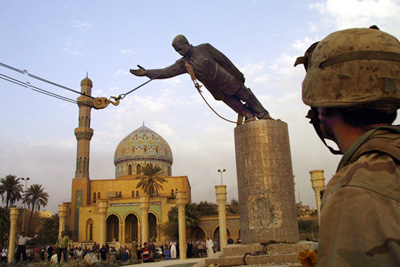
    There are some minor nuances here, but basically all three of them said they’d be willing to send a big ground force to Iraq. (Rubio didn’t get a chance to answer the question.) I don’t know if this is precisely a new position for any of them, but it’s sure the most explicit they’ve been about it on a debate stage. In previous debates, they’ve mostly focused on everything except ground troops. Now, suddenly, they all sound like they’re gung-ho on sending over a couple of divisions. It’s 2003 all over again.

    And just to make it even more 2003-esque, you have Kasich and Trump insisting that we could get in and out lickety split. That’s exactly what George Bush told us too, but even with 100,000 troops it turned out to be a little harder than he thought. It sure sounds like history is starting to repeat itself, and not in a good way.

  • Did Bernie Sanders Oppose the Auto Rescue?


    Did Bernie Sanders vote against the auto industry rescue, as Hillary Clinton says? This morning on Twitter I called the question “fair game,” and a couple of friends suggested I was being an insufferable Hillary shill for saying this. Maybe so! But in an effort to cement my insufferable shillosity, let’s take a look at this in more detail. I have two or three points to make.

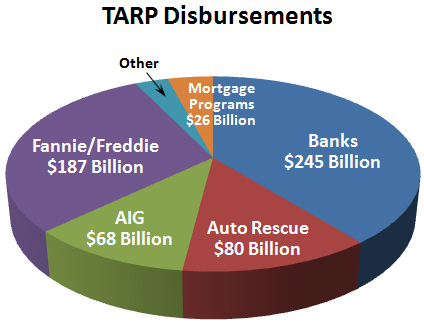
    Before we get to that, a brief bit of background. On December 11, 2008, the Senate took up a standalone auto rescue bill. Bernie Sanders and Hillary Clinton both voted for it, but it was killed by Republicans. The next day President Bush announced that he would fund a small, interim auto rescue himself. “Given the current weakened state of the U.S. economy,” his press secretary said, “we will consider other options if necessary including use of the TARP program to prevent a collapse of troubled automakers.” A week later Bush used money from the first $350 billion tranche of the TARP bank bailout to do just that. In January, president-elect Obama asked Bush to request a release of the second TARP tranche, which he did. This came to a vote in the Senate on January 15, 2009. Clinton voted yes and Sanders voted no. Several months later, Obama used money from this second tranche of TARP to fund his final auto rescue plan.
    Those are the facts. Now let’s get to the messier arena of interpretation and compromise.

    First: TARP was primarily a bank bailout. Everyone agrees about that. But did senators also know that it might be used to fund an auto rescue? Michigan senator Debbie Stabenow claims that this was common knowledge: “A lot of folks said we shouldn’t do it because somehow it was helping the banks,” she said a few days ago. “It was the auto bailout we were talking about. I was very clear with colleagues that we had to do this.”

    But Stabenow is a Clinton supporter, so she might be stretching things a bit. Let’s take a look at contemporaneous reporting:

    January 13: “We had a sense, based on the representations that were made at the time, that it [the first TARP tranche] was about saving the financial system,” [Mitch] McConnell said. “The outgoing administration then ended up using it for an automobile bailout. And I think I’m safe in saying that that diminished significantly the enthusiasm among Republicans for the second tranche of the TARP.”

    January 14: On the other side of the aisle, many Republicans who voted for the first tranche of the TARP were leery about this second vote, because at least $23.4 billion of the initial outlay has been used, over their objections, to bail out the auto industry.

    January 15: Some conservatives…also maintain that the enormous bailout plan has illegally grown beyond its original focus on the financial services industry to include a bailout of the auto industry and more.

    January 15, letter from Larry Summers to Congress urging release of TARP II: “Firms in the auto industry, which were provided assistance under the EESA, will only receive additional assistance in the context of a comprehensive restructuring designed to achieve long-term viability.”

    It’s pretty clear that the auto rescue was a live subject at the time, and there was widespread concern that TARP funds might be used for the auto industry. TARP was unquestionably a bank bailout bill, but it’s hard to sustain an argument that no one at the time envisioned it being used to rescue the auto industry too.

    Second: Hillary Clinton’s attack on Bernie Sanders is so common it’s practically a cliche. She’s pointing to a huge bill with a thousand provisions and then criticizing Bernie for voting against one of them—even though it was really the other 999 he opposed. It’s not especially admirable for Hillary to stoop to this, but on a campaign smear scale it rates about a 3 out of 10. It’s practically a sport in Congress to introduce bills whose only real purpose is to force your opponents to cast a vote that can later be denounced.

    Third: Beyond the tedious campaign attacks and the semantics of the auto rescue, there really is an important issue here. Bernie took a look at a big, complicated TARP bill and decided that its good points weren’t enough to justify bailing out a bunch of Wall Street zillionaires. Hillary made the opposite judgment. Since resolving this kind of dilemma is a pretty common state of affairs in congressional legislation, it tells us something important about how they view the legislative process and the world in general.

    As it happens, I supported TARP. Even with all its faults, I thought it was vitally important to pass something that demonstrated a commitment by the federal government to keeping the financial system afloat. There are plenty of others who disagree, including a number of economists I respect. But no matter how much it rankles, the banks needed to be rescued—and in my view, they needed to be rescued in a very dramatic, very public, very deep-pocketed way. I just wasn’t willing to risk the economy on anything less, even if that meant giving the president almost unfettered discretion to use the money as he saw fit.

    If you agree, then Hillary’s pragmatic willingness to compromise looks pretty responsible and Bernie’s intransigence looks pretty reckless. But if you think TARP was a blank-check travesty that did little more than give a bunch of free money to big banksters and the shaft to ordinary homeowners—and you’re willing to bet the ranch that it wasn’t really necessary anyway—then Hillary looks like a lackey of Wall Street and Bernie looks prescient.

    That’s a genuine argument. It’s not the argument we’re having, of course, because presidential campaigns don’t really lend themselves to abstract governance issues like this. But it’s probably the best way of viewing it. Was TARP, in the end, a pretty good deal? Or should we have risked holding out for better oversight and more restrictions on how the money was used? Generally speaking, Hillary is the candidate of the former and Bernie is the candidate of the latter. Make your choice.