• Apple-FBI Spat Enters the Twilight Zone


    What in God’s name is this all about? In its motion filed Friday to force Apple to create a special version of iOS that would allow the FBI to crack the San Bernardino attacker’s iPhone, a footnote revealed that Apple and the FBI had discussed several options for obtaining information on the phone:

    The four suggestions that Apple and the FBI discussed (and their deficiencies) were….(3) to attempt an auto-backup of the SUBJECT DEVICE with the related iCloud account (which would not work in this case because neither the owner nor the government knew the password to the iCloud account, and the owner, in an attempt to gain access to some information in the hours after the attack, was able to reset the password remotely, but that had the effect of eliminating the possibility of an auto-backup).

    With the iCloud password changed, the iPhone can’t connect to the iCloud account and do a backup. But Apple says it wasn’t Syed Farook who changed the password:

    Apple executives said the company had been in regular discussions with the government since early January, and that it proposed four different ways to recover the information the government is interested in without building a backdoor. One of those methods would have involved connecting the iPhone to a known Wi-Fi network and triggering an iCloud backup that might provide the FBI with information stored to the device between the October 19th and the date of the incident.

    Apple sent trusted engineers to try that method, the executives said, but they were unable to do it. It was then that they discovered that the Apple ID password associated with the iPhone had been changed. (The FBI claimed earlier Friday that this was done by someone at the San Bernardino Health Department.)

    Friday night, however, things took a further turn when the San Bernardino County’s official Twitter account stated, “The County was working cooperatively with the FBI when it reset the iCloud password at the FBI’s request.”

    This is pretty bizarre. Why did the FBI say it was Farook in their court filing if they knew it wasn’t? And how did the San Berdoo Health Department change the iCloud password, anyway? You need the old password to do that. But if they know the old password, why can’t they change it back? Very mysterious.

    UPDATE: Apparently there are a couple of ways this could have happened. If the Health Department knew Farook’s email account, they might have been able to use the “Forgot my password” option to reset it. Alternately, if the phone was MDM managed, they might have been able to reset the passcode remotely. However, that seems unlikely since they would have had other, better options if they had been using MDM.

    Why did the Health Department have the phone, anyway? I’m surprised the police or the FBI didn’t snatch it instantly.
  • Donald Trump Might Be Single-Handedly Ruining the Economy


    Companies and things Donald Trump has started boycotting in the past few months:

    1. Oreo cookies
    2. Carrier air conditioners
    3. iPhones and all other Apple products
    4. Starbucks
    5. Macy’s
    6. The Republican debate, for a while anyway
    7. Traveling to Mexico
    8. HBO
    9. Univision

    Typically, the reason for the boycott is some kind of personal feud (5, 6, 8, 9); companies making things overseas (1, 2); companies doing things he disapproves of (3, 4); and countries doing things he disapproves of (7).

    In fairness, he’s on the business end of plenty of boycotts too. He might personally be responsible for last quarter’s lousy economic growth.

  • Why Is General Relativity So Damn Hard to Understand?


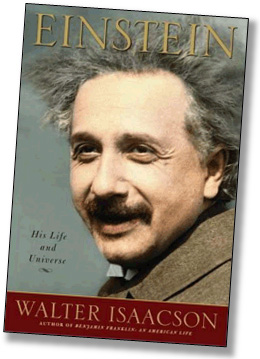
    Bob Somerby is reading Walter Isaacson’s biography of Albert Einstein, which he calls “a pleasure to read.” Except for one thing: Isaacson’s description of the theory of relativity is incomprehensible. For example:

    The passage shown below comes from Isaacson’s Chapter One.

    The general theory of relativity…can be described by using another thought experiment. Picture what it would be like to roll a bowling ball onto the two-dimensional surface of a trampoline. Then roll some billiard balls. They move toward the bowling ball not because it exerts some mysterious attraction but because of the way it curves the trampoline fabric. Now imagine this happening in the four-dimensional fabric of space and time.

    We’d have to call that passage bafflegab. No one has the slightest idea what Isaacson means when he refers to “the four-dimensional fabric of space and time.” We all can picture that trampoline—but none of us knows how to imagine that “four-dimensional fabric!” Nor does Isaacson give us the tools to do so, or notice that he has failed.

    Somerby is complaining about a big problem here. But it’s not Isaacson’s fault. Or even the fault of science writers in general. It’s a defect in the universe itself.

    As it turns out, explaining the “fabric” of spacetime isn’t hard. Yes, it’s four-dimensional. But all this means is that you define it using four numbers. If you described me via my age, weight, height, and IQ, that would be a “four-dimensional” representation of Kevin Drum. It’s not a big deal.

    Now suppose you want to describe an event. You need to specify where it happened and when it happened. Take, for example, the airplane crashing into World Trade Center 1. It happened at 40.71º latitude, -74.01º longitude, and 6,371 kilometers (relative to the center of the earth) at 13:46:30 GMT on 11 September 2001 (relative to the common era calendar). As an event in spacetime it’s represented by an ordered 4-tuple:

    There are other events that happened at the same time in other places (me saying “oh shit” in California); at the same place in other times (breaking ground on WTC 1 in 1966); and entirely different times and places (the Battle of Gettysburg). If you collect every possible location of an event ever—that is, every combination of four numbers specifying times and places in the universe—that’s all of spacetime. Physicists are likely to call it a manifold or a Minkowski space. For laymen, fabric is fine.

    This is all pretty simple. You might not know the mathematics for dealing with arrays of four numbers at a time, but it’s well developed. And if you combine that with a few other concepts—like the idea that the speed of light is always constant—you’ll eventually end up with the theory of gravitational attraction that’s called general relativity.

    Unfortunately, “eventually” is a long way away. I can teach you to add and subtract, and “eventually” that will lead you to the theories of financial derivatives that we lovingly called rocket science when they were helping the economy implode in 2008. I can teach you the color wheel and eventually you might become the next Rembrandt. I can teach you to read and eventually you might tackle Kant or Wittgenstein.

    So what’s a science writer to do? General relativity is a set of mathematical equations. Plug in the numbers and it turns out to predict the way gravity works with astonishing precision. But can someone who doesn’t understand the math picture in their head what those equations “mean”? Well, what does a Rembrandt mean to a blind person? What do derivatives mean to someone who doesn’t understand the Black-Scholes model? What does Kant mean to someone who’s never studied philosophy? You can do your best to find some kind of analogy that kinda sorta gets these ideas across, but none of them will ever be simultaneously comprehensible and truly accurate to a layman.

    I said earlier that this was a defect in the universe. Here’s the defect: the universe is hard! Humans have a hard time understanding it if they aren’t willing to study diligently. (And sometimes even if they are.) There’s really no way around this. In the case of science, there’s no law that says the universe has to work in ways that the overclocked ape h. sapiens can make intuitive or visual sense of. You can read an article in Discover and get a glimpse. A really talented writer can give you a slightly better glimpse. If you get a PhD in physics you’ll get an even better glimpse. You’ll start to grasp simultaneity, light cones, stress-energy tensors, geodesics, world lines, Riemannian geometries, and frame dragging. But will you ever truly understand? Will you ever truly be able to picture it? Probably not. You might eventually be able to manipulate the algebra deftly, but at a visceral level our brains evolved to understand spear throwing and baby raising, not differential equations or tensor analysis. Welcome to the universe, you allegedly sentient being, you.

    Next: In part 2, I explain general relativity so you can understand it. No joke. It’s not that hard at all! Though I admit that I’m going to cheat.

  • The Story of David Cameron’s “National Veto” That Isn’t


    The machinery of the EU is awesomely trifling. I was reading earlier today about David Cameron finally reaching an agreement that allows Britain some special privileges designed to keep them from exiting the union. But it was odd. One of the concessions he won appeared to give Britain “a national veto over EU legislation,” and yet every news report treated this like a minor afterthought. So I got curious and tried to figure out what was going on. Here’s the provision Cameron got:

    • If the EU proposes a new law, it is required to send out a draft to all member countries for a 12-week review.
    • If 55 percent of the member countries object, the Council will “discontinue the consideration of the draft legislative act in question” unless they choose to amend it.
    OK. That’s something, I guess. So what was the rule before? Feast on this:

    • If a third of the member countries object to a new law, it will be reviewed. But that’s it. No action is required.
    • If half of the member countries object, the new law will not only be reviewed, but the EU Commission will have to explain why it thinks the law is OK.
    • After that, the Council and the European Parliament are required before the first reading to “consider whether the legislative proposal is compatible with the principle of subsidiarity.”
    • If 55 percent of the Council Members (or a majority of the European Parliament) believe the proposed law is incompatible with subsidiarity, it will be shelved.

    So under the old rules, if half the member countries object to a proposed law and 55 percent of the Council subsequently agrees, it’s shelved. Under the new rules, if 55 percent of the member countries object, it will be shelved immediately.

    It would take a high-power microscope to see the difference here. The new rules eliminate the Council vote, but that would only rarely make a difference. You have to figure that if 55 percent of the member countries object, they’re also going to vote against it in Council—and no law can pass with only 45 percent approval anyway. You’ve needed 55 percent for the past couple of years. I suppose that eliminating the Council vote eliminates time to pressure folks into changing their minds, but that’s about it.

    It is stuff like this that greases the gears of the EU. Veteran EU watchers will snicker at me for being captivated by this, but captivated I am.

  • On Second Thought, Maybe Bernie Sanders’ Growth Claims Aren’t As Crazy As I Thought


    A couple of days ago I blasted the Bernie Sanders campaign for touting a stupendously optimistic study by economist Gerald Friedman of how their domestic spending plans would supercharge economic growth. This was based on a simple fact: the projections were far higher than anything in postwar US history.

    But I got to pondering this a bit more. The Friedman study projected very high GDP growth, which is just a combination of workforce growth and productivity growth. You can increase GDP by having more workers, or by keeping the same number of workers and making them more productive. The study suggested that Sanders’ programs would increase workforce participation by a huge amount, but I figured I’d let that go for now. I was more interested in the 3.18 percent average annual productivity growth over a decade. That’s was pretty wild: we’ve never done that since World War II, and we’ve only come close twice. So how does Friedman justify this? Here it is in its entirety:

    Higher demand for labor is also associated with an increase in labor productivity and this accounts for about half of the increase in economic growth under the Sanders program.18

    18There is a strong positive correlation between productivity growth and levels of unemployment and rates of GDP growth; the R2 in a regression for productivity growth and real GDP growth is 0.65. Higher GDP growth explains all of the higher productivity growth projected here. The association of higher productivity growth and low unemployment is sometimes called “Verdoorn’s Law”….

    That didn’t sound very promising. Friedman is projecting historically unprecedented productivity growth based on some old papers that examine an association proposed in 1949 between long-run GDP growth and productivity—which seems a bit circular for our purposes even if it’s true. That’s pretty thin.

    Still, I was curious. Then on Thursday economist Jamie Galbraith mocked a severely critical letter from former CEA chairs because it roasted Friedman’s study without doing any actual analysis of his forecasts. Now, Galbraith was rather careful not to suggest that he actually thinks Friedman is right, but he nonetheless conceded only that one might “quibble” with Friedman’s productivity numbers. Overall, he said, Friedman’s methods were thoroughly mainstream. “When you dare to do big things, big results should be expected. The Sanders program is big, and when you run it through a standard model, you get a big result.”

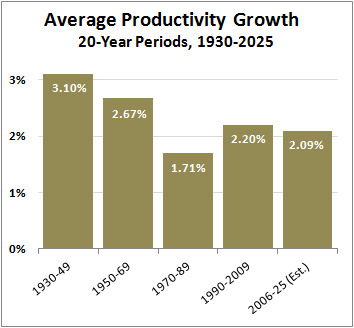
    Maybe so, though I continued to be pretty skeptical of Friedman’s rosy projections. So I decided to take another look at historical productivity figures to back myself up. This turned out to be far more difficult than I expected. You can get productivity figures from the BLS, the OECD, and from various academic estimates, and they’re all different. And none of them go back further than 1950 or so. Still, after an eye-blurring bit of work powered by dexamethasone, I came up with fairly reasonable estimates averaged from a few sources, including my own homebrew calculations. Then I broke them up into 20-year buckets, because you frequently see productivity fall and then make up ground when you look at more than just a few years at a time. For the final bucket, I averaged actual numbers from 2006-15 with Friedman’s estimate for 2016-25. You can see the result on the right.

    And it turns out that…Friedman isn’t projecting anything wildly out of the ordinary after all. However, I’d caution about two things. First, my productivity numbers might be wrong. Probably not by a lot, but maybe by a modest amount. Second, the final figure for 2006-25 assumes that Sanders’ programs can make up for the unusually dismal productivity numbers of 2006-15. I think there are good reasons to doubt that. Nonetheless, given past history it’s not insane to think it might happen if we implemented a pretty massive spending and stimulus program.

    I dunno. Maybe you’re interested in this, maybe not. I’m still pretty skeptical myself since different ways of looking at the data make Friedman’s projections look a lot less plausible. In any case, I’m sure that qualified economists will weigh in with more sophisticated evaluations fairly soon. But I set out to take another whack at these projections, and I didn’t really get what I expected. So I figured I should share.

  • Hillary Clinton Needs to Explain Why Young Voters Don’t Need a Rebel


    Over at the LA Times, Cathleen Decker says that timing is a big deal in politics, and Hillary Clinton’s timing is rotten:

    She’s running a campaign for president on the argument that she is the most carefully prepared, judiciously educated candidate for the White House — at a time when many voters want to cast their lot with newcomers.

    ….Clinton heard it Thursday night, most painfully from one of her supporters….“We need a rebel,” a college student and supporter told the candidate, in explaining Clinton’s persistent problems with young voters. “My generation is a little wary of placing another politician in the White House. With your tenure in politics, how are you going to deserve our vote?”

    If you are Hillary Clinton, how do you answer that?

    I’m generally pretty skeptical of amateur speechwriting, which too often simply assumes that what a politician should really say is whatever the amateur speechwriter happens to believe. Maybe I’m about to do that too. But here’s roughly what I think she should say:
    A rebel? No, that’s not what we need. What we need is a revolution.

    But how do we get that? FDR got one. But he was no rebel: he was a rich patrician from the Hudson Valley. LBJ got a revolution, and he was no rebel either. He was a mainstream Democrat from Texas who loved to wheel and deal. Barack Obama got a mini-revolution, and do you think he’s a rebel? He’s not. He’s a pragmatic, evidence-driven, modern progressive.

    So where did these revolutions come from? Listen to a few numbers. When FDR was elected in 1932, he got a Congress to die for: 60 Democratic senators who could power through almost any filibuster and a 71 percent majority in the House. In 1964 LBJ got 68 senators and 68 percent of the House. In 2008, Obama got 60 senators and 59 percent of the House.

    What does that mean for young voters—or anyone else who wants to shake up the political establishment? It means we need a 50-state strategy—along with 50 states of grindingly hard work from the bottom up—to elect big Democratic majorities to Congress. And to go with that, we need a president who’s not only obsessive about pitching in to this tough slog from the top down, but knows how to work with Congress—including the few Republicans we’ll probably still need—to get things done.

    That’s not Bernie. God love him, but he just isn’t much interested in getting more Democrats in Congress. Last quarter I raised $18 million to help Democrats get elected this cycle. Bernie raised nothing. Bernie has no real interest in a 50-state strategy. I do. Over a 25-year career in Congress, Bernie has accomplished virtually nothing—because he’s always been more interested in playing the gadfly than in building majorities for change.

    If you want a revolution, don’t fall in love with someone who talks big. Fall in love with someone who cares about the same things you do and knows how to get them done. And help us get a Democratic Congress. It’s not sexy, but that’s where revolutions are born.

    None of this is new ground for Hillary. She’s been calling herself a “progressive who likes to get things done” for a long time. She just needs a convincing elevator speech that really contrasts her favorably with Bernie on this score. Maybe not my little invention, but something along these lines.

  • Friday Cat Blogging – 19 February 2016


    Today we have bunk bed kitties. Among felines, I’m not sure whether the alpha gets the top bunk or the bottom bunk. Since they usually like hiding in nooks and crannies, I’m guessing bottom bunk. Other evidence corroborates this. Hopper used to let Hilbert bully her, but lately she barely even opens an eyelid when he tries to push her around. And sure enough, he just sadly backs away. Poor thing. He used to think he was the toughest mammal in the house, but time has taught him otherwise.

    Also, Hopper bit his ear a few days ago. If that doesn’t get the message across, I don’t know what will.

  • Ted Cruz Wins the Family Values Endorsement


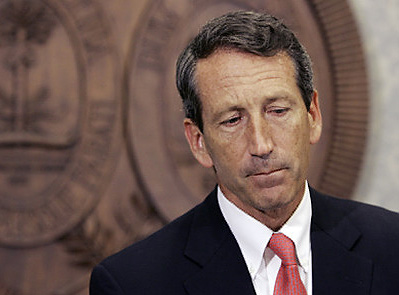
    Exciting news! Former South Carolina governor Mark “Appalachian Trail” Sanford has endorsed….
    Ted Cruz! This is quite a coup. As you no doubt remember, Sanford demonstrated his commitment to traditional Republican values by starting up an extramarital affair; disappearing to Buenos Aires for a six-day vacation with his beloved; telling his spokesman to claim that he was gone because he was “hiking the Appalachian Trail”; and then tearfully admitting his affair and claiming that he had found his “soul mate.” He subsequently got divorced, and later on broke up with his soul mate.

    In fairness, the generous folks of South Carolina decided to elect him to Congress in 2013. So I guess all is forgiven. Certainly Ted Cruz has forgiven him.

  • Obama Kept His Immigration Reform Promise to Latinos in the Only Way That Actually Matters in Politics


    Dara Lind reports that young Latinos are torn between Bernie Sanders and Hillary Clinton. But not because of anything either candidate has said:

    Instead, the president on their mind is Obama. They’re still wrestling with his failure to keep his campaign promise to pass immigration reform, and the record deportations of his first term.

    ….”My biggest fear,” says Jocelyn Sida of the civic engagement group Mi Familia Vota, “is that the mentality of Latinos is going to be all about broken promises, don’t trust any candidate or campaign.”…Sida’s reference to “broken promises” is right on. For many — especially for young Latinos, many of whom came of political age during the Obama administration — the outgoing president is associated with the promise he made, then broke, on immigration reform, as well as the deportations that took place in its stead.

    There are lots of obvious things to say before I comment about this. I’m not young. I’m not Latino. I’m not idealistic. And I’m a pretty big fan of Obama. So I have my own biases.

    And yet…there’s still something dispiriting about this. Did Obama break his promise to introduce comprehensive immigration reform in his first year? Yes indeed. He says it was because the economy had collapsed and he had to spend all his time dealing with that. But no one really buys that. The stimulus bill passed pretty quickly, and during the rest of his first year Obama found time to deal with health care, Afghanistan, General Motors, climate change, touring the Middle East, and plenty of other things. Was he really so busy that he couldn’t spend some time on immigration reform?

    The answer is that Obama is skirting the truth here—but, oddly for a politician, not in a way designed to make him look better. The real truth is that during an epic unemployment crisis he had no chance of getting the votes to pass immigration reform. So like any president, he triaged. He spent his time on other things in hopes that he could make a successful run at immigration reform a little later. Was this the right call? We’ll never know, but it sure strikes me as correct.

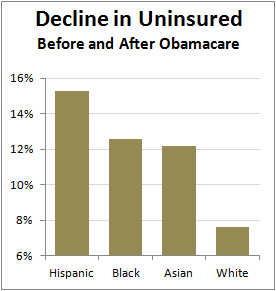
    In the end, of course, disaster struck: Democrats lost their House majority in 2010, and even with a strong enforcement record (all those deportations) and Republican support, immigration reform could no longer pass. But this is hardly the end of the story. Obama signed the mini-DREAM executive order in 2012. He worked hard to pass comprehensive reform in 2013. He signed another historic executive order in 2014 aimed at immigrant adults. And although this is seldom given much attention, the biggest beneficiaries of Obamacare have been Hispanics.

    So did Obama break his promise? Yes. Should young Latinos be demanding that the next president make immigration reform a priority? Yes. That’s how you get things done.

    But should they feel betrayed by Obama? I don’t think so. The nutshell version is this: Every president has to decide which of his priorities can pass Congress. If Obama had tried to push immigration reform in 2009, it almost certainly wouldn’t have passed, no matter how hard he had pushed. That’s the fault of reality, not presidential willpower. So, as Obama so often does, he waited. He waited for the economy to improve, and in the meantime he tried to set the stage for success with a strong enforcement record—even at the expense of losing political support from an important voting bloc. When the time came, he worked with Republicans and came close to passing something. But the House balked and it failed.

    None of this would have changed if Obama had barreled ahead in his first year. He would have lost just as badly, but two other things would also have happened. First, some of his other first-year initiatives would likely have fallen by the wayside. Second, he would have had a big, symbolic losing fight to his name. That would have done him a world of good in the Hispanic community, but he wasn’t willing to go down that cynical path.

    I’m not young. I’m not Latino. I’m not idealistic. But I don’t consider it a betrayal to have a president who shows me the respect of foregoing the cheap and cynical political stunt in favor of a longer, tougher, but more realistic chance of getting something actually done.

  • One Last Look at the South Carolina Polls Before Tomorrow’s Primary


    South Carolina Republicans go to the polls tomorrow to coronate Donald Trump. Or do they? The latest NBC/Wall Street Journal poll says Trump’s lead has narrowed, but that’s just one poll. For what it’s worth, here are the latest Pollster aggregates for the race. Marco Rubio is closing in on Ted Cruz! Kasich is making a late run! Jeb Bush is screwed! And Trump just seems to keep cruising along. Life is weird.