• Your Boss Wants You to Think Twice About That Back Surgery


    Corporations typically use data mining of personal information in order to sell more stuff to their customers. However, corporate wellness programs are mostly used in an effort to sell less stuff to their employees. For example:

    Based on data such as an individual’s history, the firms can identify a person who might be considering costly procedures like spinal surgery, and can send that person recommendations for a second opinion or physical therapy.

    Spinal surgery, which can cost $20,000 or more, is another area where data experts are digging in. After finding that 30% of employees who got second opinions from top-rated medical centers ended up forgoing spinal surgery, Wal-Mart tapped Castlight to identify and communicate with workers suffering from back pain.

    To find them, Castlight scans insurance claims related to back pain, back imaging or physical therapy, plus pharmaceutical claims for pain medications or spinal injections. Once identified, the workers get information about measures that could delay or head off surgery, such as physical therapy or second-opinion providers.

    So what do you think? Programs designed to lower health care costs are a good idea. Providing useful health information to employees is a good idea. But how about providing information specifically designed to influence a course of treatment? Is this an attempt to steer employees away from fly-by-night doctors who recommend back surgery for everyone? Or just another green-eyeshade attempt to persuade employees to forego expensive procedures?

    Hey, those are good questions! Answers will be forthcoming some day.

  • Judge Orders Apple to Help FBI Crack San Bernardino iPhone


    A federal judge wants Apple to build a “back door” that allows it to access encrypted data on the iPhone belonging to the San Bernardino attackers. Apple is resisting:

    The order, signed Tuesday by a magistrate judge in Riverside, Calif., does not ask Apple to break the phone’s encryption but rather to disable the feature that wipes the data on the phone after 10 incorrect tries at entering a password. That way, the government can try to crack the password using “brute force” — attempting tens of millions of combinations without risking the deletion of the data….Federal prosecutors stated in a memo accompanying the order that the software would affect only the seized phone.

    In theory, this should be little more than a macabre joke. If Apple is truly using strong encryption, it wouldn’t take ten million tries to crack the password, it would take more tries than there are atoms in the universe.

    Unless, of course, the attackers are really stupid and used “123456” or “Jihad Forever” as their password. Which they very well might have. Folks like this aren’t always especially bright.

    In any case, I find it hard to side with Apple here. It’s one thing for Apple to implement strong encryption that even Apple itself can’t break. It’s another to deny law enforcement the ability to even try to break the encryption. My initial reaction—which I admit might change if I think about this further—is that liberals have never opposed the right of the government to execute a search. We just want them to get a warrant first, and we want it particularized to a specific case. So we object to warrantless searches and we object to mass collection of surveillance data. A court order that applies to a specific case shouldn’t be a problem.

    Apple, of course, is arguing that if they create a special FBI version of iOS, it can be used anytime and anywhere, with or without a warrant. So that’s the question for the court. If they compel Apple to create a version of iOS that can be hacked, are there legally enforceable restrictions on its use? Or does it become a permanent plaything for anyone who can issue a national security letter—which appears to include practically the entire FBI? This will be an interesting case going forward.

  • MSNBC Embarrasses Itself Yet Again


    As John McEnroe might say, you have got to be kidding me:

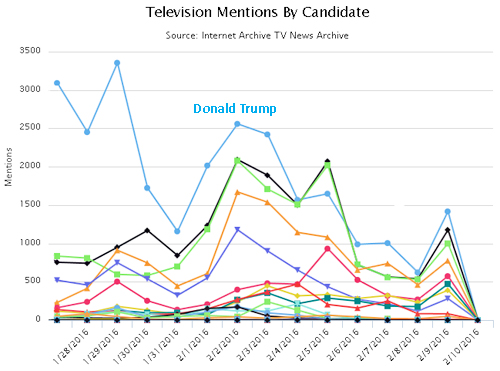
    This is just what the world needs: assisting Donald Trump yet again in his eternal quest for more television air time. This particular lovefest-cum-fuck-you is being hosted by one of his biggest fans, and is scheduled directly opposite the CNN town hall with Carson, Cruz and Rubio.

    Look, I get it: ratings are everything, and Trump pulls ratings. But surely TV executives still have a sliver of self-respect left? Were they afraid they hadn’t mentioned Trump enough in February, and he might get mad at them?

  • Ted Cruz Is New Winner in Richie Rich Tax Contest


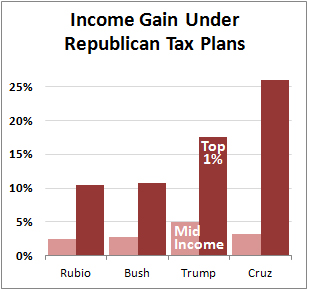
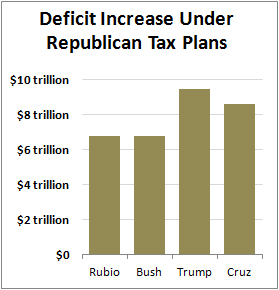
    Hooray! The Tax Policy Center has analyzed Ted Cruz’s tax plan, which means we now have data for all of the top four Republican candidates: Donald Trump, Jeb Bush, Marco Rubio, and Cruz. Click the links for details. Or just look at the charts below for the nickel summary.

    Folks, Ted Cruz is killing it. The other guys are touting tax plans that give paltry income gains to the middle class and big income gains to the rich. Cruz gives the usual paltry sop to the middle class, but incomes of the rich would skyrocket 26 percent under his plan. 26 percent! That’s what I call a tax plan.

    Trump is still the winner in the budget-busting contest, but Cruz is close. His plan would increase the deficit $8.6 trillion over ten years. Overall, I have to say that Cruz is bringing his A game. If you calculate his Richie Rich Index™—percentage deficit increase plus percentage income increase for the rich—Cruz clocks in with a score of 87.4, beating out Trump by a hair. Congratulations, Ted.

  • Always Bring a Nuke to a Knife Fight

    Yesterday Donald Trump finally went ballistic over Ted Cruz’s attacks against him. After listing half a dozen alleged lies, he made this threat:

    One of the ways I can fight back is to bring a lawsuit against him relative to the fact that he was born in Canada and therefore cannot be President. If he doesn’t take down his false ads and retract his lies, I will do so immediately.

    The great thing about this is that Trump doesn’t even bother pretending that he wants to sue Cruz because he truly believes Cruz isn’t a natural-born citizen. He just flat-out admits that he plans to do it as revenge for Cruz being mean to him. The Golden Rule here is simple: “They pull a knife, you pull a gun. He sends one of yours to the hospital, you send one of his to the morgue.”

    This appears to be a considerable source of Trump’s appeal. His supporters don’t care much about actual political positions; they care about having a mean SOB in office. They probably like Trump more because he’s going after Cruz out of anger rather than as a matter of principle.

  • California Conservatives Are Still Idiots


    California conservatives are idiots. Check this out:

    The state’s powerful agriculture industry and its political allies are gathering signatures for a November ballot initiative that would grab bond money earmarked for California’s bullet train and use it instead for new water projects.

    You all know how I feel about the LA-San Francisco bullet train. I don’t know how I feel about a bunch of new water projects, but there’s a decent chance I’d vote for an initiative like this just to kill the train boondoggle once and for all. Except for this:

    In addition, the measure would make substantial changes to state water law via a constitutional amendment, setting domestic water use and irrigation as the first- and second- highest priorities — ahead of environmental conservation.

    ….Jim Earp, a member of the California Transportation Commission who led the rail bonds campaign, said the water measure could have a difficult time because its backers were greedy. “They have basically a deeply flawed measure,” Earp said. “They couldn’t resist overreaching. They couldn’t resist the temptation to rewrite water laws to benefit corporate farmers who are going to underwrite the campaign.”

    The eminent domain folks made the same mistake a few years ago, and they made it twice. Instead of trying to pass a simple measure that would have barred eminent domain for private projects—which I would have voted for—they couldn’t resist larding up their measures with a bunch of wish-list provisions from libertarians and property developers. So they lost.

    I predict the same thing here. The bullet train isn’t popular these days and water is a big concern. That’s a handy confluence of events for the ag industry. But they couldn’t stay content with just raiding a bit of money for water projects. They’re so furious about their water supply being restricted by a bunch of starry-eyed greens that they had to toss in a provision directly targeted at environmental concerns. But like it or not, Californians care about the environment, and they’re not likely to approve this nonsense. So the initiative will go down. Idiots.

  • Raw Data: Fewer Blacks Are Going to Jail These Days


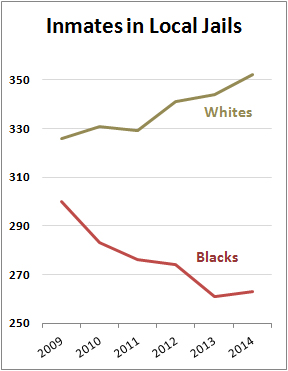
    Last week Keith Humphreys noted something interesting: although incarceration rates have gone down recently, the absolute level of white incarceration has risen while the absolute level of black incarceration has fallen. But that’s for prisons. What about local jails?

    Same thing, it turns out. Since 2009, the number of white jail inmates has gone up by about 30,000 while the black jail population has gone down by 40,000. Humphreys comments: “In short, if you broaden the lens of analysis from prisons to include jails, the patterns I wrote about are even stronger: Being behind bars is becoming a less common experience for African-Americans and a more common experience for non-Hispanic Whites.”

    I don’t quite know what this means, but it’s an interesting tidbit of data. Blacks are still in jail (and prison) at a higher relative rate than whites, but since 2009 that’s at least starting to reverse a little.

  • People in the Northeast Sure Do Love Their Landlines


    At the LA Times, Michael Hiltzik writes:

    Although customers have been rapidly abandoning their landline phones for wireless and Internet-based service, more than 18% of California households still relied on landlines for all or most of their phone service as of 2012, according to federal government estimates.

    Huh. Only 18 percent? That’s a lot lower than I would have thought. And that got me curious. Which states have the highest percentage of households that have given up on landlines completely? Which states have the lowest percentage? Here’s the answer:

    I don’t see much connecting the top ten. I guess they’re a little more rural than average, but that’s about it. The bottom ten, however, are exclusively from the northeast. And more recent surveys confirm this: At the end of 2014, about 30 percent of households in the northeast were wireless-only compared to 50 percent in every other region. That’s a pretty big difference.

    This is just idle curiosity, but I wonder what the deal is here? Something regulatory? Why would the entire northeast be so dedicated to their landlines?

  • Democrats Will Be Fighting the Ghost of Robert Bork This Year


    Let us speak of Robert Bork. I promise that I have a point to make with this.

    If you read mainstream coverage of the political fallout over Antonin Scalia’s death, you won’t see Bork mentioned much. But you should, because his defeat for a Supreme Court vacancy in 1987 remains absolutely central to contemporary Republican views of the Supreme Court and is largely responsible for their longstanding bitterness over the direction of the court.
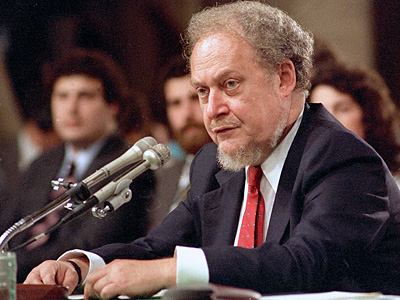
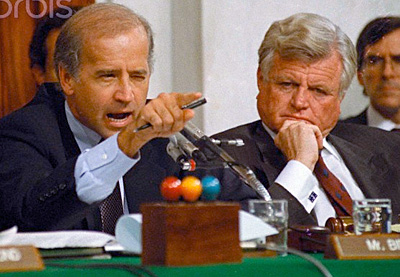
    When Democrats think of Bork, it’s primarily as a reactionary anti-abortion zealot who richly deserved to be voted down in the Senate. Republicans decidedly don’t. They regard him as a brilliant legal scholar1 who was eminently qualified to serve on the Supreme Court until he was torpedoed by disgracefully unscrupulous attacks from Teddy Kennedy and Joe Biden. Bork may not have been the first Supreme Court nominee to be rejected by the Senate, but he was the first during the politically charged post-Roe era, and the first to be rejected on a nearly party-line vote over ideology, rather than scandal.

    That seat eventually went to Anthony Kennedy, who turned out to be a centrist conservative. Two years later, partly to avoid another Bork-like conflagration, George H.W. Bush nominated David Souter to an empty seat. But Souter turned out to be a liberal. The year after that, Bush nominated Clarence Thomas, who was confirmed—but only barely and only after an epically ugly fight.

    That four-year period from 1987 to 1991 dominates the way Republicans think about the Supreme Court. It represents two things to them: that Democrats have no qualms about waging scorched-earth campaigns of utter ruthlessness, and that Republicans need to be unceasingly alert to weak-kneed betrayal from allegedly conservative court nominees. This trauma runs very deep, and Democrats simply don’t have anything like it in their recent history. Since Roe, Democratic presidents have nominated four justices, and all four have been confirmed with only the usual amount of political squabbling and partisan trash talk. The Republican attacks on Sotomayor and Kagan were patty-cake compared to Bork and Thomas.
    Because of this history, Republicans are much more sensitive to Supreme Court politics than Democrats. You can see this in the peculiarly common belief on the right that John Roberts is a conservative traitor because he voted to uphold Obamacare.2 It doesn’t matter that his reasoning was perfectly sound. He voted the wrong way, and that immediately roused memories of Kennedy and Souter and judicial betrayal.

    In the same case, both Elena Kagan and Stephen Breyer voted to uphold limits on Medicaid expansion. How did Democrats react? Basically with a yawn. Most of them vigorously disagreed with Kagan and Breyer, but that was it. Nobody suggested they were traitors to the cause.

    And now—finally!—for the point I promised to make: What all this means is that Republican voters are likely to be more fired up by the Scalia vacancy than Democrats. And they’re going to stay fired up by Fox News and the rest of the gang. If Democrats want to match this, they’re going to have to really work at it. My guess is that the Supreme Court fight is good for a 1-2 percent increase in Republican turnout this November. It’s not clear to me if Democrats can match this.

    1He was.

    2Donald Trump channeled this common view when he recently said Roberts “turned out to be a nightmare for conservatives.”


  • A Mixed Story on Health Care Spending


    CORRECTION: My “corrected” chart is all wrong. Click here for both an explanation and the proper chart.


    Katherine Hempstead of the Robert Wood Johnson Foundation is optimistic about the growth of health care spending:

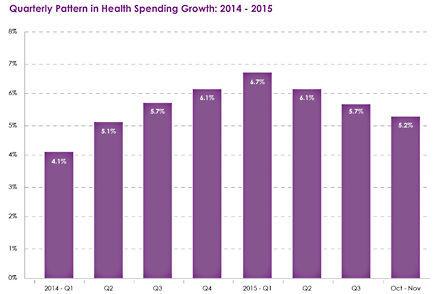
    The quarterly trend in overall health spending growth using the Altarum Health Spending Economic Indicators series shows a clear peak in Q1 2015 at 6.7 percent, with subsequent declines every quarter. Partial data for Q4 (October and November) show a spending growth rate of 5.2 percent. While overall spending growth in 2015 will clearly exceed that of 2014, a reduction appears to be underway.

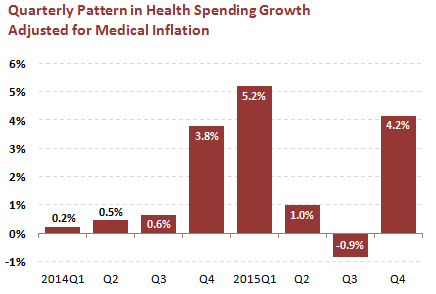
    As near as I can tell, this spending data hasn’t been adjusted for inflation. When you do that you get the chart at the bottom, which tells a different story. There was indeed a peak in the first quarter of 2015 followed by a sharp drop, but spending growth has gone up since then.

    In the long term, I’m fairly optimistic about the trajectory of health care spending. As Hempstead says, it makes sense that we saw some large increases when Obamacare was first implemented, since it brought a lot of new people into the health care system. But after the first year or two, that will flatten out and long-term trends should continue to dominate.

    That said, you still need to look at this stuff in real terms. And when you do that, we’re not quite seeing the steady downward march that Hempstead suggests.

    UPDATE: I originally used overall CPI to adjust the health spending numbers, but it’s probably better to use just the medical component of CPI. I’ve modified the chart to reflect this.