• NYT: We’ve Figured Out How Trump Gamed the Tax System


    A few weeks ago the New York Times got hold of the first page of Donald Trump’s 1995 tax return. It showed a net operating loss of $916 million, which Trump was able to use to offset his income over the next 20 years, thus avoiding millions of dollars in income taxes. But while solving one mystery, it opened another: Just exactly how did Trump manage to declare such a big loss? Several theories made the rounds, but the Times now thinks it has the answer, thanks to a cache of “newly obtained documents.” Here’s the nutshell version of the Times’ explanation:

    • Trump was a terrible businessman and lost a huge amount of money on his casino operations in the early 90s.
    • As part of his bankruptcy negotiations in 1991, he persuaded banks to forgive hundred of millions of dollars in loans.
    • Forgiven loans count as “Cancellation of Debt” income, which should have offset his huge operating losses. But somehow they didn’t. Why?
    • The Times says it was because Trump used a legally dubious “equity-for-debt” swap. Basically, he swapped the bonds he couldn’t pay for new bonds that he classified as equity shares in the casino partnership.

    The Times makes a good case that Trump’s own tax lawyers told him this plan was extremely risky (see the excerpt from the official tax opinion on the right) and would most likely be disallowed by the IRS. But we don’t know if it was. The trail stops cold in 1995.
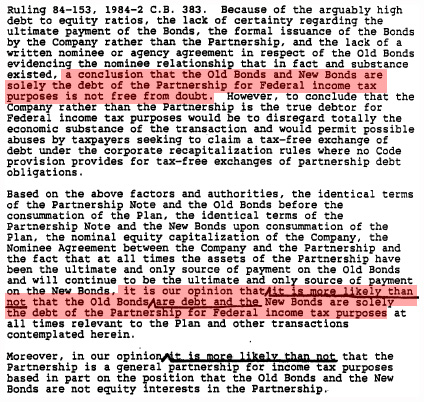
    If I’m reading this right, the basic story is that Trump gave his banks “New Bonds” in place of their old bonds and classified the new bonds as equity shares in the casino partnership. Trump then valued the equity as equal to the old debt, thus showing no net loan forgiveness and therefore no COD income. This despite the fact that, in reality, the equity was close to worthless.

    So Trump then had $916 million in operating losses, but no debt forgiveness to offset it. “Even in the opaque, rarefied world of gaming impenetrable tax regulations,” says the Times, “this particular maneuver was about as close as a company could get to waving a magic wand and making taxes disappear.”

    At this point, the question of how Trump gamed the tax system is mostly a matter of academic interest. Still, I’ve written about this before, and figured I should follow up with the latest theory. And this is it.
  • No, Trump Didn’t Do Best in “Rapidly Diversifying” Counties


    The Wall Street Journal reports that Donald Trump is doing especially well in places where white majorities are dwindling:

    Small towns in the Midwest have diversified more quickly than almost any part of the U.S. since the start of an immigration wave at the beginning of this century. The resulting cultural changes appear to be moving the political needle.

    That shift helps explain the emergence of Republican presidential nominee Donald J. Trump as a political force, and signals that tensions over immigration will likely outlive his candidacy….Mr. Trump won about 71% of sizable counties nationwide during the Republican presidential primaries. He took 73% of those where diversity at least doubled since 2000, and 80% of those where the diversity index rose at least 150%, the Journal’s analysis found.

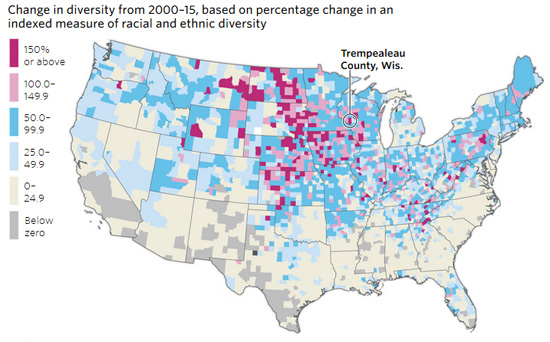
    Hmmm. I’m no political scientist, but I play one on the internet—and 71 percent vs. 73 percent sure doesn’t sound like a very substantial effect to me. Trump’s 80 percent win rate in counties where diversity rose by 150 percent is slightly more impressive, but the sample size is pretty low. Here’s the diversity map:

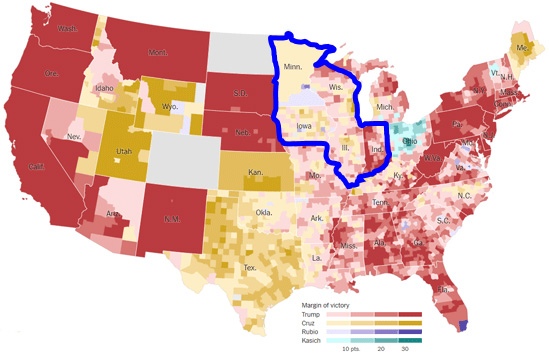
    The Journal identifies a “distinct cluster of Midwestern states—Iowa, Indiana, Wisconsin, Illinois and Minnesota” that saw the fastest influx of nonwhite residents. So let’s take a look at who those states supported in the Republican primaries:

    That sure doesn’t look like a region where Trump kicked any special ass. In fact, aside from his home territory in the mid-Atlantic states, he did best in the South, which has seen virtually no change in diversity according to the Journal’s map. White folks there have been living among nonwhites for a long time, and they were completely in love with Trump.

    I wonder what accounts for that? Economic anxiety, perhaps?

    Unemployment is actually lower in rapidly diversifying counties than in the country on the whole, a sign that concerns over lost jobs are weighing less on voters in these areas….Craig Williams, chairman of the Carroll County Republican Party, said it is the lawlessness of illegal immigration that bothers residents. “People talk about immigration as if we’re a bunch of racists,” he said. “Do we have laws, or do we not have laws? If we’re just going to ignore them, then what’s the point?”

    It’s a chin scratcher, all right. I guess we’ll never know.

  • Will Orange County Finally Turn Blue This Year?


    Orange County, California. Conservative suburbia. Reagan country. Ground zero for decades of cold warrior political domination. And above all, a reliable generator of Republican votes and Republican fundraising. But just as the demographics of America have been changing, so have the demographics of this famous conservative bastion:
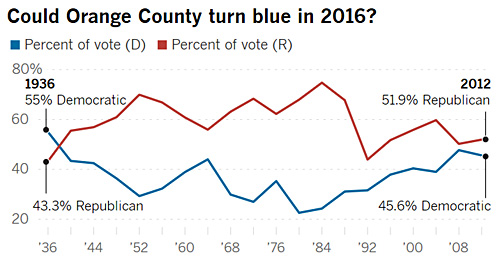
    In 1990, whites made up nearly two-thirds of the county’s population. Now, they are a minority. The county’s Latino and Asian populations have grown enormously—some in low-income neighborhoods, particularly in Santa Ana, but many in newly diverse, affluent communities.

    As the region has grown more diverse, GOP margins have narrowed…Trump’s disparaging rhetoric about Mexicans and Muslims, his breaks with past Republican stands on trade and the overall tone of his campaign seem likely to create the final tipping point this month.

    There are only seven days to go before we find out if Trump manages this historic task. It would be fitting if he’s the one to put the final nail in the coffin of 80 years of GOP domination of my hometown. Only seven days!

  • Press Corps Goes Crazy For Russia Today


    Harry Reid may be a loose cannon, but never say he can’t spur people to action. In 2012 he blandly declared that a friend of his told him that Mitt Romney had paid no income tax for ten years. Reid’s friend may or may not have been imaginary, but a few weeks later Romney released his 2011 tax return along with topline information for the previous two decades.
    Yesterday Reid followed up this triumph by writing a letter to FBI director James Comey accusing him of withholding “explosive” information about close ties between Donald Trump and the Russian government. Is this true? Who knows? But Reid sure has sparked a firestorm of activity:

    • CNBC reports that Comey opposed having the FBI’s name on a report accusing Russia of interfering with US elections. “He believed it to be true, but was against putting it out before the election,” said CNBC’s source. That’s odd in light of the fact that Comey released much more damaging information about Hillary Clinton a mere 11 days before the election.
       
    • Our own David Corn reports that a “former senior intelligence officer for a Western country” says that he informed the FBI in July that the Russian regime has been cultivating Donald Trump for five years. “Aim, endorsed by PUTIN, has been to encourage splits and divisions in western alliance,” the former spy said in a memo. He claimed that Russian intelligence had “compromised” Trump during his visits to Moscow and could “blackmail him”:
       

      The former intelligence officer says the response from the FBI was “shock and horror.” The FBI, after receiving the first memo, did not immediately request additional material, according to the former intelligence officer and his American associates. Yet in August, they say, the FBI asked him for all information in his possession and for him to explain how the material had been gathered and to identify his sources. The former spy forwarded to the bureau several memos—some of which referred to members of Trump’s inner circle. After that point, he continued to share information with the FBI. “It’s quite clear there was or is a pretty substantial inquiry going on,” he says.

    • NBC News reports that the FBI is conducting a preliminary inquiry into the “foreign business connections” of Paul Manafort, Trump’s former campaign manager.
       
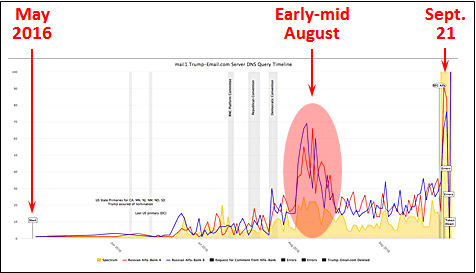
    • Frank Foer reports on the very peculiar transmissions between a Trump computer and a computer owned by Alfa Bank—a Russian bank run by oligarchs close to Vladimir Putin. The transmissions began early this year, peaked in early August, and then abruptly ceased a few weeks ago when a New York Times reporter began inquiring about them.

    So that’s the Russia news of the day. Is it newsworthy, or just a bunch of ungrounded speculation? Nobody knows! And we probably won’t find out before Election Day. It’s all going to hang like a dark cloud over the final week of the campaign, ominous but ultimately unknowable. Exciting, isn’t it?

  • Donna Brazile Is the Worst Mole in History


    Donna Brazile has been let go as a CNN analyst because she leaked a debate question in advance to Hillary Clinton. Earlier this year, before a town hall debate in Flint, Brazile tipped the Clinton campaign that she would be asked about…wait for it…lead poisoning. Needless to say, the whole point of holding the debate in Flint was because of it lead poisoning problem.

    At least we’ve learned one thing this election cycle: Donna Brazile is the worst mole in history.

  • We are a Nearly Perfectly Polarized Nation


    With 8 days left until we elect a new president, Morning Consult decided to poll the American public about the Comeygate emails that nobody has seen and which may or may not even be anything be new. The results are kind of perfect. They asked which is worse: Hillary Clinton’s use of a private email server, or Donald Trump’s comments on women, Muslims, Mexicans, and other minority groups? The answer:
    • Democrats: Trump’s comments, 85-12, percent.
    • Independents: A tie, 44-44 percent.
    • Republicans: Clinton’s email server, 82-10 percent.

    Elsewhere, they asked about Trump’s comment that Clinton’s use of a private server was worse than Watergate. Among Republicans, 82 percent said it was. I wonder if they would have agreed if Trump said it was worse than the Holocaust?

    I do wonder sometimes what these folks think is in these emails. I mean, suppose the worst: Hillary Clinton set up the private server in a deliberate attempt to evade FOIA and allow her staff to delete embarrassing emails. What do they think she would have inexplicably fessed up to on her BlackBerry? The mythical stand down order on Benghazi? That she really did order a hit on Vince Foster? Her plan to take away everybody’s guns once she becomes president? It’s a mystery.

  • What Not to Read During This Year’s Election Campaign


    Even those of us who have read a fair amount of history have plenty of lacunae. After all, a lot of stuff has happened since the glaciers receded and someone accidentally discovered that if you picked the little seedy bits off of some plants and tossed them away, they’d grow into new plants.
    Anyway. A couple of weeks ago I needed something new to read, and the choice came down to a gauzy bit of fiction or a history of Reconstruction. I chose the history. What a mistake. In the middle of a depressing election that’s turning largely on the politics of racial resentment and the loss of white supremacy, I’m taking the occasional breather by reading about possibly the most depressing era in American history—which, of course, turns pretty much entirely on the politics of racial resentment and the loss of white supremacy. And it’s not like this will have a happy ending or some kind of surprise twist. I know how it’s all going to turn out, after all. I think maybe I should have waited.

    Then again, maybe not. Maybe it’s the ideal read during Trumpmania. And with 150 mg of venlafaxine coursing through my body each day, I’m able to remain in a pretty chipper mood regardless. Better living through chemistry, my friends.

  • Is the FBI in an Unseemly Rush to Exonerate Hillary Clinton?!?


    From Rich Lowry:

    And Now the Rush to Say ‘Nothing to See Here’?

    Will the FBI now adopt an obviously election-dictated schedule for reviewing the Abedin emails? From First Read:

    NBC’s Pete Williams reports that it’s possible the FBI’s review of the emails could end quickly….“Officials say there’s no way to tell how long that will take. But they say if it goes quickly, and nothing classified is found, the FBI could say so within the next few days. It largely depends on how many of the e-mails are duplicates and how many are new to the investigators.”

    ZOMG! Having released a letter casting suspicion on Hillary Clinton despite having literally no evidence of anything new, the FBI might—might!—publicly exonerate her before the election if they review the emails and find nothing. WHY ARE THEY IN SUCH A RUSH??? Wouldn’t justice be better served by simply letting the FBI’s unfounded suspicion hang over the rest of the campaign?

    Never have I seen anyone so outraged at the prospect of quickly confirming that someone is innocent—something I’m sure Lowry expects since every email story of 2016 has eventually turned out to be hot air. But I think Lowry is being a little too obvious about it.

  • Poll Tightening? Meh.


    If you were a cynical observer and someone asked you what the media narrative would be during the last two weeks of the election, your answer would be simple: Tightening. With Hillary Clinton obviously way ahead and interest waning, reporters would be invested in telling everyone that the race was tightening so that they’d keep reading the news. Sportscasters do this endlessly when they’re faced with trying to keep their audience around during a blowout game.

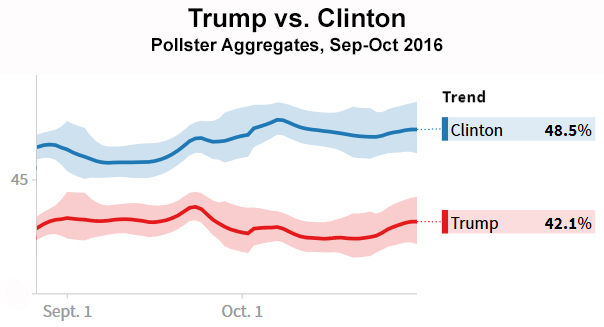
    Believe it or not, I’m not that cynical. And yet, here we are, and everyone is talking about tightening. So why am I not talking about it? Well, take a look:

    Do you see much tightening there? I don’t. Now, as it happens, there actually is a bit of tightening here, maybe half a point or so over the past week. But it’s so small it’s almost invisible even in a big chart.

    Of course, this is just Pollster. Why rely solely on them? There are plenty of other poll averagers out there. The truth is that I don’t have a very good reason for this decision. I initially chose to use them because they produced nice looking graphics that I could manipulate fairly easy to show different time periods, different candidates, different polls, and so forth. Then I kept using them out of a sense that I should be consistent, rather than bopping around from site to site looking for numbers that happen to back up whatever point I wanted to make.

    Of course, I could use The Upshot’s roundup of all the poll averages, and then average those. But enough’s enough. There’s a point at which you’ve squeezed all the information you can out of the lemon.

    So for better or worse, I’m stuck with Pollster. In another week we’ll know how accurate they turned out to be. In the meantime, I’m not seeing much tightening there, and I’m not seeing much more anywhere else—including from Sam Wang, my longtime preferred poll averager when it comes to predictive accuracy. There’s maybe a point of tightening over the past month, maybe half a point, but that’s all. This race has been astonishingly stable for an entire year, and so far it’s staying that way.

  • Inflation Problem Remains Unlicked


    From the Wall Street Journal:

    After being given up for dead, inflation is gradually coming back to life.

    It’s not roaring back. Indeed, it’s still below the 2% level the Federal Reserve targets, one reason the Fed is almost certain to leave interest rates unchanged when it meets this week.

    ….The behavior of inflation-protected bonds suggests that in early July, investors expected U.S. inflation to average 1.4% over the coming decade. As of Friday, that had risen to 1.7%. That is still below the Fed’s 2% target, evidence that investors remain unconvinced the Fed has licked the low-inflation problem.

    The “low-inflation” problem! That’s totally accurate, but did you imagine you’d ever see the Wall Street Journal discussing the problem of inflation being too damn low? For those of us of a certain age, it feels like an alternate universe.

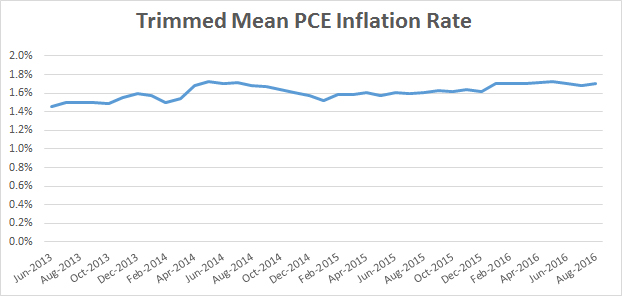
    Anyway, the primary inflation measure used by the Fed is the trimmed mean PCE rate. Here it is. It’s been going up steadily but very slowly for the past few years, but it’s still pretty low and there’s not even a hint of acceleration yet.