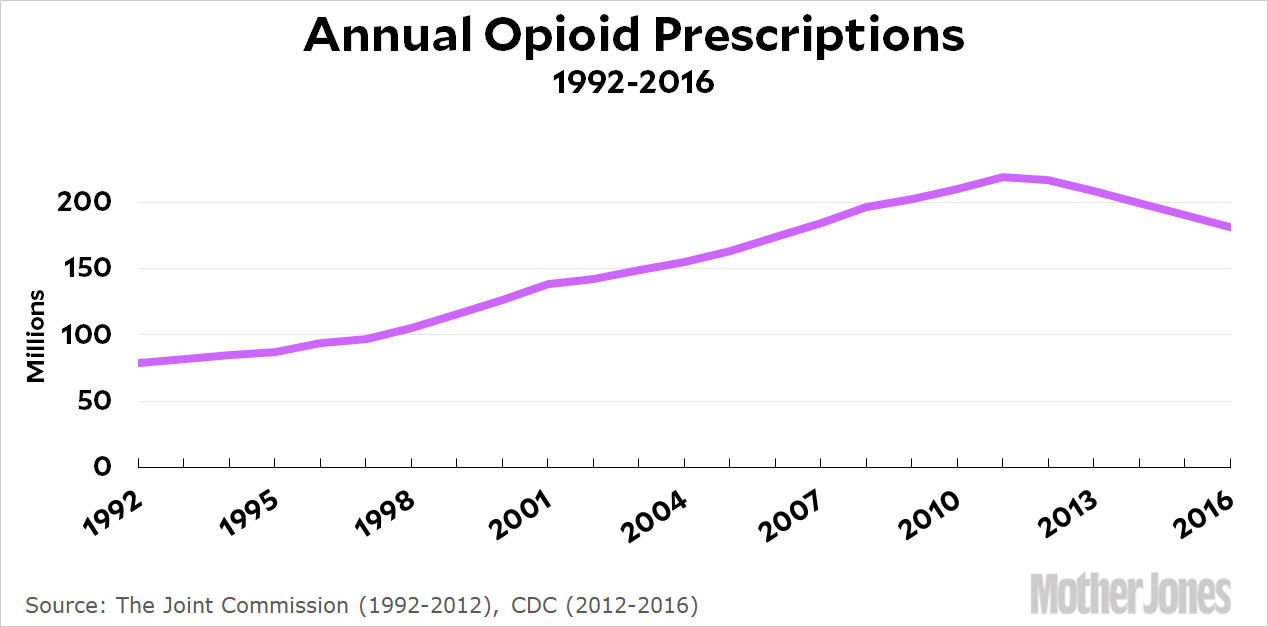
“We started it,” Gawande told me flatly. He argued that health providers are at the root of the country’s staggering opioid epidemic. He didn’t blame the pharmaceutical companies — although there is good evidence that they played a large role — but instead focused on how views of pain began to shift in the 1990s, with doctors urged to take their patients’ suffering more seriously.
The medical profession certainly shares some of the blame for this, but I wouldn’t go as far at Gawande. I’m open to correction on this, but my understanding is that it was really the confluence of three different things:
Doctors. During the 70s and 80s, the medical profession began to get more serious about pain treatment. Several influential articles in medical journals argued that patients who were treated with opioids rarely became addicted, and this contributed to an increased willingness to prescribe them.
Parents. During the 80s and 90s, parents became more insistent about treating pain in their children for things like sprained ankes and broken bones. Instead of aspirin, they wanted Vicodin. This made everyone, doctors and patients alike, more comfortable about using opioids.
Big Pharma. Pharmaceutical companies never bothered promoting morphine because it’s cheap and earns them no money. But when patented opioids like Percocet and OxyContin came onto the market, pain suddenly became a big moneymaker. This required steady introductions of new products as old ones went off patent, and therefore much more aggressive marketing than in the past.
In 2001, this all came together when The Joint Commission, which accredits medical facilities, issued new guidelines on pain:
Pain should be assessed in all patients.
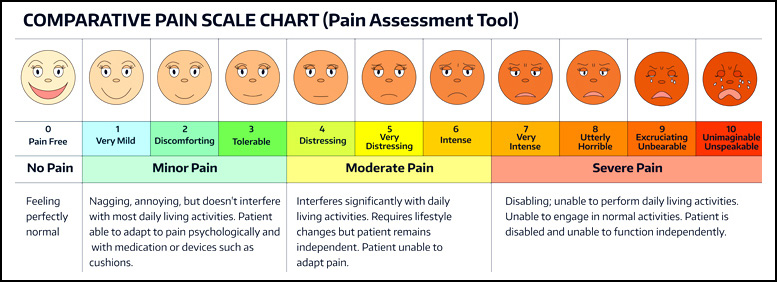
Pain intensity should be evaluated using the now-familiar 1-10 scale, and that scale should be prominently posted everywhere that patients are assessed.
Pain should be managed “aggressively and effectively.”
Patients should be instructed about pain and the importance of effective pain management.
These days, The Joint Commission is eager to disassociate itself from this mess. Last year they issued a statement saying that the 2001 standards never so much as mentioned opioids and certainly had nothing to do with rise in use of opioids. Needless to say, this is special pleading on steroids. It’s true that The Joint Commission didn’t start the opioid epidemic, but they certainly put their blessing on it. And there’s little question that both pharma and doctors lobbied for standards that mandated more aggressive pain management.
But that doesn’t let the rest of us off the hook. Boomer parents also bear some responsibility thanks to their unwillingness to tolerate even moderate pain in their children. Doctors were primed to respond, and even when they were skeptical they often decided that in the face of a demanding parent, the easiest course was just to prescribe an opioid and send everyone on their way. It’s not like the kids are all going to become junkies, right?
The goal now, obviously, is to substantially reduce the routine prescription of opioids for every ache and pain—especially in children and teens—but without making life hell for chronic pain sufferers who genuinely need strong medication. We need to react, but not overreact.
Once upon a time only weirdos like me (and you, dear readers) paid this much attention to politics. I documented the minutiae that most people weren’t aware of. Now everybody knows! Social media has led to a kind of “bleed” such that everybody is aware of all of the stupid shit that once upon a time only weirdos like me (and you!) were aware of. Even if you aren’t that interested in politics, the information comes at you like the Kardashians. I don’t know if this is good or bad. Once upon a time it was easy to tune out politics. Now it is impossible.
I think this is wildly wrong. At a guess, public knowledge of political comings and goings hasn’t changed in decades. The vast, vast majority of people pay only the slightest attention to politics, spending their time instead on soap operas, gossip magazines, kids’ soccer games, problems at work, trying to lose ten pounds, unpaid bills, pro football, the price of hamburger, and the guy down the street with the barking dog. Social media may have pushed politics into people’s faces a little more, but it’s also pushed all that other stuff into people’s faces a little more.
However, this seems eminently measurable. So how about it, political science types? What kind of survey data do we have that measures interest in politics beyond the superficial? What other indicators might provide clues? Turnout rates aren’t up. Small-dollar political contributions are probably up (?), but that’s still a minuscule portion of the population. Total viewership of news programs is probably down. What else?
Over at New York magazine, Jon Chait pushes back against Lee Drutman’s notion that America is trapped in a descent into “doom-loop partisanship.” The problem, Chait says, is far more specific: one of our major political parties is normal while the other has gone nuts.
The Only Problem in American Politics Is the Republican Party
The psychological relationship between the parties has a certain symmetry…. superficial similarity to the terror with which partisans now greet governments controlled by the opposing party…. competing tribal epistemologies…. news media that is open to contrary facts…. no equivalent to a Rush Limbaugh in influence and sheer lunacy….etc.
….The doom loop Drutman describes is, in reality, both sides responding to the phenomenon of Republican extremism. Republicans are sealed off in a bubble of paranoia and rage, and Democrats are sealed off from that bubble. Democrats fear Republican government because it is dangerous and extreme. Republicans fear Democratic government because they are dangerous and extreme.
There’s much more at the link, where Chait describes the asymmetry between the parties well. I don’t disagree with a word he says. However, I want to stress one small qualification. America is a democracy, and parties survive only if they gain popular support. Over the past couple of decades, we liberals have marveled at the steadily increasing lunacy of the Republican Party, confidently predicting at every turn that eventually the fever has to break. But it hasn’t. Republicans have won the presidency at the same rate as usual. They have won the House. They have won the Senate. They control state governments. They control county governments. There are still a few blue enclaves like California where Democrats truly control things, but not many. Generally speaking, the only thing Democrats truly control in America is its big cities. Urban mayors are almost uniformly Democratic.
In other words, the problem is not the Republican Party. The problem is that lots of people vote for the Republican Party. The lunacy will stop when that does.
If you think this comment is pedantic, I submit that you have a deep misunderstanding of politics. Roughly speaking, liberals would do well to forget the Republican Party even exists. Their focus should be almost exclusively on how and why conservatives continue to attract the support of half the American public no matter how crazy they seem to become. Until we figure this out, things are only going to get worse.
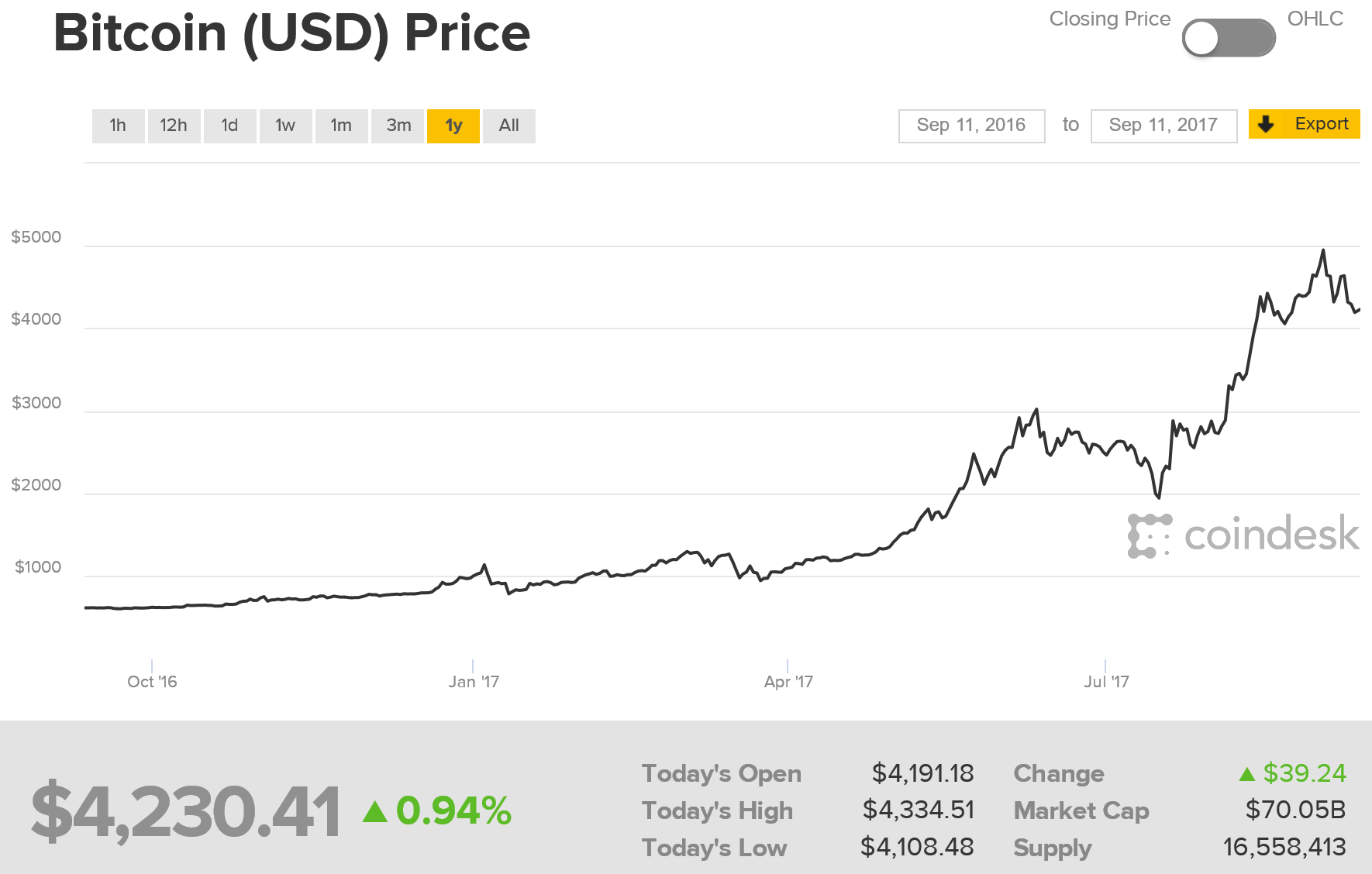
Over the past year Bitcoin has soared in value, largely due to its popularity in China, one of the world hubs of Bitcoin mining and trading. Unfortunately for Bitcoin, the Chinese government is not a fan of cryptocurrencies, which are mostly traded by Chinese citizens who are hedging against falls in the yuan. It’s an extra problem the central government could do without in its longstanding battle to stabilize the yuan and eventually turn it into a fully floating currency.
In the past, the Chinese government has banned Bitcoin transactions at banks and retailers, and more recently it banned ICOs, Initial Coin Offerings. Now it’s going further:
Chinese authorities are ordering domestic bitcoin exchanges to shut down, delivering a heavy blow to once-thriving trading hubs that helped popularize the virtual currency pushing it to recent record highs. China’s central bank, working with other regulators, has drafted instructions banning Chinese platforms from providing virtual currency trading services, according to people familiar with the matter.
It’s still legal to mine Bitcoins and invest in them, but for how much longer? China seems pretty determined to keep Bitcoin from gaining any more traction. Will it work? Or will determined traders figure out a way to keep using Bitcoin regardless? In the past, China’s actions have pushed down the value of Bitcoin for short periods, but it always rebounds, finding ever higher highs. Recently it hit $5,000 before falling to a bit over $4,000:
The latest Chinese action could push Bitcoin down even further. And if it doesn’t, will China get tougher, banning Bitcoin investment entirely? This will be an interesting test of the power of stateless digital currencies vs. the old-fashioned power of real-world governments to control their own territory. As China goes, so goes Bitcoin.
A couple of days ago Amazon announced that it would be opening a “second headquarters” somewhere in the United States. Since then, there’s been a cottage industry in pieces about why some particular city would be great for Amazon.
Knock it off, please. Amazon can google this stuff as well as the rest of us, and they already know which cities are serious contenders. Among those cities, the winner will be whichever one showers them with the biggest bribes.
Alternatively, they literally know the winner already, and the competion is just a ruse to raise the bribe amount from gargantuan to record-shattering.
One way or another, though, it’s all about the bribes. And if you have to ask the price of entry, you can’t afford it.
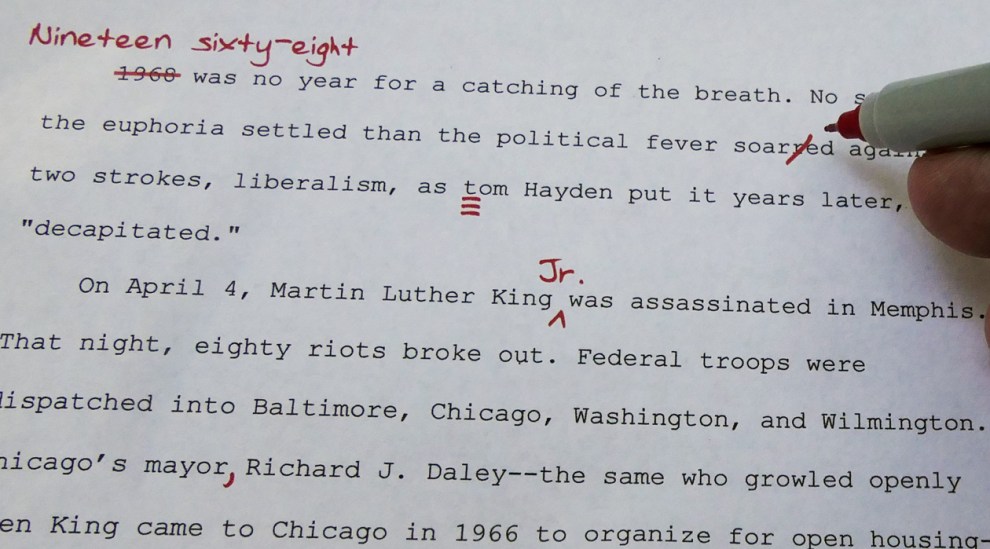
This is a no-no, because you’re not supposed to start a sentence with a numeral. Because of this rule, here’s how that sentence is rendered in Todd Gitlin’s The Sixties:
Nineteen sixty-eight was no year for a catching of the breath.
That sure looks dumb to me. But hey, rules are rules. Whatcha gonna do? I say: change the rule. For one thing, I don’t know where this “rule” came from. Who invented it? Why do we follow it? For example, what’s wrong with the following sentence, which is a pretty common formulation?
69 percent of Americans believe the earth is getting warmer due to human activity. That drops to 23 percent among Republicans.
That seems perfectly readable to me, whereas spelling out sixty-nine doesn’t. That’s because we’re not used to seeing large numbers spelled out, since it’s never done anywhere else. Note that if we abolished this rule it would also solve the idiotic workaround of things like, “Seven in ten Americans believe the earth is getting warmer.” That solves the copy-editing problem, but makes the entire story hard to read and less accurate. Writers end up switching back and forth between percentages and fractions, which is confusing as hell.
Please note that none of this applies to small numbers, which have their own rule: numbers from 0-12 are generally spelled out, while larger numbers are rendered in numerals. So you’d never see, for example, “3 of my friends are coming over to visit.”
Change the rule! Change the rule! Who do I see about doing this?
Yesterday I posted a picture of the moon peeking out from behind the clouds, and wondered aloud about why the clouds had a bit of a red tinge to them. The most common answer had to do with our local wildfires, but this was wrong. I failed to mention that this photo was taken a month ago, and this misled a lot of you. The winning answer involved Science™: it was all due to moonlight filtered by the water droplets in the air. The droplets cause the blue light to scatter, leaving behind the rust-colored tinge.
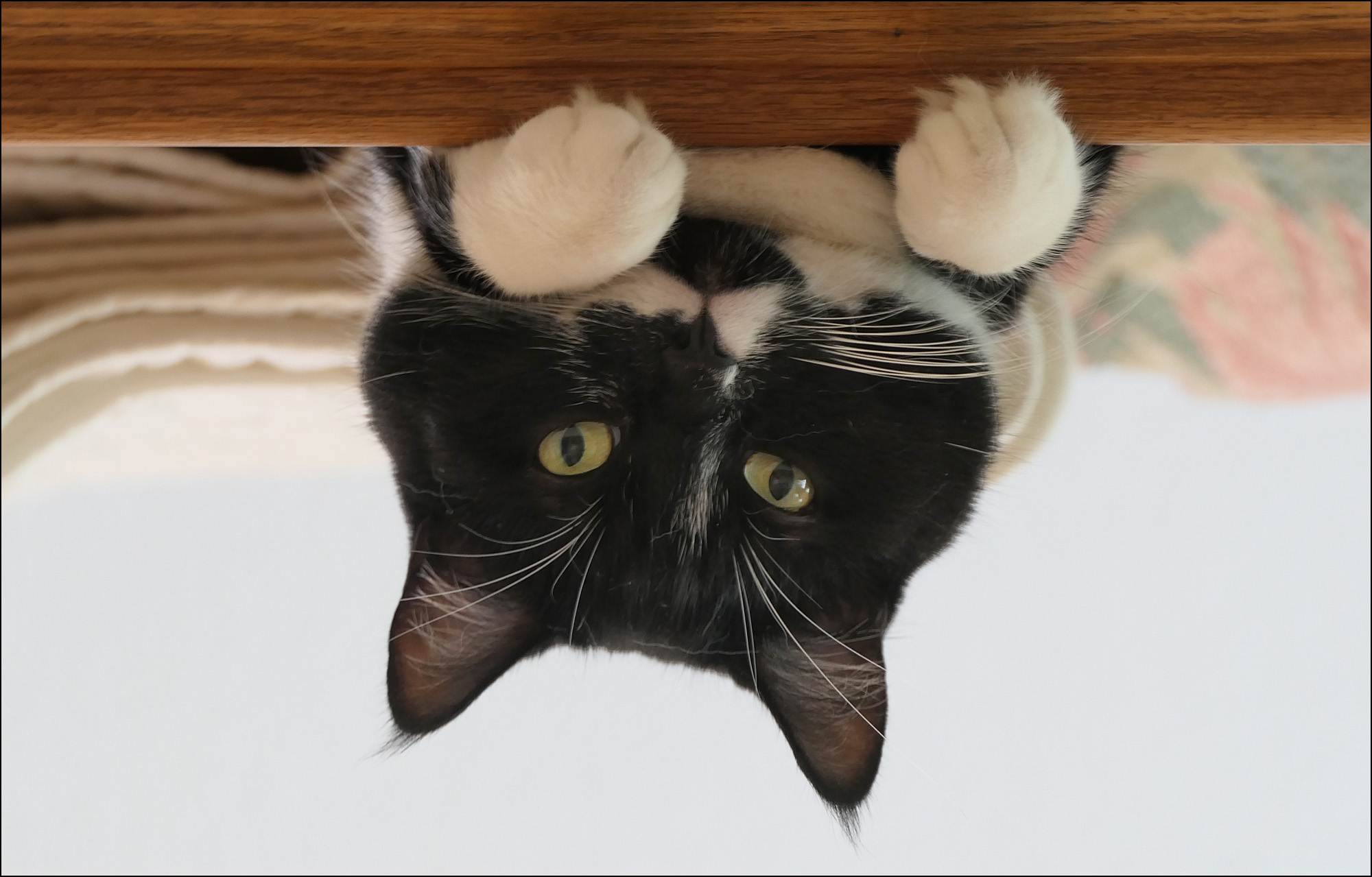
But enough about that. In today’s catblogging, our local cats are back after last week’s kitten blogging. Today’s photo features Hilbert hanging over the second-story balcony to keep an eye on everything happening downstairs. And what was happening? Some suspicious-looking guy with a camera was walking around taking pictures of cats.
A couple of years ago I wrote about an NBER study showing that Fox News induces people to vote Republican. Not too surprising. But now this study is finally being published, so it’s getting renewed attention. Are there any differences between the old and new versions? Well, there’s this:
Old paper: Were a viewer initially at the ideology of the median Democratic voter in 2008 to watch an hour of Fox per week, her likelihood of voting Republican would increase by just over 15 percentage points.
New paper: Were a viewer initially at the ideology of the median Democratic voter in 2008 to watch an additional 3 minutes of Fox News per week, her likelihood of voting Republican would increase by 1.03 percentage points.
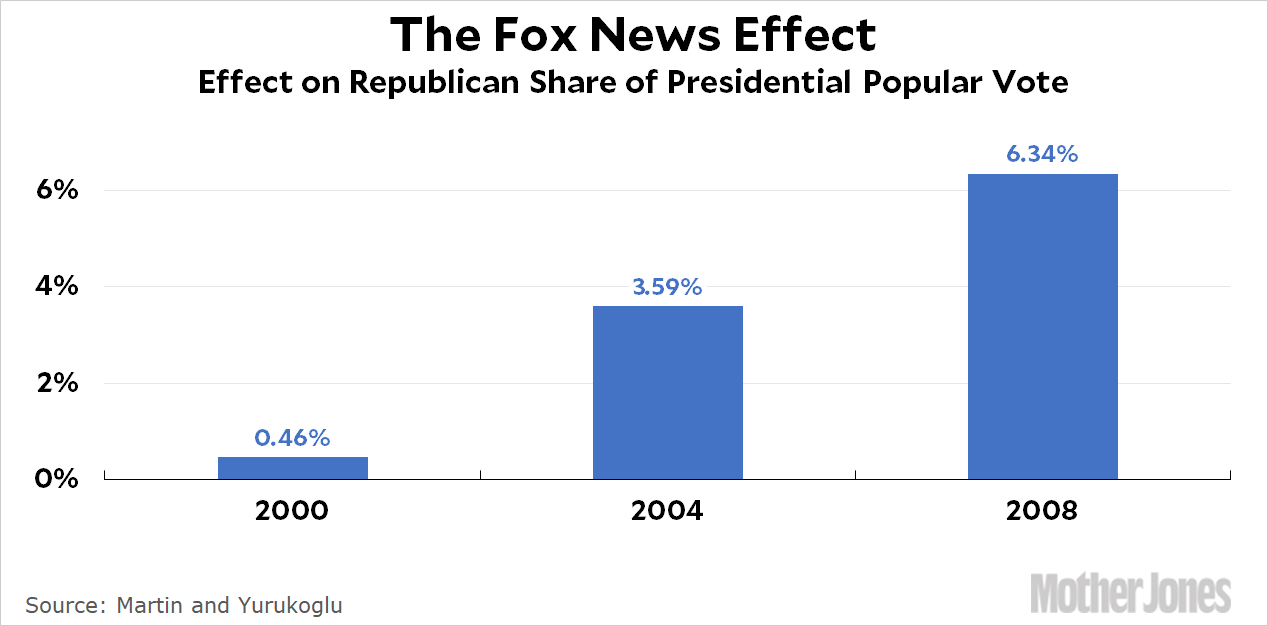
Hours have turned into minutes. That’s about it. The basic results stay the same, as illustrated here in colorful chart form:
In 2008, John McCain won 45.7 percent of the popular vote. This paper is therefore suggesting that if Fox News didn’t exist, he would have won only 39.4 percent of the vote. That would have been quite the epic shellacking for a two-person race, right up there with Barry Goldwater and Alf Landon.
This seems a little excessive. For one thing, if the numbers were really that high it implies that Democrats would have occupied the White House continuously since 1992 if only Fox News had never existed. I’m not sure anyone buys that.
Still, even if the effect isn’t this big, other studies have confirmed that Fox News has a clear effect on voting while liberal outlets like MSNBC don’t. This means we can thank Fox News for both the Iraq War and Donald Trump. We can also thank them for their decades-long effort to weaponize the aggrieved white vote. Thanks, Fox News!
POSTSCRIPT: Why the focus on presidential races? There’s a lot more data available for House races, and it’s more geographically concentrated too. Somebody should do this kind of research to see how much effect Fox has on House and Senate races.
Should the city of Richmond, Virginia, tear down the statues of Confederate leaders that line Monument Avenue? Ed Gillespie, who’s running for governor this year, says no:
Gillespie, a former Republican National Committee chairman, lobbyist and adviser to President George W. Bush, said he would prefer to keep the statues up – in part because of the cost of removal, which has been estimated at $5 million to $10 million for the statues that tower over Richmond’s Monument Avenue. “There’s a lot more things we could do here in Richmond with $10 million,” Gillespie said.
Really? $10 million to tear down five statues? Not exactly:
“I never thought they’d go away,” said Bill Gallasch, 74, president of the Monument Avenue Preservation Society….A real estate agent and former appraiser, Gallasch said he believes removing the monuments would knock 10 to 20 percent off property values in the area around the avenue — costing as much as $3 million a year in city tax revenue.
Property values! Where have I heard this argument before? But would removal of five statues representing the leading white supremacists of the Confederacy really knock 10-20 percent off property values in the area? If Gallasch is wrong, then the statues might as well come down. But if he’s right, then the statues really, really ought to come down.
POSTSCRIPT: As for the actual cost of removing the things, I’ll bet there are plenty of folks who’d be willing to do it for free. And if you insist on professionals, I’ll bet a Kickstarter campaign would raise the money in no time.
And we respect that! But maybe you’re of a mind to support our work directly instead? We have until December 31 to raise the last $400,000 we need to keep our nonprofit newsroom running at full strength into 2026. Will you make a gift today?
We noticed you have an ad blocker on. Can you pitch in a few bucks to help fund Mother Jones' investigative journalism?
Billionaires own the media,
but they don’t own us.
At Mother Jones we know these aren’t conventional times, and they require unconventional coverage. That’s what deliver every day: fierce, independent journalism you can’t find elsewhere. Perhaps never in the history of our country has that been more necessary than now. But we can’t do it without reader support—your support. Please chip in today.
Billionaires own the media,
but they don’t own us.
At Mother Jones we know these aren’t conventional times, and they require unconventional coverage. That’s what deliver every day: fierce, independent journalism you can’t find elsewhere. Perhaps never in the history of our country has that been more necessary than now. But we can’t do it without reader support—your support. Please chip in today.