• Trump Can’t Even Implement His Own North Korea Sanctions

    The Trump administration is urging the rest of the world to sanction North Korea harshly in response to their recent missile launches and nuclear tests. There’s only one problem:

    The U.S. ambassador to the United Nations said Monday that North Korea’s leader, Kim Jong Un, is “begging for war,’’ and called for members to exhaust all possible diplomatic measures and impose urgent economic sanctions to prevent it.

    ….The Trump administration is also moving to cut off from the international financial system Chinese banks and trading companies that supply Pyongyang, however, those cases are moving slowly because of the hiring freeze at the State Department and personnel shortages at the Justice and Treasury departments, according to Stanton. “The government has made some of the right policy decisions, at least in sanctions, but they are not putting enough people on task,’’ he said.

    Typical Trump. He’s too incompetent to implement even policies that are straightforward and have broad bipartisan support. This is, simultaneously, my greatest hope and my greatest fear for the next three years.

  • Men and Women Have Reacted Differently to Donald Trump’s Election

    Richard B. Levine/Levine Roberts/Newscom via ZUMA

    I’ve now had a similar conversation three separate times in three completely different contexts—most recently last night—and that’s enough times to make me think it’s something worth writing about.

    It’s pretty simple. Liberals of all stripes were, obviously, pretty upset when Donald Trump won the election. It’s not just that he’s conservative. It’s also because his victory was so unexpected and because Trump is such an ignorant, loudmouthed cretin. It’s far worse than 2000, when George Bush won.

    But apparently there’s a big difference in the way men and women reacted. Generally speaking, men were upset. They were unhappy. They were resolved to fight back.

    So were women. But they were also far more emotionally affected. They were distraught. They went on crying jags. They were seriously depressed. They found it hard to concentrate at work.

    Why the difference? Last night’s theory is that lots and lots of women have had to put up with various kinds of sexual molestation since they were very young. This includes everything from random pervs to unwanted advances to wolf whistles to wandering hands to groping to more extended assault—especially during their childhood and teenage years. This has happened to many of them far more often than men think because women usually don’t dredge up this stuff and tell us about it. But it leaves serious scars.

    And now one of those guys is in the White House. It causes all the old stuff to bubble up, and when it’s added to everything else it produces a pretty serious and long-lasting bout of depression.

    It’s worth noting that although this has now come up in three very different settings, the conversation is always with people I know. This spans a lot of ages, but it’s mostly well-educated white folks who are pretty politically aware. So I don’t know if this is also true of other demographics.

    I’m not really sure how to report on this, or how many people are willing to talk about it publicly. But it sure seems like a real thing. I’d like to find out more about it.

  • Should Democrats Trade DACA for Border Wall Funding?

    Albin Lohr-Jones/Pacific Press via ZUMA

    DACA, the “mini-DREAM Act” enacted by executive order under President Obama, is about to be killed by President Trump. Politico reports:

    President Donald Trump has decided to end the Obama-era program that grants work permits to undocumented immigrants who arrived in the country as children, according to two sources familiar with his thinking. Senior White House aides huddled Sunday afternoon to discuss the rollout of a decision likely to ignite a political firestorm — and fulfill one of the president’s core campaign promises.

    The administration’s deliberations on the issue have been fluid and fast moving, and the president has faced strong warnings from members of his own party not to scrap the program….In a nod to reservations held by many lawmakers, the White House plans to delay the enforcement of the president’s decision for six months, giving Congress a window to act, according to one White House official.

    A lot of liberals are describing this as “hostage taking,” but I’m not sure that’s fair. That term is approporiate for things like threatening not to raise the debt ceiling, which would cause havoc, but not for fairly ordinary legislative maneuvering. It looks like Trump is doing two things here. First, he wants to put some of the responsibility for DACA back on Congress. If they fail to save it, then he can say it wasn’t a unilateral action on his part. Congress agreed by declining to pass its own bill.

    Second, he’s probably using this as a bargaining chip. Most likely, he’ll make it clear that he won’t veto a budget bill that includes DACA if Congress appropriates money for his border wall. This is a fairly ordinary sort of thing for a president to do. FDR would be entirely unsurprised by horsetrading like this.

    So what should Democrats do if this is how things go? I’d say: take the deal.¹ A couple of billion dollars for a border wall is galling, but it isn’t really all that damaging. Conversely, a truly permanent DACA would be a boon for nearly a million young immigrants. Nobody likes being forced to trade votes like this, but this is the way politics works. If this deal is really available, Democrats should signal that they’re interested.

    ¹That’s assuming it’s a simple swap of DACA for border wall money. In real life, it will end up being much more complex.

  • How Do We Value Human Lives?

    SIPA Asia via ZUMA

    A couple of weeks ago I mentioned that I’ve been meaning to write about an interview with Paul Slovic, who has done loads of research on the limits of human compassion. So why not today? Here’s how it starts:

    I’ve been doing research on risk for close to 60 years now. [In the 1970s] I was struck with Daniel Kahneman and Amos Tversky’s work on prospect theory. It had something called a value function in it, which indicated how people value things as the amounts increased. Changes at small levels had a big impact, and then as the magnitudes got larger, it took more and more of a difference to be noticeable.

    ….I talked with Tversky about that, and [wondered] if that applied to lives. We both figured it would — and that this is really a pretty scary kind of thing. It means that there is no constant value for a human life, that the value of a single life diminishes against the backdrop of a larger tragedy.

    This is something I’ve been noodling about for years. It’s related, in a way, to the infamous trolley problem in philosophy. Roughly speaking, the trolley problem is this: You’re watching an out-of-control trolley car. It’s about to crash into five people and kill them all, but if you pull a lever it will go off onto a siding and kill only one person. Should you throw the lever?

    There are a million variations on this, but I don’t care about any of them. The trolley problem is essentially about what we should do. I’m interested in what people actually do in circumstances like this. In other words, how do ordinary people value human life in practice? Off the top of my head, I can list a bunch of obvious factors that go into this:

    • Family: we value family above non-family.
    • Friends: we value friends above strangers.
    • Eyesight: we value people who are near us, who we can actually see and hear, more than people we can’t.
    • Proximity: we value people close by more than people halfway across the world. (This one is more than normally pertinent right now. More than a thousand people have died and more than a million have been displaced by massive floods in South Asia recently. But here in the US, the news is all about flooding in Houston, even though it’s far less severe.)
    • Tribalism: we value members of our tribe—towns, nations, religions, ethnic groups, etc.—more than we value outsiders.
    • Small numbers: If Slovic is right, we put more value on small numbers of lives. We discount huge numbers because it seems like nothing we can do will make a difference.
    • Publicity: We can be persuaded to value some lives more highly than others. Thanks to a massive, ongoing publicity campaign, we care more about breast cancer, for example, than we do about pancreatic cancer, even though they’re about equally deadly.
    • Personal action. We value lives more highly if we’re personally responsible for them. (This is the crux of most trolley problems. If you do nothing, five people die but it’s not your fault. If you pull the lever, only one person dies, but her death is directly a result of something you did.)
    • Hierarchical position. A schoolteacher will value lives of students in his classroom more than those in another classroom because he has a special responsibility to his students.

    I could go on and on. At the risk of sounding morbid, however, I’m curious about actual research done on this subject. What are, say, the top five determinants of how we actually tend to value lives? What kind of predictive power do they have? How much does this change across cultures? On average, can we predict that most people would expend more effort to save the life of a friend in their line of sight than they would to save 100 strangers across town? How about a thousand strangers? Or, if Slovic is right, do the numbers essentially go to infinity very quickly? Perhaps there’s no difference between 100 strangers and 100,000 strangers. If that’s the case, what’s the biggest number that matters? Is it the famous 150 that supposedly represents the maximum number of people the human brain can feel close to at any given time?

    I’m not really sure how you’d do empirical research on this, but there are lots of people out there who are smarter than me. Has any research like this been done? Nothing obvious jumped out at me when I looked for it, but then again, I wasn’t even sure how to search for it. Does anyone know of anything interesting along these lines?

  • When to Support Donald Trump: A Handy Guide

    Dan McLaughlin has a question:

    Do Liberal Writers Really Believe In An Obligation To Oppose Everything Trump Does?

    If you follow many liberal/progressive writers or pundits, you hear an awful lot of variations on the argument that there’s an absolute moral obligation to oppose everything Trump and his Administration do – every proposal, every initiative, regardless of its merits as policy.

    I wouldn’t call it a moral obligation, exactly. More like a handy heuristic. Donald Trump has an almost unerring instinct for lousy policy, even by conservative standards, so it makes sense to oppose everything out of the box. If, after intensive study, it turns out that he’s accidentally proposed something worthwhile, then sure: go ahead and support it. Just don’t expect it to happen very often.

  • Prepare To Be Blown Away By the iPhone 8

    Hayley Tsukayama reports on the latest exciting news from Apple:

    Having decided to give the latest iPhones — the iPhone 7 and iPhone 7 Plus — a smaller-than-expected makeover, the pressure is on to deliver something spectacular with the next models. Apple insiders expect the company to show off a 10th-anniversary model of the iPhone that is substantially redesigned, with an edge-to-edge screen and no home button.

    ZOMG! I’m not sure my heart can take excitment of this caliber. Does “substantially redesigned” mean yet another kind of connector so you have to toss out all your old accessories? Dees it mean a slightly different form factor so that your old cases won’t work? Does it mean a brand new color?¹ Does it mean putting the headphone jack back on top? Or wait. Does the iPhone even have a headphone connector anymore? I guess not. That was last year’s big news. Maybe this year they’ll adopt an entirely new way of piping encoded music that’s only compatible with Apple branded buds. It’s all to protect the customer experience, you see.

    Perhaps you’re an Apple fan and don’t appreciate my juvenile snark. I understand. But seriously, Steve Jobs died six years ago. How long does it take before his reality distortion field fades away too?

    ¹In fairness, though, I have to give the color bamboozlement award to Microsoft this year. They recently released a new stylus for the Surface tablet, and the old silver color has been rebranded platinum and costs $20 more.

  • Raw Data: Inflation Has Been Running at 0% All Year

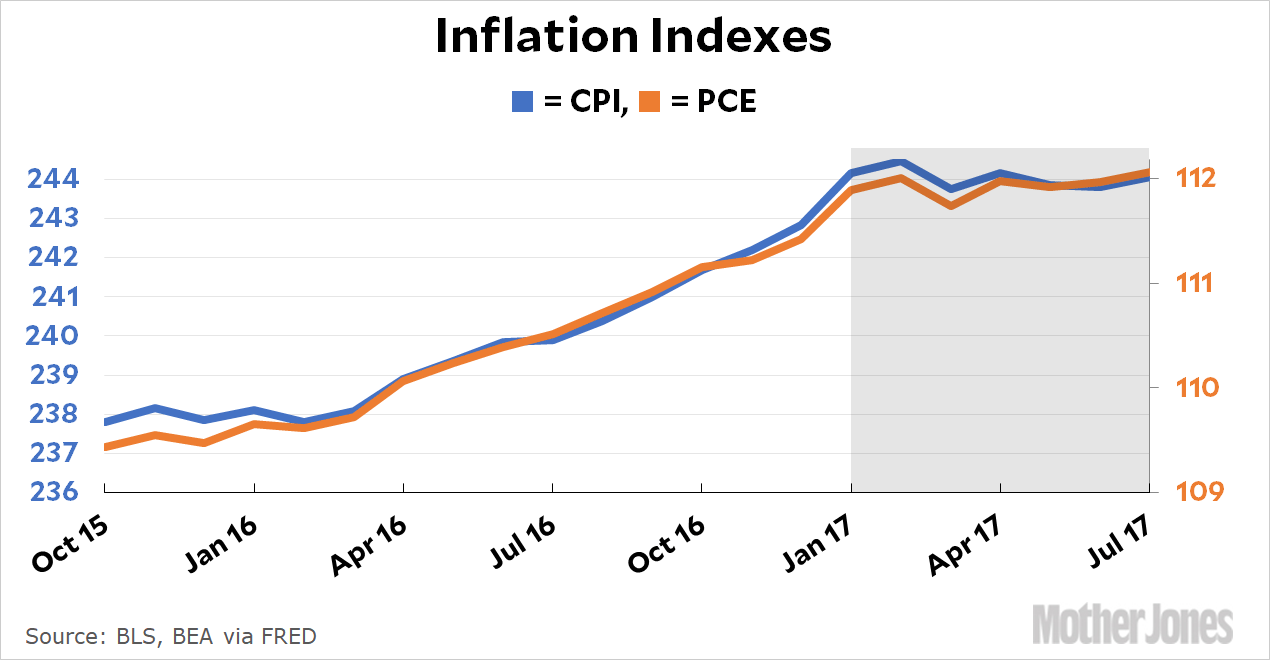
    I mentioned inflation in the previous post, but it’s worth pointing out something that hasn’t gotten a ton of attention: since the beginning of 2017, inflation has been dead flat:

    Some of this is due to declining oil prices, but even the core indexes (which exclude food and energy) are running at an annual rate of only 0.8 percent. This is yet another sign that the economy has been so-so over the past few months. Wage growth is modest and there’s no inflationary pressure at all.

  • Here’s the Story on Wage Growth

    Has the economy really recovered? Wages are the big story, and Jared Bernstein has everything you ever want to know here. But in case you just want the nickel version, here it is:

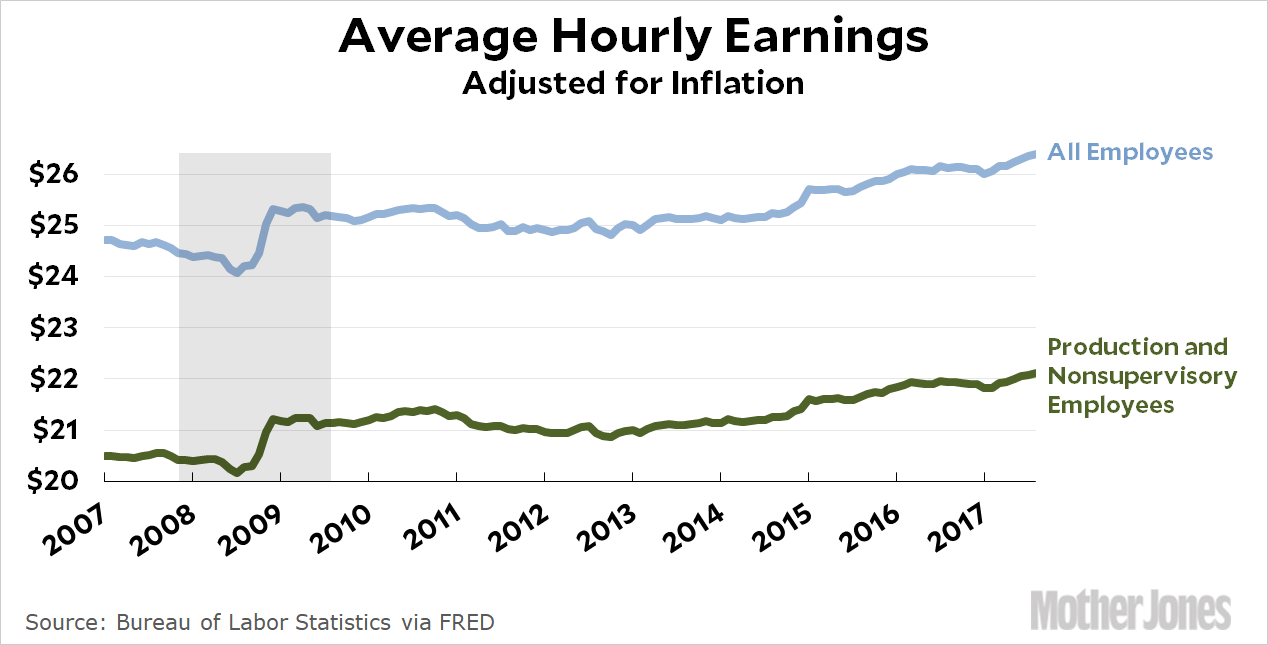
    Since 2014, hourly wages have gone up 1.6 percent per year for all employees and 1.5 percent per year for production and nonsupervisory employees. The Employment Cost Index, which includes benefits, has increased even less.

    The real question, however, is whether we’re seeing any acceleration in wages. It sure doesn’t look like it to me. If you squint, you can see that wage growth is slightly higher since the start of 2017, but that’s entirely due to inflation slowing down to zero. Employers haven’t quite caught on to that yet, but they will.