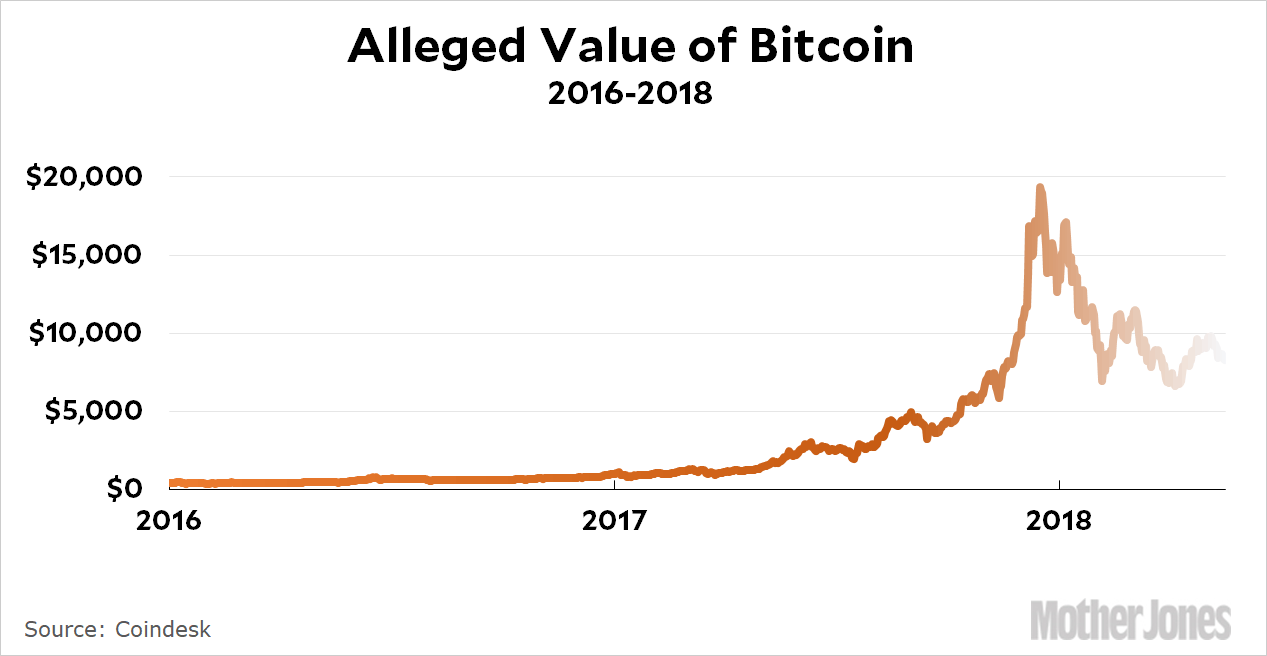
In news that should surprise no one, the Wall Street Journal reports that many cryptocurrencies are fraudulent:
Hundreds of technology firms raising money in the fevered market for cryptocurrencies are using deceptive or even fraudulent tactics to lure investors. In a review of documents produced for 1,450 digital coin offerings, The Wall Street Journal has found 271 with red flags that include plagiarized investor documents, promises of guaranteed returns and missing or fake executive teams.
“Jeremy Boker” is listed as a co-founder of Denaro, an online-payment project. In investor documents for a public offering in March, which claimed to have raised $8.3 million, Mr. Boker boasted of his cryptocurrency startup’s “powerhouse” team. In his biography, he noted a “respectable history of happy clients” in consulting before he launched Denaro. In fact, Mr. Boker’s bio image was a stock photo, there is no evidence he exists and the rest of his team appears to be fictional, except for two freelancers who said they were paid by people unknown to them to market the project, the Journal found.
I think a better choice of words would be that 271 ICOs are more obviously fraudulent than the other 1,179 ICOs that are just normally bamboozley. In any case, this kind of outright fraud is the kind of thing that becomes widespread when a bubble is about to go kablooey.
Back in the day—namely, a few months ago—I thought that maybe I just didn’t quite get blockchain technology. There must be something to it that was escaping me. But I’ve given up on that after reading quite a bit more about it. Blockchain is an interesting, if minor, innovation that has some potentially useful applications. But that’s it. It’s not a world-changing technology and it doesn’t decentralize the management of fiat currencies unless you decide not to count all the extremely centralized infrastructure that’s required to make it useful in the real world. And cryptocurrencies themselves are just a straight-up bubble of the kind that makes tulips look perfectly sensible. At least tulips are pretty. I’m pretty sure that if the trade in bitcoin were required to obey the normal rules of financial exchanges—for example, trades being recorded only if they’re made with normal, legitimately acquired money, not other flim-flam cryptocurrencies—it would collapse overnight.
So when does it collapse? Bubbles always seem to last about 50 percent longer than you’d think they possibly could, so I suppose the cryptocurrency bubble has a little while longer to go. But its implosion can’t be too far away.