• Can We Cut the Crap on Executions?

    This is just nuts:

    Hamstrung by troubles with lethal injection — gruesomely botched attempts, legal battles and growing difficulty obtaining the drugs — states are looking for alternative ways to carry out the death penalty. High on the list for some is a method that has never been used before: inhaling nitrogen gas….There is no scientific data on executing people with nitrogen, leading some experts to question whether states, in trying to solve old problems, may create new ones.

    ….The push for change comes because lethal injection, introduced 40 years ago as more efficient and humane than the electric chair or gas chamber, has not met that promise. Indeed, it has sometimes resulted in spectacles that rival the ones it was meant to avert.

    It’s nuts for two reasons. First, there’s “no scientific data”? Technically, sure, there’s no data on using nitrogen in executions. But we all know what happens if you’re put in a tank that’s pumped full of nitrogen: you pass out in a minute or two and then you die. You might feel a little lightheaded or euphoric before you pass out, but that’s it. End of story.

    Second, this whole business of desperately looking for more “humane” or “efficient” ways of killing people is creepy as hell. We know perfectly well how to kill people efficiently: firing squads, hanging, the guillotine, etc. The problem is that people who support the death penalty are apparently squeamish about seeing people actually die violently in front of their eyes. I have no sympathy for them. If you want to kill people, you should have the fortitude to watch your handiwork without the pretense that it’s happening in a nice, clean hospital and being performed by nurses. For one thing, it’s unfair to nurses. This is why I’d support a comeback for hanging. If you can’t stomach the thought of a hangman’s gallows, maybe you should rethink your support of capital punishment.

    By the way, this was the point that Kevin Williamson was making in his infamous abortion meltdown.¹ He wasn’t saying he wanted exceptionally gruesome executions just for women who get abortions. He was saying that if the state is empowered to execute people, it should always be deliberately gruesome so that people can see what they’re voting for. That was it. And I agree with him.

    ¹Just to refresh your memory: Williamson believes abortion is murder, and proposed that women who get abortions should be subject to execution. He hedged a bit on whether he himself approved of capital punishment, but he definitely said that abortion should be legally treated as homicide.

  • Yet More on Short Buildings

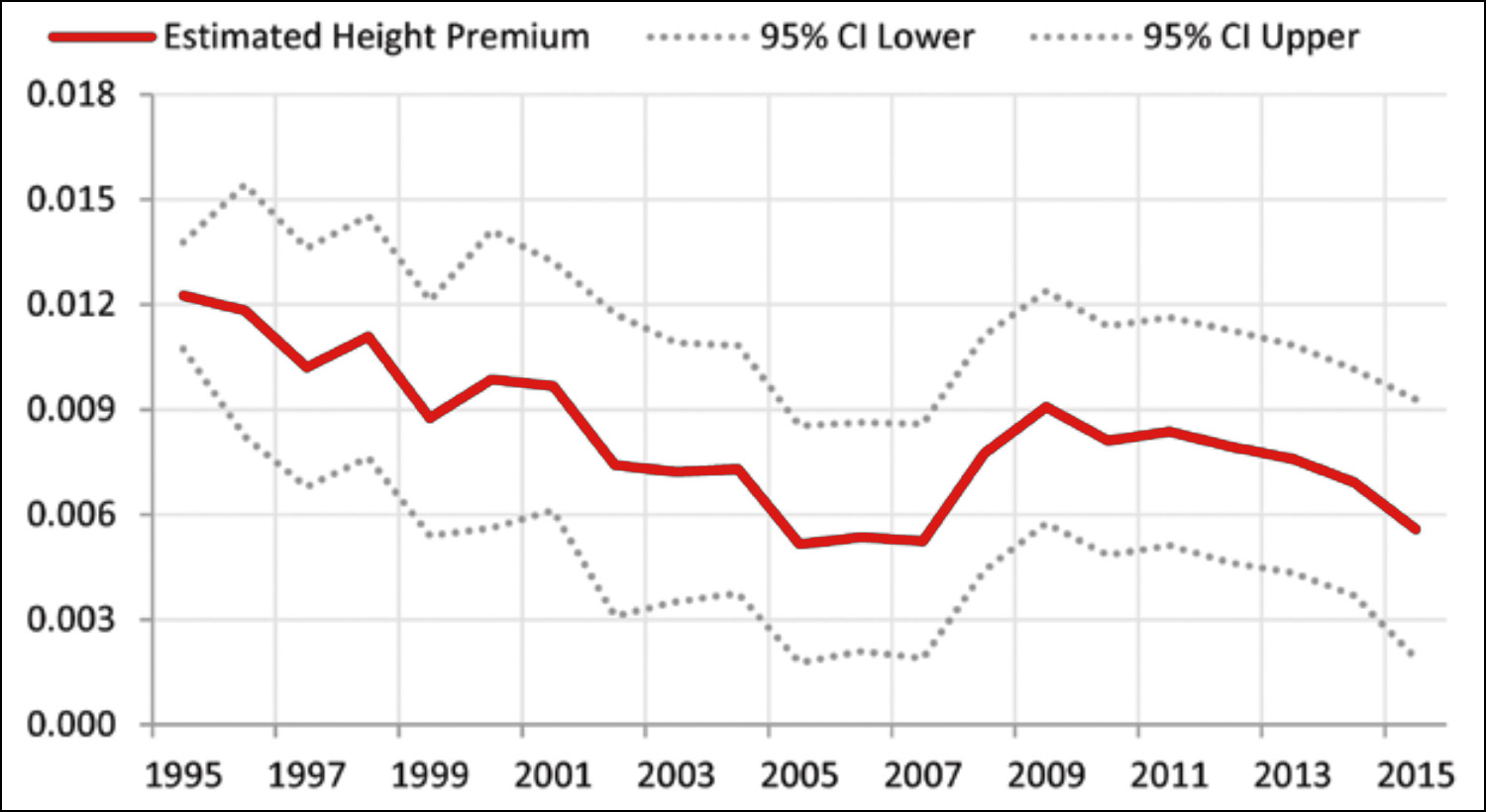
    I’m just playing around here, but here’s a bit more data on building height in response to my earlier question about why all buildings in a neighborhood aren’t the same height (i.e., whatever height delivers the highest profits). First off, there’s an incentive to build high because people will pay more for offices and condos on upper stories. In New York, however, that height premium has been declining:

    Interesting! Nonetheless, no matter what city you’re in, it’s still generally more profitable to build higher since the price per square foot goes down. Here is Dean Dalvit:

    For the most common office building size, two to four stories tall, the range is from just over $140 per square foot in Winston-Salem to over $240 per square foot in New York….By taking advantage of savings provided by vertical construction, you will see approximately a 4% savings in cost per square foot by increasing the stories to between five and ten stories….For buildings between eleven and twenty stories tall, there is approximately an 11% savings over the mid rise buildings and 15% over low rise….Over twenty stories starts getting into more unique building characteristics that will drive costs in various ways.

    Speaking broadly, then, if a particular neighborhood can support a 20-story building, you’d expect to see a lot of 20-story buildings. But there’s also this:

    In other words, a 20-story building might be the most profitable, but if you only have enough money to build a five-story building, you might go ahead and do that instead of spending time trying to scare up more financing. It’s still profitable, after all.

    Beyond this, of course, there are lots of land use restrictions that change over time and can impact building height. The most famous, perhaps, is New York City’s air rights regulation, which limits total building height in an area but allows developers to swap air rights. It’s sort of cap-and-trade for building height. This means that in a neighborhood with, say, a 60-story cap, it might make sense to build a 40-story building and then sell your unused air rights to someone else who wants to build an 80-story building. There’s lots of stuff like that around.

    This is just more food for thought, not any kind of final say on this. If you enjoy falling down internet rabbit holes, you might want to try looking into urban design. I do this periodically, and there is no deeper rabbit hole around.

  • Lunchtime Photo

    It’s spring, and the swallows have returned to Capistrano. At least, I suppose they have. They’ve certainly returned to Irvine.

    Swallows are hard birds to photograph! They might even be worse than those damn honeybees. They never get very close, they’re really fast, and they change direction constantly. Not only does that make them hard to follow, but even on the rare occasions when I manage to follow one for a second or two, the autofocus still needs at least a little time to lock on before the bird decides to pull a 180 and disappear. That doesn’t happen very often.

    But it does once in a while. I’ve been experimenting with triptychs lately, and it works nicely with the swallows for two reasons. First, the color of the water changes depending on time of day and whether I’m shooting into or away from the sun. It’s kind of striking to see the different colors all in one place. Second, the individual photos are smaller than usual, which lets me hide the fact that they aren’t completely sharp. Except for the top one, which is really good. And the timing is really nice on the bottom one. The middle one is kind of meh, though.

    May 2, 2018 — Irvine, California
  • How Do We Get the Kids to Vote?

    Andy Abeyta, Quad-City Times/Quad-City Times via ZUMA

    As I’m sure you all know, the latest craze among kids is the Juul, a vaping device that produces pure (flavored) nicotine hits. That’s it. No tobacco, no tar, nothing that has ever touched soil. Just nicotine.

    Over at the New Yorker, Jia Tolentino writes about Juuling this week. Its main attractions appear to be (a) the nice nicotine hit, and (b) it’s something adults disapprove of. But there’s more:

    At Cornell, Jason told me, people Juuled in bathrooms and classrooms, in “every nook and cranny of this campus.”…Jason believes that the Juul craze is fundamentally ironic. “It’s young people doing something terrible for them that’s supposed to be healthy,” he said. He compared the infatuation with Juul to the millennial love of the restaurateur and TV host Guy Fieri—“this completely bizarre food personality that people call Daddy now”—and observed that his generation was most flippant when it came to serious things, “like health, or mortality.”

    ….In Charlottesville, I went to the main library on campus to meet a freshman from Virginia Beach named Katie McCracken….She took out her phone, opened Snapchat, and scrolled through her saved pics and videos: people hitting multiple Juuls simultaneously, her friends in dramatic poses with deadpan expressions and Juuls in their mouths. I burst out laughing at one captioned “100% Headass.”…I asked Katie if she thought that Juul relieved her generation’s anxiety or exacerbated it. “I don’t know,” she said. “People definitely stress-Juul. But everything we do is like Tide Pods. Everyone in this generation is semi-ironically, like, We’re ready to die.

    I don’t actually have any comment to make about Juuling. But this article was a reminder of something that’s long bothered me about reporting on kids: too much of it is focused not just on college kids, but on elite college kids. In this article, the main message from America’s youth is that everything is ironic and “we’re ready to die.” In political writing more generally, it’s about how liberals need to appeal to kids by supporting college loan forgiveness, urbanization, and bicycle lanes.

    That’s fine if your goal is to appeal to about 10 percent of young people. But what about the rest of them? The ones who went to state colleges, or community colleges, or no college at all? On average, they probably don’t care much about college loans, urbanization, or bicycle lanes. They work, they raise children, they pay rent, they buy groceries, and they just generally lead lives that are unironically dedicated to making ends meet.

    When we talk about the problem liberals have getting young people to vote, these are the people we’re talking about. Not the already-engaged college kids. They vote religiously. The ones who don’t are high school grads who don’t really care about microaggressions or the Pacific garbage patch or Donald Trump’s lies. They don’t pay much attention to politics and don’t really see that it affects them much anyway. The question is, how are you going to get them to vote? If you actually care about the youth vote, this is the problem you should be obsessed with—even though it’s boring as hell. If you’re not obsessed with this, then you don’t really care about getting young people to vote. You’re just saying you do as a cover for whatever agenda you do care about.

    Which is it?

  • Why Do We Have So Many Short Buildings?

    Tyler Cowen poses a conundrum that I’ve also wondered about:

    Why aren’t all tall buildings in the same neighborhood the same height?

    Let’s say there is a 40-story building and a 60-story building. You would think the different builders face more or less the same costs for their height decisions. If you want to own 60 stories, it is still the case that everyone can build the cheapest-height building, and you can buy the stories you want from a variety of sellers.

    If you had lots of companies that needed 60 stories, and you didn’t want to split up those firms across locations, and lots of companies that needed only 40 stories, the differential building heights could be explained rather easily. But that doesn’t seem to be the case. Most tall buildings house a variety of tenants, and those tenants don’t “need the whole height” or anything close to it.

    Cowen seems (?) to be coming at this with the assumption that the 40-story building is cheaper, so why doesn’t everyone build 40-story buildings? But I assume the opposite: the taller the building, the cheaper it is on a per-story basis. So why doesn’t everyone just build the tallest building that makes economic sense?¹ Is this mostly down to those dreaded land-use regulations (setbacks, air rights, shadow coverage, political tiffs, etc.)? Changes in taste over time? Some kind of practical issue that makes it harder to build higher than I think?

    Do any of our urbanist mavens know the answer?

    ¹Which can vary from place to place. It might be 100 stories in New York and five stories in Peoria.

  • Gavin Newsom Tagged as Big Fat Liar

    Rory Merry/AFLO/ZUMAPRESS

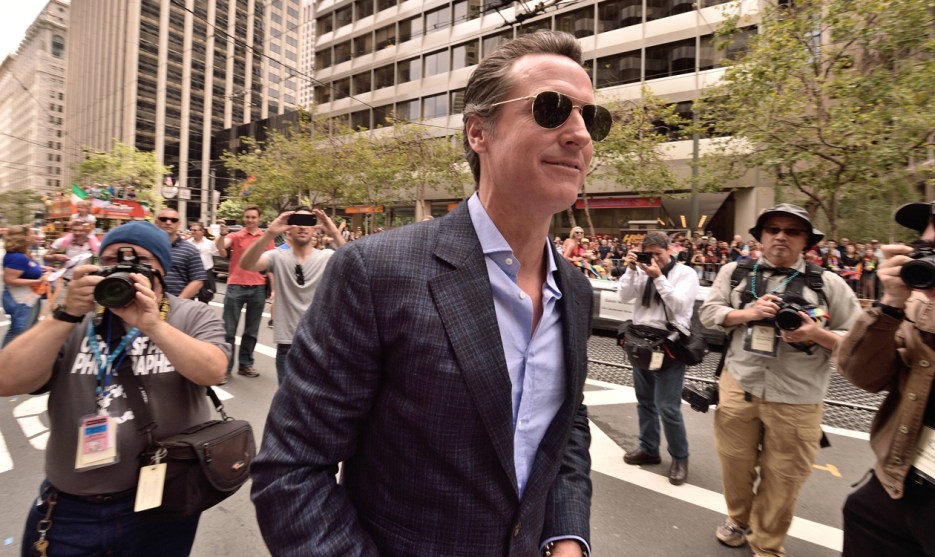
    In an ad currently running on every TV in California, our well-coiffed lieutenant governor, Gavin Newsom, says he was “the first to take on the National Rifle Association and win.” This has unleashed a tsunami of tut-tutting, like today’s column in the LA Times from George Skelton:

    You’ve got to wonder what goes through a candidate’s head when his first TV ad contains an indisputable, major falsehood. Maybe nothing goes through it….After Newsom’s TV ad was released April 23, it was assailed in several news media outlets. PolitiFact, a nonpartisan organization that referees political ads, rated Newsom’s claim of being the first to fight the NRA and win as “false.”

    In case you’re wondering what’s going on, Newsom did indeed take on the NRA when he sponsored Prop 63 a few years ago. And he did indeed win. This is not a huge accomplishment here in Blue-State-istan, but he did do it. So what’s the fuss?

    Well, he wasn’t “the first.” This cracks me up. If Newsom had acted like a Republican, he would have said that he crushed the NRA like an eggshell,¹ that his opponents were all pawns of Big Gun,² and that Californians were finally safe from gun violence.³ Everyone would figure that this was just the usual Republican pandering to the base and would have pretty much ignored it. But if a Democrat tells a teensy little fib, he’s suddenly unfit for office. I love politics.

    ¹The NRA didn’t even bother fighting Proposition 63.

    ²Every Democrat in the state supported it.

    ³Prop 63 didn’t really do much.

  • Chess Robots Are Getting Kind of Sneaky

    PhotoXpress/ZUMApress

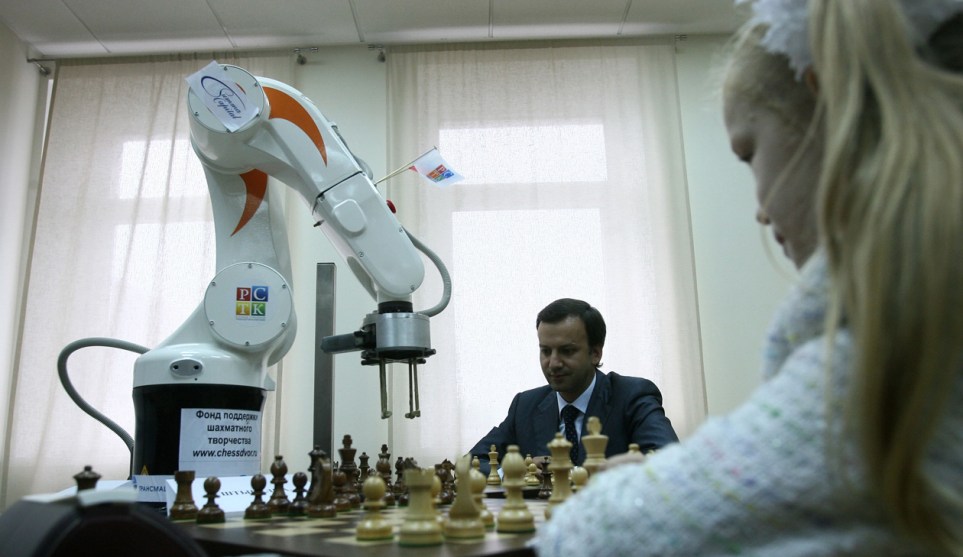
    From Garry Kasparov, trying to get everyone to calm down about increasingly intelligent AI:

    Imagine a chess program with the potential to trounce human opponents and explain its moves to us, revealing the patterns that turn knowledge into practical wisdom, like a father teaching chess to his daughter or son.

    That sounds so cozy. Just me and my robot teaching me how to play chess by the dancing light of the fireplace before tucking me in for bed at night.

    And then, when we’re all asleep, killing us all!

    No, wait. That’s not my schtick. And then, when we’re all asleep, taking all our jobs!

  • Wall Street Got Its Tax Cut, and Now It’s Depressed

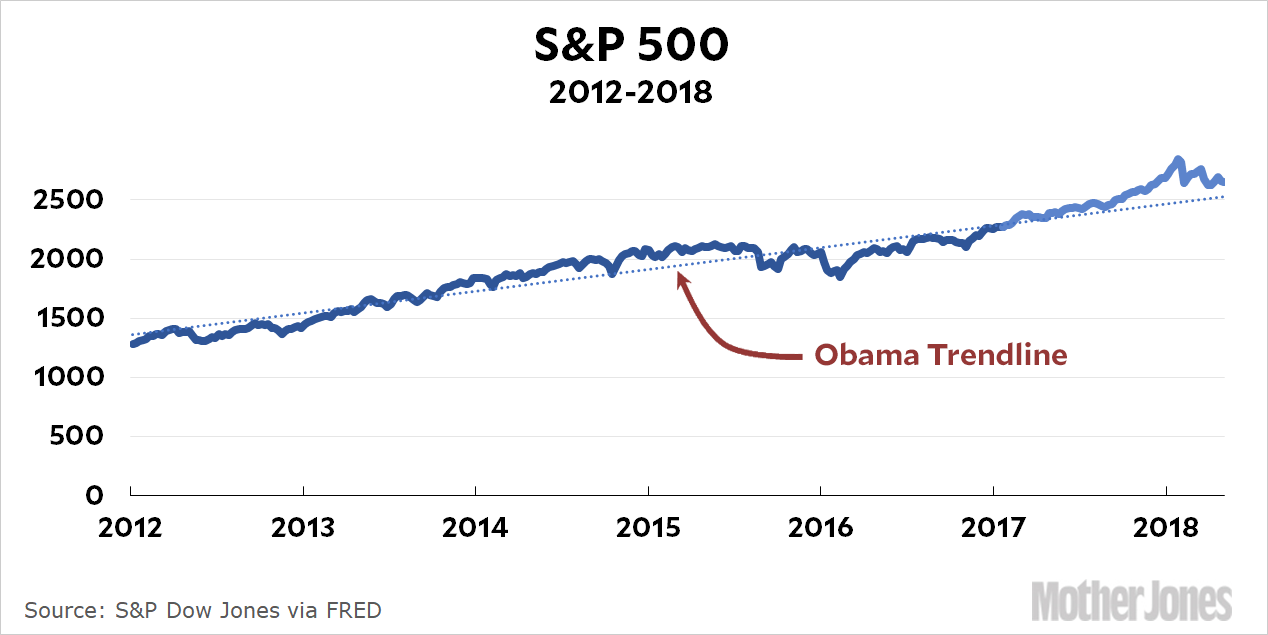
    I don’t follow the stock market super closely, but I was curious about why I haven’t heard Donald Trump bragging about it lately. This is why:

    The market seems to have spiked in anticipation of the tax cut, but then it slumped once it finally got its tax cut. Kinda strange. I guess they’ve got nothing to look forward to now except three years of Trump doing God-knows-what to wreck the economy in service of whatever moronic ideas happen to flit across his brain or capture his attention from Fox & Friends. That’s tough luck, guys, but you know what they say about lying down with dogs.

  • One Space or Two? That Recent Study Won’t Tell You.

    A recently released study tested whether it was better to put one space or two spaces after a period. A commenter at Kieran Healy’s Twitter feed comments:

    I guess this confusion isn’t surprising, but the “rule” has never changed. It’s always been two spaces for monospaced fonts, like the ones on typewriters, and one space for proportional fonts, like the one you’re reading now. There was good reason for this:

    • Monospaced fonts like this one already have a lot of air.  Two spaces make it easier to quickly distinguish when a new sentence begins.
    • Proportional fonts like this one are denser and don’t have that problem. Spaces and capital letters jump out at you.

    More to the point, proportional text in magazines, books, and newspapers is usually justified on both right and left—like this paragraph. When text is justified, typesetting equipment ignores your spaces entirely, putting in just enough to make the line lengths come out right. So it doesn’t really matter what you do.

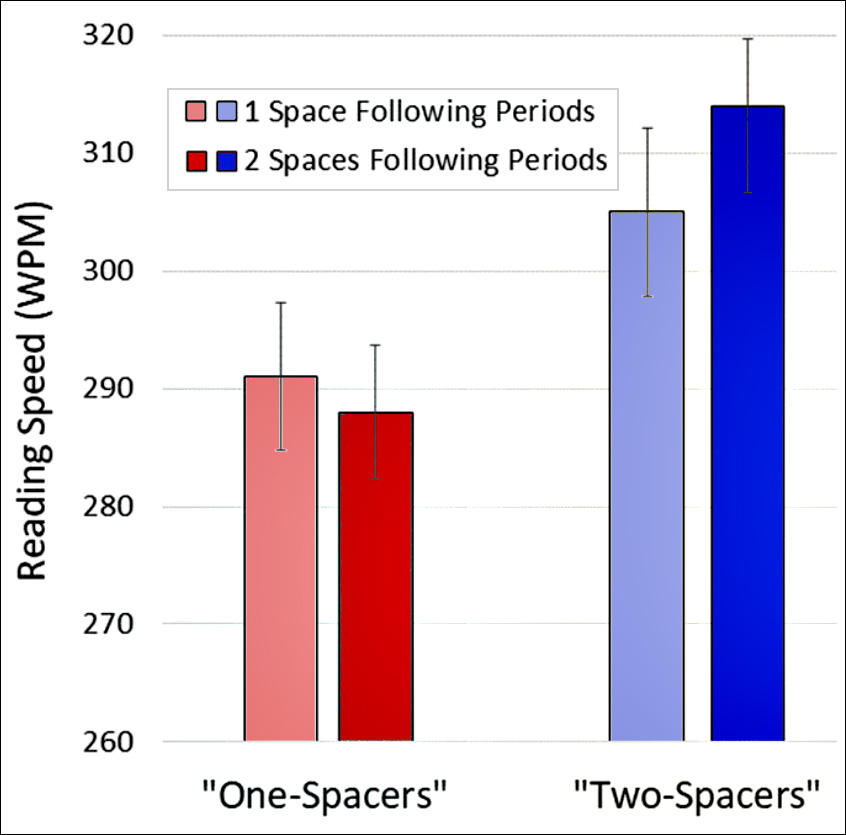
    Still, what about the study? As it turns out, the authors tested only monospaced fonts, which is odd since almost no one uses them anymore. Here’s an excerpted and colorized version of their main result:

    Among people who preferred one space, reading speed was about 5 wpm higher with one space. Among people who preferred two spaces, reading speed was about 9 wpm higher with two spaces. In other words, people preferred whatever they preferred, and the difference wasn’t very much anyway.

    Oddly, though, the folks who preferred two spaces were generally faster readers than those who preferred one space. For $39 I suppose I could find out if the authors had anything to say about this. However, I suspect it means that the difference between the two groups isn’t random.

    So the whole study is pretty useless.  What would be more interesting would be a study of proportional fonts.  Over the past couple of decades, it’s become far more common to use a ragged right margin, like the one you’re reading now.  The reason is readability: By keeping the spacing constant, instead of tweaking it to make the line lengths come out evenly, the text is easier to read.  But with even spacing, would two spaces after a period make the text even easier to read?  I don’t know!  Someone should do a study to find out.