• Quote of the Day: A Universal Theory of San Francisco

    Joan Cros/NurPhoto via ZUMA

    From Fran Taylor, a San Francisco resident who attended a hearing about electric scooters in the city:

    I think the scooters run amok are actually a plot of the young people to kill off all us old farts so they can have our rent-controlled apartments.

    Is that a joke? I guess so, but in a funny-cause-it’s-true sort of way. In any case, apparently scooters are like Uber, but for scooters. Literally:

    Some of the scooter start-ups haven’t exactly been asking for permission. Bird, which has raised $115 million from venture capitalists, was founded by former Uber executive Travis VanderZanden….“It is clear that many of these companies continue to build their corporate empires off a basic premise: making massive profit always trumps protecting the public, and innovation is only possible by cutting corners,” said Aaron Peskin, a city supervisor. “It would be very nice if the tech bros could come in and ask for permission instead of asking for forgiveness,” he said.

    Cities need to wise up. Uber performed a massive proof-of-concept that it is, in fact, better to beg for forgiveness than to ask for permission. If cities want to nip this in the bud, they’re going to have to get tough: send out a truck to round up all the scooters and then pulp them. Eventually the tech bros will get the message that they need to ask for permission just like everyone else.

  • Why Should Progressives Force Big Cities to Become Even Bigger?

    This is every American city dweller's nightmare.SIPA Asia via ZUMA

    Jonathan Chait wrote a piece yesterday titled “The Urban Housing Crisis Is a Test for Progressive Politics”:

    You can dive in to the details if you want, but the bottom-line conclusion is quite simple: Housing is too expensive in many cities because there isn’t enough of it. There isn’t enough of it because zoning and other regulations prevent the construction of high-density housing….Expanding the supply of housing allows people to move in to cities without displacing existing residents. The simple Econ 101 model of supply and demand does not solve every problem, but it does solve this one.

    Why don’t we do it?…Even where activists have managed to broaden the question — like in California, where they brought a bill to the state level — it turns out that progressives are susceptible to NIMBYist rhetoric. Allowing the construction of more multifamily housing means relaxing — gasp — regulations. And it means working with — gasp — developers….The controversy in California and other Democratic-dominated areas has been heavily infused with instinctive support for existing regulation, and distrust of business as a malignant force….It is also a political test for whether progressives will be manipulated by knee-jerk suspicions, or be able to think clearly about using the market to serve human needs.

    I feel the need to push back. Chait is right that development is primarily a local issue, and also right that most local government in large cities is Democratic. But this isn’t really a partisan issue. As he acknowledges, the problem is that city dwellers almost unanimously don’t want lots of dense new development, and whoever is in power will get thrown out pretty quickly if they do things that most of their constituents hate. Calling this a test for progressive politics is almost certainly wrong on this level.

    It’s also wrong on several other levels:

    • This is not Econ 101, not by a mile. Just as building more highways attracts more cars and ultimately does nothing for traffic, building more housing attracts more people. We could make housing less expensive in Los Angeles—just as we could reduce traffic by building highways 40 lanes across—but the amount of new housing it would take to make a sizeable dent in prices is truly vast.
    • Don’t believe it? Consider New York City. Sure, building stuff there is hard, but it’s a city that’s basically friendly to high rises—and it has been since the invention of the safety elevator. By American standards, it also has a uniquely effective mass transit system. And yet, New York City is an expensive place to live. It’s been an expensive place to live for the past century. [See update below.] If you want cheap housing, this means you have to think beyond New York City. Whatever your plans are, they probably won’t work unless you have denser development and better mass transit than New York. There is not a city in America that’s within light years of this.
    • In terms of pure politics, do Democrats really want to be the party of dense, high-rise development? This is precisely what the fever swamps of the right think of liberals, and not in a good way. Taking this up as a theme sounds a lot like political suicide to me.
    • Again, in terms of pure politics, Democrats already suffer from self-gerrymandering: too many Democratic supporters are packed too densely into a few big cities. Do we want to make this even worse?
    • The reason people oppose dense development is not generally because they distrust developers.¹ It’s because traffic in big cities is already horrible and dense development will make it worse. If you ask people, that’s what they say, and it’s worth taking them at their word. There may be other reasons as well, including some less savory ones, but traffic really is the big kahuna. Nor are residents willing to be bought off by airy promises of better transit or whatnot. They’ve heard that song and dance before. Unless you have a real solution to increased traffic—and I’ll bet you don’t—you simply don’t have a solution for the most common complaint about dense development.
    • That said, is more and better mass transit the answer? Sure, if you mean a lot more. People generally hate mass transit—usage is dropping in LA even as the traffic gets worse—but they’ll use it if it’s convenient enough. However, in most cities that requires truckloads of money and, therefore, truckloads of higher taxes. Good luck.
    • In suburbs, things are even worse. The whole point of living in the suburbs is that it’s not the big city. This means that trying to convince suburbanites to become more like big cities is simply hopeless. They will fight you in the streets, fight you in the fields, fight you on the beaches, etc. They will never surrender.

    Beyond all this, I’m not convinced that making our big cities bigger is even a good idea. Why should we? There are benefits to urbanization, but there also limits to economies of scale. Should New York have 20 million people? Should LA have 10 million? Why? Wouldn’t it be a better idea instead for, say, Pittsburgh to have a million people? Or Nashville? Or Little Rock? We’d be a lot better off with a few dozen more cities of a million or two million than half a dozen behemoths of 10 million.

    Now, these cities might not want to grow either. Different cities have different priorities. But there are plenty of cities that do want to grow, so why not focus on them instead of trying to force unpopular ideas on a small number of our already biggest cities? This is a long-term problem no matter which way you slice it, but I’ll bet that if progressives started putting their efforts into making biggish mid-size cities into smallish big cities, they’d have a lot more luck. It would be a winning formula on a whole bunch of different levels.

    ¹Which is not to say that lots of people don’t distrust developers. They tend to be a pretty unsympathetic lot.

    UPDATE: This isn’t really a core part of my argument, but it appears that New York was relatively affordable up through the 50s, and then took off after that. Apologies for the error. However, it’s expensive today despite pretty high density and pretty good mass transit.


  • The New Hotness: Fuel Economy Kills

    Take that, you gas-sipping Japanese tin can.

    From the LA Times this morning:

    The Trump administration is embracing a curious — and some would say dated — argument as it builds its case to weaken federal rules championed by California that require cars and SUVs to average 55 miles per gallon by 2025. It is warning that the fuel-efficiency targets, seen by most as key to meeting climate and air quality goals in California and nationwide, could actually end up killing people.

    ….The agency is preparing to make the case that tough fuel economy rules could effectively force automakers to sell smaller, lighter and thus less crash-worthy vehicles. That, in turn, would lead to more crash-related deaths. And it warns the rules could drive up the cost of cars to the point that consumers will put off buying new, safer models equipped with life-saving technology improvements.

    This is only a “curious” argument if you don’t understand its audience. The aim here is not to build a case for the process of repealing the Obama fuel-economy rules. The aim is to appeal to Trump’s base, which has long held this theory to be gospel truth. When I’m on the road, I want a couple of tons of metal between me and the rest of the idiots.

    The kernel of truth here is that all else being equal, if a big car smashes into a little car, the big car will take less damage. However, as long as cars are, on average, all getting bigger or smaller at the same time, there’s no change in overall safety.

    But that doesn’t matter. The Trump base will slam down its beer and say it’s about time someone gets it. The usual suspects will write op-eds making the case that Trump’s EPA is right. John Lott will whip up a statistical study to prove that fuel economy kills. David Roberts will write 5,000 words at Vox explaining why Lott is wrong. And then the whole thing will be forgotten.

  • Guess What Paul Ryan Wants To Do as His Congressional Swan Song?

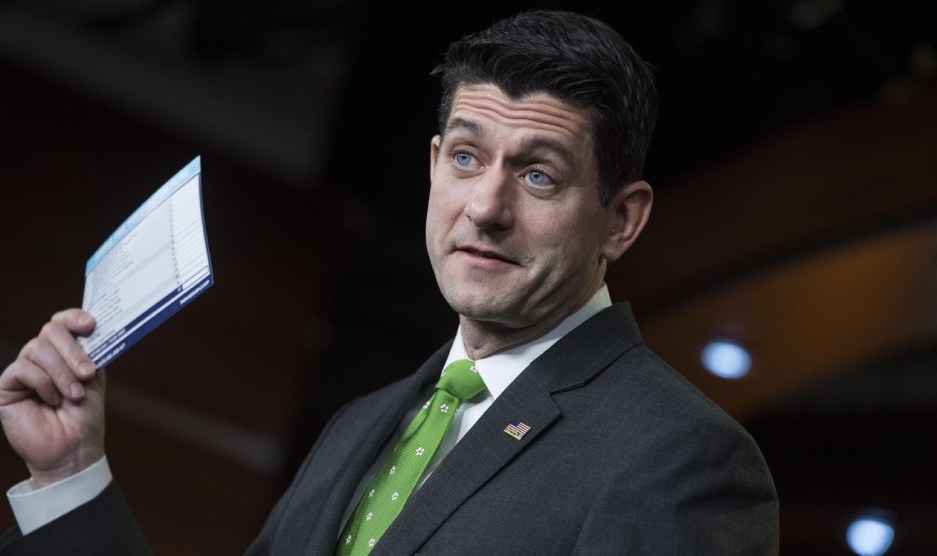
    Yes, Paul Ryan is still droning on about his tax return on a postcard. And yes, it's the same one that includes a 100-page asterisk where you do your actual taxes.Tom Williams/Congressional Quarterly/Newscom via ZUMA

    The Washington Post reports that the Republican tax cut hasn’t been a big hit with the public: “A Wall Street Journal and NBC News poll published this week found that 27 percent of respondents thought the tax law was a good idea, while 36 percent said it was a bad idea.”

    Bummer. So what’s the Republican plan to get the public back on its side?

    House Speaker Paul D. Ryan (R-Wis.) aims to pass another massive tax cut this summer, which Republicans hope will rev up the GOP base and improve the standing of Republicans at the polls….Conservative leaders met with Ryan on Monday and expect a vote in June or July. That would give lawmakers time to discuss the issue with constituents over the August recess and ahead of Labor Day, the traditional kickoff to the election campaign season.

    Of course that’s the plan. The answer to every problem always and everywhere is a tax cut.

  • How Much Trouble Is Michael Cohen In?

    Go Nakamura via ZUMA

    This is a helluva strange story from the Wall Street Journal:

    One of President Donald Trump’s longtime legal advisers said he warned the president in a phone call Friday that Michael Cohen, Mr. Trump’s personal lawyer and close friend, would turn against the president and cooperate with federal prosecutors if faced with criminal charges.

    Mr. Trump made the call seeking advice from Jay Goldberg, who represented Mr. Trump in the 1990s and early 2000s. Mr. Goldberg said he cautioned the president not to trust Mr. Cohen. On a scale of 100 to 1, where 100 is fully protecting the president, Mr. Cohen “isn’t even a 1,” he said he told Mr. Trump….“Michael will never stand up [for you]” if charged by the government, Mr. Goldberg said he cautioned the president.

    ….Mr. Goldberg provided fresh details about the search warrants executed against Mr. Cohen, which he said came from a conversation in recent days with Mr. Trump’s lawyer, Ty Cobb. Mr. Cohen faces scrutiny over his payment to the former adult-movie star Stephanie Clifford for her silence, as well as his taxi business, according to people familiar with the matter.

    Put aside the question of whether any of this is true. It doesn’t matter. The real question is why Jay Goldberg repeatedly, and in vivid terms, told a national newspaper that (a) Cohen was unreliable, (b) he had reported this to Trump, and (c) Trump apparently didn’t push back. This isn’t the kind of conversation that would normally elicit anything more than a terse “no comment,” but Goldberg provided the Journal with a two-hour interview.

    This is not an accident. Nor is Goldberg just a guy who doesn’t know how to keep his mouth shut. He’s a skilled and famous lawyer who’s, um, associated with mob figures like Matty “The Horse” Ianniello, Joe “Scarface” Agone, and Vincent “Jimmy Blue Eyes,” and who once described himself to a gossip columnist as a ‘‘killer’’ who could ‘‘rip skin off a body.’’

    So why did Goldberg do this? And why did the White House not push back against the story? Was there some reason that all parties involved wanted to make sure that this opinion of Cohen was made very, very public?

  • Quotes of the Day: A Roundup

    Tyler Cowen: “Kim [Jong Un] is only human and has to be thinking some about his own life. Does he want 40 or more years of lining up officials and executing them?”

    Larry Summers: “My experience with crises is that they are never resolved until the authorities have made a forecast that proves too pessimistic.”

    Barack Obama: “For instance, they could have me say things like, I don’t know…President Trump is a total and complete dipshit. Now, you see, I would never say these things—at least not in a public address.”

    Donald Trump: “James Comey, the worst FBI Director in history, was not fired because of the phony Russia investigation”

    Donald Trump: “In fact, when I decided to do it, I said to myself, I said, you know, this Russia thing with Trump and Russia is just a made-up story. It’s an excuse by the Democrats for having lost an election that they should have won.”

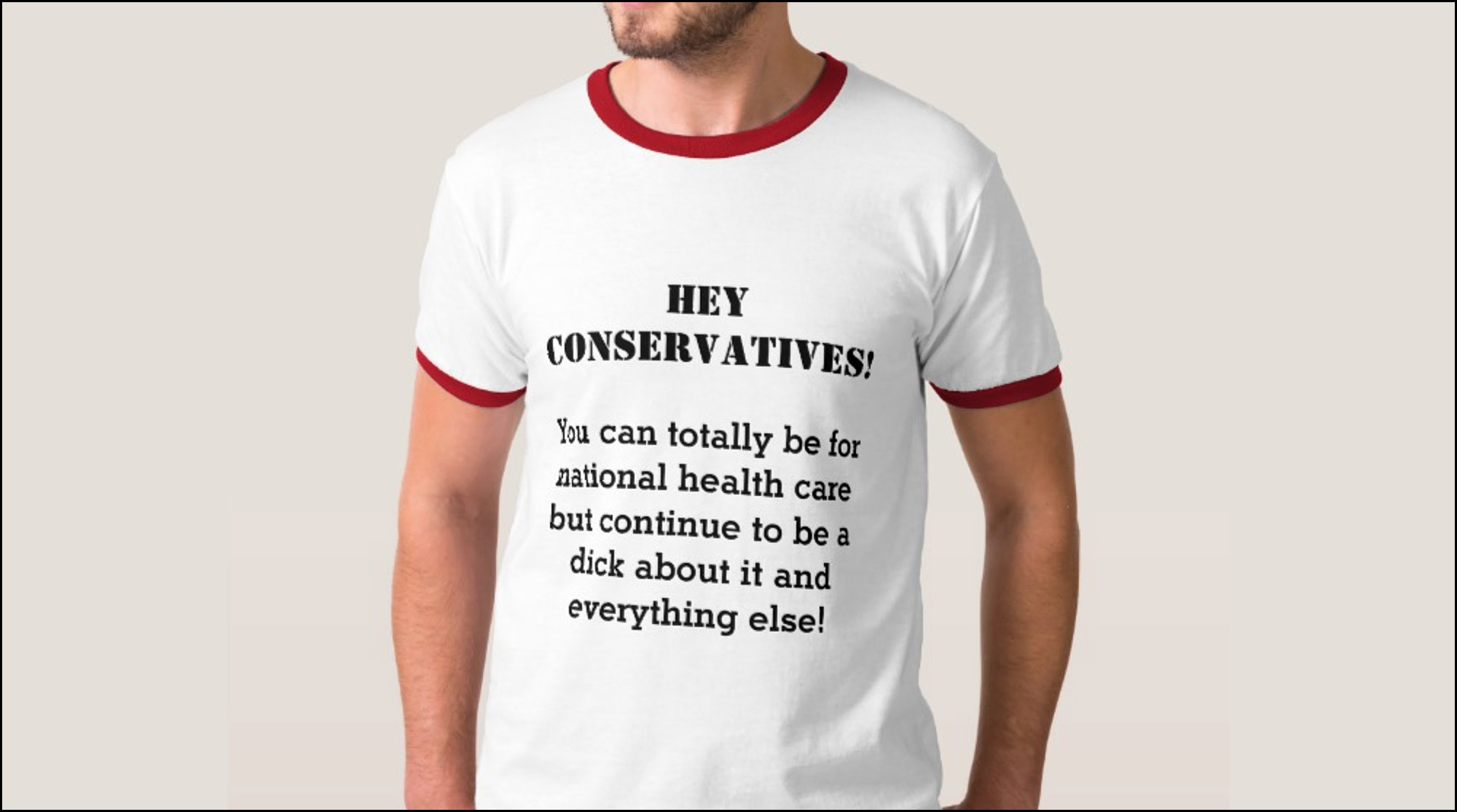
    Mitchell Stein: “I think we need t-shirts: ‘Hey conservatives! You can totally be for national health care but continue to be a dick about it and everything else!’ Thanks @kdrum” You’re welcome:

  • Lunchtime Photo

    I am waiting with bated breath for one of our Monarch butterfly cocoons to begin hatching. I have high hopes of catching it in a time-lapse video, which I will post here if I manage to get it. In the meantime, here’s a checkered white butterfly, very common here in Southern California. It’s slightly shaky because I took it through my window while I was writing a blog post.

    June 19, 2017 — Irvine, California
  • In Which I Defend a Rapacious Pharmaceutical Company

    The Washington Post reports on a group of doctors who were testing lower dosages of an expensive blood cancer drug called Imbruvica to see if it was effective at lower doses. Then the companies that make Imbruvica hit back:

    The researchers at the Value in Cancer Care Consortium, a nonprofit focused on cutting treatment costs for some of the most expensive drugs, set out to test whether the lower dose was just as effective — and could save patients money. Then they learned of a new pricing strategy by Janssen and Pharmacyclics, the companies that sell Imbruvica through a partnership. Within the next three months, the companies will stop making the original 140-milligram capsule, a spokeswoman confirmed. They will instead offer tablets in four strengths — each of which has the same flat price of about $400, or triple the original cost of the pill.

    Just as scientific momentum was building to test the effectiveness of lower doses, the new pricing scheme ensures dose reductions won’t save patients money or erode companies’ revenue from selling the drug. In fact, patients who had been doing well on a low dose of the drug would now pay more for their treatment. Those who stay on the dose equivalent to three pills a day won’t see a change in price.

    “That got us kind of p—ed off,” said Mark J. Ratain, an oncologist at the University of Chicago Medicine who wrote about the issue in the Cancer Letter, a publication read by oncologists. “We were just in the early stages of planning [a clinical trial] and getting it organized, and thinking about sample size and funding, and we caught wind of what the company was doing.”

    I can’t believe I’m defending a pharmaceutical company, but what did these oncologists expect? Everyone knows that the price of drugs like Imbruvica doesn’t depend on the cost of actually manufacturing the stuff. Whether it costs a penny a pill or $100 a pill is irrelevant. These drugs are priced to recover their R&D costs based on the number of patients who are likely to use them. If the number of pills required was any kind of factor at all, they’d manufacture them in 10-milligram sizes and make people buy 14 or 28 of them.

    You can argue about whether drug pricing is too high, but there’s really no argument that the price of a cancer drug should decrease if it turns out you can use less of it. That’s strictly a clinical judgment. The pharmaceutical company still has to recover its development costs, and that doesn’t change regardless of how big a dose is typically required.¹

    ¹Actually, the new pricing model for Imbruvica may be fairer than the old one. Should a 300-pound person pay more than a 150-pound person just because their body requires a bigger dose? Should people with higher cancer loads pay more than those with lower cancer loads? That’s not at all clear, is it?

  • A Health Care Lesson From a Rich Canadian

    This is how beloved Canadian health care is.Image Source/ZUMAPRESS

    I got this email from a friend a few days ago and thought I’d share it:

    I go to conferences which often have Canadian participants. Once I was speaking with a Canadian, who turned out to be extremely fiscally conservative. Thus, I steered clear of politics but we stumbled on healthcare because he mentioned that his spouse had suffered from two major cancer incidents. I mentioned that this must have been a financial disaster for him. He responded — very nonchalantly — basically along the lines of oh no that was mostly handled by our health care service. His out-of-pocket was fairly low under his supplemental insurance. Both times. Wife is doing well in remission. I asked — because I had heard it — whether treatment was delayed because of the limited number of doctors, etc. I got a weird bemused look in return and he just said no, there was no issue with it. That was really it. He didn’t praise or condemn the system. It was just a positive fact of his existence in Canada.

    Then he complained at length about taxes, too much government intervention in all aspects of life, stifled innovation, etc. This guy was wealthy, successful in business, travelled, had houses, etc. And apparently still had a living spouse to share them with without risk or fear of bankruptcy. He reminded me of the many firebreathing Medicare recipients in the U.S. who despise the government, complain about bankrupting the nation, high taxes, welfare louts, but are highly defensive of Medicare — with no self-awareness.

    It makes me kind of want to say to conservatives here that, it’s OK, you can totally be for national healthcare and still be a dick about it and everything else. It won’t turn you into a liberal. I’ve seen it!

    Consider it said. Hey conservatives! You can totally be for national health care but continue to be a dick about it and everything else!

  • Big Bank Finale

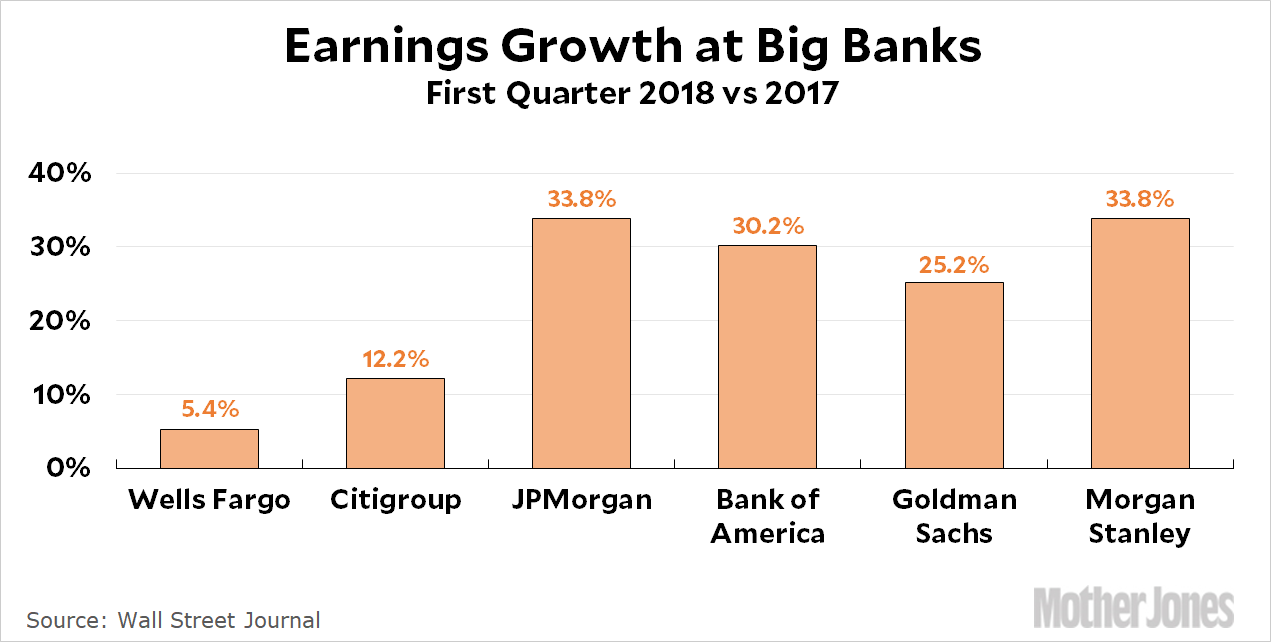
    I’ve come this far, so I guess I might as well finish up:

    Much of this is due to the Republican tax bill, of course, which has showered Wall Street with billions and billions of dollars. And why do we think that lower tax rates on big banks are going to improve their ability to lubricate the American economy? That’s a very good question, isn’t it?