• We Need More Research Into Race and IQ, Please

    Here in my little corner of the blogosphere, IQ and race are having yet another mini-moment. The reasons don’t really matter, and the arguments are exactly the same as they have been every time before. On the “blacks are dumber” side, it always goes something like this:

    • IQ is real; it matters; it’s partly determined by genetics; and blacks, on average, score lower on IQ tests than whites.

      Therefore:

    • Group IQ differences between blacks and whites are at least partly genetic.

    There is enormous evidence to back up everything in the first bullet. But none of it implies that the second bullet is true, even though it might seem like common sense to people who haven’t thought very hard about it. Unfortunately, this includes almost everyone, which makes it easy to perpetuate the meme that blacks are genetically less intelligent than whites. This is sometimes done explicitly, but more often with a sort of wink-wink-nudge-nudge bit of handwaving.

    This is why I’m all in favor of aggressive, well-funded research into race and intelligence. I don’t mean the fake Pioneer Fund sort of “research,” I mean honest, dispassionate research performed by real neuroscientists and geneticists. My read of the evidence so far is that racial IQ differences are very unlikely to be biologically based, and I would really, really like the research community to demonstrate this rigorously once and for all—and the sooner the better. This stuff will never go away until they do.

  • The White House Personnel Office Is Just a Big Frat Party

    The Washington Post reports that the White House office responsible for recruiting political appointees is a clown show:

    Two office leaders have spotty records themselves: a college dropout with arrests for drunken driving and bad checks and a lance corporal in the Marine Corps reserves with arrests for assault, disorderly conduct, fleeing an officer and underage drinking.

    ….Under President Trump, the office was launched with far fewer people than in prior administrations. It has served as a refuge for young campaign workers, a stopover for senior officials on their way to other posts and a source of jobs for friends and family, a Washington Post investigation found. One senior staffer has had four relatives receive appointments through the office….Even as the demands to fill government mounted, the PPO offices on the first floor of the Eisenhower Executive Office Building became something of a social hub, where young staffers from throughout the administration stopped by to hang out on couches and smoke electronic cigarettes, known as vaping, current and former White House officials said.

    The rest of the piece basically says the personnel office is wildly understaffed; that nobody outside the White House is volunteering to help screen candidates; and anyway, nobody wants to work for Trump in the first place. But this bad situation isn’t made any better by hiring people like this into six-figure jobs:

    One of the newcomers was a former Trump campaign worker named Caroline Wiles. Wiles, then 30, is the daughter of Susan Wiles, a prominent lobbyist and political operative in Florida….The younger Wiles has an unusual background for a senior White House official. On a résumé she submitted to the state of Florida she said she had completed course work at Flagler College in Florida. On her LinkedIn page, she says she simply lists Flagler under education. A Flagler spokesman said she never finished her degree. “She did not continue her enrollment or graduate from here,” said spokesman Brian Thompson.

    Wiles has had a string of political jobs, including work at her mother’s lobbying firm and as a campaign aide for candidates her mother advised, including Florida Gov. Rick Scott and Donald Trump. She also worked for an education organization that helped provide health care to needy students. Over the years, she has had multiple encounters with police. In 2005, she had her driver’s license suspended for driving while intoxicated, police records show. In 2007, she was arrested for driving while intoxicated and arrested for passing a “worthless check.” She was found guilty of a misdemeanor for driving under the influence. The charge related to the bad check was dropped in a plea agreement.

    Bygones. What’s important is helping out the daughter of a powerful Flordia lobbyist. We all deserve second chances on the taxpayer’s dime, right?

  • George Mason Economics Department Embarrasses Itself

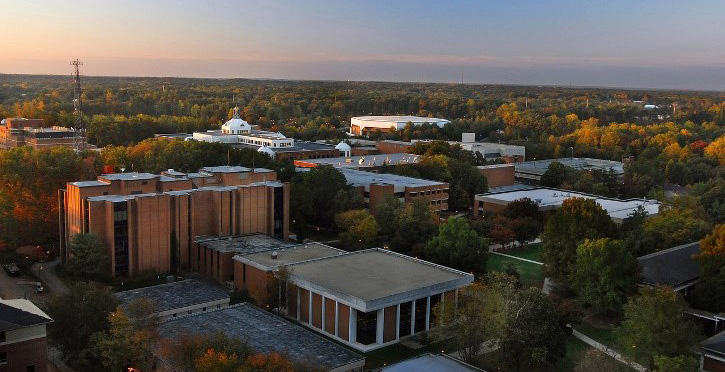
    George Mason University

    Donald Boudreaux earned a PhD in economics from Auburn University three decades ago. He is currently a professor of economics at George Mason University. Two days ago he wrote this in the New York Times:

    Not long ago an academic paper by the economists David Autor, David Dorn and Gordon Hanson garnered an unusual amount of public attention because of its estimate that trade with China from 1999 to 2011 destroyed 2.4 million jobs in the United States.

    These estimates of jobs destroyed by trade sound big, but they’re actually tiny. Relative to overall routine job destruction and creation — “job churn” — the number of American jobs destroyed by trade is minuscule. In January alone, the number of American workers who were laid off or dismissed from their jobs was 1.8 million. The number of workers who quit their jobs that month was 3.3 million….In a normal year, then, the number of workers laid off or dismissed averages 21 million….Clearly, trade is a trifling source of job loss when compared with other sources. These other sources are ordinary economic changes that, like trade, fuel our high standard of living.

    This is nuts. It’s like saying a few degrees of climate change is no big deal because the temperature changes 20 or 30 degrees every single day when the sun goes down. Jared Bernstein asked David Autor what he thought of this:

    It’s unfortunate that a Ph.D. economist would not recognize the crucial difference between gross and net job losses. By Boudreaux’s logic, since “in a normal year, then, the number of workers laid off or dismissed averages 21 million,” the U.S. Great Recession was a negligible event: the U.S. lost fewer than 4 million jobs in the first year (a mere one-quarter’s worth of job losses) and no more than another 2 million in the second year (only a month’s worth). It’s remarkable that we even noticed!

    I find it hard to believe that Boudreaux does not, in fact, recognize this. So why did he say it? That is a mystery, and one worth finding the answer to.

    On a side note, I’d also take the Times to task for this. It’s fine for them to invite credentialed economists to opine on issues of the day, even if they have contrary views. It’s another thing for them not to notice opinions so bizarre that even a layman recognizes them as specious. Why did they publish this?

  • Why Do We Need So Many Pennies?

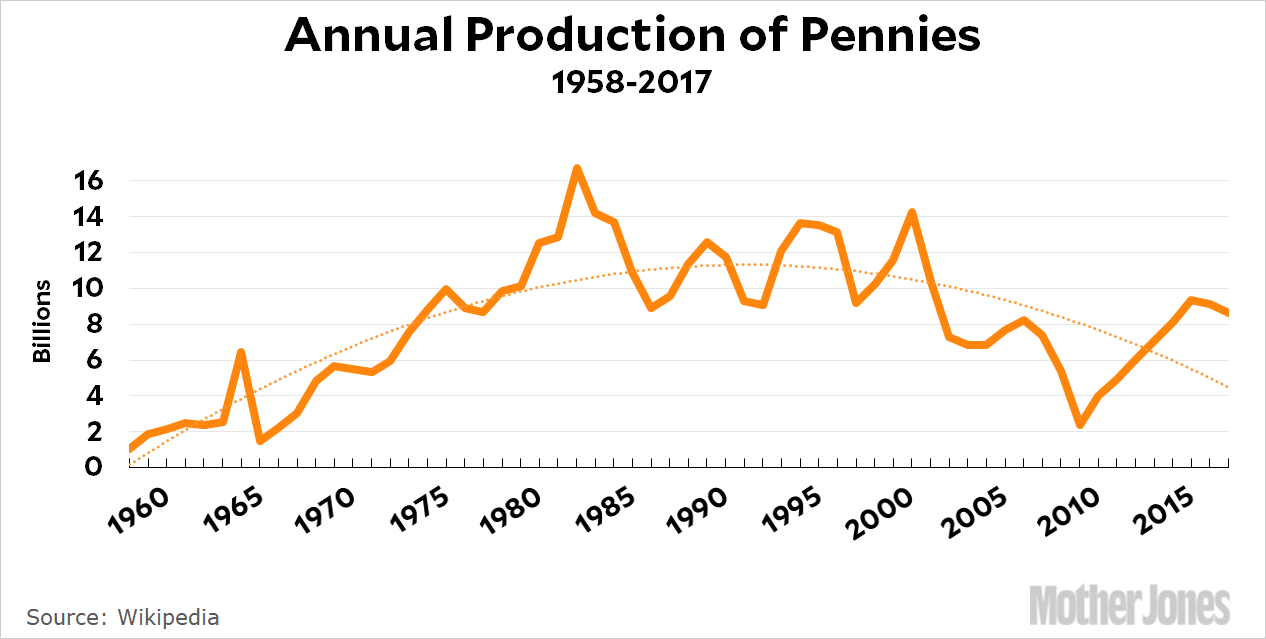
    Last night I happened to be looking at an old book of pennies and I was struck by the number of pennies minted each year. It’s gone up a lot since I was born. Here is penny production over my lifetime:

    In 1958 we produced six pennies for every person in the United States. In 1982 that peaked at 72 pennies per person. Last year we minted 26 pennies per person.

    Why the huge increase from 1958 through 1982? And why the decrease since then? I spent a few seconds googling this, but turned up nothing except an endless supply of rants about how we should get rid of the penny entirely. A few thoughts:

    • On a per-transaction basis, you never need more than four pennies per transaction. Given the randomness of sales taxes and the number of items purchased, I’d bet that the average number of pennies used per transaction hasn’t changed much.
    • As credit and debit cards became more popular, the number of cash transactions has probably decreased. This might explain the decline since 1982.
    • Does the increase through 1982 have something to do with people keeping pennies in their pockets less and instead tossing them into a coffee can when they get home? I have no reason to think this habit has changed over the years, and it would reach a steady state pretty quickly anyway. I don’t think this is likely to be a factor.
    • Production nearly doubled from 1978 through 1982 and then nearly halved from 1982 through 1986. What’s up with that huge spike?
    • Why the gigantic decline in 2009? On a per-capita basis, it was the lowest penny producing year since the year I was born. Does it have something to do with the financial crash?

    It’s mysterious. The more people rant about eliminating the penny, the more pennies we make. We are a peculiar people, aren’t we?

  • Facebook Accidentally Tells the Truth

    Xinhua via ZUMA

    BuzzFeed has dug up a memo written a couple of years ago by Facebook vice president Andrew “Boz” Bosworth. He now says he never believed any of it and wrote it just to be provocative. Here’s an excerpt:

    The ugly truth is that we believe in connecting people so deeply that anything that allows us to connect more people more often is *de facto* good. It is perhaps the only area where the metrics do tell the true story as far as we are concerned…. That’s why all the work we do in growth is justified. All the questionable contact importing practices. All the subtle language that helps people stay searchable by friends.

    ….I know a lot of people don’t want to hear this….We do have great products but we still wouldn’t be half our size without pushing the envelope on growth…. That’s our imperative. Because that’s what we do. We connect people.

    You can decide for yourself if you buy the excuse that Bosworth was just trying to stimulate discussion. I don’t. This sounds to me precisely like the kinds of things Mark Zuckerberg used to say in public until he wised up. This is Zuckerberg’s vision, connecting everyone in the world whether they want to be connected or not. It also happens to be great for the bottom line, which means that at Facebook church and state are always on the same page. That’s a powerful combination for conquest, as the entire continent of South America can attest.

  • Lunchtime Photo

    This handsome little bird is a yellow warbler, or so I’m told, and it will stay that way unless someone reliable tells me different. It is feasting on one of our yummy, yummy seed pods.

    UPDATE: It’s a lesser goldfinch. You can tell by the beak.

    February 8, 2018 — Irvine, California
  • Here’s the Latest From the “Robots Are Taking All Our Jobs” Front

    Back in 1984, when I got my first job in the tech industry, human beings created circuit boards. Engineers designed them, and then other people figured out how to fit all the chips onto a board and connect them to each other in the proper way (this is called “routing”). It’s a tricky task, and it got trickier as circuit boards got denser and more complex.

    Eventually, autorouting software got good enough to be a significant help, and then—well, you know what happened next, don’t you? Autorouting software got so good that it could do the whole task on its own in a few seconds. People who did routing for a living were all put out of jobs.

    Autorouting software is not artificial intelligence. It’s just ordinary software that got better and better. But what about chess software? What about go software? What about software that does what PhD biochemists do?

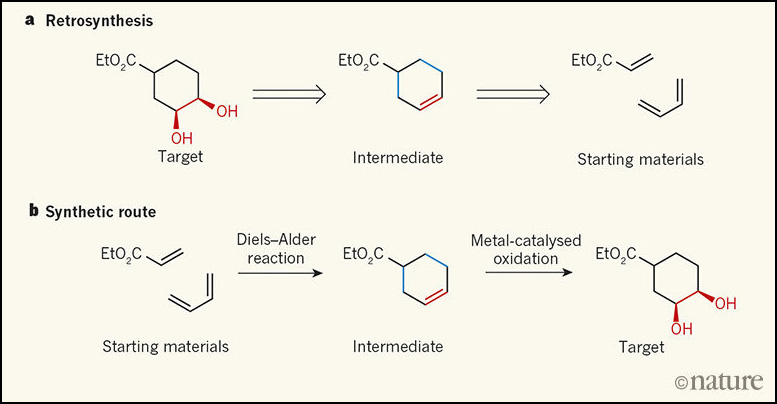
    Wait. What was the last one again? Here is biochemist Derek Lowe on a new piece of software for performing retrosynthesis, the process by which chemists create blueprints for constructing organic molecules:

    Organic synthesis is a lot harder to reduce to game-type evaluation than chess is, as the authors rightly point out. To get around this, the program combines neural-network processing with a Monte Carlo tree search technique….What the authors did…was have the program generate retrosyntheses for already-synthesized molecules, and then have these routes and the known ones evaluated blind by experienced chemists. The results were a toss-up: the machine routes were considered just as plausible or desirable as the human ones, and that (as above) is a victory for the machine. AI wins ties.

    ….Where does that put us? And by “us”, I mean “us synthetic chemists”. My conclusions from the earlier paper stand: we are going to have to get used to this, because if the software is not coming to take retrosynthetic planning away from us now, it will do so shortly….It’s not that this new software is coming up with routes that no human would be able to. But if we’re approaching “good as a human”, the next step is always “even better than a human”. Eventually — and not that long from now — such programs are going to go on to generate “Hey, why didn’t I think of that” routes, but you know what? Those of us in the field now are going to be the only ones saying that. The next generation of chemists won’t bother.

    I want to emphasize, as usual, that this is still not AI. However, it uses techniques that are to AI what Robert Goddard’s model rockets were to the Apollo program. Goddard didn’t know for sure that what he was doing could be scaled up to man-on-the-moon size, just as we don’t know for sure that current deep-learning algorithms can eventually form the basis for AI. But the odds seem pretty good. In time, our current algorithms will seem like little more than toylike proofs of concept, but they’ll still be the starting point. Lowe says the next generation of chemists won’t bother with synthetic transformation routes, but of course that’s only the beginning. Eventually, they won’t bother with creating new molecules at all. A computer will do it.

    So who will be put out of work first? Truck drivers or pharmaceutical biochemists? Is anyone taking bets?

  • Charts of the Day: The Banking Industry Ten Years After the Crash

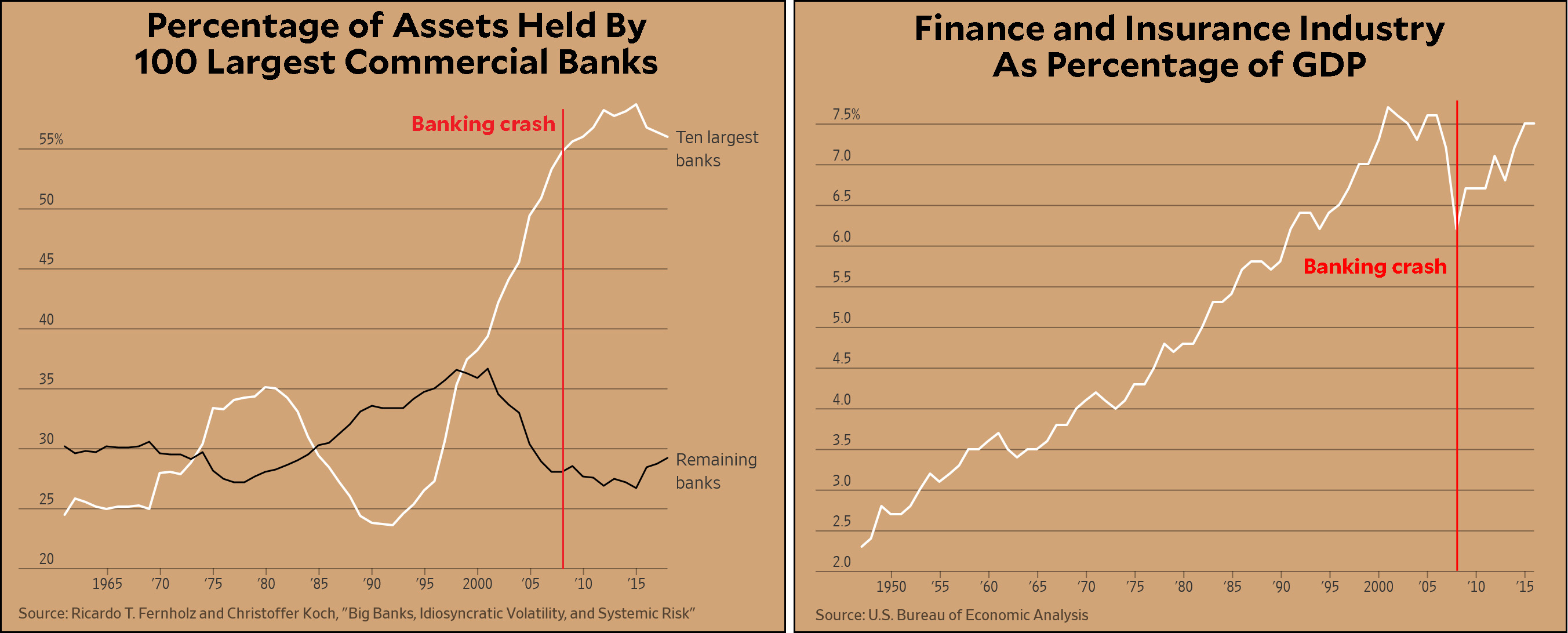
    The Wall Street Journal has a graphical retrospective today about the banking industry ten years after the great crash. Here are a couple of their charts:

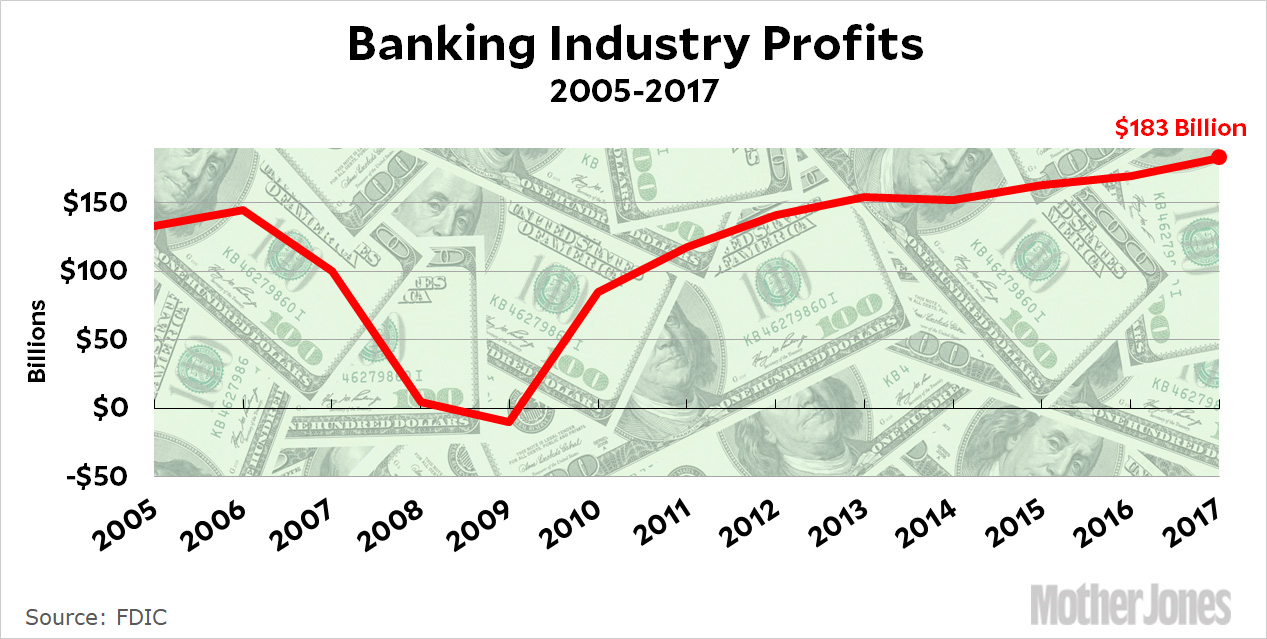
    The Journal inexplicably left out a chart on banking industry profits, so I’ll just add that one myself:

    Remember this the next time you hear tales of woe from the financial industry about the devastating effects of Dodd-Frank. It’s really crippled their ability to make money, hasn’t it?