Today’s regularly scheduled lunchtime photo has been pre-empted by one of Harold Pollack’s wonderful pictures taken this weekend at Chicago’s March For Our Lives. There are more here. Normal Kevin photoblogging will return tomorrow.
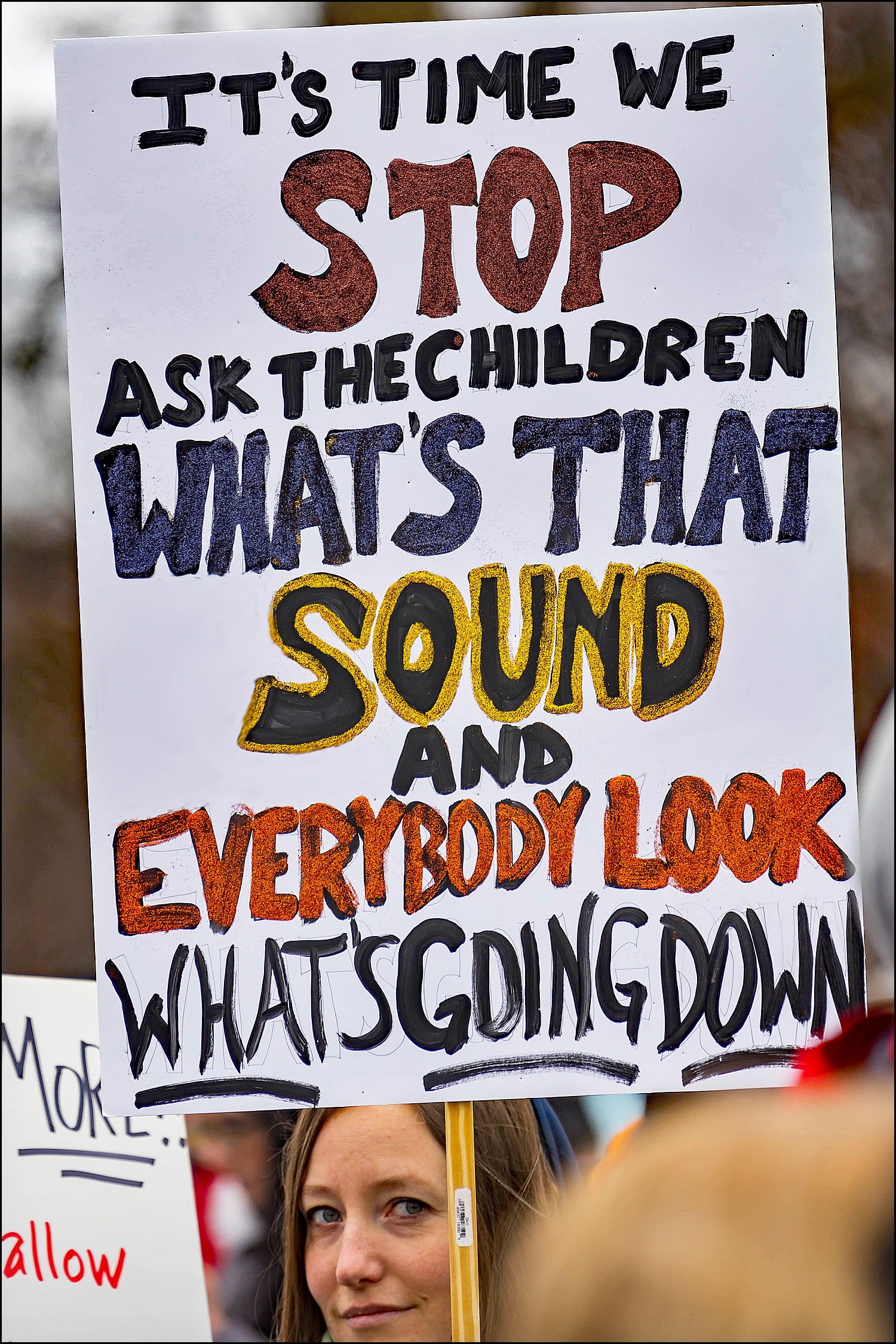

Today’s regularly scheduled lunchtime photo has been pre-empted by one of Harold Pollack’s wonderful pictures taken this weekend at Chicago’s March For Our Lives. There are more here. Normal Kevin photoblogging will return tomorrow.
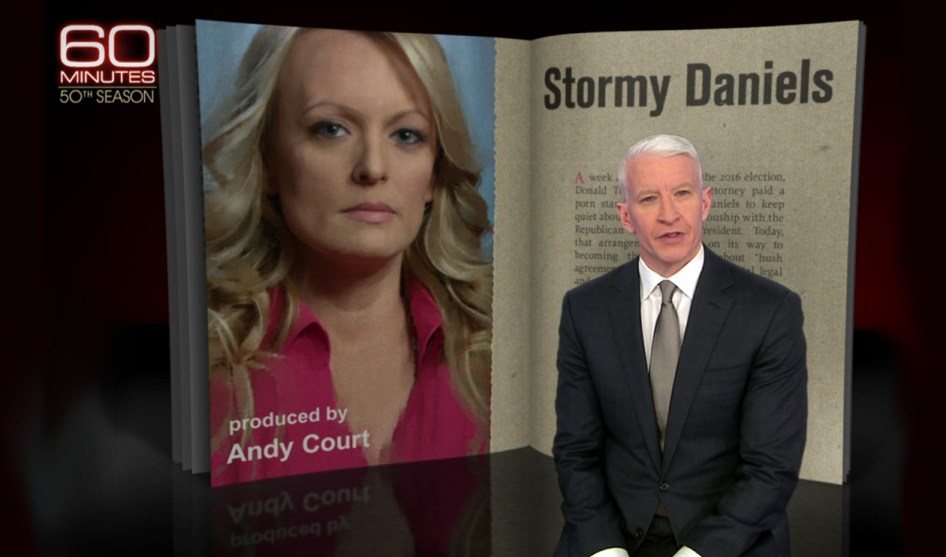
60 Minutes
Am I obligated to write about the Stormy Daniels interview on 60 Minutes last night? I am? Fine: I didn’t really learn anything new. She mostly repeated the basic story that InTouch published a couple of months ago, and added that she never wanted to go public but was forced to after the Wall Street Journal published a story about the hush money agreement. After that, well, if you’re going to go public, you might as well do it right. And she’s doing it right: the ratings for 60 Minutes were up 111 percent last night compared to last week.
In any case, there was really nothing new to learn anyway. At this point, I don’t think anyone doubts that the affair happened or that Donald Trump was well aware of the hush money agreement. However, we did get our first sustained look at Daniels in an interview. And she did well. She doesn’t sound rehearsed or evasive and she doesn’t sound embarrassed. She mostly sounds annoyed about the whole thing.
In any case, the great thing about the Stormy Daniels story is that Trump has really met his match. She’s trolling him just as loudly and just as relentlessly as Trump trolls everyone else. She’s not intimidated and she doesn’t really seem to care that Trump is president of the United States. What’s more, her lawyer seems like an easy match for Trump fixer/lawyer Michael Cohen, who is surely one of the more obnoxious figures to invade our TV screens in recent memory. Inae Oh has more about that here. Apparently he’s promising everything short of a blue dress to prove that Stormy Daniels is telling the truth. I guess we should all keep our popcorn poppers warmed up.
Adam Ozimek is not happy with economic growth, and he blames the Fed:
Does It Matter That The Fed Has Been Wrong For Years?
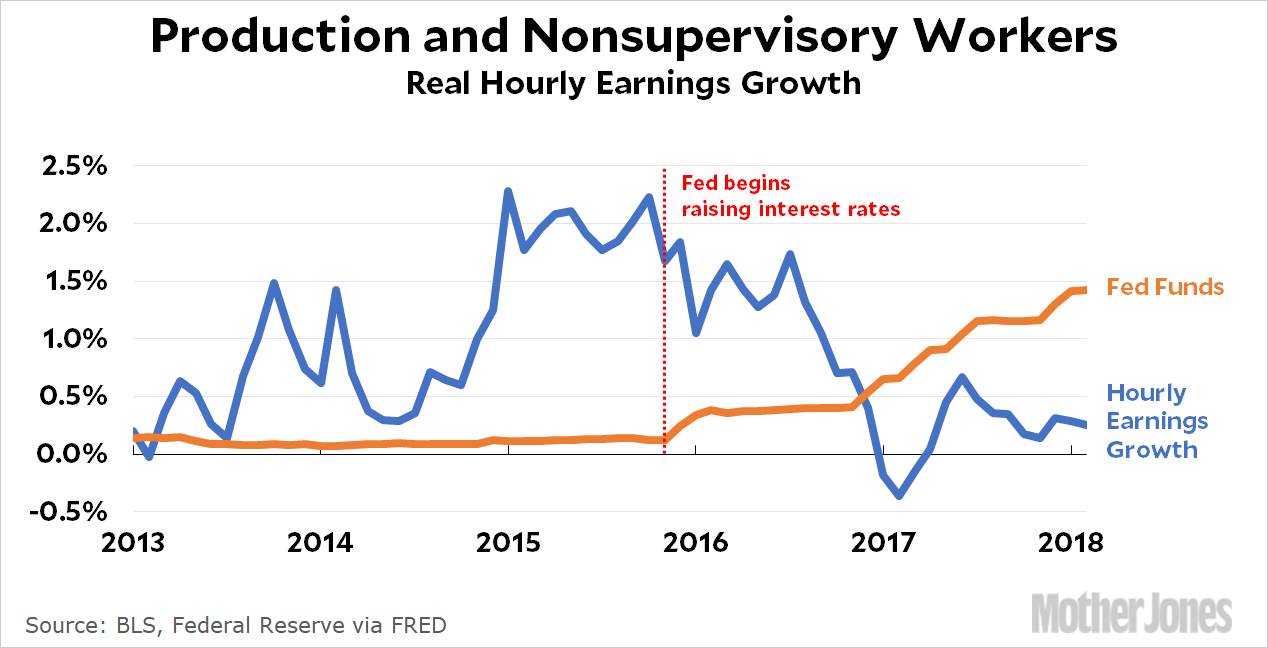
First, let’s look at job growth. No doubt it remains strong. We’re adding about 2 million jobs a year, and so it’s easy to think that interest rate hikes have done no damage. But this is excessively dichotomous thinking. This paints job growth as either “good”, and therefore unable to improve upon, or it is “bad” and therefore able to be improved upon. Instead I’d argue growth is good but could have been better.
….It’s useful to rewind to December 2015, a little over two years ago, and when the Fed started raising interest rates.
Read the whole thing for more. I’ll get you started with a simple chart:
Hey Californians! Our state has finally made it easy to look up your risk of dying in an earthquake with a fun, interactive map. For example, here I am:
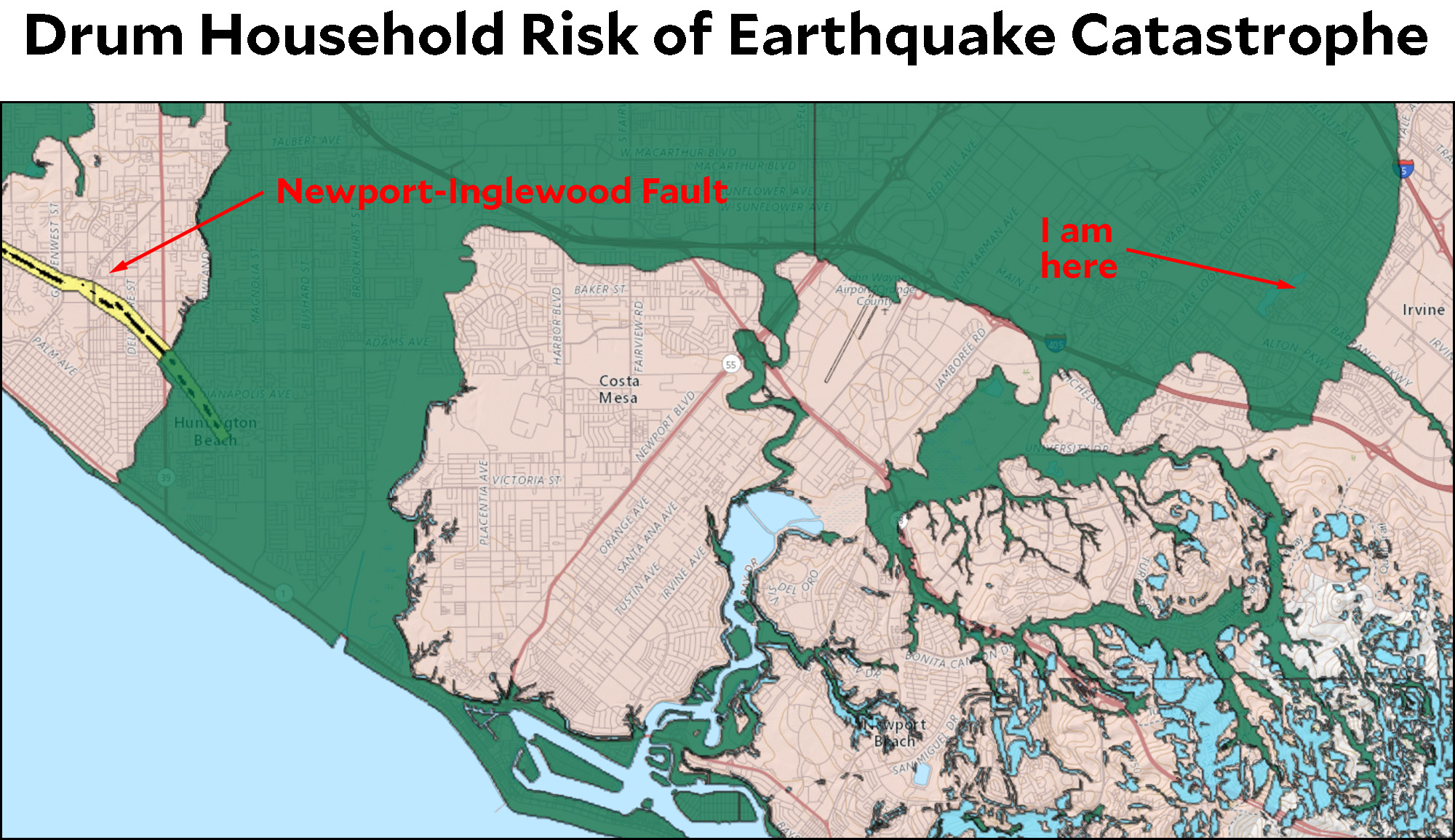
The green color indicates that I live in both a fault zone and a liquification zone. This is because most of Irvine rests on a giant foundation of mud, which could be good or bad, depending. But I’m right on the edge of it, and ten miles away from the bitty little Newport-Inglewood fault. So no worries. Unless they decide that the Inglewood-Newport fault is a lot more important than they thought. The LA Times has an explainer about the map here.
BTW, Southern California is not the land of a thousand lakes. The blue areas are landslide zones. Except for the blue areas that are water. Those are a slightly lighter shade of blue. In any case, I’m in no danger of landslides.
As for where you really, really don’t want to be, it turns out the answer isn’t San Francisco. It’s Seattle.
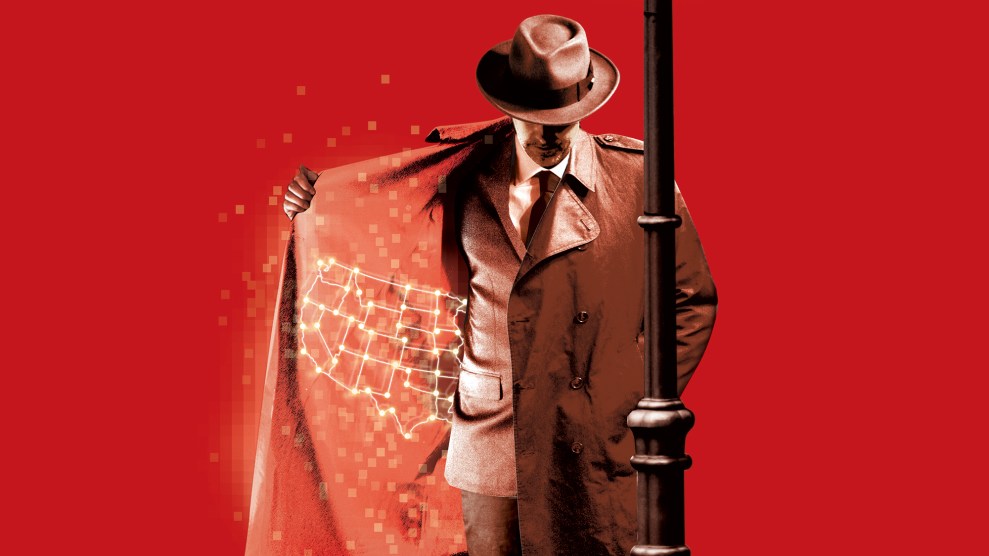
Doug Chayka
We all know by now that Cambridge Analytica managed to amass 50 million Facebook records for use in Donald Trump’s 2016 campaign. What we don’t know is whether those records actually did Trump any good. Alexander Nix, the CEO of the company, naturally said that Cambridge’s proprietary “psychographics” profiling was instrumental to Trump’s victory. He said the same thing about every other campaign Cambridge worked on. It turns out, however, that the campaigns themselves were considerably less enthusiastic about Cambridge’s work:
Even as Nix jetted around the globe and Cambridge opened new offices in Brazil and Malaysia, the company found itself with few allies in the United States. Trump campaign alums and Republican Party staffers distanced themselves from the company—especially after news broke last October that Nix had communicated with Assange.
….By late 2017, after giving every indication that Cambridge Analytica intended to be a major player in American politics, Nix told Forbes the firm was no longer “chasing any US political business,” a decision he framed as a strategic move. “There’s going to be literally dozens and dozens of political firms [working in 2018], and we thought that’s a lot of mouths to feed and very little food on the table.” This seemed dubious—working on a winning presidential race is a golden ticket that most consultants would dine out on for years. In reality, Cambridge Analytica’s reputation for spotty work had circulated widely among Democratic and Republican operatives, who were also put off by Nix’s grandstanding and self-promotion. Mark Jablonowski, a partner at the firm DSPolitical, told me that there was “basically a de facto blacklist” of the firm and “a consensus Cambridge Analytica had overhyped their supposed accomplishments.”
This is from “Cloak and Data,” Andy Kroll’s definitive look at the rise and fall of Cambridge Analytica from our May/June issue. It’s online now, and if you want to understand what Cambridge Analytica was really all about, you need to read it.
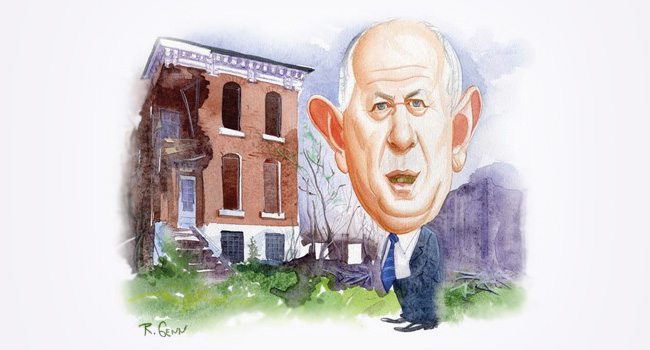
This is the artwork that ran above Williamson's piece. The artwork, like the story, focuses on Illinois Gov. Pat Quinn and alleged corruption in infrastructure spending. So why did the story start off with a gratuitous swipe at a black kid?Roman Genn/National Review
The Atlantic recently hired hardcore libertarian/conservative Kevin Williamson to be its newest columnist. Liberals are pissed. Partly this is because Williamson believes abortion is murder and therefore any woman who gets an abortion should be executed. This is typical of Williamson: he’s happy to say out loud things that plenty of other conservatives believe but are too smart to admit.
But Williamson also stands accused of racial insensitivity. His most often-quoted transgression is the first paragraph of a cover story he wrote for National Review in 2014. Here it is:
East St. Louis, Ill. — ‘‘Hey, hey craaaaaacka! Cracka! White devil! F*** you, white devil!” The guy looks remarkably like Snoop Dogg: skinny enough for a Vogue advertisement, lean-faced with a wry expression, long braids. He glances slyly from side to side, making sure his audience is taking all this in, before raising his palms to his clavicles, elbows akimbo, in the universal gesture of primate territorial challenge. Luckily for me, he’s more like a three-fifths-scale Snoop Dogg, a few inches shy of four feet high, probably about nine years old, and his mom — I assume she’s his mom — is looking at me with an expression that is a complex blend of embarrassment, pity, and amusement, as though to say: “Kids say the darnedest things, do they not, white devil?”
Describing a black boy as a “primate” is not a good look. But that’s not really the worst part of this paragraph. After all, it’s possible that Williamson didn’t realize this description was offensive. That’s not a great excuse, but it would speak mostly to cluelessness, not racism.
But here’s the thing. Williamson’s piece wasn’t about race. It was a fairly routine takedown of Democratic governor Pat Quinn prior to an upcoming election. It’s not even a very ideological takedown, focusing its spotlight mostly on alleged corruption in infrastructure spending. If Quinn had an R after his name, I could see myself writing almost exactly the same piece.
What leapt out at me, then, is this: what is this paragraph even doing in Williamson’s story, let alone acting as the lede? It has nothing to do with Quinn. It has nothing to do with corrupt infrastructure spending. It has nothing to do with the horrible condition of East St. Louis. It literally has nothing to do with anything in the rest of the piece.
To me, this says more about the editorial process at National Review than anything else. If I had turned in this piece, my editors would have instantly flagged both the “primate” language and the fact that the whole paragraph served no purpose except to make black people look dull and irresponsible. I’m willing to bet there’s not a single person in the entire MoJo newsroom who lacks the minimal sensitivity needed to recoil from this. Hell, it made me recoil, and I’m hardly the wokest guy on the planet.
But at National Review—well, I don’t know. Do they simply have no one on staff who noticed this? Did they notice but give in to Williamson’s demand to keep it? Did they actively like it because they knew it would appeal to their readers? Was the first draft even worse and this is actually the toned-down version?
There’s no telling. The most sympathetic explanation is that they care so little about racial philistinism that they either didn’t notice or didn’t care that Williamson’s piece began with a gratuitous swipe at blacks. After that, the possible explanations all go downhill.
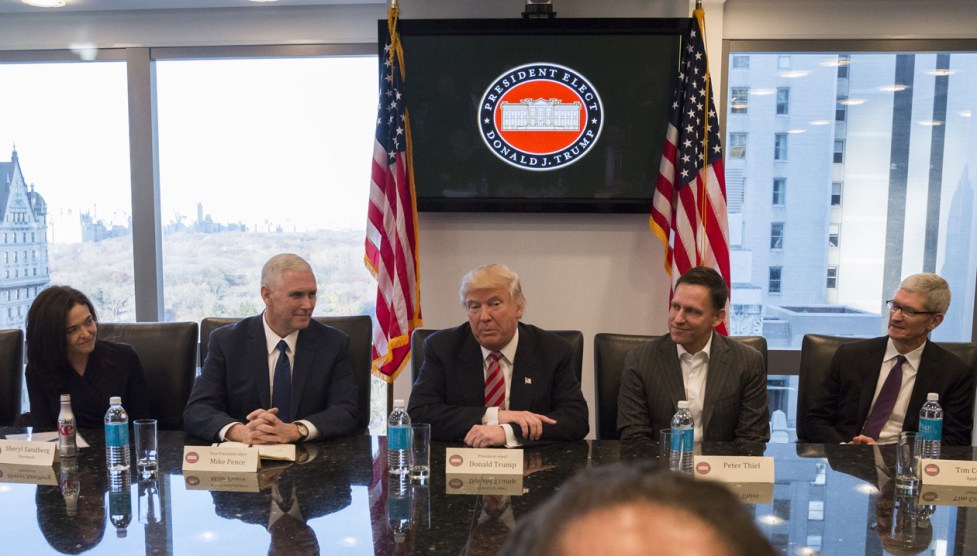
In fairness, Sheryl Sandberg's job requires her to sit next to Mike Pence, Donald Trump, and Peter Thiel and still smile like she's having a good time. So maybe she and her boss deserve all the riches they're getting from harvesting our personal information.Albin Lohr-Jones/CNP via ZUMA
Mike Masnick, in a piece subtitled “from the let’s-at-least-be-accurate dept,” says that Facebook doesn’t actually sell its user data. It sells ads that are targeted based on user data. Fair enough, and you can read his entire post to see why he thinks that distinction is important. However, before he gets there, he says this:
Before we dig into why they’re so different, let’s point out one thing that Facebook deserves to be yelled at over: it does not make this clear to users in any reasonable way. Now, perhaps that’s because it’s not easy to make this point, but, really, Facebook could at least do a better job of explaining how all of this works….Facebook, over the years, has done a piss poor job of explaining to users what data it actually keeps and what it does with that data. Despite some pretty horrendous practices on this front early on, the company has tried to improve greatly over the years. And, in some sense, it has succeeded — in that users have a lot more granular control and ability to dig into what Facebook is doing with their data. But, it does take a fair bit of digging and it’s not that easy to understand — or to understand the consequences of blocking some aspects of it.
I politely disagree. The pattern of Facebook’s conduct just doesn’t fit this narrative. In fact, Facebook doesn’t want to explain how all of this works. Facebook hasn’t tried to improve over the years. And their privacy settings are hard to understand because Facebook wants it that way. Consider:
Facebook’s behavior leads to only one sensible conclusion: they want to collect as much personal information as possible and they don’t really want to you to know about it. This is not illegal. Arguably, it’s not even wrong. Facebook’s whole business model is about providing users with a valuable free service and then using their personal information to pay for it. This is hardly a state secret, and to complain that they do it effectively is sort of naive. Supermarkets do something pretty similar with loyalty programs, and it costs a lot of money to opt out. Credit reporting agencies do the same thing, and you can’t opt out at all. Hell, at least Facebook gives privacy obsessives the possibility of opting out but still using the service for free.
So what am I griping about? Two things, I guess. The first is that Facebook is so damn churlish about just admitting what they do. The second is that people keep falling for the idea that Facebook is really, really trying to be better but repeatedly fails because…
Because why? Lousy management? Crappy programmers? A misunderstanding of what people want? A lack of control from the top? Come on. Facebook has none of these problems. They have top-notch management, brilliant engineers, a razor-keen understanding of what people want vs. what might piss them off, and a CEO with total control and an almost monomanical vision. Anything they do on the privacy front they do deliberately and methodically.
Facebook’s usual approach to these periodic storms of outrage is to apologize, make a few small changes, and then wait for the latest “delete Facebook” movement to settle down. If they lose 0.001 percent of their accounts in the meantime, they’ll make it up in the next ten minutes. And that’s exactly what they’re doing this time. Why else do you think it took them five full days to respond at all to the latest storm, before going public with a message so synchronized that you’d think Mark Zuckerberg and Sheryl Sandberg were zombie clones? It’s because they’re good managers, and they figured most people would move on to other, less boring things in five days. For the rest of us, they’re offering up a carefully constructed bit of pablum designed to maintain their usual charade.
And for those of us who are going to keep bitching no matter what? Well, haters gonna hate. Every company has haters, and they don’t really matter unless they have friends in high places. So far, none of Facebook’s haters do.
Tyler Cowen links today to a paper suggesting that knowledge of a person’s social network is more important than specific knowledge about the person herself. For some reason I clicked. It turns out the paper is written by a bunch of math and physics types and includes stuff like this:
The predictive information contained within a user’s text can be characterized by three related quantities, the entropy rate h, the perplexity 2h, and the predictability Π….We applied a nonparametric entropy estimator that incorporates the full sequence structure of the text. This estimator has been proved to converge asymptotically to the true entropy rate for stationary processes and has been applied to human mobility data.
In other words, it’s pretty much incomprehensible. However, it’s incomprehensible in a way that appeals to me, so I read it. I’ve got an hour or two to kill right now, so why not?
The authors are looking at something very specific when they talk about “predictability.” They analyzed the Twitter feeds of about a thousand people, and for each tweet they tried to predict what the next word in the tweet would be given the person’s past writing. Their question is, if you look solely at the writing of the person’s friends on Twitter, how accurately can you predict what they’re going to say? It turns out that this depends on how many friends you look at, with predictability topping out at around 15 friends.
So how good is predictability when you look at 15 friends? Pretty damn good:
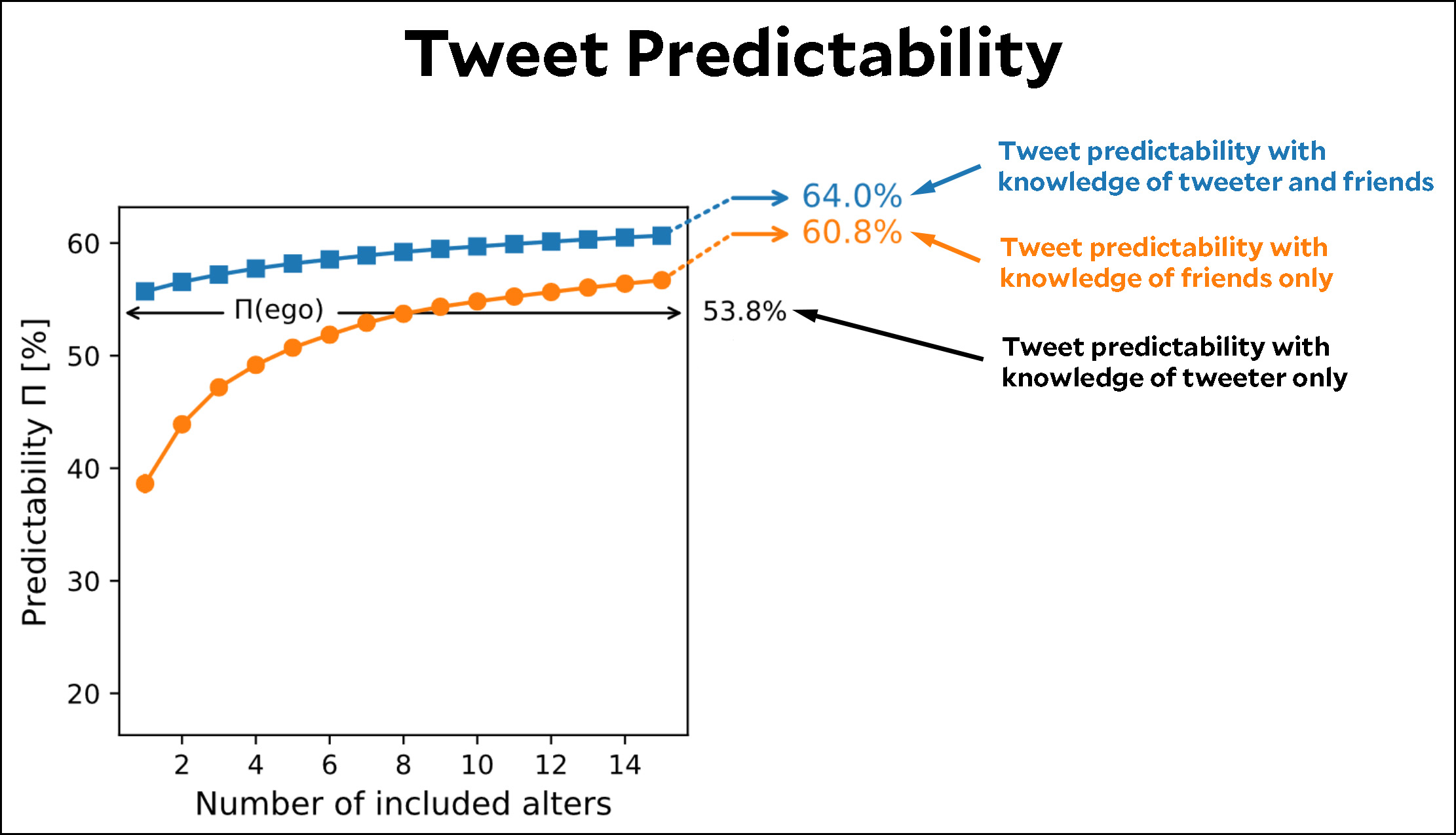
At around nine friends, the friends were better predictors than the person’s own past writings, represented by the black line labeled Π (ego). At 15 friends, the friends are considerably better, and adding the person’s own past writing increases predictability by only 3.2 percentage points. The authors point out what this means:
This may have distinct implications for privacy: if an individual forgoes using a social media platform or deletes her account, yet her social ties remain, then that platform owner potentially possesses 95.1% of the achievable predictive accuracy of the future activities of that individual.
In a nutshell, this means you can delete your Facebook account all you want, and it barely matters. If I already know who your friends are, I have a continuing stream of information about what things you’re likely to buy and which candidates you’re likely to vote for.
This paper, obviously, uses a very restricted meaning of “predictability.” Nonetheless, it’s suggestive that other kinds of predictability may be accessible through your friends too. If your friends like guns or beauty supplies, there’s a pretty good chance that you do too. Likewise, if some hot new fashion hits the stores and your friends all hate it, you probably hate it too. And if your friends seem to be undecided about a political candidate and are potentially persuadable with a specific message? Well, you probably are too, even if you insist that you are truly a unique snowflake uninfluenced by fads and peer pressure.
In other words, we are all doomed. Unless you can convince all your friends to abandon social media, it barely matters if you yourself do. Big Brother is still watching.
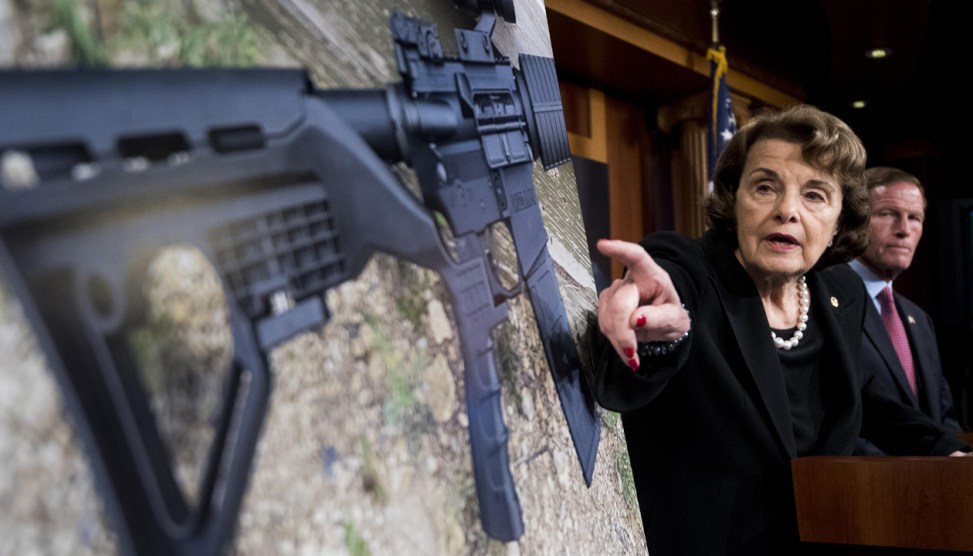
Sen. Dianne Feinstein in 2017, introducing legislation to ban the sale and possession of bump-stocks. Her bill went nowhere, of course, thanks to NRA opposition and Republican cowardice.Bill Clark/Congressional Quarterly/Newscom via ZUMA
Donald Trump this morning:
Obama Administration legalized bump stocks. BAD IDEA. As I promised, today the Department of Justice will issue the rule banning BUMP STOCKS with a mandated comment period. We will BAN all devices that turn legal weapons into illegal machine guns.
— Donald J. Trump (@realDonaldTrump) March 23, 2018
This is actually sort of true, more or less. That’s unusual for Donald Trump. But the reason it’s true is that Obama didn’t interfere when the ATF concluded in 2010 that the law gave them no authority to regulate bump stocks. The Kenyan socialist gun-hating dictator-in-chief then followed the law! Hard to imagine, isn’t it?
Needless to say, Sen. Dianne Feinstein and others have introduced legislation over the years to ban bump stocks as part of a very modest assault weapons ban, but these bills never saw the light of day thanks to NRA and Republican opposition. Last year, Feinstein introduced a bill limited just to banning bump stocks, but it also died thanks to NRA opposition and Republican timidity. Big surprise, eh? So now Trump is going to try to do it via executive order.
Will this work in the face of previous rulings that bump stocks are legal under current law? Will the NRA sue to overturn the EO? If they do, who will the courts side with? We could know the answers to all these questions next week if Republicans simply passed a bill to ban bump stocks. The original ATF ruling was based on statutory interpretation, not constitutional law, so a new law would clean up any confusion instantly. But Republicans are afraid to take even this tiny step for fear of crossing the NRA, so instead we probably won’t know for years.
I’ve been playing around some more with high-speed photography ever since I discovered that my camera’s shutter speed goes up to 1/32,000th of a second. Below you can see the results. I’ve got two hummingbird pictures, both full-frame photos taken within a few feet. I’ve got a honeybee flying around. And I’ve got a wasp (?) of some kind. All were taken at 1/16,000th of a second. They’re shockingly good.
But I need some help. I’d love to putter around with this some more, but what can I use it for? It needs to be something outdoors, since ultra-high shutter speeds require a lot of ambient light, and it needs to be something really fast. Cars and soccer balls might as well be molasses at these speeds. I need fast. Anyone got any good ideas?
UPDATE: In comments, Chris Hill suggests the “wasp” is really a hoverfly. I’ll buy that. But its shape is very distinctive, and so are its markings (two slanted white stripes followed by three horizontal white stripes). I can’t find one that looks anything like that.
UPDATE 2: It appears to be a four-spotted aphid fly.





Award-winning photojournalism.
Stunning video. Fearless conversations.


