Over at The New Republic, Walter Shapiro notes that Joe Biden faces multiple challenges in his inaugural address. Among them is a deep cynicism about the American economy:
The second challenge Biden must face is the cynicism of millions of Americans who view the economy as a permanently rigged game. Taking office in the wake of the financial collapse, Obama departed from soaring oratory to offer a laundry list of program ideas: “We will build the roads and bridges, the electric grids and digital lines that feed our commerce and bind us together.”
Twelve years later, voters on the economic margins have heard it all. Empty slogans like Biden’s awkwardly phrased “Build Back Better” are unlikely to create bonds of trust with the incoming president. From “green jobs” to “rebuilding the infrastructure,” standard Democratic rhetoric about the economy has become forced and mechanical. The widespread feeling is that programs will be announced and promises made, as the rich become richer and everyone else struggles to keep their heads above water.
This is such conventional wisdom that I can barely bring myself to disagree with it. But it’s just not right.
Take the belief that the economy is rigged in favor of the rich. In 2016 an Edison poll showed that 91 percent of Americans agreed. In 2020, however, a Crosscut poll pegged it at just a little over half and a Marketplace poll was in the same ballpark. Four years of strong wage growth seems to have made a significant dent in how the American public feels about this.
Likewise, voters “on the economic margins” may indeed have heard it all. But since the end of the Great Recession, household incomes of the poorest quintile have increased 22 percent (adjusted for inflation, of course). Half of that has come just in the past four years. It’s unlikely that they’re unusually unhappy about the economy.
The surprising thing about all this is not Shapiro’s view that the working and middle classes have gotten the shaft over the past few decades. Of course they have. The surprising thing is that this fact generally hasn’t triggered much of a backlash. Remember Occupy Wall Street? That was about as close as we’ve gotten recently to a grassroots protest against a rigged economy, and it fizzled out after just a few months. Nothing similar has ever taken its place.
“For Biden’s inaugural address to influence the politics of the next four years,” Shapiro says, “the incoming president must find a way to reach at least some of the disillusioned and the disaffected.” Sure. But money really doesn’t seem to be at the root of this disaffection. Consider this chart:
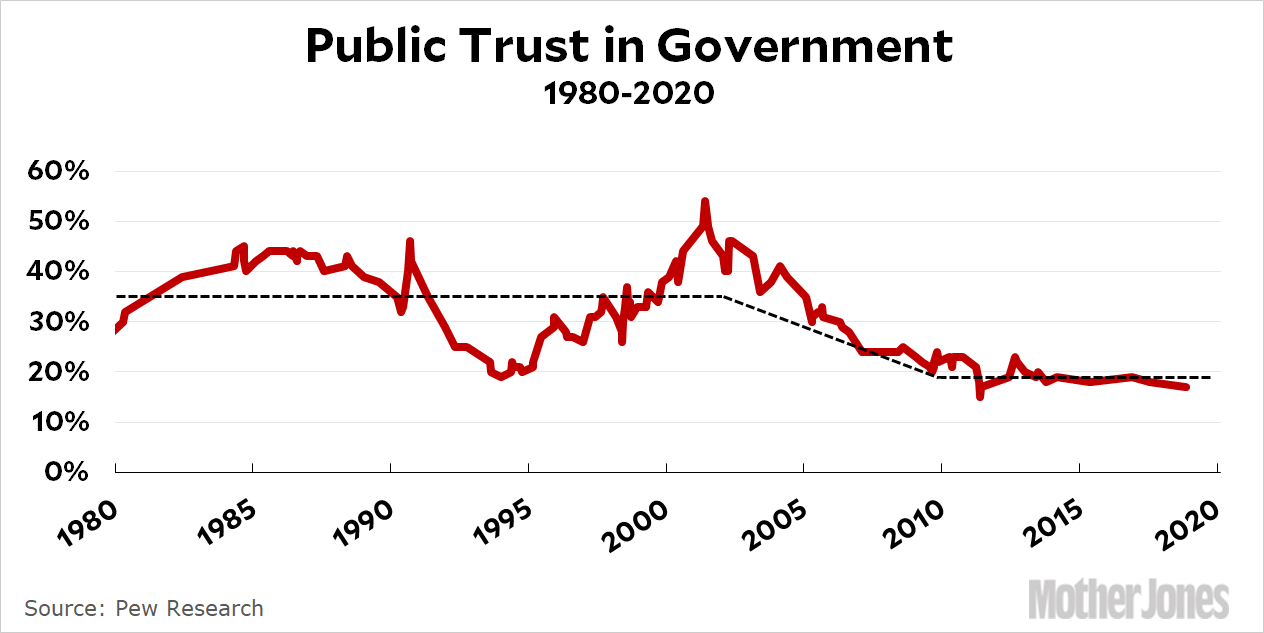
Although the spike after 9/11 makes it hard to tease out the underlying trend, it’s apparent that trust in government took a sharp downward fall starting in the early 2000s and continuing through about 2009. When the Great Recession hit, trust leveled out. When the economy began to recover, trust continued to be level. During the strong growth of the past four years, it stayed level yet again. It’s pretty clear that something happened during the first few years of the 2000s that started a long downward spiral, one that we’ve never recovered from. Money obviously doesn’t seem to be at the root of this in a broad sense, and polls of financial satisfaction confirm that the same is true in a more personal sense. It’s something else. And whatever it is, it’s what Joe Biden needs to address.
There’s a hint in the chart: again, it’s something that started to affect us around the year 2000. And it’s probably not strongly related to money. But what? I’ll provide the answer tomorrow.