Our house in Caherdaniel was at the top of a hill near two cemeteries. The newer graveyard was, as you might expect, boring. I passed it twice a day as I drove out each morning and in at night, but I never bothered looking around. The old graveyard, however, was great. It was thickly overgrown, foggy at times, and full of ruined old church buildings. I was pretty careful when I walked around in it, but not careful enough: I tumbled completely into a hole covered by brambles and vines one time. I sustained no damage other than a few scratches, but for a while I wondered how I was going to get back up. I was suspended entirely by plants, and there was no obvious way to lift myself into a sitting position, let alone a standing one. But eventually I did, and after that I was even more careful.
Anyway, here’s a Celtic cross at sunset over one of the graves.
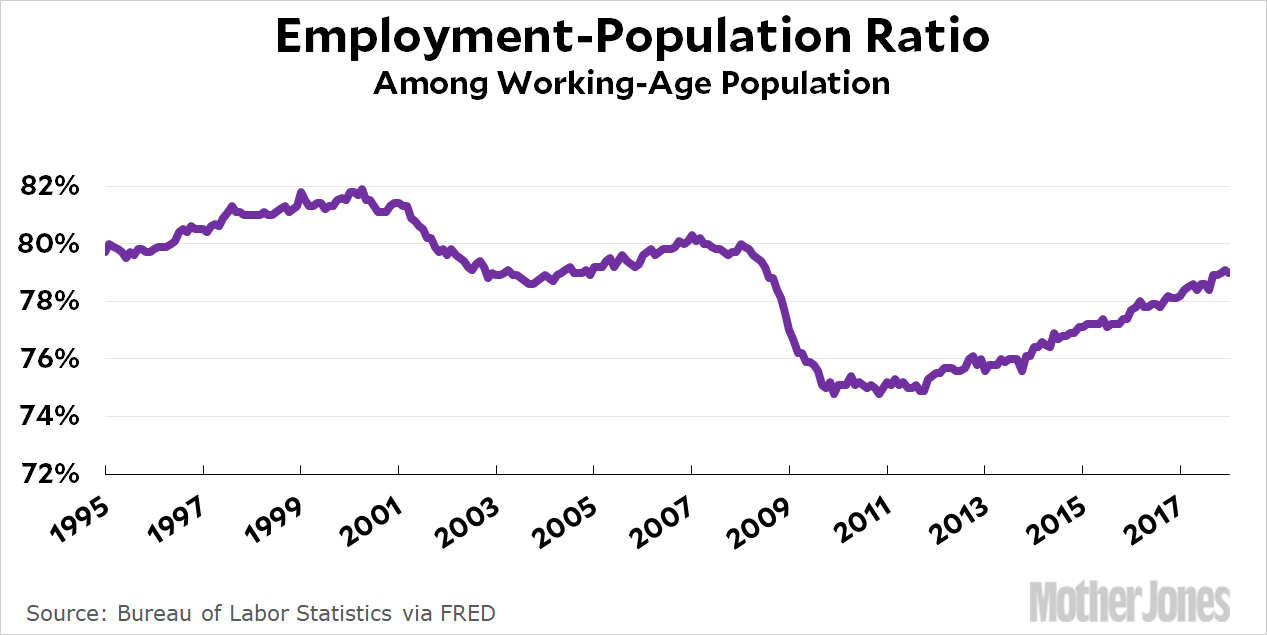
Via Andrew Van Dam, a new paper tries to estimate why there are fewer people working than in the 90s. Much of this is due to the aging of the workforce, but even among prime working-age people the employment rate is down. Here’s the employment-population ratio for those aged 25-54 since the mid-90s:
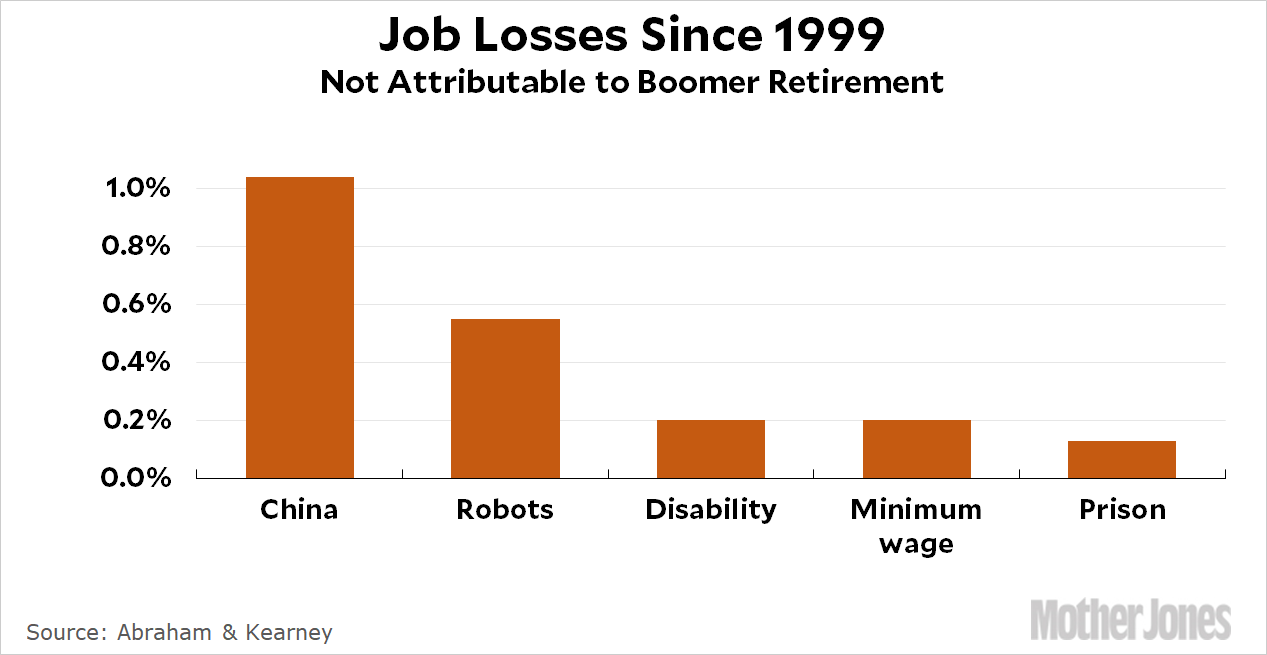
The peak of the dotcom boom is probably not the right comparison, but even if you use the mid-90s more generally as a baseline, about 2-3 percent of the working-age population has dropped out of the workforce over the past two decades. Why? Here’s what the authors came up with:
For practical purposes, the entire story is China and automation. The other three factors had a minimal effect, and the following things had no effect:
SNAP (food stamp) expansions
Obamacare/Medicaid
More generous EITC
Increased rates of spousal employment
Increased difficulties due to lack of family leave
Expanded immigration
Decline in unionization
The China effect is a one-off phenomenon, and it’s pretty much over. We’ve lost all the jobs we’re going to lose. Automation, however, is just getting started. I don’t personally expect it to have a big impact in the near future, but starting in the mid 2020s I think it will. This is the biggest economic challenge of the next few decades.
Three technology titans have powered nearly half of the S&P 500’s advance this year, a worrying sign for investors expecting a strengthening economy to lift shares of manufacturers, oil companies and other firms whose fortunes typically improve with growth.
The S&P 500 technology sector has driven more than three quarters of the index’s gains, according to S&P Dow Jones Indices. The next biggest contributor is the consumer-discretionary sector—which includes tech-focused Amazon and Netflix—with more than a third of the advance.
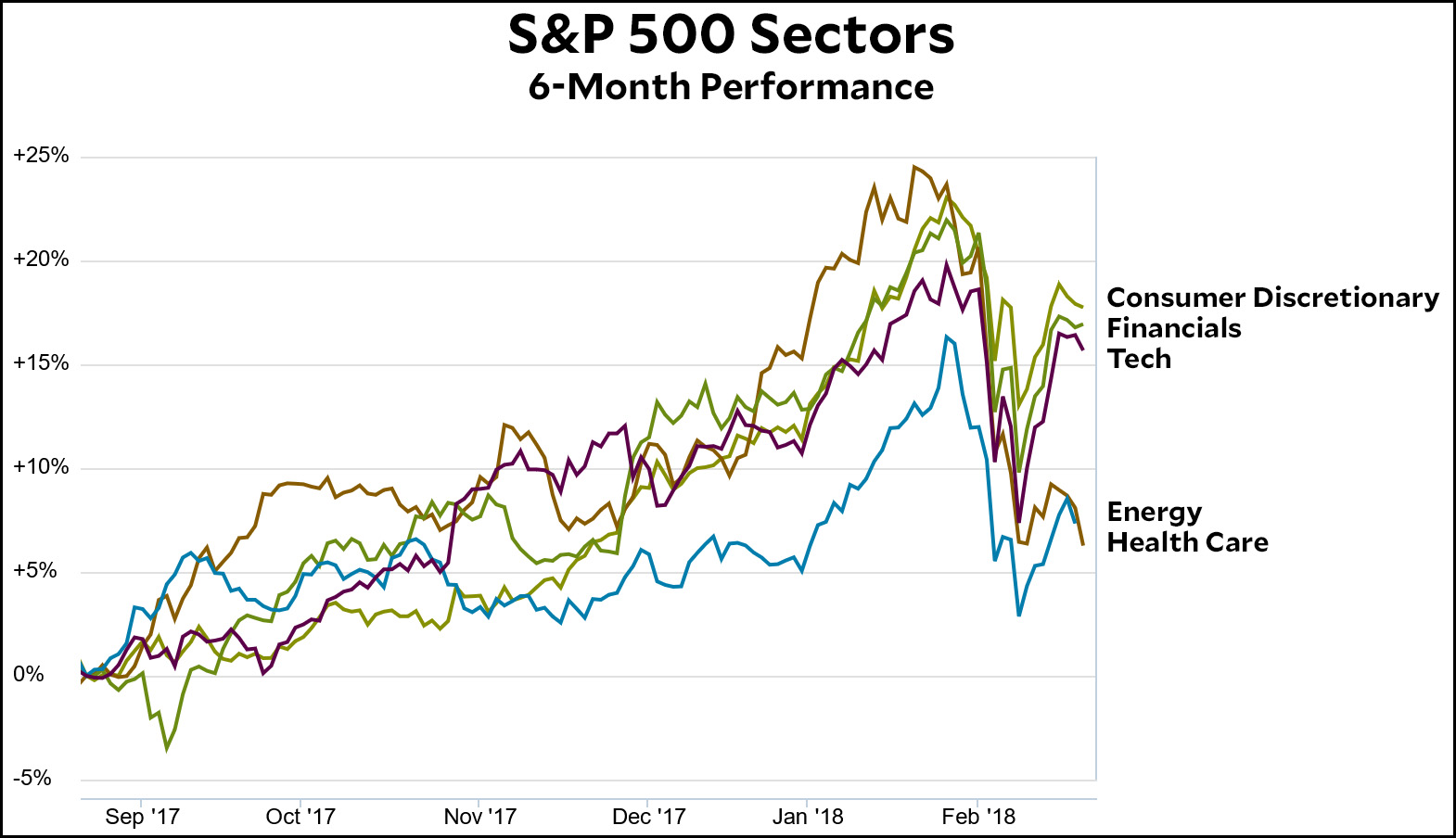
If you look at a few weeks of performance, you’ll always find something to worry about. Here’s what a few S&P sectors look like for the past six months:
Tech is doing great, but so are financials and the consumer discretionary sector—which does include Amazon, but is overwhelmingly standard consumer stuff like Disney and Comcast and McDonalds. And consumer durables have been kicking ass for the entire past year.
I don’t know how long this will keep up, but the market isn’t about to crater as soon as tech stocks come back down to earth. It’s going to crater if the Fed doesn’t allow middle-class earnings to rise and consumers stop spending. This is one sense in which the stock market really is a proxy for the entire economy.
Students training for a license to carry a concealed weapon in Chino, California.Jebb Harris via ZUMA
The ability of Donald Trump to drive the news media is spectacular. Every newspaper is leading with Trump’s call to arm teachers, and in the Washington Post Philip Bump even goes so far as to figure out how much that would cost (about $1 billion). I don’t blame Bump for doing this—it’s the kind of thing I’d do, after all—but it’s insane nevertheless. We’re not going to hand out Glocks to third-grade teachers. Most teachers don’t want to be armed. And having lots of guns around schools is pretty much begging for trouble anyway.
Mostly, though, it’s insane. We’re not going to arm teachers. Trump knows it. The NRA knows it. It’s just a random tarball tossed out to distract attention from the obvious problem. And it works.
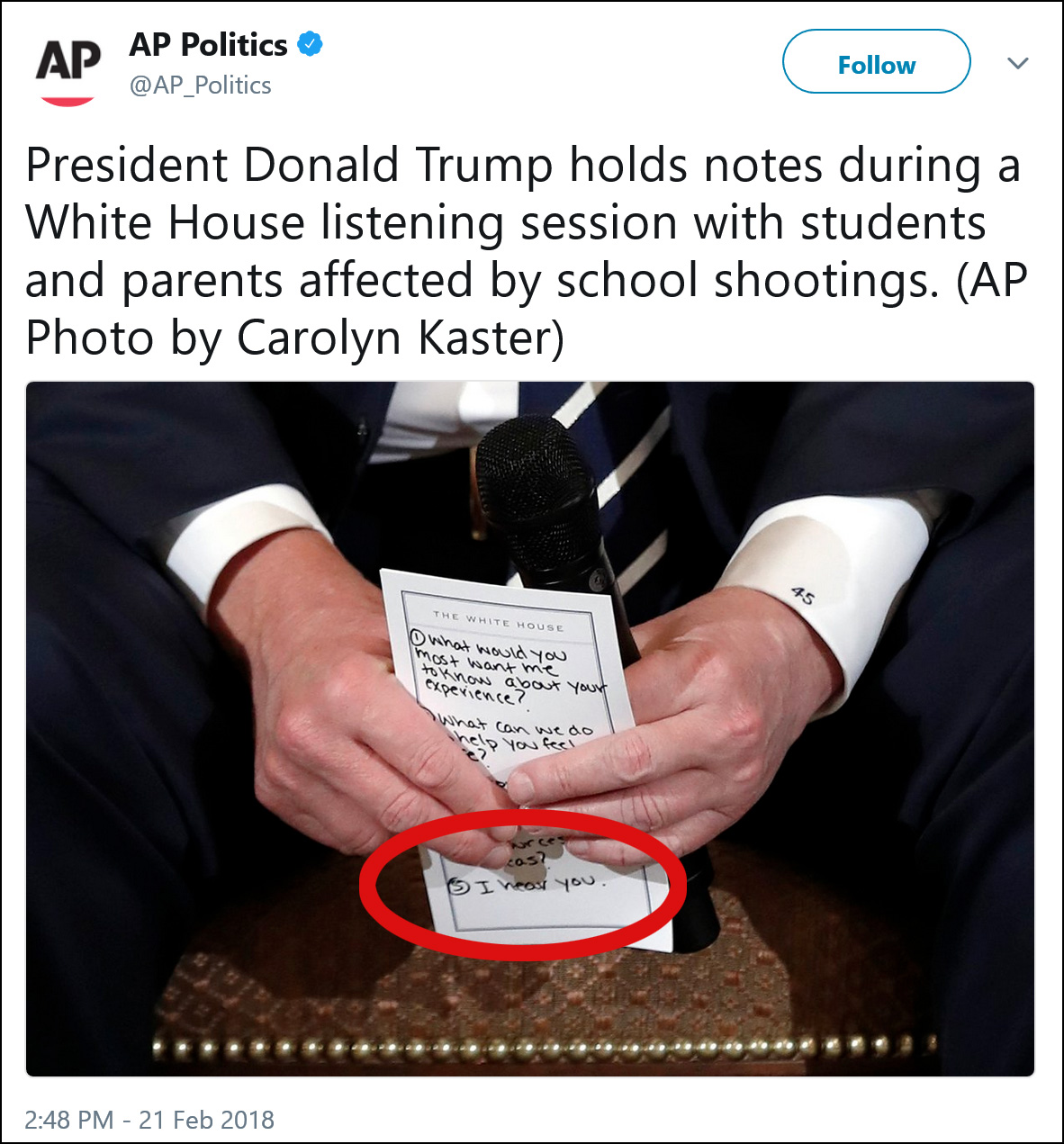
Behold the president of the United States, at an Oval Office meeting with students and parents from Parkland, Florida. His staff had to remind him that every once in a while he should pretend to be paying attention to the grieving families he was meeting with.
Have recently become obsessed with the topic of why the internet has gotten so bad and what it says about commercialization, concentration, civic spaces and cooperative human endeavors.
If you’ve got something you read on this you want to share, post it here ⬇️
It’s funny. Generally speaking, I’m not a cheerful, optimistic guy. And yet, I feel much more sanguine about social media than most of the folks I read on—well, on social media.
There are several reasons for this. For one thing, I’m not convinced that social media has changed people or that it “says something” about contemporary society. I think there have always been lots of assholes out there, and all social media does is congregate them in a single place. Second, the media wildly overcovers Twitter and Facebook because reporters (and famous people in general) tend to be on Twitter and Facebook themselves. Reddit is far more of a cesspool than Twitter will ever be, but you only rarely hear of it. Why? Because most reporters never read it. Third, as I’ve mentioned before, we humans are bad at arithmetic. The emotional impact of a thousand trolls haranguing you is way out of proportion to how much you should care about 0.0001 percent of the population hating on you.
I figure we’ll all adapt to this stuff eventually. The media will get bored with social media and the rest of us will figure out that tidal waves of assholes aren’t really all that meaningful.
But there’s one other thing that keeps me hopeful. I think of social media in its current incarnation as similar to war: a war between trolls and the rest of us. The trolls are on offense, and right now they have the upper hand. But military technology usually follows cycles like this. Offensive capabilities improve, and defenses only catch up later. Likewise, we’re only now starting to get serious about defending ourselves against trolls. But we’ll figure it out, and social media will be safe again. Then we’ll go through the same cycle again with something else.
I think we’re at the nadir of social media right now. A decade ago it was new enough that usage was low and trolls weren’t a big problem. A decade in the future we’ll figure out how to bottle up the trolls. Right now, though, we’re kind of screwed. But it won’t last.
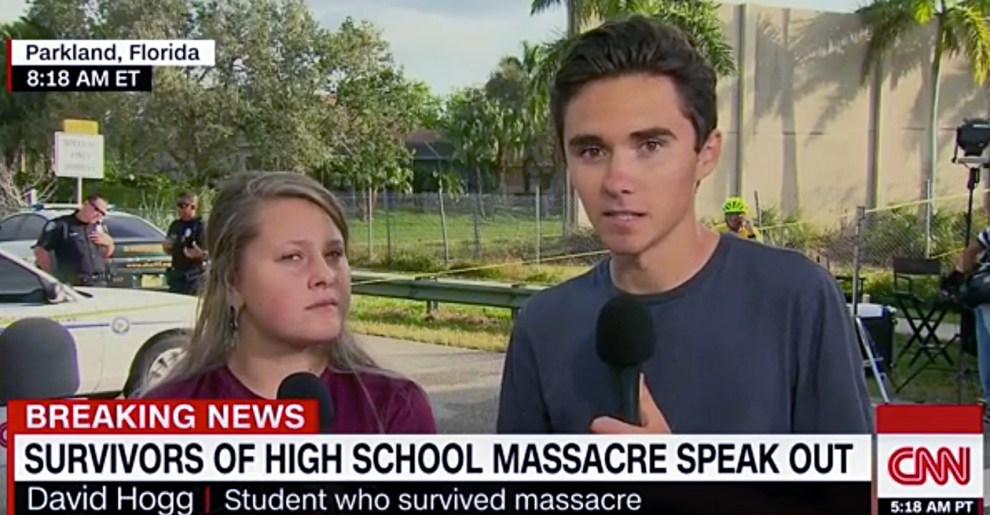
Just in case you don’t know, the latest right-wing nutball conspiracy theory is that David Hogg, a student at Marjory Stoneman Douglas High School, is not what he seems:
In certain right-wing corners of the web — and, increasingly, from more mainstream voices like Rush Limbaugh and a commentator on CNN — the students are being portrayed not as grief-ridden survivors but as pawns and conspiracists intent on exploiting a tragedy to undermine the nation’s laws. In these baseless accounts, which by Tuesday had spread rapidly on social media, the students are described as “crisis actors,” who travel to the sites of shootings to instigate fury against guns. Or they are called F.B.I. plants, defending the bureau for its failure to catch the shooter. They have been portrayed as puppets being coached and manipulated by the Democratic Party, gun control activists, the so-called antifa movement and the left-wing billionaire George Soros.
The theories are far-fetched.
Indeed they are, but let’s be honest: not as far-fetched as the idea that Hillary Clinton ran a pedophile ring out of the basement of a pizza parlor.
I know, I know: Just yesterday I announced a new right-wing nutball conspiracy theory, and today I have a brand new one. What can I say? Back in the good old days when Bill Clinton was accused of running drugs out of Mena airport and murdering Vince Foster, the conspiracy theories were weeks or even months apart. Today that seems quaint. Like any addict, modern right-wing nutballs demand higher highs and more frequent highs. Also like any other addict, they become ever more willing to sink to any depths to feed their habit. At least Bill Clinton was president of the United States, after all. Presidents are used to being attacked. Now they’re going after 17-year-olds who have just watched a gunman massacre their friends. I’m almost afraid to ask what’s next.
As an old man tottering into the sunset of his life, I would like to verify from my own experience that, yes, there was a time when kids went to high school without giving a moment’s thought to being gunned down by a mass murderer. Hard to believe, I know.
As we all know, kids today are better behaved, on average, than kids in the 70s and 80s. So that’s obviously not the reason. But what else could it be? It’s a mystery.
The Key to Weight Loss Is Diet Quality, Not Quantity, a New Study Finds
A new study, published Tuesday in JAMA…found that people who cut back on added sugar, refined grains and highly processed foods while concentrating on eating plenty of vegetables and whole foods — without worrying about counting calories or limiting portion sizes — lost significant amounts of weight over the course of a year….The research lends strong support to the notion that diet quality, not quantity, is what helps people lose and manage their weight most easily in the long run. It also suggests that health authorities should shift away from telling the public to obsess over calories and instead encourage Americans to avoid processed foods that are made with refined starches and added sugar.
This was not my emphasis. I led with the comparison of low-fat and low-carb diets. Why the difference?
First things first. I didn’t have access to the study itself, which is often reason enough for me not to comment on something. On the other hand, here’s the abstract:
Conclusions and Relevance In this 12-month weight loss diet study, there was no significant difference in weight change between a healthy low-fat diet vs a healthy low-carbohydrate diet, and neither genotype pattern nor baseline insulin secretion was associated with the dietary effects on weight loss. In the context of these 2 common weight loss diet approaches, neither of the 2 hypothesized predisposing factors was helpful in identifying which diet was better for whom.
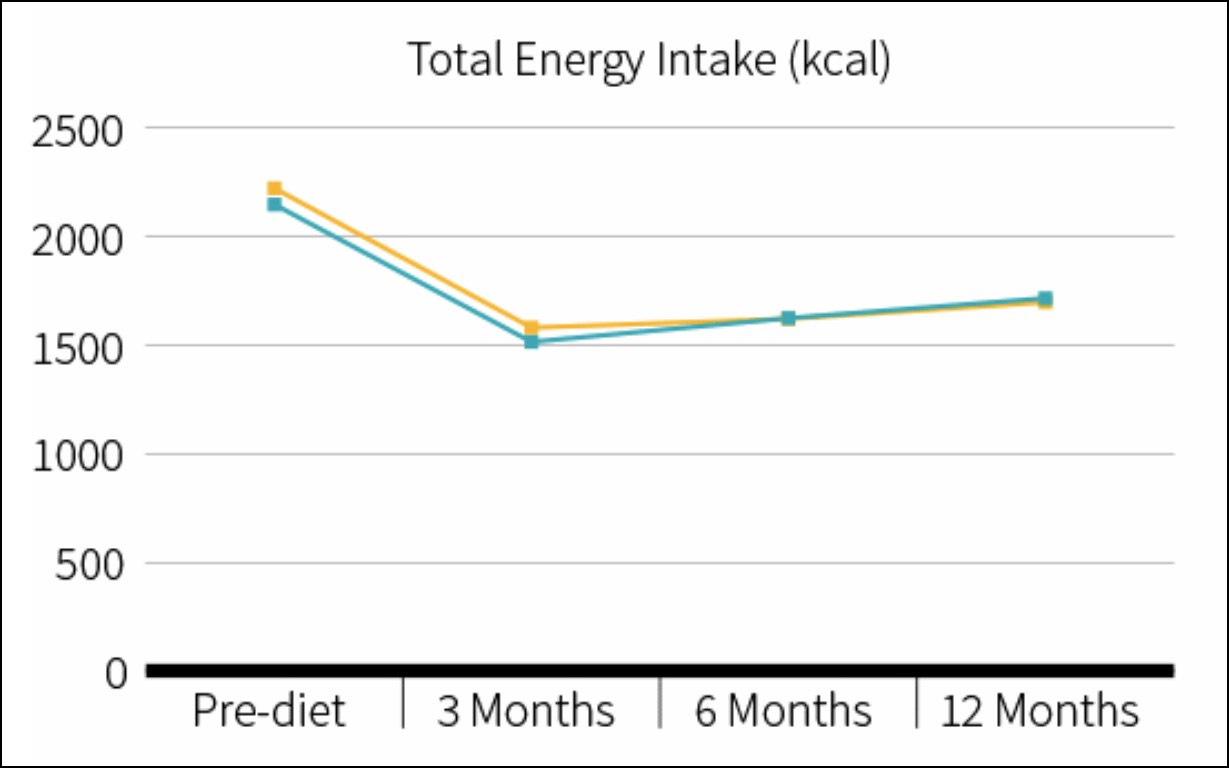
It sure seems like the main point of the study was to compare low-fat vs. low-carb diets, and to test the insulin secretion theory underlying low-carb diets. In any case, the reason I went ahead and commented even without reading the paper was because Examine.com had a long, detailed, and seemingly fair-minded description of the study. Here’s one of their charts:
It’s true that the researchers didn’t emphasize calorie counting. They recommended generally healthy eating combined with an emphasis on either low-carb or low-fat diets. The result, however, was that participants ended up consuming about 500 fewer calories per day. That’s a huge amount, and is almost certainly the reason for the weight loss. In fact, I’m surprised the average weight loss wasn’t more. But what underlies this large reduction in calorie consumption? Here’s what the lead author, Christopher Gardner, told Examine.com:
We did not “prescribe” a specific caloric restriction. We focused on reducing foods high in fats or foods high in carbs, and we advised the participants that they needed to find the lowest level of fat or carb intake they could achieve while not feeling hungry….We wanted for them to find a new eating pattern they could maintain without even thinking of it as a “diet”….Table 2 in the paper shows that the participants reported “achieving” a ≈500 calorie deficit, without us prescribing one … and it was fairly consistent through the 12 months. Now, I honestly think they likely exaggerated the caloric restriction. But in fact they did lose >6,500 lbs collectively…So they must have eaten less. I think this is an important area to explore.
That highlighted section has been the advice of nutritionists forever. If you think of something as a “diet,” you’ll eventually fall off the wagon. But if you think of it as making a permanent, sustainable lifestyle change, you’ll…
…well, as near as I can tell, you’ll probably still fall off the wagon eventually. But it will take longer. In any case, there’s exactly zero that’s new here. And the general advice to eat more vegetables and cut back on processed foods, added sugar, and refined grains is likewise of longstanding. My take is that there’s just nothing new in this part of the study. What’s new is comparing low-fat to low-carb diets in a fairly rigorous way, and then checking the insulin secretion theory of the low-carb diet. So that’s what I emphasized.
POSTSCRIPT: There’s still the question of why a low-carb or low-fat diet leads to lower calorie consumption. One theory is that as you get used to it, your hunger decreases and you just naturally eat less. Another theory is that these diets are pretty boring and make eating less attractive. Yet another theory is that carbs and fats are the main sources of calories in American diets, so if you significantly cut back on one or the other you’re almost certain to cut back on calories too. It takes a helluva lot of vegetables to make up for not eating meat or bread, and few people are that crazy for vegetables.
In any case, if you cut back on something with lots of calories, you’re cutting back on calories. As I said yesterday, “As near as I can tell, the bottom line is that if you want to lose weight, eat less.” The big difference between me and the New York Times is that they made this the lead, while I made it my last paragraph.
And we respect that! But maybe you’re of a mind to support our work directly instead? We have until December 31 to raise the last $400,000 we need to keep our nonprofit newsroom running at full strength into 2026. Will you make a gift today?
We noticed you have an ad blocker on. Can you pitch in a few bucks to help fund Mother Jones' investigative journalism?
Billionaires own the media,
but they don’t own us.
At Mother Jones we know these aren’t conventional times, and they require unconventional coverage. That’s what deliver every day: fierce, independent journalism you can’t find elsewhere. Perhaps never in the history of our country has that been more necessary than now. But we can’t do it without reader support—your support. Please chip in today.
Billionaires own the media,
but they don’t own us.
At Mother Jones we know these aren’t conventional times, and they require unconventional coverage. That’s what deliver every day: fierce, independent journalism you can’t find elsewhere. Perhaps never in the history of our country has that been more necessary than now. But we can’t do it without reader support—your support. Please chip in today.