I took this picture at the Plaza Bolívar on my first day in Colombia, and I think it might be my favorite of the whole trip. I assume this needs no explanation. It’s just adorable.


I took this picture at the Plaza Bolívar on my first day in Colombia, and I think it might be my favorite of the whole trip. I assume this needs no explanation. It’s just adorable.
According to the Wall Street Journal, in the second quarter “American consumers spent at the strongest pace since late 2014.” Is that true?
Sure, if you look at Q2 compared to Q1. But why would you? A better measure is simple year-over-year growth, and that shows nothing special at all:
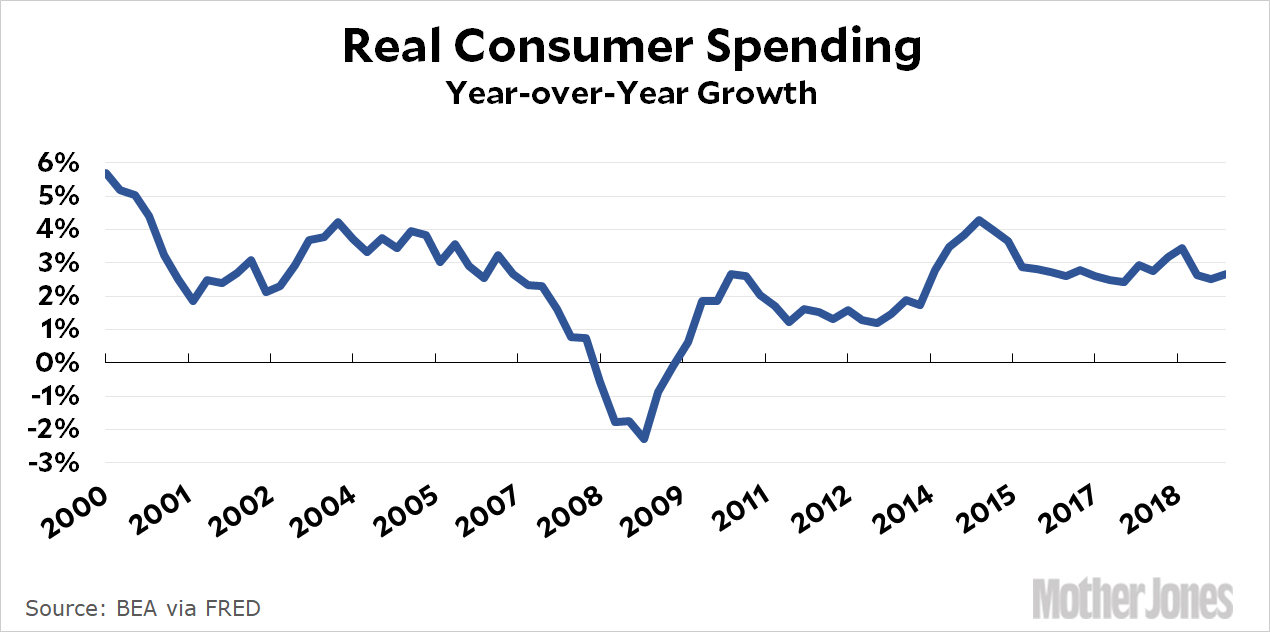
Consumer spending growth is holding steady, which is good news. But it certainly isn’t setting any records.
The Trump administration plans to eliminate regulations that limit methane leaks because—well, just because:
The plan “delivers on President Trump’s executive order and removes unnecessary and duplicative regulatory burdens from the oil and gas industry,” said the E.P.A. administrator, Andrew Wheeler. “The Trump administration recognizes that methane is valuable and the industry has an incentive to minimize leaks and maximize its use.”
Quite so. Let’s take a look at how those incentives are doing:
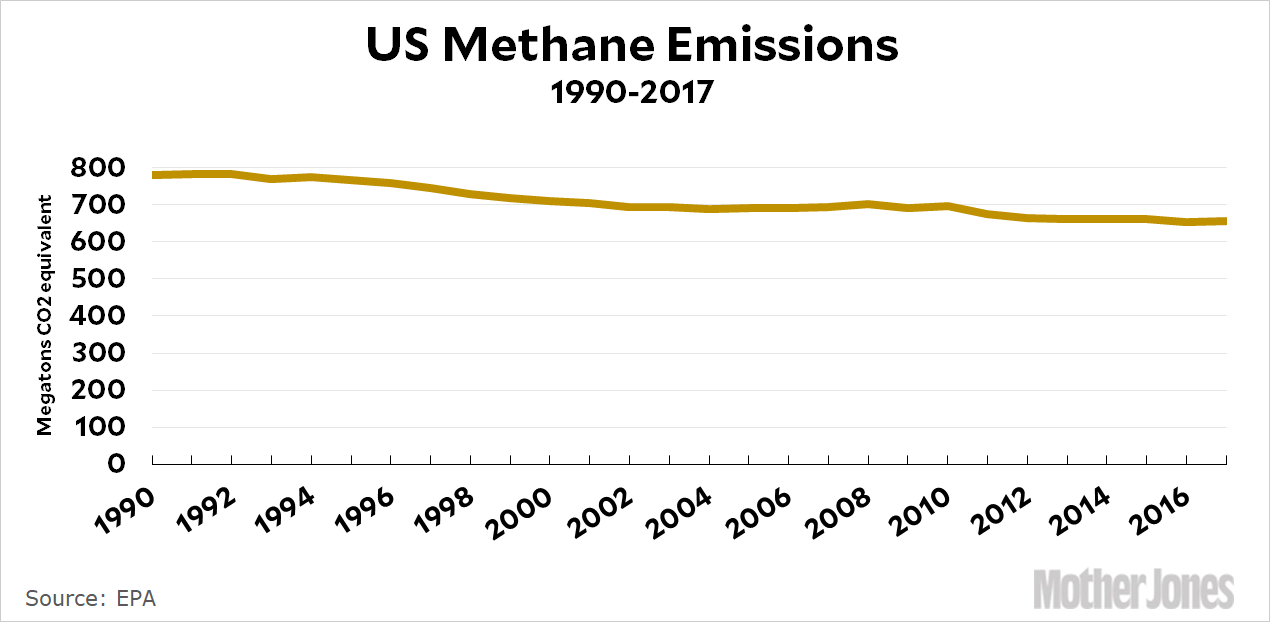
At this rate, market incentives should cut methane emissions in half by, oh, 2070 or so. Still, this kind of thing owns the libs by showing once again that manly men like Trump don’t believe in global warming. I mean, it’s not as if the natural gas industry itself has been begging for emission regs to be eliminated:
Larger companies have invested millions of dollars to promote natural gas — which produces about half as much carbon dioxide as coal — as a cleaner option than coal in the nation’s power plants. They fear that unrestricted leaks of methane could undermine that marketing message, hurting demand.
Exxon wrote to the E.P.A. last year urging the agency to maintain core elements of the Obama-era policy. And earlier this year Gretchen Watkins, the United States chairwoman for Shell, said the E.P.A. should impose rules “that will both regulate existing methane emissions but also future methane emissions.” Susan Dio, the chairwoman and president of BP America, wrote an op-ed article in March saying that regulating methane is the “right thing to do for the planet” and for the natural gas industry.
Even if this is just a PR gambit, who cares? Progress is progress. Unless it’s Obama progress, that is.
The Conference Board reports that Millennials had a great 2018:
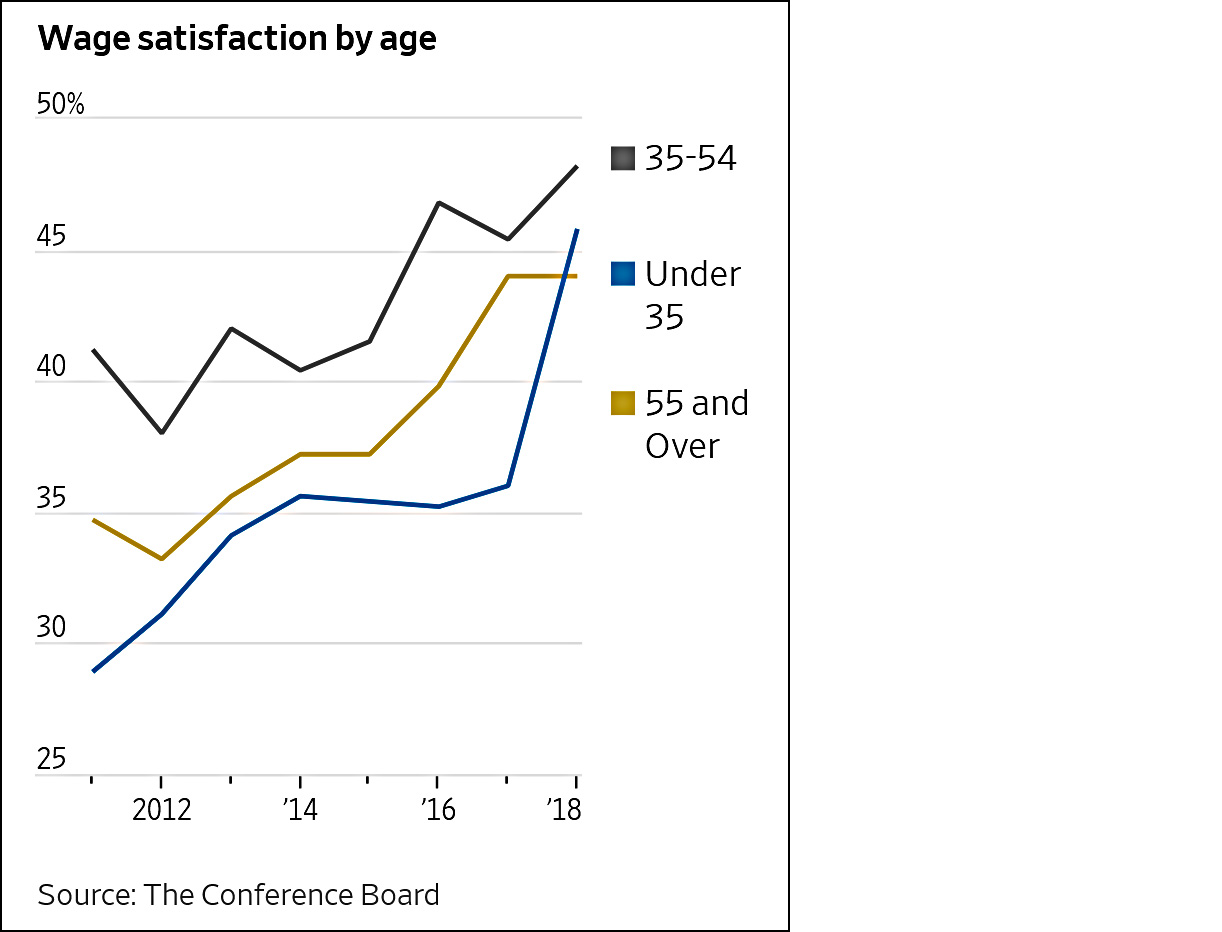
In general, job satisfaction is up:
In all, nearly 54% of U.S. workers said they were satisfied with their jobs in 2018, the highest share reported in more than two decades, said the Conference Board, which has been polling about workplace satisfaction since 1987….Overall, median weekly earnings rose 5% from the fourth quarter of 2017 to the same quarter in 2018, according to the Bureau of Labor Statistics. For workers between the ages of 25 and 34, that increase was 7.6%.
Millennials took a bigger hit from the Great Recession than most age groups, but now they’re rebounding more strongly.
Data For Progress has done some new polling about the popularity of various progressive issues. What’s interesting is that they present state-by-state results, so it’s possible to see how things shake out in places like Wisconsin, which was critical to Donald Trump’s victory in 2016 and will almost certainly be critical again in 2020. So without further ado, here’s how the good people of Wisconsin feel about the progressive agenda:
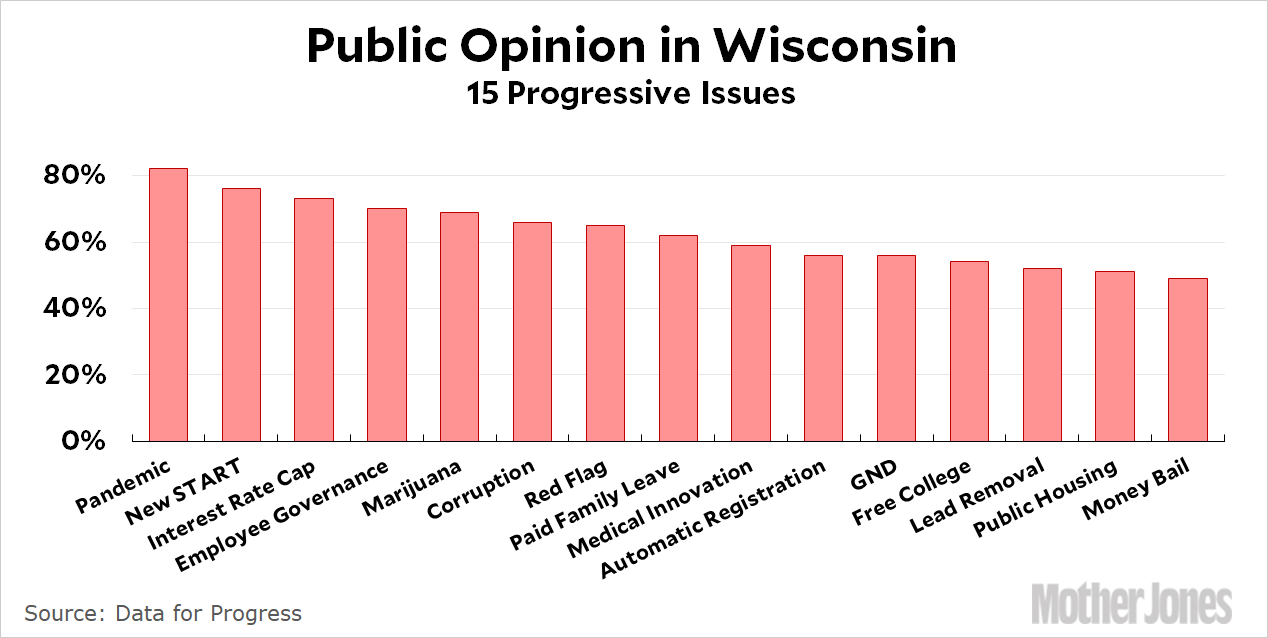
It’s no surprise to see high support for pandemic protection—who’s against pandemic protection?—but I’m a little surprised that extending the New START treaty with Russia polls so strongly. Who knew?
In any case, the issues that seem to resonate most are ones that have a very personal effect: caps on credit card interest, employee governance, and marijuana legalization. The ones that poll the worst mostly don’t: lead removal, public housing, and an end to money bail.
One other note: this poll is a good illustration of why I say that the real baseline for issue popularity is around two-thirds. As you can see, every single issue here polls above 50 percent.¹ That’s obviously a meaningless number, especially since all of these issues will lose support if they become part of a campaign where the opposition gets to demonize them. The top five, which are genuinely more popular than the others, all poll above 66 percent. That’s the real number you want to start with.
¹Except for poor old money bail, which only gets 49 percent approval.
Here’s a pair of pinks for you. The top photo is a Mexican pink and the bottom photo is a windmill pink. The top one actually looks more like a windmill to me, but I suppose I’m thinking of the Dutch kind rather than the American farm kind.


Tom Edsall writes today that, contrary to popular opinion, the surge of whites into the Republican Party has been led mostly by folks without college degrees but with high incomes:
Low-income whites without college degrees have moved to the Republican Party, but because they frequently hold liberal economic views — that is, they support redistributionist measures from which they benefit — they are conflicted in their partisan allegiance.
It’s not hard to see why this is the case, especially for men:
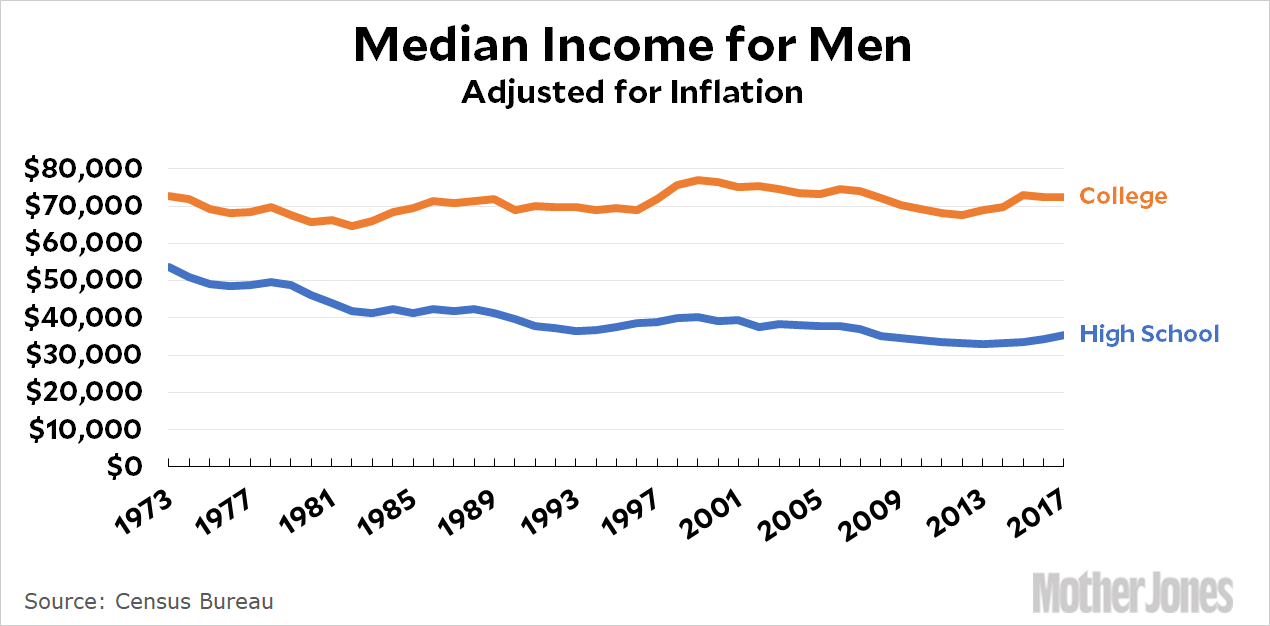
College-educated men haven’t been doing great: their incomes have been treading water for the past 40 years. But men with only a high-school diploma have simply cratered: their incomes have dropped by nearly $20,000 since 1973. Trump appeals to the white segment of this group with his racial demagoguery because he has no real economic message for them and neither do Democrats.
The white working class may not be essential to Democrats these days, but it’s unquestionably a group that has suffered a lot in recent decades and would be receptive to a genuinely populist economic appeal—including, but not limited to, a truly full-throated commitment to unionization. It’s no wonder that Elizabeth Warren is making the inroads that she is.
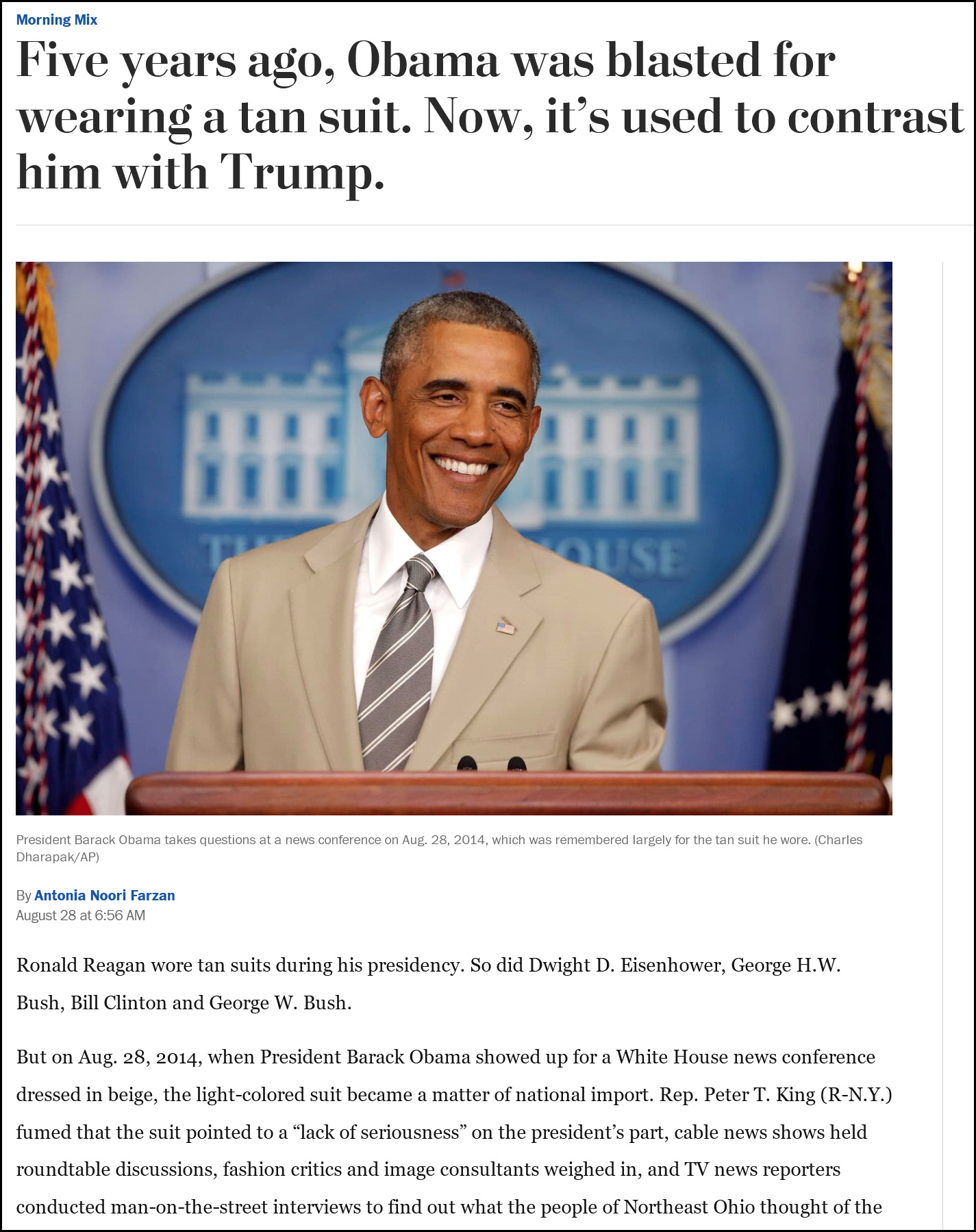
Today the Washington Post commemorates the five-year anniversary of one of our nation’s greatest scandals:
Meanwhile, for about the hundredth time, Josh Marshall says that Donald Trump is finally losing it:
Trump seems to be coming apart. Adam Smith said there’s a great deal of ruin in a nation. We’ve seen that it’s like that with Trump to at least a degree. Yet something seems different here. His chaos has intensified but intensified into monotony. And now his domestic chaos is generating an entirely different kind of economic and systemic chaos and breakdown abroad which he may not be able to control. Specifically, economic chaos abroad may chip away, slowly or abruptly, at his ability to maintain a meager popularity at home. We now seem on the verge of, if not an international crisis, than perhaps an abrupt economic slowdown that will be in significant measure driven by the president’s idiotic and impulsive behavior.
I’ll grant that Trump’s Twitter stream has been especially manic for the past month or two, and I don’t want to ascribe any deep Machiavellian purpose to it. Still, I wonder if, consciously or not, there’s method to the madness. With election season coming up, Trump needs a signature issue that ignites his base and also appeals to more moderate suburban voters. But what? One way of finding out is to fling an endless stream of mud against the wall until you finally find something that sticks. Maybe that’s what he’s doing.

Christopher Brown/ZUMA
The Washington Post reports that Donald Trump wants his wall built, and he doesn’t want silly little laws standing in the way:
When aides have suggested that some orders are illegal or unworkable, Trump has suggested he would pardon the officials if they would just go ahead, aides said. He has waved off worries about contracting procedures and the use of eminent domain, saying “take the land,” according to officials who attended the meetings. “Don’t worry, I’ll pardon you,” he has told officials in meetings about the wall.
“He said people expected him to build a wall, and it had to be done by the election,” one former official said.
Asked for comment, a White House official, who spoke on the condition of anonymity, said Trump is joking when he makes such statements about pardons.
Who knows? Maybe Trump really is just joking. But why does the White House press office need anonymity in order to say so?
8minute Solar Energy
Fighting climate change is hard in the face of relentless denialism and stonewalling from the Republican Par—
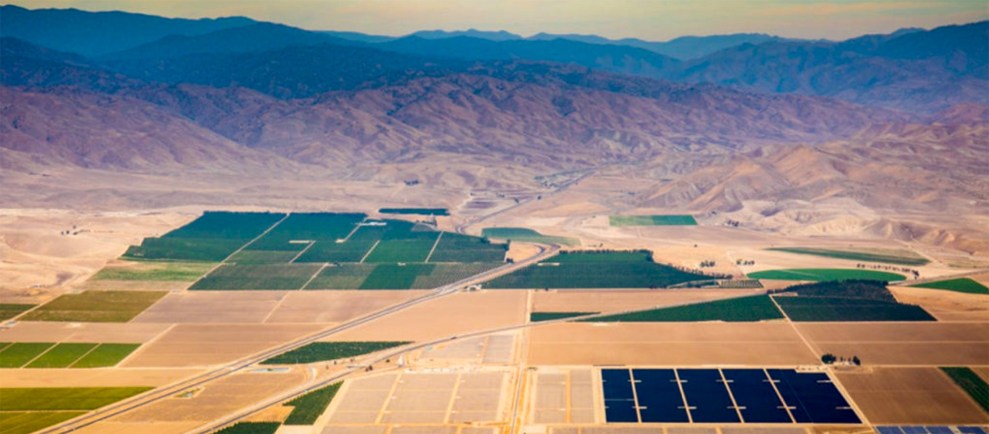
Los Angeles has been sitting on a contract for record-cheap solar power for more than a month — and city officials declined to approve it Tuesday because of concerns raised by the city-run utility’s labor union, which is still fuming over Mayor Eric Garcetti’s decision to shut down three gas-fired power plants….In addition to 400 megawatts of solar power, the Eland project would include at least 200 megawatts of lithium-ion batteries, capable of storing solar power during the day and injecting it into the grid for four hours each night. The combined price to L.A. ratepayers of the solar and storage would be 3.3 cents per kilowatt-hour — also a record low for this type of contract.
….In recent months, IBEW Local 18 has run television and radio ads attacking Garcetti’s Green New Deal initiative, which includes the retirement of three coastal gas plants that employ more than 400 LADWP workers. City officials say none of the LADWP workers at those plants will lose their jobs. But that hasn’t satisfied the union, which has warned that Garcetti’s plans for fighting climate change could drive up electricity prices and eliminate good-paying jobs.
Oh.

Award-winning photojournalism.
Stunning video. Fearless conversations.


