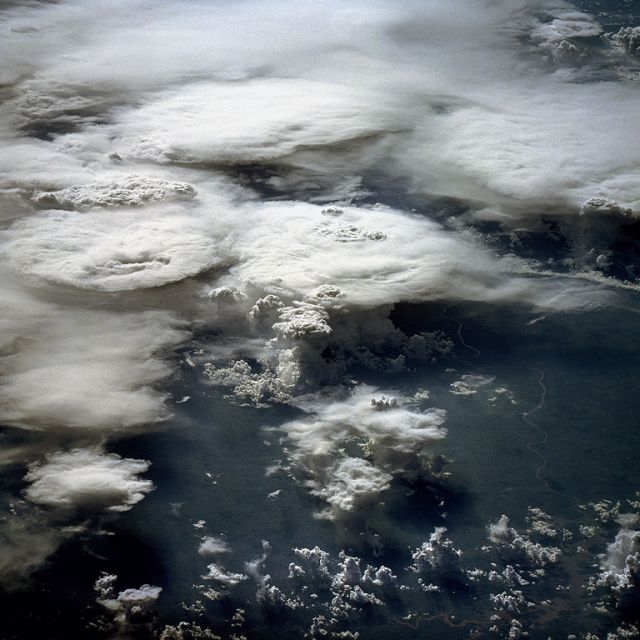
Thunderstorms over Brazil: NASA astronaut photos via Wikimedia Commons
More than two dozen major climate models are being used to forecast global warming from rising greenhouse gas emissions—notably how much warming will occur when atmospheric carbon dioxide doubles from preindustrial times. At current rates that unhappy milestone will be reached well before 2100. So which models are more accurate?
For decades the leading models have predicted an average rise of 5 degrees Fahrenheit (2.7 degrees Celsius), with models on the low end predicting a rise of 3 degrees F (~1.6 degrees C) and those on the high end predicting 8 degrees F (5.3 degrees C). Now a new analysis in the leading journal Science suggests that the higher end forecasts are more accurate.
Why? Moisture has a lot to do with it. Clouds, well, they cloud the picture. Satellites observe clouds. But satellite failures, observing errors, and other inconsistencies make it difficult to build a global cloud census consistent over many years. A better measure is water vapor. Satellite estimates of the global distribution of humidity have become more reliable than their estimates of clouds.
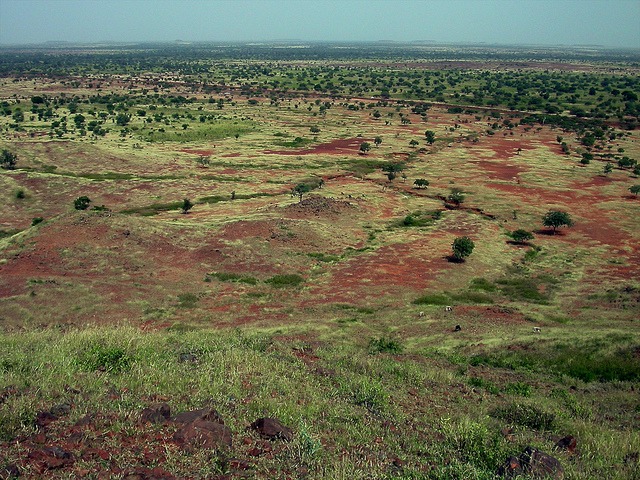
Relative humidity is incorporated in climate models to generate and dissipate clouds. So the authors checked the distribution of relative humidity in 16 leading climate models to see how accurately they portray the present climate. They focused on the subtropics, the places where sinking air from the tropics make dry zones, home to most of the world’s major deserts.
What they found was that estimates based on observations show relative humidity in the dry zones between about 15 and 25 percent. Whereas many models inaccurately depict humidities of 30 percent or higher. Less humidity equals fewer clouds equals less albedo to reflect sunlight back into space, hence more warming.
The models that best captured the actual dryness currently seen in the subtropics were those with the highest temperature forecasts. Specifically those projecting a global temperature rise of more than 7 degrees F (3.8 degrees C) by the time of doubled C02 levels. The three models with the lowest temperature forecasts were also the least accurate in depicting relative humidity in these zones.
The paper:
- John T. Fasullo and Kevin E. Trenberth. A Less Cloudy Future: The Role of Subtropical Subsidence in Climate Sensitivity. Science. DOI: 10.1126/science.1227465.