Fierce, investigative journalism doesn’t happen by accident—it happens because readers like you make it possible. Every dollar you give before midnight Friday to support our nonprofit newsroom will be matched dollar-for-dollar. We can’t do our work without you. Don’t miss this chance!
2X match ends Friday: Fierce, investigative journalism doesn’t happen by accident—it happens because readers like you make it possible. Every dollar you give before midnight Friday to support our nonprofit newsroom will be matched dollar-for-dollar. We can’t do our work without you. Don’t miss this chance!
Seven years ago I wrote a piece for Democracy about where political trends would take us by 2024. Here’s one bit:
Trend #5:The Republican Party will continue to become ever more dependent on the white vote, while the Democratic Party will depend ever more on minorities.
….So what does this all mean? One: Certain aspects of the culture wars will heat up. In particular, thanks to the increasingly polarized demographics of the two main political parties, fights over immigration and race may well be even more acrimonious than they are today.
That’s all I said in that particular piece, but in other posts where I had more space I still mostly failed to grapple with the obvious conclusion of my own reasoning. I figured there was a limit to what Republicans could do. They could pack-and-crack congressional districts. They could squeeze a little more turnout out of evangelicals and older whites. Fox News could run its endless “scary black folks” segments. State legislatures could pass photo ID laws designed to suppress black voter turnout.
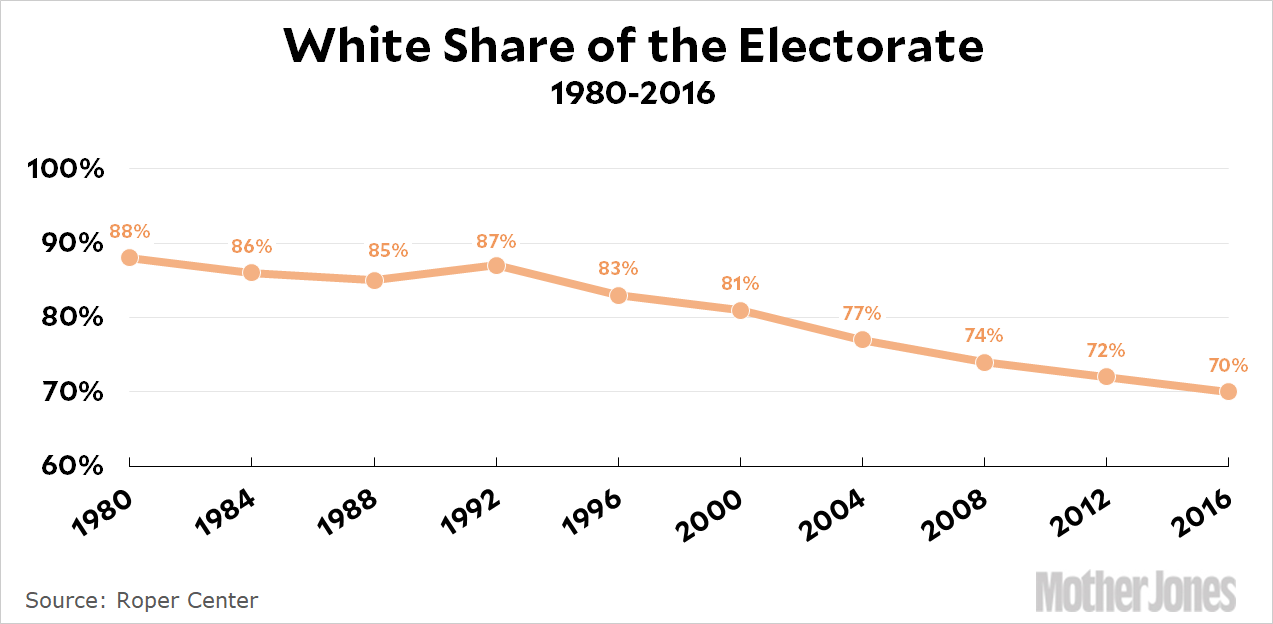
But they were running out of options. The last item in that list is a good example of what influenced my thinking. The truth is that photo ID laws have only a tiny influence on presidential elections. It turns out that most people who lack photo IDs aren’t likely to vote in the first place, and loud pushback from liberals offset some of the losses anyway. What’s more, photo ID laws were passed only in states with total Republican control, and by definition those are states that are mostly safe Republican havens to start with. The fact that Republicans put so much energy into this project only showed how desperate they were. There just wasn’t much left for them to do in the face of demographic changes that were reducing the size of their white base by a point or two every election cycle.
For what it’s worth, this was mostly the conclusion of Republicans themselves, too. The famous post-election autopsy written by the Republican National Committee after Mitt Romney’s 2012 loss, said this:
In 1980, exit polls tell us that the electorate was 88 percent white. In 2012, it was 72 percent white….According to the Pew Hispanic Center, in 2050, whites will be 47 percent of the country….The Republican Party must be committed to building a lasting relationship within the African American community year-round, based on mutual respect and with a spirit of caring.
But there was always a glaring problem with this strategy, one that everybody was keenly aware of: reaching out to black voters would only work if Republicans also ceased their tolerance of white bigotry. In other words, they’d almost certainly lose votes on a net basis at first, which would mean handing over the presidency—and maybe much more—to Democrats for upwards of a decade or so. That’s just too big a sacrifice for any political party to make.
So instead they took another route: they went after the white vote even harder. In Donald Trump they found a candidate who wasn’t afraid to appeal to racist sentiment loudly and bluntly, something that simply hadn’t occurred to other Republicans. They never thought they could get away with something like this in the 21st century, and normally they would have been right: it would have lost them as many votes among educated whites as it won them among working-class whites. But after eight years of a black president in the White House, racial tensions were ratcheted up just enough that Trump could get away with it. Only by a hair, and only with plenty of other help, but he did get away with it, losing 10 points of support among college-educated whites but gaining 14 points among working-class whites.
The entire Republican Party is now all-in on this strategy. They mostly stay quiet themselves and let Trump himself do the dirty work, but that’s enough. Nobody talks anymore about reaching out to the black community with a spirit of caring or any other spirit. Nor is there anything the rest of us can do about this. Republicans believe that wrecking the fabric of the country is their only hope of staying in power, and they’re right. If working-class whites abandon them even a little bit, they’re toast.
So all we can do is try to crush the Republican Party at the ballot box. What other options are there? Reactionary American whites, as always, won’t give up their power unless it’s taken from them by either a literal or figurative war. Liberals need to be as Lincolnesque¹ as possible in this endeavor—we don’t have to win the votes of unrepentent bigots, just the fretful fence-sitters—but we also need to be Lincolnesque² in our commitment to winning the Trump-inspired race war we’re now in the middle of.
¹That is, with malice toward none and charity for all.
²That is, with an iron determination to win.
UPDATE: I’ve made a couple of very slight wording changes to the last paragraph, just to make it absolutely clear what I mean here.
CNN has a big story today about WikiLeaks founder Julian Assange and his seven years spent living in the Ecuadorian embassy. Apparently the Ecuadorians became suspicious of Assange fairly quickly and kept him under regular surveillance. The CNN reporters got hold of a report that Ecuador commissioned from UC Global, a private Spanish security company, and notes over and over in its story that Assange interacted frequently with Russian agents.
But I think we’ve known that for a long time. The question is whether or not Assange knew they were Russians. The CNN piece has exactly one sentence about that:
After the election, the private security company prepared an assessment of Assange’s allegiances. That report, which included open-source information, concluded there was “no doubt that there is evidence” that Assange had ties to Russian intelligence agencies.
Well, sure, there’s no doubt that “there is evidence,” but how strong is the evidence? What is it based on? Is UC Global’s analysis trustworthy? I would be entirely unsurprised if Assange knew who he was dealing with all along, but there’s nothing much here to demonstrate that. At the very least, I’d like to see some of the context around those six words. This is a mighty big accusation to hang on a mighty small excerpt.
More housing charts! I came across these while reading about the shortage of starter homes, and they were interesting in different ways. First up is a chart from Bloomberg that shows total rent as a percent of total disposable income:
There are two ways to look at this. The rental market obviously goes though a boom-and-bust cycle, and right now we’re near the peak of a boom. Since the early aughts, total rent has soared from about 2.8 percent of disposable income to 3.8 percent. That’s an increase of about a third over the course of only a dozen years, which amounts to a real growth rate of 3 percent per year. That’s a lot. (Note, however, that some of this is due to higher levels of rentership following the housing bust. If more people are renting, then total rent paid also goes up even if prices remain the same.)
The other way to look at this is to follow rent from peak to peak of the cycle. If you do that, total rent has increased from about 3.7 percent of disposable income to 3.8 percent. That’s an increase of one-thirtieth over the course of 60 years, which amounts to a growth rate of only 0.05 percent per year.
Which one of these is the “true story”? Both of them. It just depends on what you happen to be interested in. Or what point you feel like making.
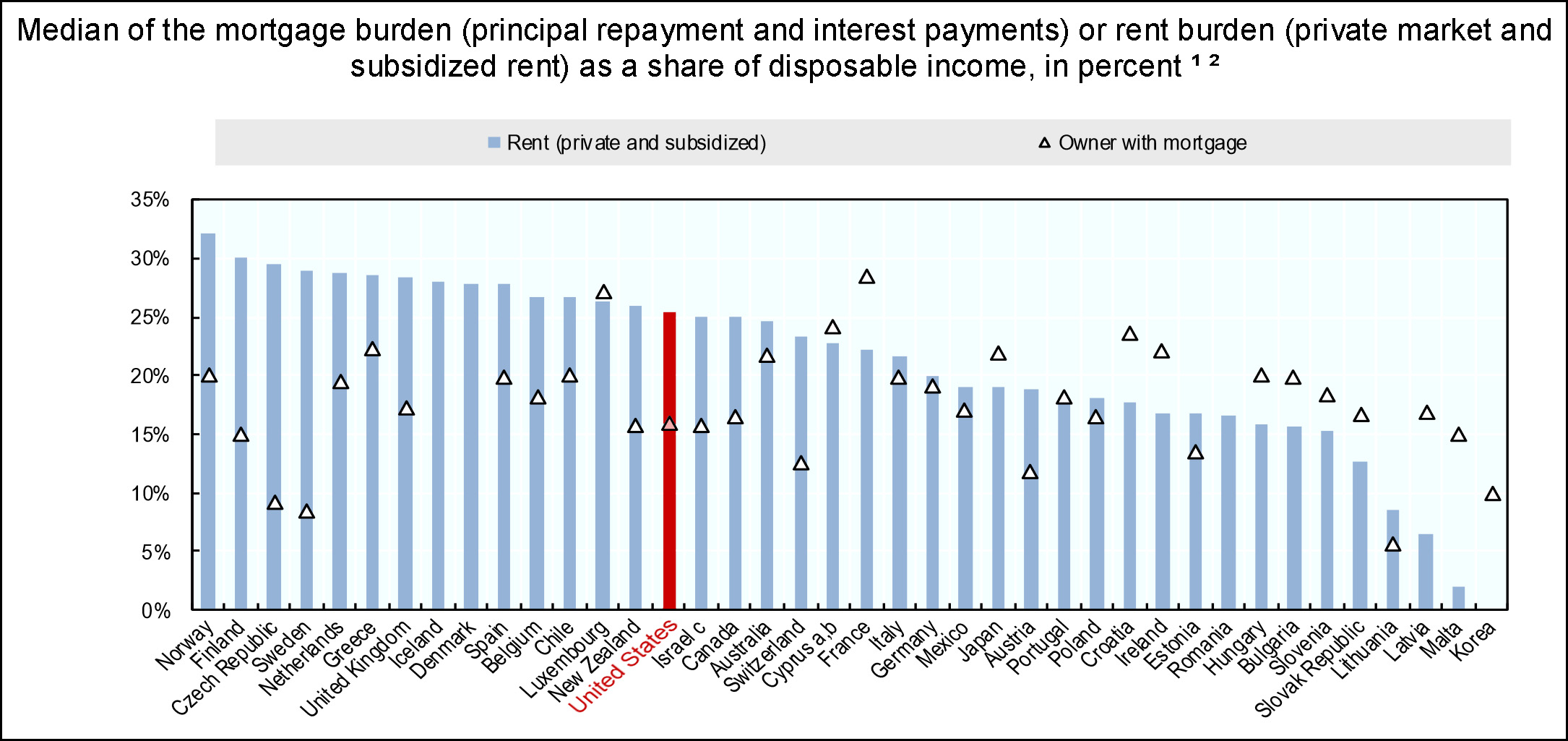
Next up is a pair of charts from the OECD. They don’t show housing burdens over time, but they do compare housing burdens in the rich countries of the world, which is kind of interesting. Here’s the first one:
This shows both median rents and median mortgages as a percent of disposable income. On this metric, the United States comes in a little above average on rents and a little below average on mortgages. But what about low-income households?
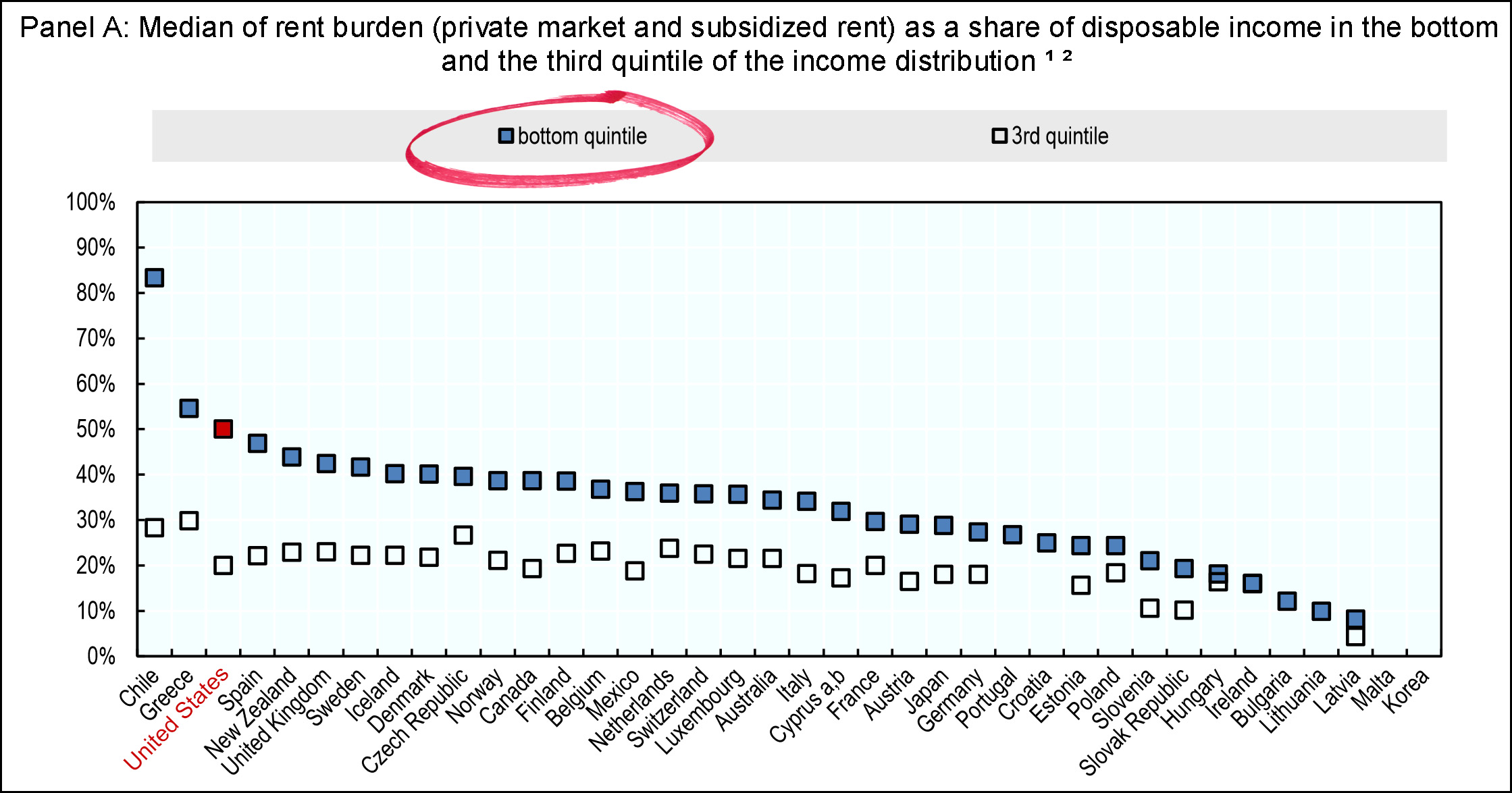
This is the average of the bottom quintile, which means we’re looking at the very poor (roughly the bottom 10 percent). On this metric the US does badly, clocking in with the third-highest rent burden. This chart includes government subsidies, which is the big difference maker. The market price for low-end housing in the US is probably similar to other peer countries, but we simply don’t provide the poor with as much assistance. As a result, the very poor pay upwards of 50 percent of their income for housing, compared to about 30 percent for countries like Germany, Japan, and France.
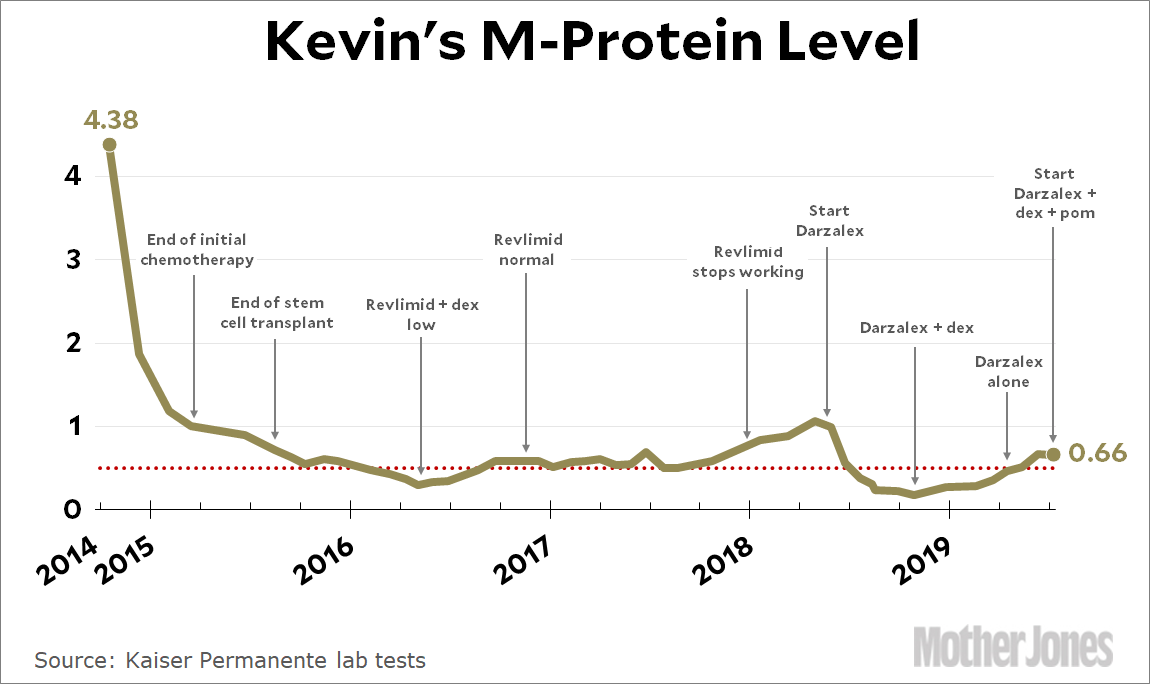
I don’t have much to report this month. I’ve restarted the Evil Dex, but the first dose was only four days ago. Tonight I start the Pomalyst. My M-protein level was stable since last month, which is good news. Maybe this is because it just happened to be stable, or maybe it’s because the dex has already started to have some effect. Who knows? Like the Iraq War, the next few months are always the ones that will tell the story.
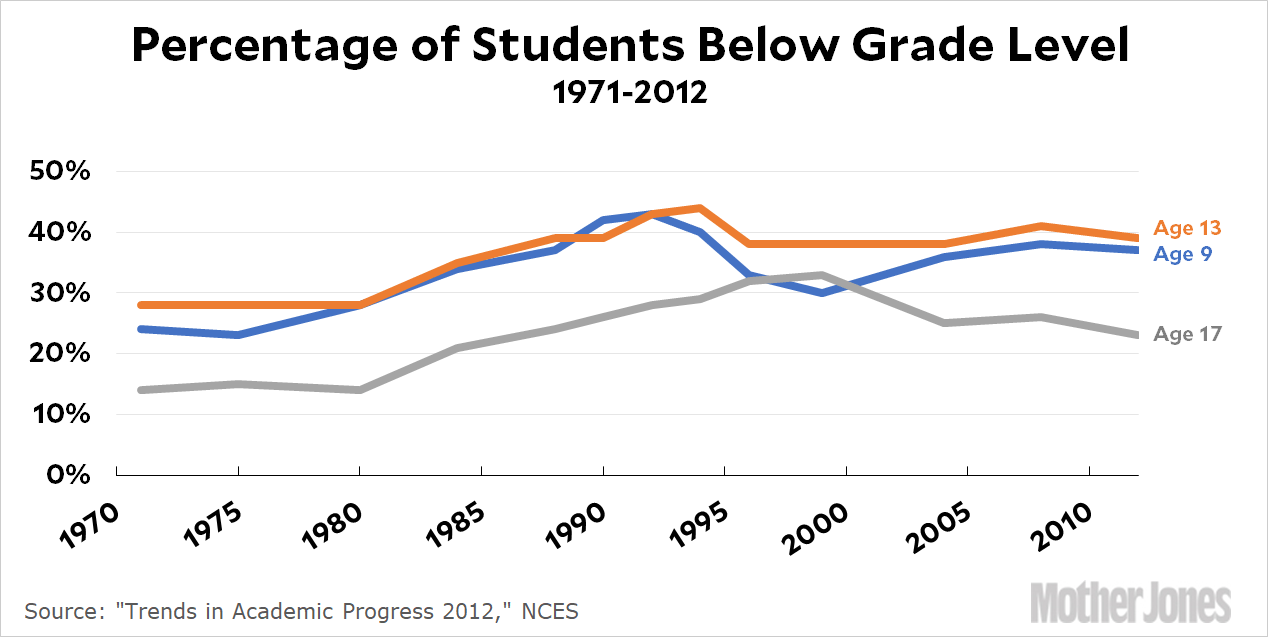
I was puttering around last night on some stuff related to education and happened to run across a couple of interesting statistics from an NAEP report a few years ago. First there’s this:
The share of students in a grade level below the one typical for their age has increased over the past 50 years. However, the share of 17-year-olds below grade level has always been well below the share of 13-year-olds. It’s unlikely that lots of 13-year-olds are suddenly catching up to grade level by age 17, so what’s going on? Are some of them being advanced just to get them out of school? Or are lots of them dropping out and no longer being counted?
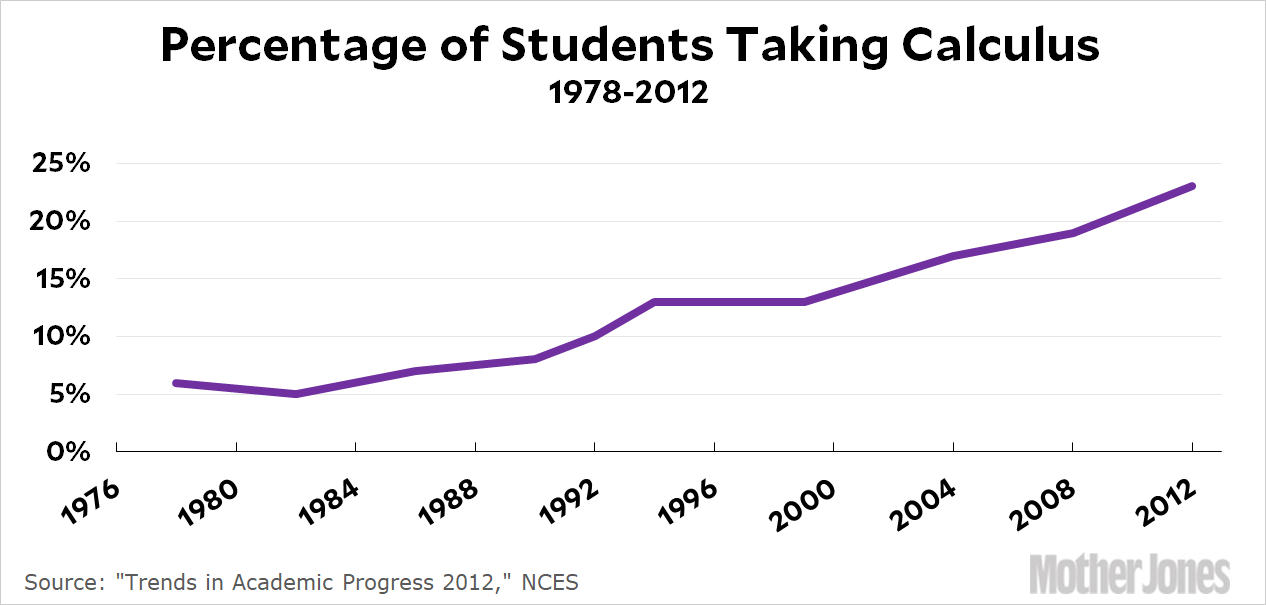
Then there’s this:
At age 13, nearly 40 percent of schoolkids are in a grade below their normal one. By age 17, a full quarter are taking calculus, a class basically unheard of for high school students 50 years ago. It seems like this says something about the extremes of the US educational system, but I’m not quite sure what.
Over at National Review, David French comments on President Trump’s racist comments this weekend telling progressive congresswomen of color that they should “go back where they came from”:
The near-total silence (at least so far) from GOP leaders is deeply dispiriting. Do they not understand the message the leader of their party is sending — especially to America’s nonwhite citizens? Do they not understand that racial malice as a political strategy isn’t just an ultimately losing proposition but also deeply divisive, picking at the scabs of America’s deepest political, cultural, and spiritual wounds?
But the problem extends far beyond Washington. There are many GOP leaders who, quite frankly, understand that they criticize even the president’s racist speech at their own peril. The grassroots have spoken. Loyalty to the president must be absolute, or one risks a primary challenge. Yet individual voters have responsibilities as well, and they must understand that extraordinary loyalty to a malicious man broadcasts their own disdain for their fellow citizens.
For all I know, French thinks we should conduct nuclear testing on the San Andreas fault and let California sink into the sea. When this is all over we can go back to arguing about that. For now, though, any conservative willing to call out Trump’s toxic appeal to white racism is basically on my side. I don’t think it’s something we can never recover from, but that’s only if it stops soon and leads to Republican defeat. If, instead, Republicans decide it’s their only road to victory—and it works—the impact on our country is difficult to imagine.
There have got to be at least a few dozen Republicans who are currently in office and have both the guts and the common decency to publicly denounce Trump’s racist swill. Where are they?
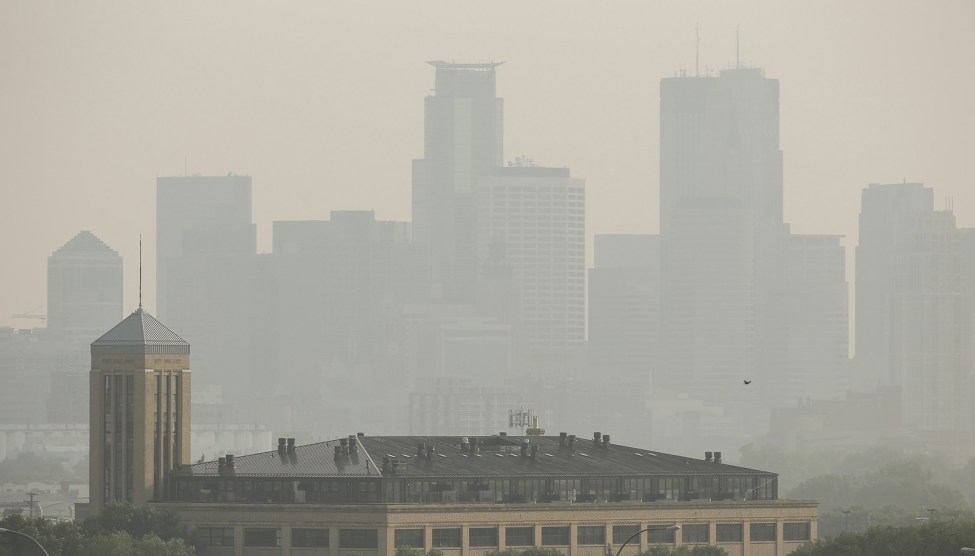
The Environmental Protection Agency is preparing to weaken rules that for the past quarter-century have given communities a voice in deciding how much pollution may legally be released by nearby power plants and factories. The changes would eliminate the ability of individuals or community advocates to appeal against E.P.A.-issued pollution permits before a panel of agency judges.
That sounds bad. Still, I suppose the silver lining here is that polluters will also lose the ability to appeal judgments that go against—
However, the industrial permit-holders could still appeal to the panel, known as the Environmental Appeals Board, to allow them to increase their pollution.
Oh. Even industry lawyers are apparently a little taken aback by this proposal, which follows a decision a few months ago to weaken New Source Review rules that require permits for power plant upgrades. Keep in mind that this is all from the president who says no one in the history of the country has been more committed to clean air and water than him.
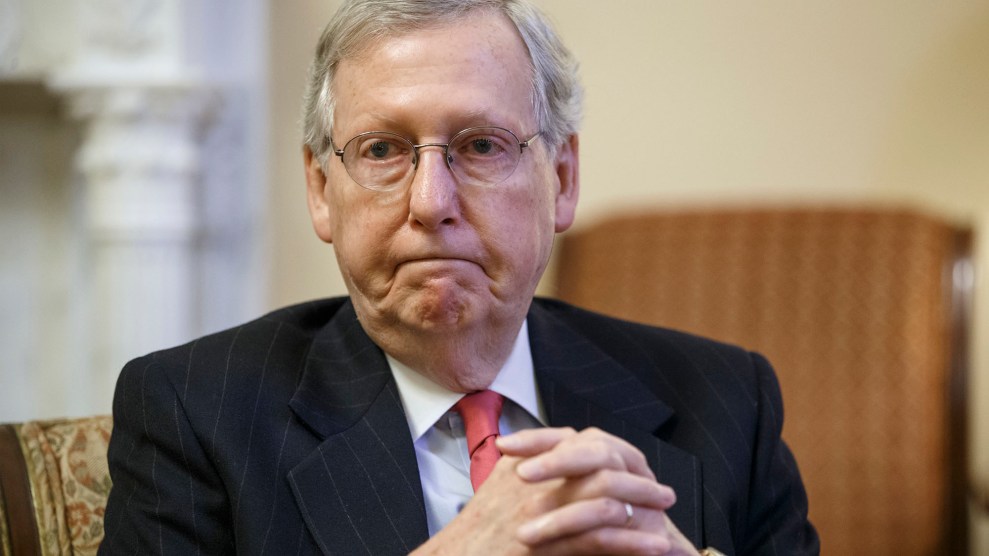
Mulvaney and Vought, among others, have sought to convince Trump to care more about cutting spending and the deficit. But Trump has rebuffed many of their proposed cuts as deficits soar. Trump recently told West Wing aides that Senate Majority Leader Mitch McConnell (R-Ky.) told him no politician had ever lost office for spending more money. Two people with direct knowledge confirmed that McConnell delivered that message in a June phone call about budget sequestration.
It’s always good to confirm that Republicans are the party of fiscal responsibility.
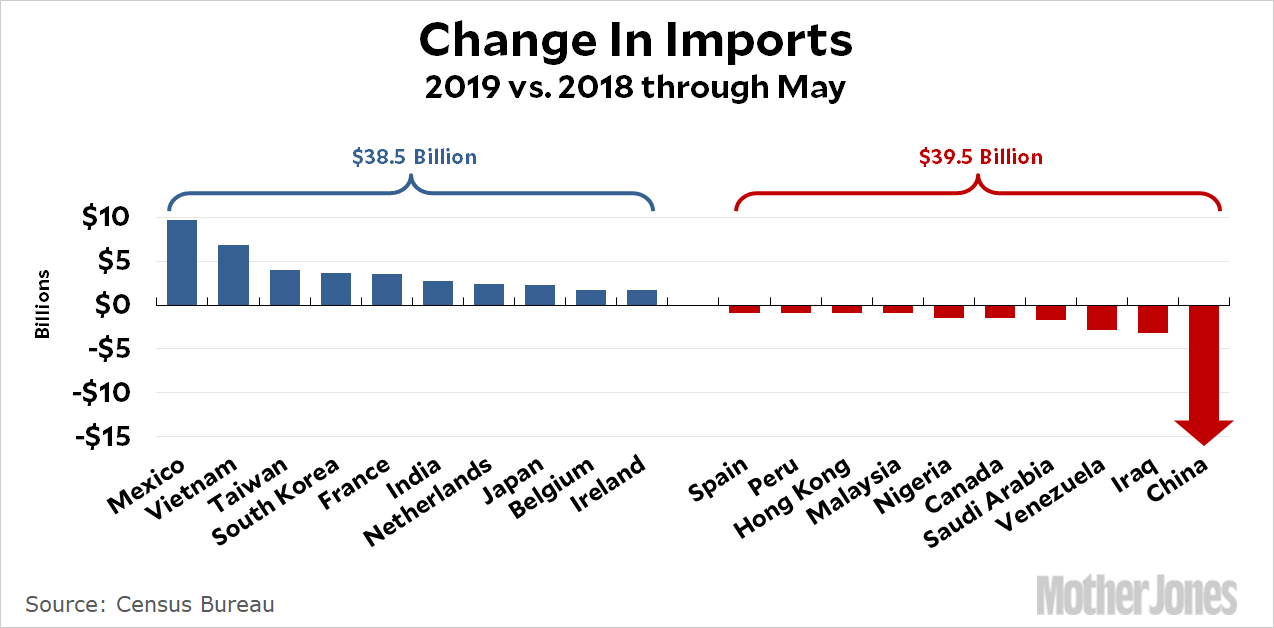
U.S. manufacturers are shifting production to countries outside of China as trade tensions between the world’s two biggest economies stretch into a second year….The biggest beneficiaries of that decline have been other countries in Asia where production costs are low, such as Vietnam, India, Taiwan and Malaysia.
“We’re moving production to other parts of the world,” Marvin Edwards, chief executive of CommScope Holding Co., said in June. The Hickory, N.C., company is making antennas for sale in the U.S. at its plant in India instead of China.
Wait. What about America?
There is little evidence, though, of U.S. manufacturers bringing production from China back to the U.S., a move the Trump administration hoped the tariffs would encourage. While imports from other Asian countries have climbed, U.S. manufacturing output has declined 1.5% through May from a recent peak reached in December, according to the Federal Reserve. The Institute for Supply Management said earlier this month that its manufacturing index slipped again in June to the lowest level since 2016.
US imports in 2019 from China and the other top ten losers total $39.5 billion less than last year. However, imports from the top ten winners total $38.5 billion more:
Anyone who wants to pretend this is great news for American workers is just joining in the Trump con. Tariffs on China might eventually force them to change some of their bad trade behavior—if Trump is smart enough to cut a serious deal—but that’s all. It will do nothing to bring low-value manufacturing back to the United States.
Can you pitch in a few bucks to help fund Mother Jones' investigative journalism? We're a nonprofit (so it's tax-deductible), and reader support makes up about two-thirds of our budget.
We noticed you have an ad blocker on. Can you pitch in a few bucks to help fund Mother Jones' investigative journalism?