Fierce, investigative journalism doesn’t happen by accident—it happens because readers like you make it possible. Every dollar you give before midnight Friday to support our nonprofit newsroom will be matched dollar-for-dollar. We can’t do our work without you. Don’t miss this chance!
2X match ends Friday: Fierce, investigative journalism doesn’t happen by accident—it happens because readers like you make it possible. Every dollar you give before midnight Friday to support our nonprofit newsroom will be matched dollar-for-dollar. We can’t do our work without you. Don’t miss this chance!
I spent last Sunday up in LA, and among other things I went out to Rodeo Drive to take pictures of the beautiful people as the sun was going down. Here was my strategy: I sat down in a chair and snapped a picture of everyone crossing Brighton Way. Pretty simple. Now, some people will tell you that small towns are the real America, but I figure that Beverly Hills is the real real America. What’s more American, after all, than vast, ostentatious wealth in the middle of one of the nation’s great cities?
So here you go: pictures of real Americans, interspersed with images of Americana from lunchtimes past, all set to Kelly Clarkson singing “America” at President Obama’s second inaugural. Happy 4th!
A day after pledging that the 2020 census would not ask respondents about their citizenship, the Justice Department reversed course on Wednesday and said it was hunting for a way to restore the question on orders from President Trump. Officials told a federal judge in Maryland that they thought there would be a way to still add the question, despite printing deadlines, and that they would ask the Supreme Court to send the case to district court with instructions to remedy the situation.
Yesterday DOJ lawyers told the judge the forms were being printed without the citizenship question. He asked them to put it in writing. Today they declined to do that.
Were they lying yesterday? Or were they telling the truth and Trump overruled them? And are they now really trying to figure out a way to keep the citizenship question? Or are they just going through the motions to mollify the boss?
Like so many things Trump-related, who the hell knows? It could be anything.
This is LA’s latest attraction, the Second Home Serpentine Pavilion, erected by the Spanish architectural firm SelgasCano. It’s pretty much what it looks like: a series of tunnel-like structures covered in colorful swatches of mylar and nylon.
It turns out, however, that it’s a hand-me-down. It was originally put up four years ago in London’s Kensington Gardens as part of the Serpentine Gallery’s annual pavilion program. Now it’s set up on the lawn behind the LA County Museum of Art near the La Brea Tar Pits. Admission is free, but you have to book an entry time online.
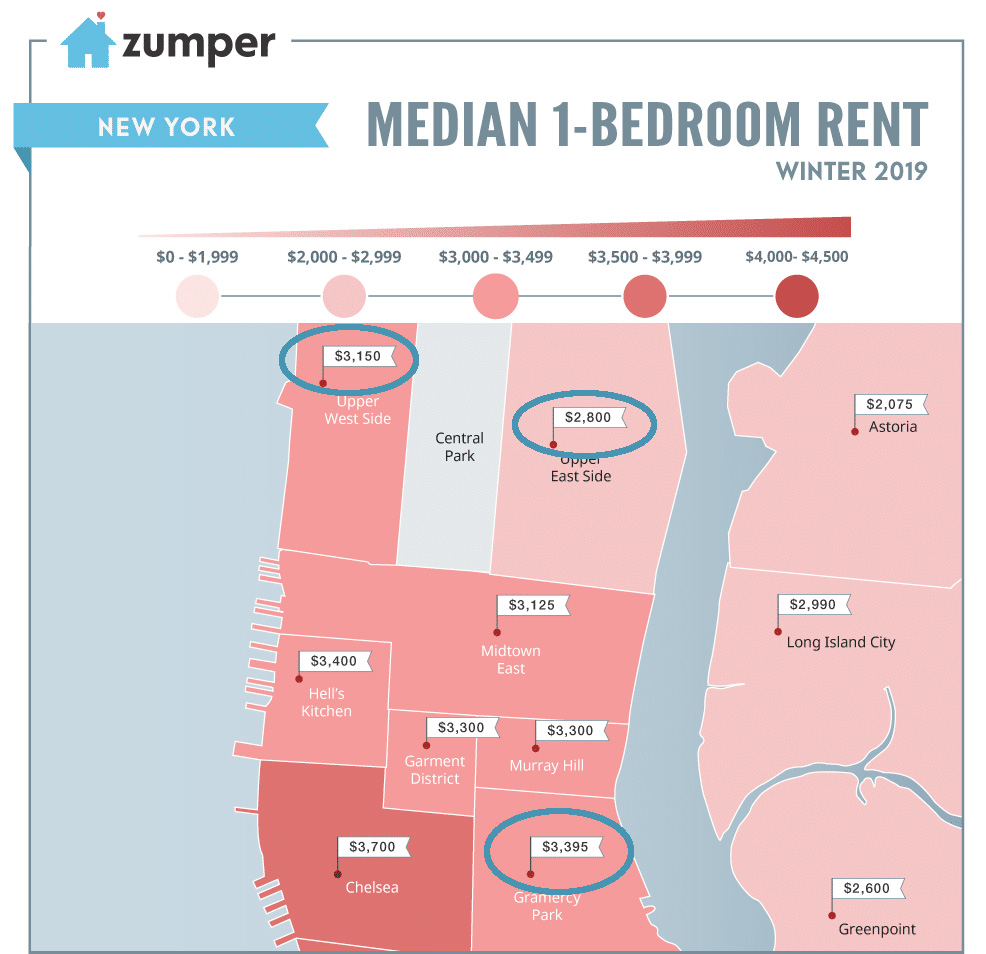
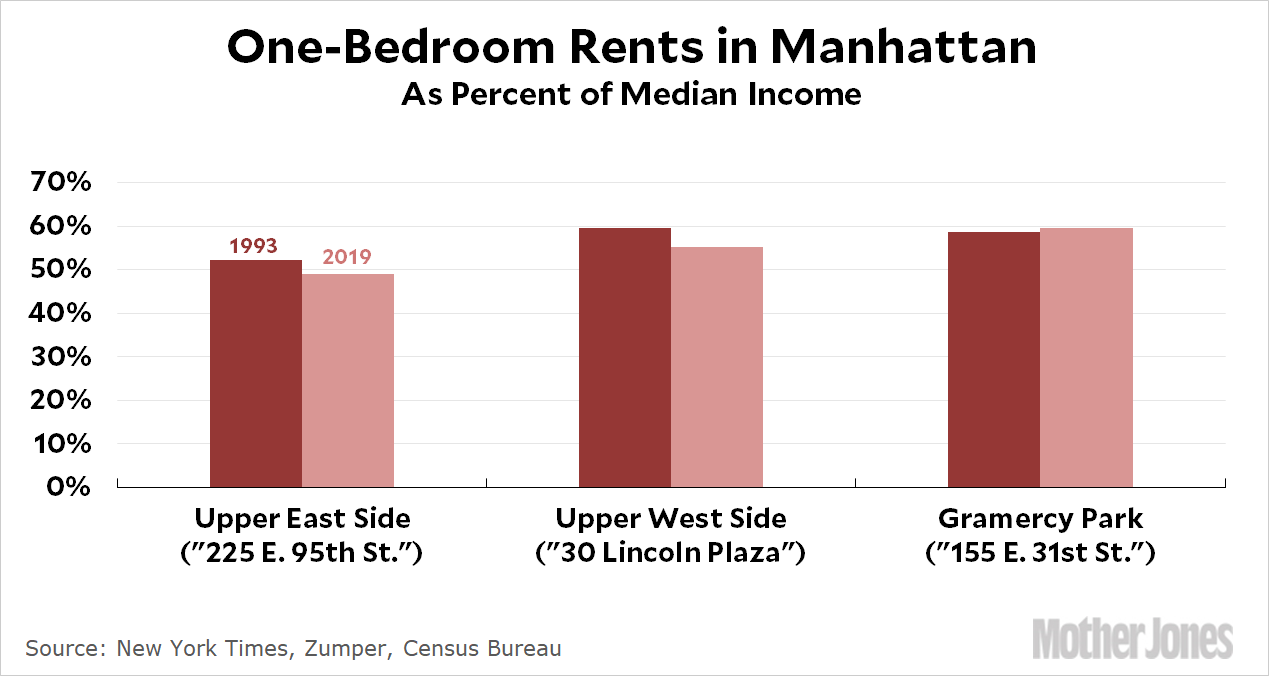
At the Windsor Court, a 700-unit building at 155 East 31st Street, a one-bedroom unit that rented for…$1,650 in 1993, an 8 percent rise….At the Normandie Court at 225 East 95th Street, rents were…$1,465 in 1993….On the West Side, at 30 Lincoln Plaza, a large building near Lincoln Center, a one-bedroom rose…to $1,675.
According to the Census Bureau, the median household income in the Northeast has increased from $33,747 in 1993 to about $68,000 today. Plugging in the 1993 and 2019 rent numbers produces this:
This is only three data points, and rents can vary within the boundaries of large neighborhoods, so this could be off by a few percentage points here and there. Generally speaking, however, it suggests that rent as a percentage of income has either stayed flat or maybe decreased a bit over the past 25 years in Manhattan.
Are there any problems with this data? Is Zumper full of shit? Is rent control too prevalent to provide an accurate picture of market rents? Or is this a reasonable snapshot of Manhattan apartments in 1993 and 2019?
After reading an article about “level 2/3” automated cars—the computer drives but you’re required to keep your eyes on the road so you can take over if you have to—Atrios says:
Insurance Rates Are Gonna Skyrocket
A couple liability suits and insurance companies are gonna drive these things off the road.
Aha! Finally a testable prediction, and one we can test in the fairly near term. I’m willing to bet a $100 contribution to Planned Parenthood that insurance rates will not skyrocket by, say, two years from now. Or one. Or three. Whatever. I’ll take the non-skyrocket side of any reasonable wager on this subject.
Word of the decision to give up the fight came initially in an email from a Justice Department attorney to lawyers who had challenged the administration in court….A Justice Department spokesperson subsequently confirmed the decision….In a terse statement, Commerce Secretary Wilbur Ross [said], “the Census Bureau has started the process of printing the decennial questionnaires without the question. My focus, and that of the Bureau and the entire Department is to conduct a complete and accurate census.”
But the head of the Trump administration says this is all fake news:
The News Reports about the Department of Commerce dropping its quest to put the Citizenship Question on the Census is incorrect or, to state it differently, FAKE! We are absolutely moving forward, as we must, because of the importance of the answer to this question.
Before long Trump is going to stand in front of a podium wearing a red tie and yelling at the reporters that they’re enemies of the people for reporting that he’s wearing a red tie. He literally thinks he can just say anything he wants these days.
A couple of days ago I wrote about “the myth of the urban millennial.” More generally, I’ve also been making the case that millennials are pretty similar to past generations, and part of that similarity has to do with their preference of where to live. But how do I know what their real preference is? Maybe lots of them want to live in big cities and the only reason they don’t is because of a housing shortage that’s driven up prices. A Twitter reader asks a reasonable question:
What data/evidence would you expect to see if in fact millennials did prefer urban housing, but were being forced to the suburbs by cost and/or the failure of the urban housing stock to keep pace with population growth?
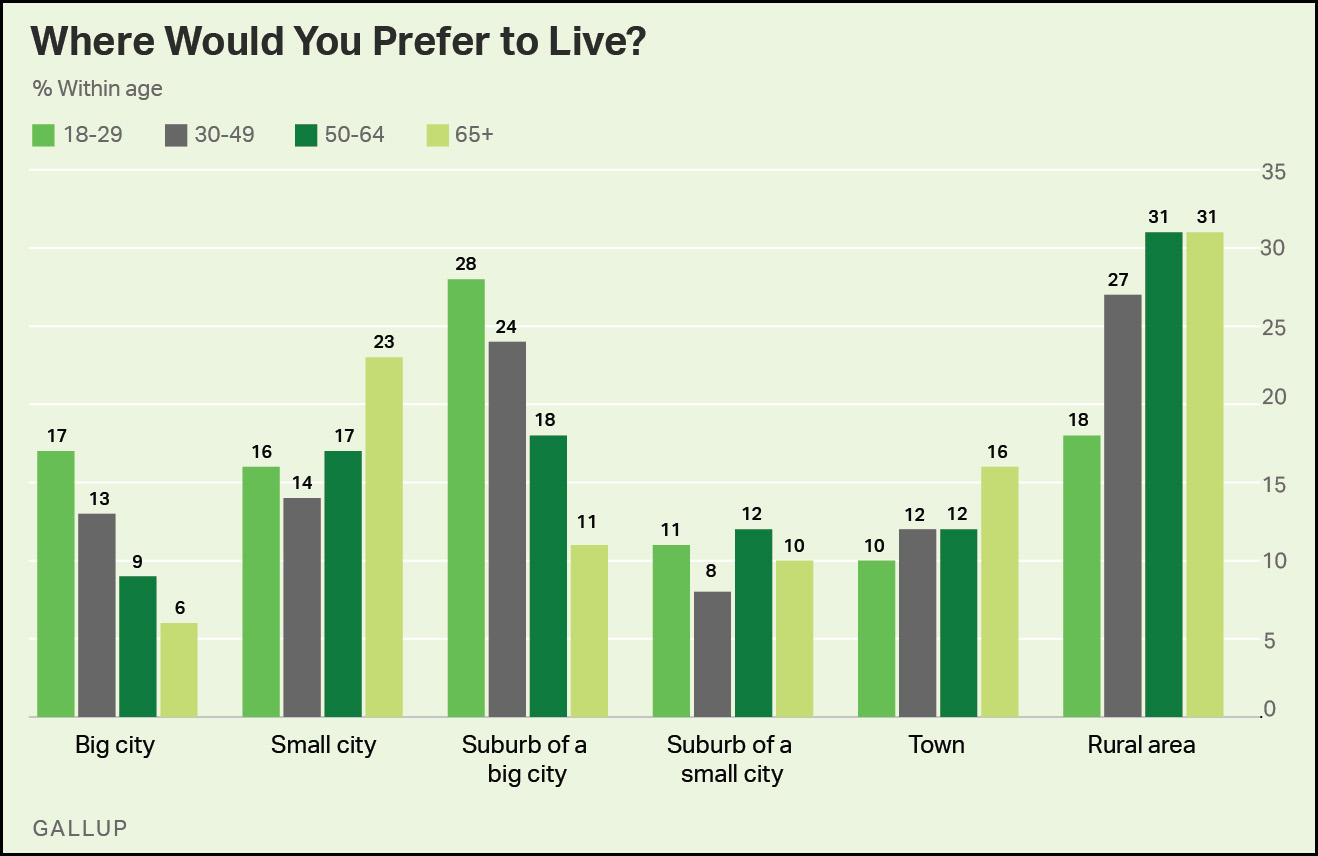
The answer here comes mostly from survey data: if there were a big mismatch, you’d expect to find lots of millennials who don’t live in cities but say they want to. However, that’s not what you find. Here are several examples, all for 18-29 year-olds:
In a 2011 survey by the National Association of Realtors, 33 percent of millennials lived in cities but only 31 percent wanted to. Conversely, 40 percent lived in suburbs but 42 percent wanted to.
In a 2014 survey by Fannie Mae, 90 percent of millennial renters said they would eventually buy a home.
In a 2015 survey by the National Association of Home Builders, two-thirds of millennials said they would prefer to buy a home in a suburb, while only 10% wanted a home in the center of a city.
In a 2018 survey from Gallup, 29 percent of millennials lived in big cities but only 17 percent wanted to live there. Conversely, 22 percent lived in suburbs but 39 percent wanted to live there.
This isn’t bulletproof evidence of anything, and there are some surveys that produce more complicated results. What’s more, there’s also some evidence of a small rise in the preference for urban living over the past couple of decades.
That said, the main finding of nearly every survey on the subject is that millennials mostly want to live in suburbs, and as they grow older that preference increases. There’s hardly any evidence at all suggesting that there’s a huge pent-up demand for city living that’s going unmet.
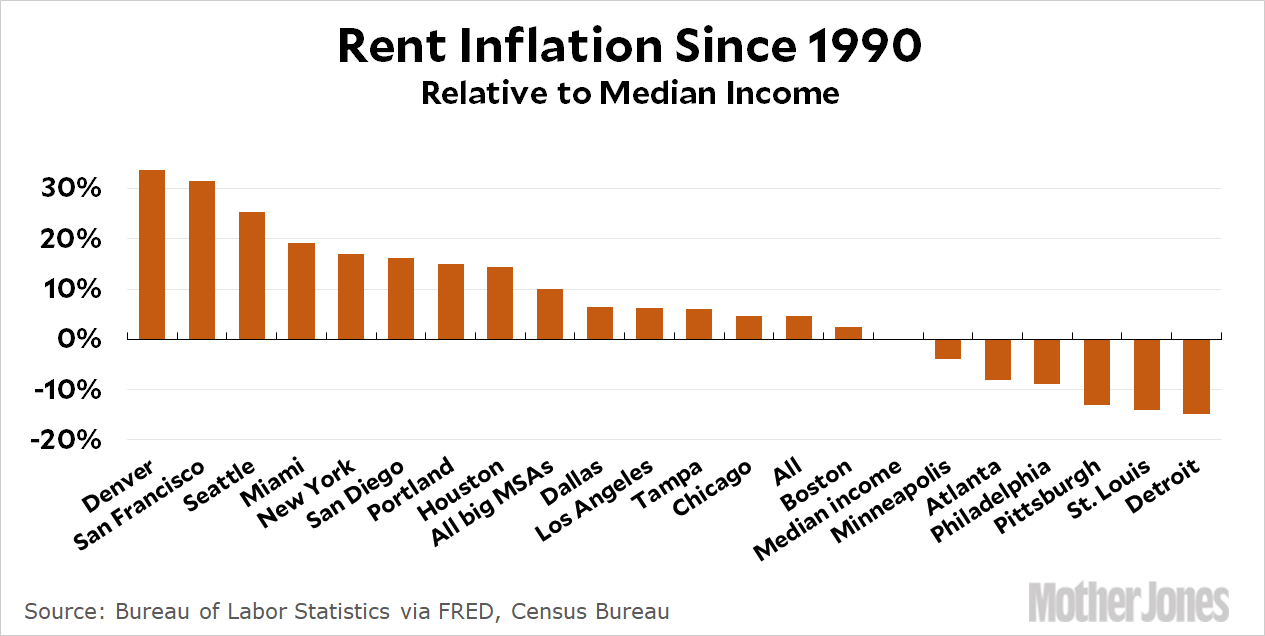
Obviously there are local exceptions to this finding.¹ Without even bothering to look, I think we can assume that the Bay Area has way less housing than it needs. The same is true of a small number of other cities that have shown big housing price increases over the past 30 years:
The average increase in the cost of housing (relative to income) is about 5 percent for all cities since 1990, and only half a dozen cities have seen increases of more than 15 percent. Put this together with survey data and rental vacancy rates and there’s little evidence of a huge surge of millennials who want to move to cities but can’t. In fact, just the opposite.
¹Though, surprisingly, not demographic ones. There’s a higher preference for city living among liberals, the young, and the college educated. However, even in these demographics there’s still a substantially higher preference for suburbs than for cities.
HUGE CENSUS NEWS — the Government just advised that the decision has been made to print the the census questionnaire WITHOUT the citizenship question. We won.
Here’s something you don’t see very often from me: horses. But these seemed like unusually handsome specimens, and with nice, soft morning lighting. I suppose they’re some particular kind of horse, but I don’t know which they are. “Brown and white” is about the closest I can come.
UPDATE: Probably skewbald (brown and white) pintos.
May 9, 2019 — Near Blowing Rock, Blue Ridge Parkway, North Carolina
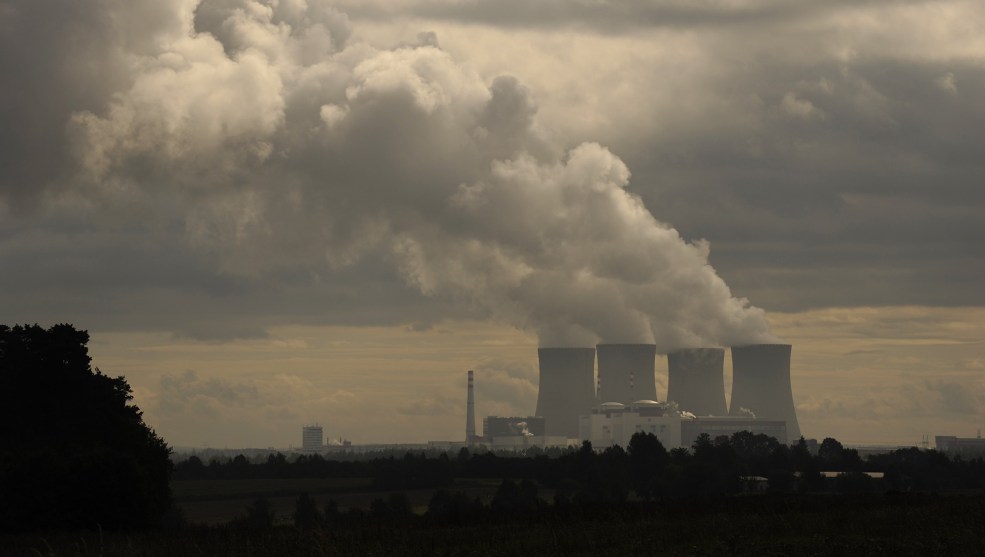
In any serious climate plan, the United States would need to plan on building a few thousand of these. California alone would probably need several hundred.Album / Prisma
The Democratic National Committee is considering a pair of resolutions on whether to host a debate of some kind devoted exclusively to climate change, amid mounting pressure from activists who want a spotlight put on the issue. At an executive committee gathering in Pittsburgh on Saturday, the DNC voted unanimously to refer two proposals—one calling for an official debate on climate change, another envisioning a less formal forum—to a committee, a DNC official confirmed to HuffPost.
There are two big problems with a Democratic climate debate. The first is that it would probably be boring since liberals all agree that it’s a huge problem that needs to be seriously addressed. What’s to argue about?
The second is that it might not be boring. If the moderators push the candidates hard, they’ll inevitably start voicing their support for policies that have no public backing. It’s easy if you stick to the Paris Treaty and CAFE standards and subsidies for solar power. That’s kumbaya stuff. For that reason, however, they’ll be taken care of in five or ten minutes with a few “show of hands” questions. Then we’ll have to get down to serious business. Which candidates support a carbon tax? How big? Who thinks we need to end coal mining? Who’s in favor of restrictions on meat production? Does anyone like the idea of a $10 gasoline tax? Should we ease environmental review rules for utility-grade solar and wind plants? What should we do about air travel? And cement production? And chemical manufacturing? Should we scrap the WTO and put in place whopping tariffs on carbon-intensive imports?
Oh, and what about nuclear power on a gigantic scale?
These are the kinds of things that get talked about among people who are serious about addressing climate change. They’re also political land mines. Nobody wants to give up their steaks or their SUVs. Nobody wants their electric bill to double or their gasoline bill to triple. Nobody likes the idea of compromising environmental rules even though we all say we believe that climate change is truly existential.
A climate debate would almost certainly devolve quickly into a contest between the candidates to demonstrate who takes climate change most seriously. That might or might not be good for the planet. But it would sure be a godsend for the Republican Party.
POSTSCRIPT: This reminds me of something. Six months ago, when I (and others) were complaining that the Green New Deal was mostly a statement of goals and not much more, we were told to hold our horses. It’s just a start. The GND folks will be filling the details soon.
Can you pitch in a few bucks to help fund Mother Jones' investigative journalism? We're a nonprofit (so it's tax-deductible), and reader support makes up about two-thirds of our budget.
We noticed you have an ad blocker on. Can you pitch in a few bucks to help fund Mother Jones' investigative journalism?