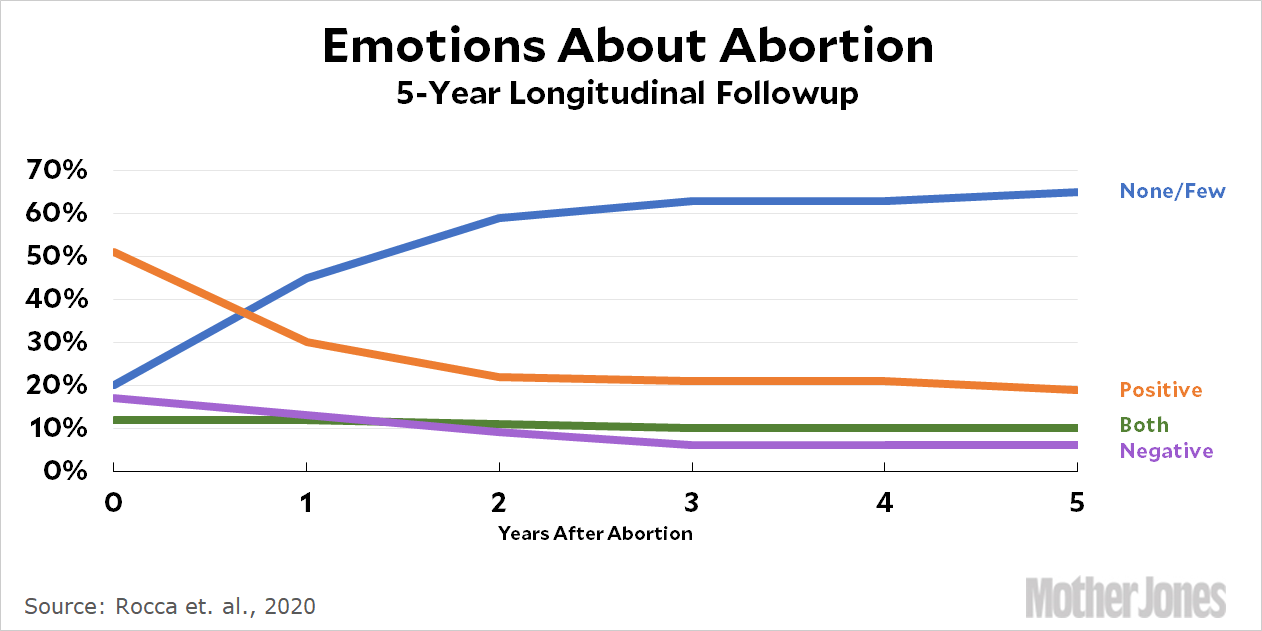
Do women who get abortions later regret their choice? Robin Abcarian writes in the LA Times today about a study that concludes otherwise:
“Tons of studies have found that relief is the most common short-term emotion after abortion, despite mixed emotions,” said the paper’s lead author, UCSF epidemiologist Corinne Rocca. “But even after five years, when emotions are pretty low, relief is still the most common one.” She found that about 99% of women who had abortions told researchers five years later that they’d made the right decision.
….Some women, naturally, dropped out of the study over the five years, leading critics to suggest that these were women who felt regret, shame or guilt about having abortions. But Rocca closely analyzed who dropped out and did not find a correlation between dropouts and negative emotions. “People can make that claim,” she said, “but I didn’t find any of that.”
This is . . . not an entirely honest summary from Abcarian. Of course people dropped out. People always drop out of longitudinal studies like this. But Abcarian doesn’t mention the real criticism of Rocca’s study: namely that it included only women who agreed to participate in the first place.¹ In other words, her sample is self-selected, not random. Rocca defends this:
38% enrollment for a five-year study asking women about a stigmatized health service is within the range of other large-scale prospective studies. Importantly, with the exception of being poorer, women in this sample were demographically similar to US women with unintended pregnancies. Also, women experienced a range of emotions at enrollment: approximately two-thirds expressed sadness and over one-third felt some regret. We have no reason to believe that women would select into the study based on how these emotions would evolve over three years.
It’s true that longitudinal studies, by definition, include only people who agree to be part of the study in the first place. If you’re studying some concrete physical phenomenon like lead poisoning or the effect of a new drug, that’s probably OK. But this is precisely why longitudinal studies aren’t generally useful for assessing things like emotional states, which can easily affect participation in unexpected ways. Rocca says “we have no reason to believe” that happened here, but that’s a pretty lackadaisical approach to legitimate criticism. I can think of half a dozen reasons off the top of my head why emotional states might affect participation. Maybe people who feel guilt are less likely to want to be reminded of it periodically for the next five years. Maybe introverts are less likely to participate. Maybe women with traditional upbringings are less likely to participate. Etc. This is an endless list, and “no reason to believe” mostly suggests that nobody bothered looking.
None of this means the study’s conclusions are wrong. My own guess, based on other research, is that it’s basically correct. That said, I just don’t see how you can claim to get any kind of reliable results from an extremely non-random sample like this. This is true both for studies we agree with and those we don’t.
¹It’s worth noting that this is true of survey-based studies too. This is just a fundamental problem when you’re studying something like emotional responses to abortion. Lots of people probably won’t want to participate, and it’s all but impossible to know for sure if that affects the randomness of your sample.
A few days ago Nick Kristof and Sheryl WuDunn wrote a piece in the New York Times called “Who Killed the Knapp Family?” The Knapps grew up in Kristof’s hometown of Yamhill, Oregon, and the answer, it turns out, is working class despair:
Of the five Knapp kids who had once been so cheery, Farlan died of liver failure from drink and drugs, Zealan burned to death in a house fire while passed out drunk, Rogena died from hepatitis linked to drug use and Nathan blew himself up cooking meth. Keylan survived partly because he spent 13 years in a state penitentiary.
….Even in this presidential campaign, the unraveling of working-class communities receives little attention. There is talk about the middle class, but very little about the working class; we discuss college access but not the one in seven children who don’t graduate from high school. America is like a boat that is half-capsized, but those partying above water seem oblivious.
It’s easy to see this just by looking at income figures from the Census Bureau. The implosion of working-class prospects led to a complete stagnation of working-class incomes from 2000 to 2017. Here it is by income quintile:
It wasn’t until 2018 that working-class families finally started earning (slightly) more than they had at the beginning of the millennium. That’s a very long drought, and in certain places that lost factories or favored industries things were far worse. Still, with that said, keep this in mind:
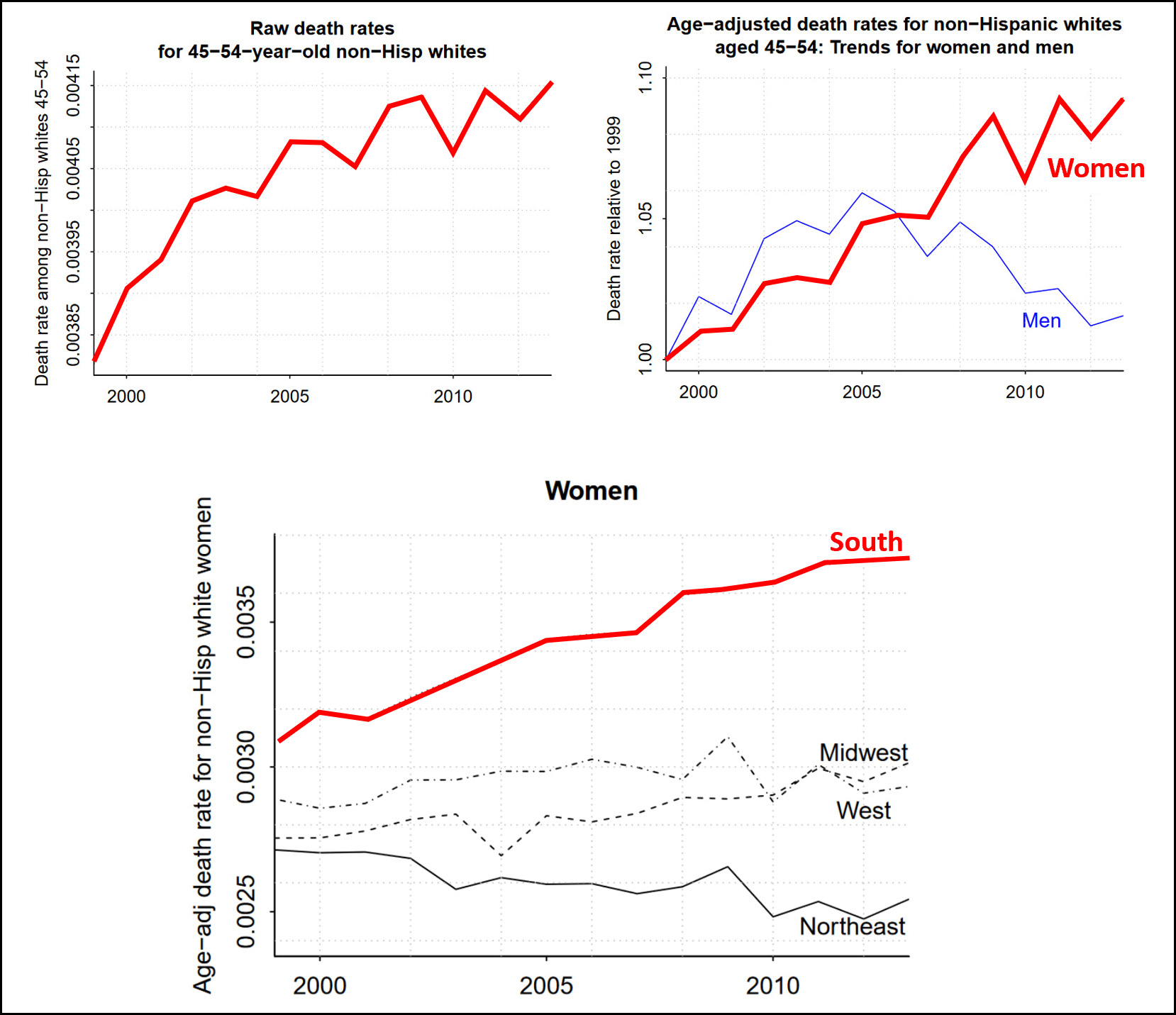
I’ve posted this more than once, mainly because no one ever seems to get it: once you run the numbers correctly, death rates have gone up only for middle-aged white women in the South. Men are fine. Blacks and Hispanics are fine. The Northeast is fine. The West and Midwest are fine. Not great, but doing OK.
That’s it. That’s all I have to say. Increased mortality rates due to despair are simply not a national phenomenon. They’ve risen significantly only for one particular demographic group, and we should stop saying otherwise.
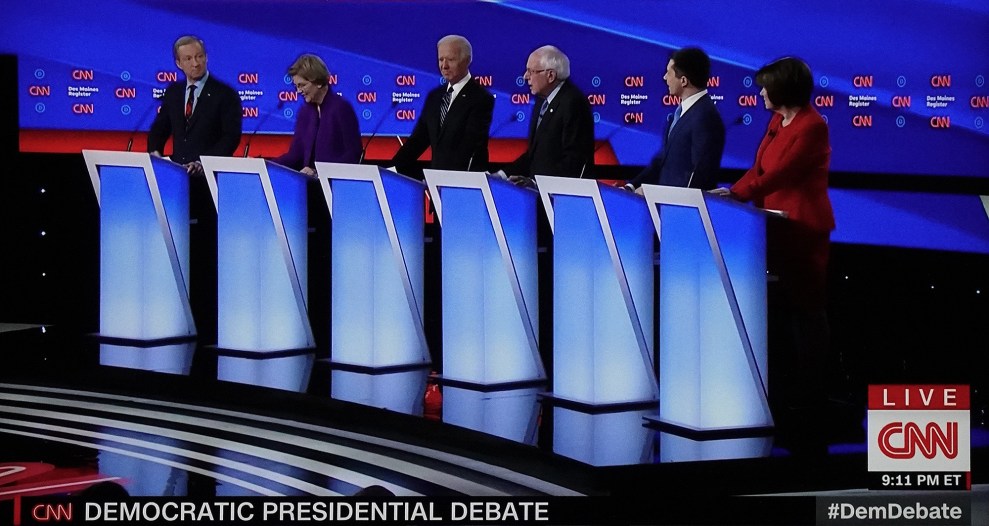
Tonight’s debate was . . . really boring. No big fights. No memorable lines. No serious FUBARs. And no clear speaking, either. I found myself not really getting a good idea of what each candidate stood for even though I already knew the answer.
Perhaps one thing that stood out was the clear division between a group of two candidates competing for the lefty vote (Sanders and Warren) vs. three candidates competing for the centrist vote (Biden, Buttigieg, and Klobuchar).¹ We political junkies have all known this for months, of course, but I suspect it was a little clearer to the audience at home than it’s been in previous debates.
The foreign policy segment of the debate was almost completely empty. Everyone wants to get out of the Middle East either mostly or totally. Everyone wants to put the Iran deal back in place. No one wants to meet with Kim Jong Un. No one provided any sense of a grander plan than undoing the damage Donald Trump has done.
The climate change discussion was equally mushy. Health care highlighted some differences, but they were chewed over so thoroughly that I’m not sure anyone really stood out. The basic fight was between improving Obamacare vs. doing something completely new, but what difference would it make? You know, and I know, but I’m not sure anyone watching on TV really got it.
I genuinely can’t pick any winners or losers out of this. I don’t think there were any. All six of the candidates seemed to perform at about the same good but not great level. I suppose the conventional wisdom is that this helps the frontrunners, but with the top four candidates in a virtual dead heat in Iowa polling, even the conventional wisdom didn’t help us much tonight.
¹Steyer didn’t really fit easily into either group.
Do you think the average viewer has any idea what the candidates are saying about health care? I don’t. Hell, even I’m not sure, and I already know what their plans are. Keep it simple, folks.
On a related issue, the biggest selling point of Medicare for All is that it’s simple. Bernie and Liz should tell people that it means if they get sick, they just show their M4A card to any doctor or hospital and they get treated, full stop. And no one can take it away.
For what it’s worth, I wish one of the Democratic candidates would voice some general, first-principle support for trade deals because they benefit American consumers by giving them access to cheaper goods and services. It’s fine to talk about how to negotiate trade deals that are better for labor and the environment, but how about a shoutout for the fundamental reason we negotiate trade deals in the first place?
As we all know, Donald Trump spent many months last year trying to force Ukraine to announce an investigation into Hunter Biden’s work for a Ukrainian energy company called Burisma Holdings. The idea was to imply that (a) Hunter was employed solely to curry favor with Joe Biden, and (b) Joe Biden therefore treated Burisma favorably when he was vice president. There was never any evidence for any of this, but Trump tried and tried to extort Ukrainian officials into insinuating it anyway. This failed, and eventually led to impeachment charges in Congress.
But just because Trump failed didn’t mean that his friends all gave up. By an enormous coincidence, it turns out that Trump’s Russian buddies from the 2016 campaign decided to investigate Burisma just a few months ago:
Beginning in early November, the Russian spy agency known as the GRU launched a cyber “phishing” campaign against Burisma Holdings to trick unsuspecting employees into giving up their email credentials so the hackers could gain access to their email accounts — once again entangling Moscow in domestic U.S. politics, according to Area 1 Security, a Redwood City, Calif., company.
The operation’s launch coincided with a congressional impeachment inquiry into Trump and whether he abused his office by seeking to press Ukrainian President Volodymyr Zelensky into announcing a probe of Burisma and Hunter Biden — an action that conceivably would aid Trump’s reelection bid.
The Russian attacks on Burisma appear to be running parallel to an effort by Russian spies in Ukraine to dig up information in the analog world that could embarrass the Bidens, according to an American security official, who spoke on the condition of anonymity to discuss sensitive intelligence. The spies, the official said, are trying to penetrate Burisma and working sources in the Ukrainian government in search of emails, financial records and legal documents.
In other words, the Russians are beavering away in all areas to try and find something that might look bad for Joe Biden. Did Trump ask them to do this? I doubt it. He just announced on TV what he’d like to see happen and the Russians took the hint. If they find anything, they’ll launder it through a couple of cutouts and then leak it to some friendly reporters. Will the American press be less credulous about reporting this stuff than they were in 2016? I wouldn’t count on it no matter how often they say they’ve learned their lesson. “But it’s newsworthy,” they’ll say.
The top photo is a southern bush monkey flower and the bottom photo is a coastal bush monkey flower. These are allegedly called monkey flowers because they look like grinning monkeys—which I confess I don’t really see. I guess my imagination isn’t good enough.
There appear to be (a) lots of kinds of monkey flowers and (b) lots of different names for each one. I think I got these identifications right, but it’s hard to say for sure. And other people might use other common names for them anyhow. The only thing I can say with real confidence is that they are monkey flowers, and almost certainly bush monkey flowers.
April 20, 2019 — Laguna Coast Wilderness Park, Orange County, California
The rules of the retirement game just got a sizable overhaul in Congress, giving a nod to the reality that many Americans can’t afford to quit working. The changes aren’t massive enough to put to rest concerns about an upcoming retirement crisis, in which some forecast a growing gap between the haves and have-nots.
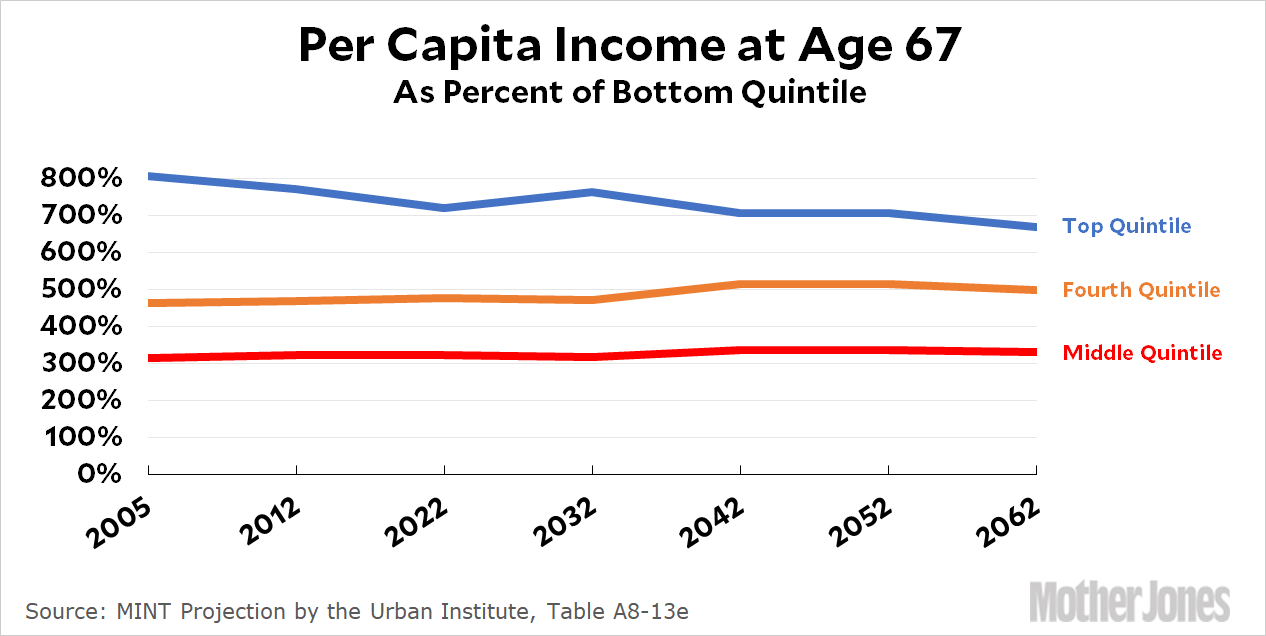
Tompor’s article is a nice summary of the new retirement rules, which are indeed mostly a good thing. But is there really an “upcoming retirement crisis?” And although “some” may forecast a growing gap between the haves and the have nots, what do actual projections say about that? The Urban Institute has done several of them based on the MINT retirement model, including distribution estimates for the average retirement income of the middle-class and the affluent as a percentage of the income of the poor:
Surprisingly, not only is the gap between rich and poor retirees not skyrocketing, it’s not even growing. For retirees in 2005, the rich earned about 800 percent of the income of the poor. For retirees in 2062, MINT projects that it’s a little less than 700 percent.
In a different table (A8-12g for those who want to check), you’ll learn that the income of retirees as a percent of the poverty rate is also projected to rise. And the number of seniors under the poverty line is projected to decline.
These are averages, and obviously the retirement income of the poor is nothing to write home about. We should increase Social Security payouts at the bottom of the income ladder to make up for that. However, although you can get different answers about the gap between rich and poor retirees by looking at different projections, the evidence suggests that it will grow by a small amount at most, and probably not all.
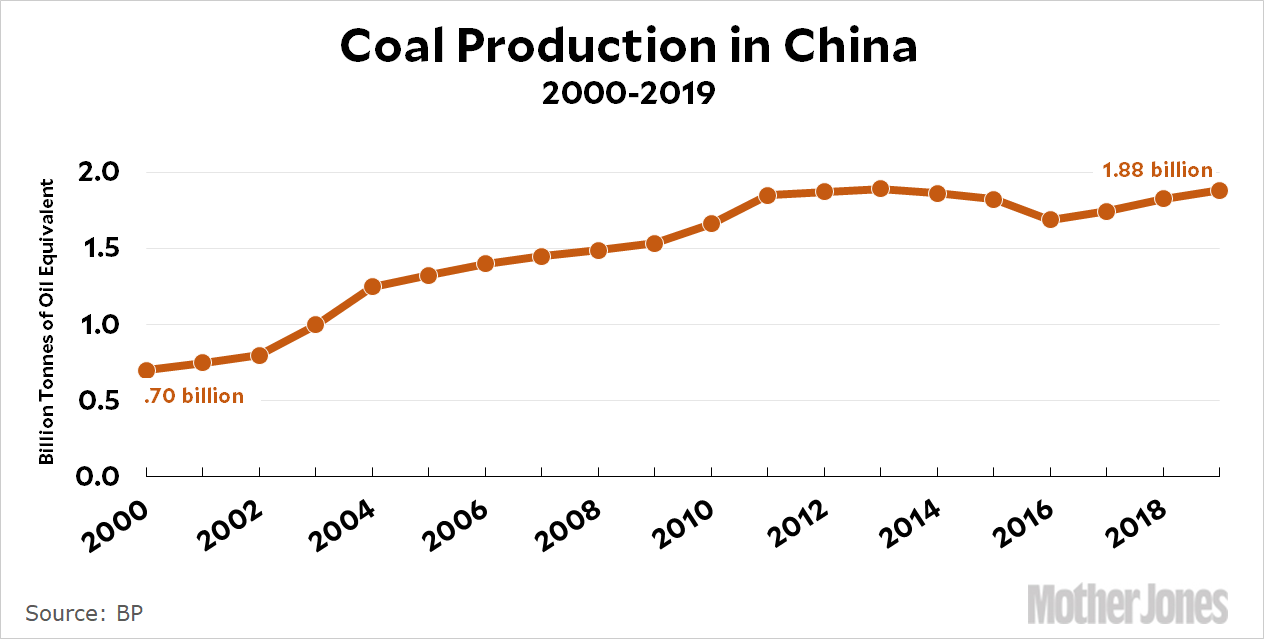
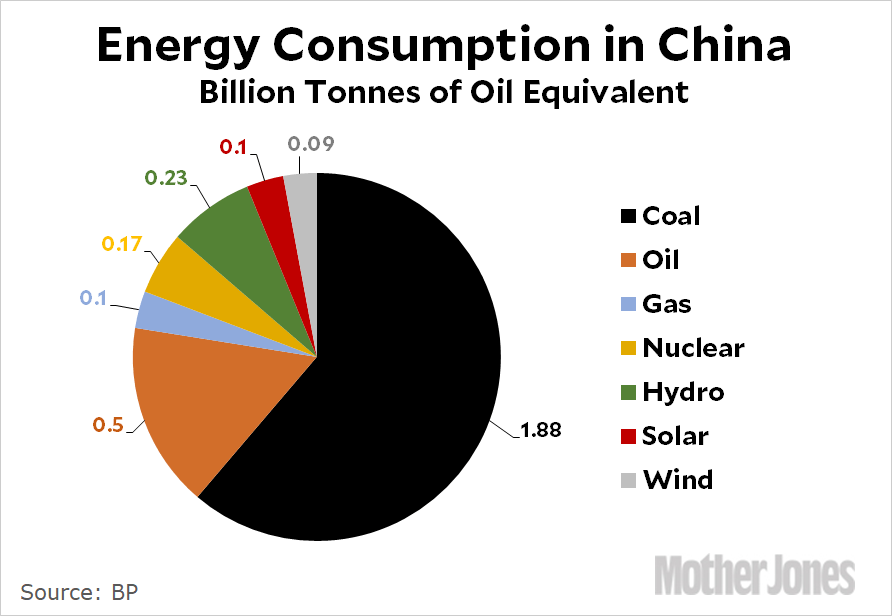
That’s likely a new record for 2019. China also produces about one-third of the world’s total of solar and wind power, but it’s still a drop in the bucket compared to coal. China’s coal production in 2019 was more than five times that of the next biggest country: the United States, at 0.36 billion tonnes of oil equivalent. Here is China’s total energy breakdown:
This is by far our planet’s biggest climate change challenge.
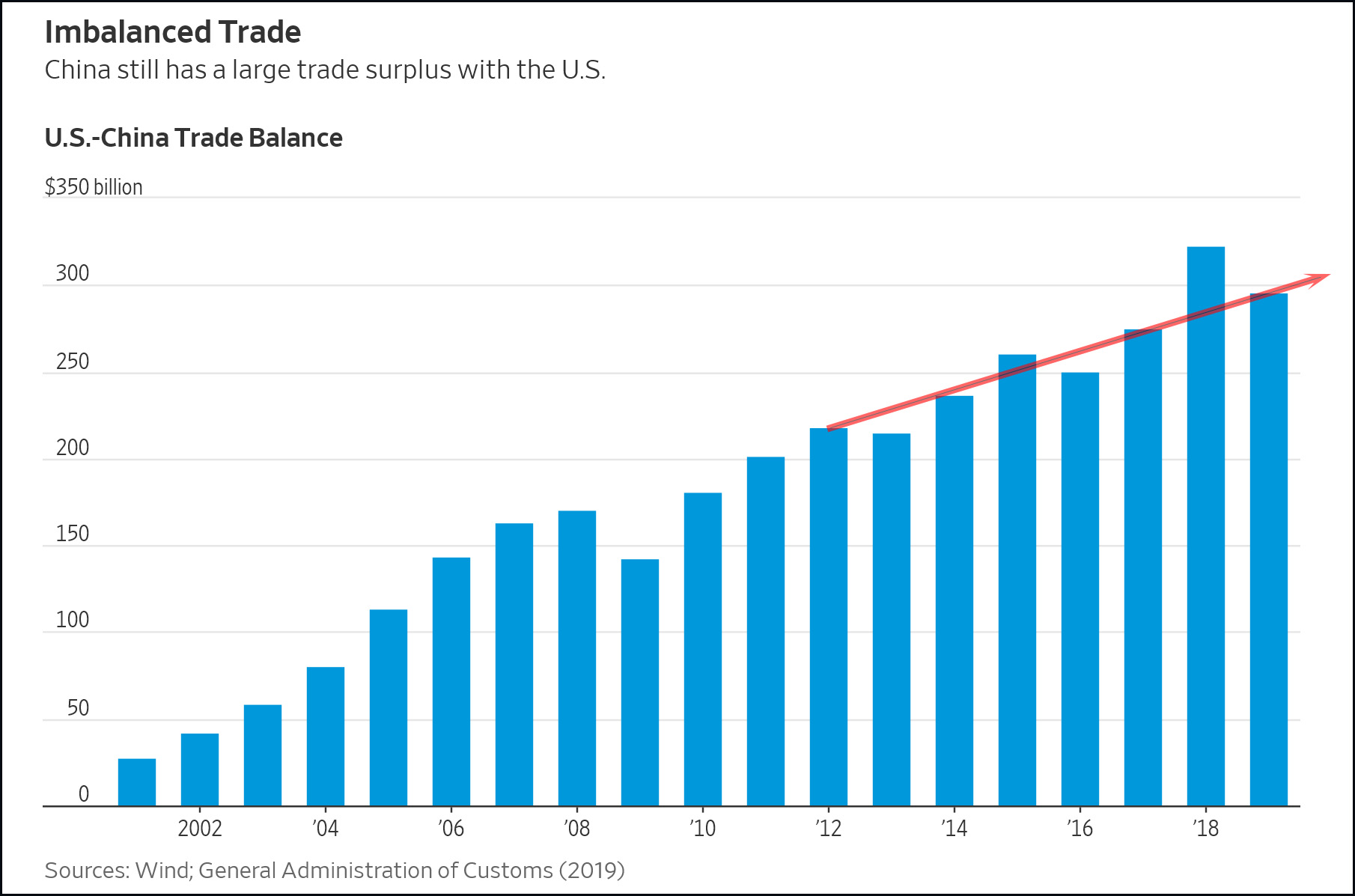
The thing to notice here is not that 2019 was way below trend, but that 2018 was way above trend. In 2019, all that happened is that our trade deficit with China returned to normal. I’m not sure why 2018 was so oddly high, but the data here suggests that Trump’s trade war has accomplished nothing in terms of lowering the trade deficit with China.
And we respect that! But maybe you’re of a mind to support our work directly instead? We have until December 31 to raise the last $400,000 we need to keep our nonprofit newsroom running at full strength into 2026. Will you make a gift today?
We noticed you have an ad blocker on. Can you pitch in a few bucks to help fund Mother Jones' investigative journalism?
Billionaires own the media,
but they don’t own us.
At Mother Jones we know these aren’t conventional times, and they require unconventional coverage. That’s what deliver every day: fierce, independent journalism you can’t find elsewhere. Perhaps never in the history of our country has that been more necessary than now. But we can’t do it without reader support—your support. Please chip in today.
Billionaires own the media,
but they don’t own us.
At Mother Jones we know these aren’t conventional times, and they require unconventional coverage. That’s what deliver every day: fierce, independent journalism you can’t find elsewhere. Perhaps never in the history of our country has that been more necessary than now. But we can’t do it without reader support—your support. Please chip in today.