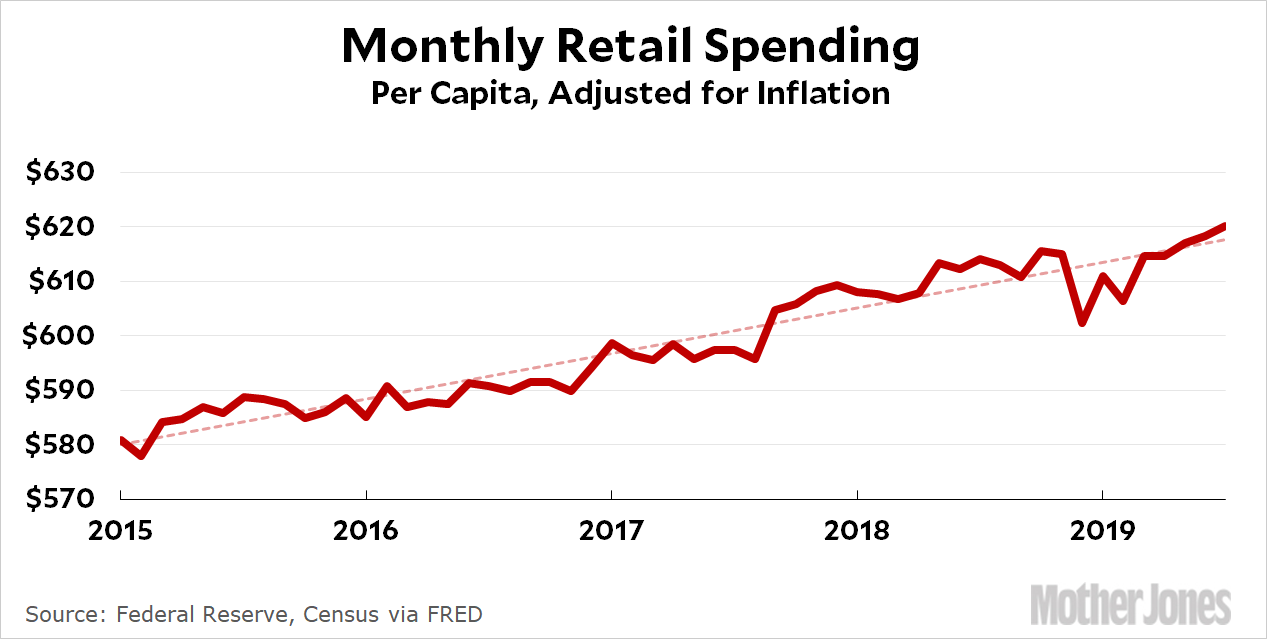
American shoppers gave the U.S. economy a solid boost in July, a counter to weakness in the manufacturing sector and Wall Street jitters about faltering growth….The robust report—the strongest reading since March and a sign that American consumers remain a source of fuel for the economy—is a positive signal for the U.S. amid warning signs of a global economic slowdown. U.S. stocks stabilized after release of the sales figures.
That’s good news, I suppose, but you might want to keep your excitement under control after you see July’s increase in context:
Retail spending has been almost eerily rock steady for years. There was a brief drop in late 2018 and then a brief uptick in the spring to get back on track, and that’s about it. Retail spending in July was precisely where you would have predicted back in 2015 if you just drew a straight line. It’s good that consumer spending didn’t plunge or anything, but July’s figures were hardly a sign of a US-led splurge.
Donald Trump sure does know how to keep the culture wars front and center:
At the urging of President Trump, Israel on Thursday took the extraordinary step of barring two Democratic U.S. congresswomen who have been outspoken critics of the president from visiting the country.
Trump, who has launched a campaign against Reps. Ilhan Omar of Minnesota and Rashida Tlaib of Michigan, tweeted Thursday: “It would show great weakness if Israel allowed” the women to visit, claiming: “They hate Israel & all Jewish people, & there is nothing that can be said or done to change their minds.”
After Trump’s tweet, the Israeli government announced it would ban the women from an upcoming congressional trip. Both are outspoken critics of Israel’s treatment of the Palestinians and support a boycott of Israel.
I suppose I shouldn’t be surprised by this kind of attention-mongering from Trump, nor should I be surprised that Benjamin Netanyahu went along with it. They’re peas in a pod, and their respective bases love this kind of petty retribution.
Several people have recommended to me a Politico piece about Elizabeth Warren’s fight to win loan forgiveness for students who had been defrauded by Corinthian Colleges after it went bankrupt. As the story opens, Warren is on Air Force One trying to enlist President Obama’s help:
Earlier, Warren and others had helped convince the Education Department to agree to cancel the loans for some of those for-profit college students, opening the door to forgiveness for hundreds of thousands of people. Now, Warren was waging a new battle against Obama’s Treasury Department, which was planning to hit students with steep tax bills on their forgiven loans.
….Warren’s goal, according to people familiar with the conversation, was not just to convince Obama that it was possible to do something that his own administration was telling him was impossible. It was to persuade him to spend some of his political capital — which was in short supply as he battled against a Republican Congress — on a group of struggling low-income students who had been defrauded by a now-defunct for-profit college chain.
Implicit in that conversation was a threat: If he didn’t act, Obama could have a public image problem on his hands in the form of a loud, popular senator who had already been raising hell about his Education Department. Not long after the Air Force One flight, the Treasury Department told Warren it had found a way to stop the students from being hit with tax bills after all.
….One former Education Department official called it an “inside/outside strategy”: Warren would hammer the administration publicly at the same time she worked behind the scenes with those government officials, acting, many felt, as an ally.
The whole piece is worth reading on its own merits, but I’m dubious that it tells us much about Warren’s “theory of change,” a buzz phrase that’s very big these days among activists. The story provides a pretty good look at Warren’s distinctive combination of tenaciousness, policy chops, and grassroots support, but it’s not clear to me how well her style would translate into being a good president. After all, this is fundamentally an account of a very small policy change that no one was really opposing and that required only the support of a president of her own party. But the challenge facing a president is to implement sweeping policy changes in the face of an entrenched opposition.
Policy chops aren’t all that helpful here beyond a certain minimum, and in any case Warren’s detailed policy expertise is in a fairly narrow area. In the vast majority of cases she’ll have to rely on her staff, just like any other president. Grassroots support is certainly helpful to a president, but Warren would soon learn that progressives have a habit of dumping you if you deviate even a little bit from the pure cause. That leaves tenaciousness, which I have no argument about. That’s helpful no matter what—though a president has to pick and choose her spots instead of simply rolling out plan after plan for everything.
How much does all this matter? In fairness to Warren, I’ve never been very taken with obsessing over a candidate’s “theory of change” to begin with. It all seems a little naive and overintellectual. You want a real theory of change? Here it is: build up enough public support for your cause that you can win the presidency along with a 300+ majority in the House and a comfortable filibuster-proof majority in the Senate. That’s pretty much it. Tedious outrage about “incipient fascism” aside, the United States is still a democracy. If you want change, you have to convince a big chunk of the population to support it. The rest is details.
Others may see this differently, but for all the sound and fury out of Fox News on one side and the #Resistance on the other, I continue to have no sense at all that Americans are truly ready for a grassroots revolution of any kind. Events could change that, but most of us are simply too comfortable to take up pitchforks these days. For the time being, the best theory of change is the good old slow boring of hard boards.
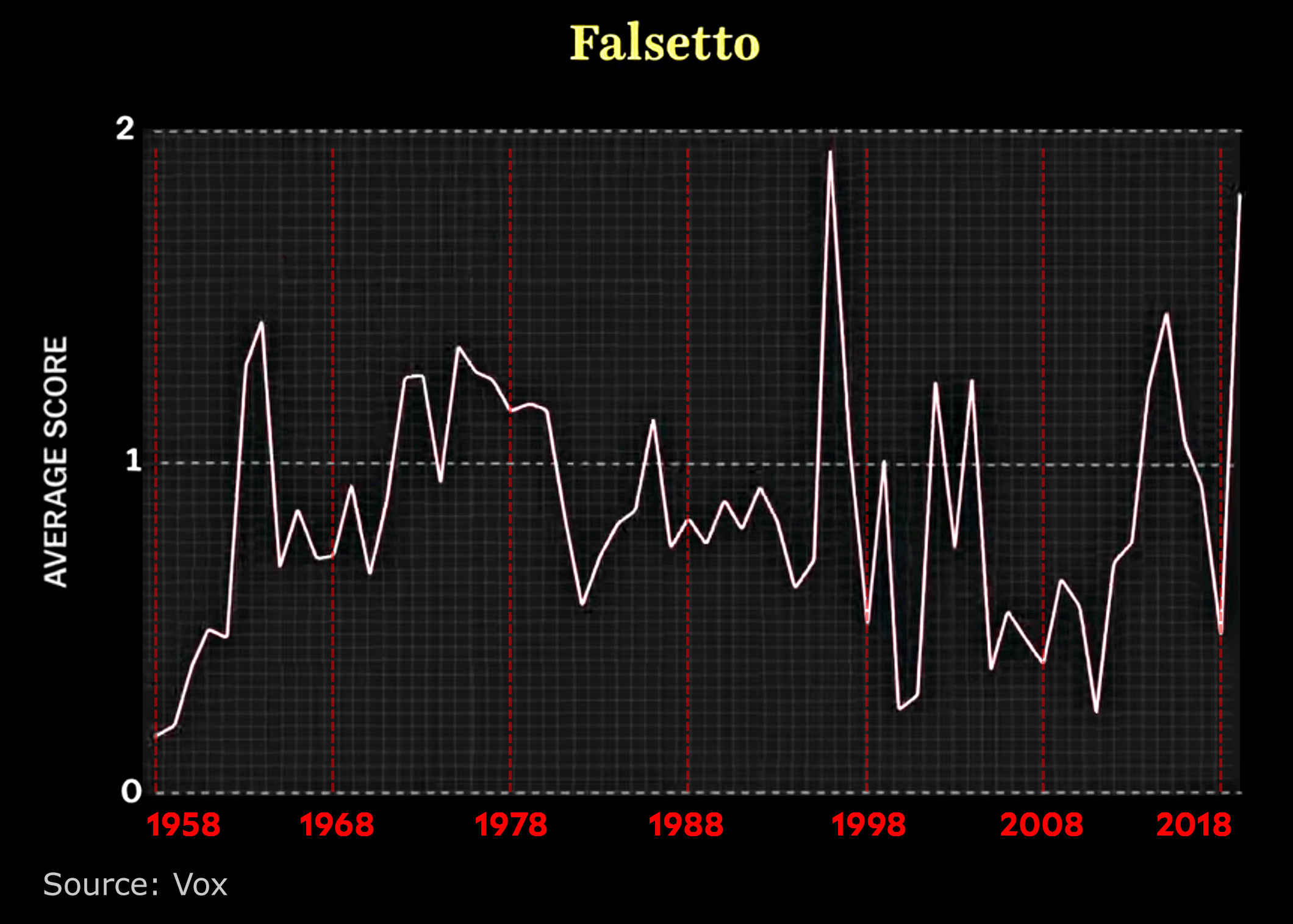
I hate falsetto. That doesn’t mean I hate you unless you also hate falsetto. De gustibus. But to me it sounds like fingernails on a chalkboard. So naturally I was curious when Voxput up a video claiming to chart the popularity of falsetto in pop music over the years.
You’ll have to watch the video if you want the whole story, including the difference between falsetto and a naturally high voice, but in the end they came through. They used Pandora metadata to score all the Top 10 songs since 1958, and then tossed out everything (mostly hip hop) that didn’t include any singing. Once that was done, here’s what they came up with:
I was born in an unusually falsetto-less year, but since then there’s no real trend to speak of. The ’70s were a strong decade for falsetto and the aughts were a weak decade, but that’s about it.
Unfortunately for me, they also discovered that falsetto songs charted better and longer than other songs, so it’s here to stay. Oh well.
Adam Neumann is the founder and CEO of WeWork, a company that buys large blocks of urban office space and then subdivides them into smaller spaces for rent to entrepreneurs, freelancers, startups, and so forth. In the past this has been considered a fairly boring kind of business, but WeWork has inexplicably been able to brand itself as a tech company and is currently valued as if it were Facebook or Google. Naturally it plans to go public soon, which means that today it released its registration documents for an upcoming IPO.
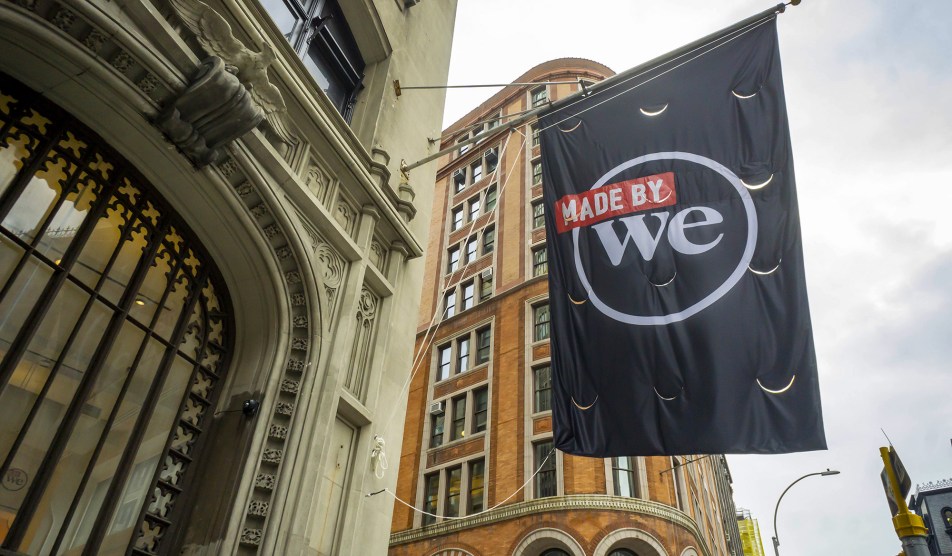
This should make Neumann even richer than he is now, but apparently that’s not enough for him. Earlier this year WeWork changed its corporate brand to We Co., obviously a critical part of its growth strategy. Naturally it then needed to acquire the trademark to “we.” Can you guess who owned that trademark? Huh? Can you? Bloomberg tells us:
The name was owned by We Holdings LLC, which manages some of the founders’ stock and other assets. WeWork said it paid the founders’ company $5.9 million for “we” this year, based on a valuation determined by a third-party appraisal. WeWork legally changed the company name last month.
That’s right, it was owned by Adam Neumann. And a completely objective appraisal paid for by Neumann decided that Neumann should be paid a completely objective $5.9 million for selling his trademark to his own company.
Isn’t that great? Don’t you wish you could do that? And it all seems so pointless. Neumann has already cashed out about $700 million worth of his stake in the company prior to the IPO, and since he still owns a third of the company¹ he’ll be worth somewhere north of $10 billion after it’s over, even though WeWork has never come close to making money and is currently burning cash at the rate of a billion or three every year. So I guess every dollar counts.
¹I think. WeWork’s S-1 form shows that Neumann owns 115 million shares of the company out of a total of 338 million pro forma shares. At least, that’s my best guess. I suppose I shouldn’t be surprised by this anymore, but it’s remarkably hard to figure this out even from formal SEC documents.
I don’t know how many people rent a car when they visit Bogotá. If you’re mostly exploring the city you’ll do it via taxis and public transportation. (Pro tip: as near as I could tell the ratio between taxis and passenger cars was about 1:1.) If you’re making only one or two trips outside the city, there are buses that will take you. But if you want to do what I did, which is to use Bogotá as little more than a home base for daily trips outside the city, then a car is the way to do it. With that in mind, here are some miscellaneous observations.
Even/Odd Days
You are only allowed to drive in Bogotá on certain days. If your license plate ends in an even number, you’re banned from the city on even-numbered days. Ditto for odd-numbered license plates. I don’t know if this applies to cars that are merely going in or out via major arteries and I never found anyone to ask. In any case, I was going to leave the city every day regardless, even if I got a ticket, so it didn’t really matter.
In the event, I got no tickets—not that I know of anyway. I guess it’s still possible that I’ll get a big packet in the mail someday filled with photos of me driving on the wrong day; making illegal U-turns; and driving down streets reserved for buses. Nothing yet, though. And I’ll note that I got curious one day and started counting license plates. Only about 80 percent were driving on the correct day. The other 20 percent were scofflaws, but nothing seemed to happen to them.
Traffic
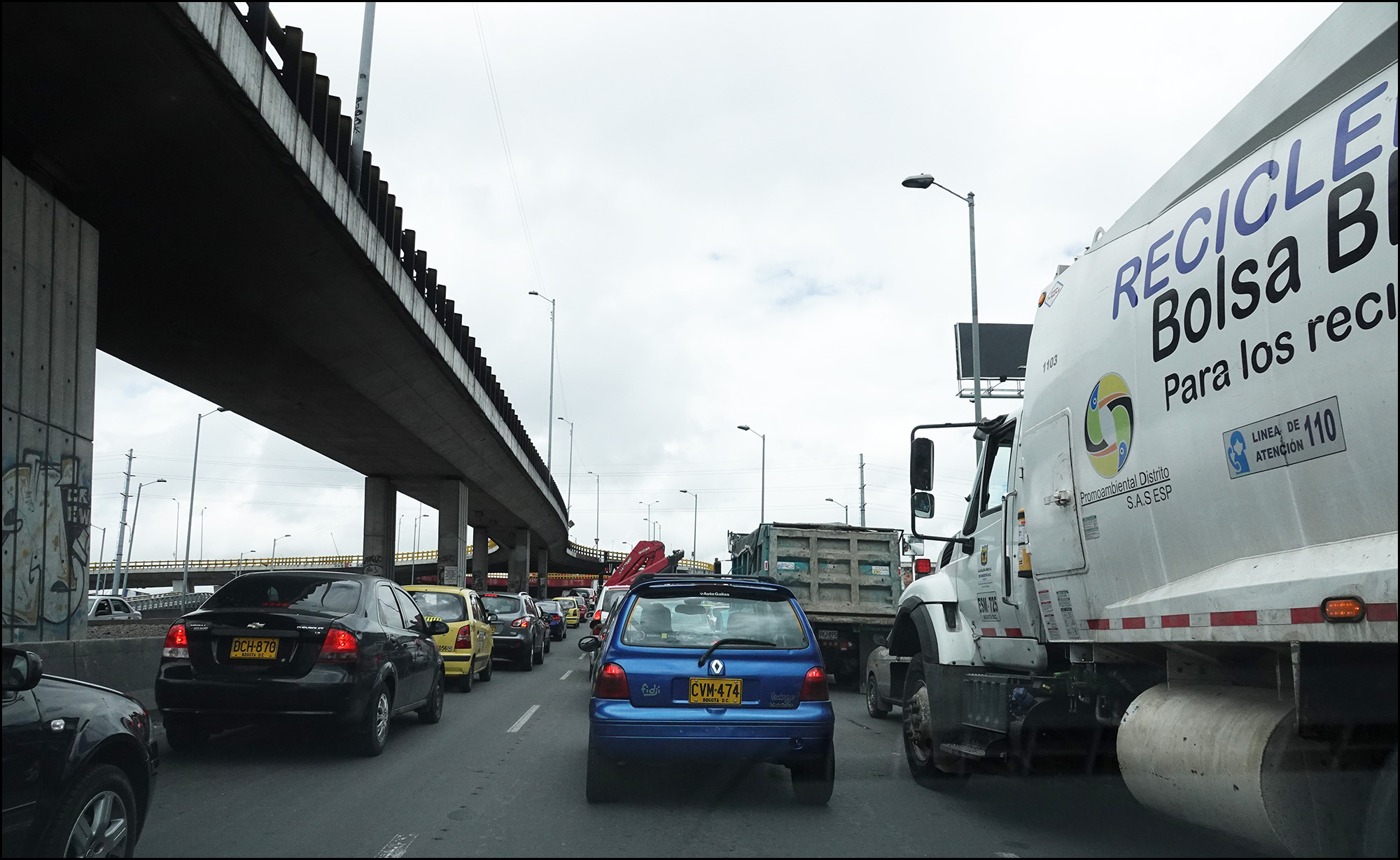
Overall, the traffic in Bogotá struck me as ordinary big-city traffic. I’ve seen worse in LA and New York. And the drivers themselves were generally not all that aggressive. So that’s not something to be worried about.
Traffic on Avenida NQS around 9 in the morning.
But there are a few things that make Bogotá traffic insane, especially for tourists. Most streets are one-way, which is not a big problem. However, often two streets in a row are one-way in the same direction, and this can be a problem. You move on the next street and finally turn in the direction you wanted, but then the street dead ends and you can only go in a direction that takes you even farther away from your destination. You try to backtrack, but then you run into a street that’s temporarily closed for construction. Then there’s another street that’s closed because it’s been turned into a pedestrian mall. If you know the city well, none of this will bother you. If you don’t, you’ll end up 20 blocks away from where you wanted to go, banging your head on the steering wheel and wondering if you’ll ever make it back. Much of this is deliberate. A regular reader who lives in Bogotá emailed me this:
There’s a story here about Enrique Peñalosa Londoño, the former mayor of Bogotá who is now back to being the current mayor. Ten years ago or so, he had a mission to rebuild the city in such a way that pedestrian walkways get built first, bus lanes get built second, and commuter car roads get built last (from his point of view, those rich folks can drive on dirt roads until the city gets around to serving them last).
Gary Hurst (documentary film maker that did the film Helvetica) did a wonderful film called Urbanized in 2011 and Enrique Peñalosa Londoño was a major segment in the documentary (and in the time devoted to the Mayor, he gives a great analysis of his city’s traffic problems, as well as how he plans to manage it all). The entire film is a great watch, and Mayor Peñalosa Londoño was one of a couple standout visionaries in the film that (almost) gave me hope for the future of human sprawl.
If the mayor wants to screw the Colombian fat cats and the rich Americano tourists, I guess I can’t argue with that. But it’s something definitely worth thinking about before you decide to tackle the streets of Bogotá.
The TransMilenio
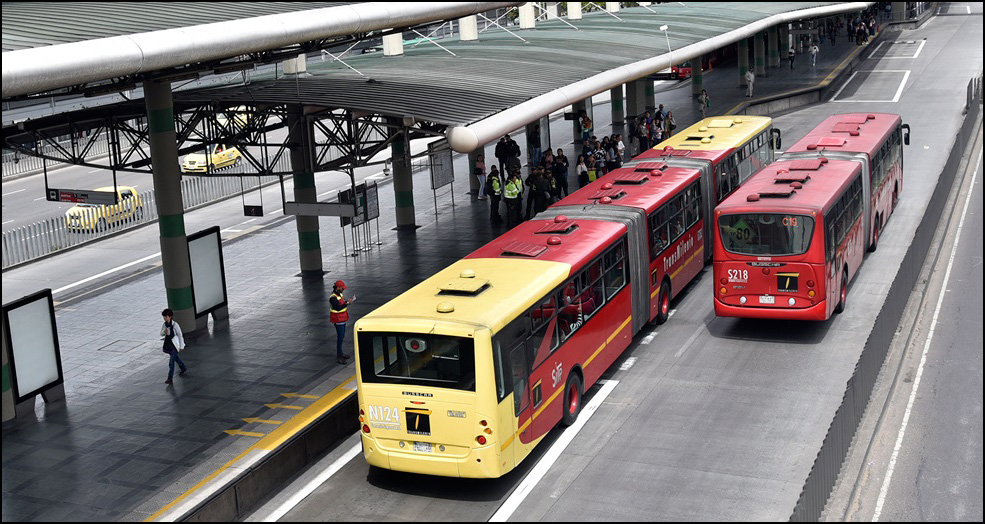
Twenty years ago Bogotá decided to build a citywide network of dedicated bus lanes. On the big avenues this meant taking about six lanes out of service in the middle of the road. The center two lanes were converted into stations, and each station had half a dozen different sections dedicated to different bus lines. Like a subway, then, you just have to enter the station and find the right platform for the bus you want.
A TransMilenio bus pulls into a station. As you can see, the station takes up two lanes, there are two bus lanes, and there are two bus lanes in the other direction. On big avenues, a total of 6 traffic lanes were taken out of commission and handed over to the TransMilenio.
This has been a big hit, but it presents drivers with a problem: If you’re on a major avenue with a TransMilenio line in the middle, there’s no place to make a U-turn across the dedicated bus lanes if you decide you’re going in the wrong direction. You’re left with two options. First, you can drive a long time until you do finally find a place to turn around. They exist every ten or twenty miles or so. Second, you can wait until you approach a major street that has a bridge over the TransMilenio line. With Google maps in hand you can probably figure out how to get there—eventually. Then you go over the bridge and figure out to merge into the traffic going in the direction you want. If you’re lucky, there will be a simple loop to get you on. If you’re less lucky, you’ll have to take some educated guesses and hope that one or two of them allow you access to the Avenue.
It’s Construction Century in Bogotá
Streets are torn up everywhere. Other streets have been turned into pedestrian ways. Others are restricted to buses. And still others simply dead end for no apparent reason. There are orange banners strewn all over the city that tell you (I think) what’s what and where the detours are. To use them you’ll need to read Spanish and have some familiarity with the layout of Bogota’s streets. Good luck.
Security
As our Colombian friend Ana has told us, all cars in Colombia are equipped with automatic doors that lock after 30 seconds. It’s for your protection! There are two lessons to be learned from this:
If you leave your car, even if you absolutely, positively know it’s just for a few seconds to take a look at something, take your car keys with you. Every time.
When the rental folks give you an emergency roadside assistance number, don’t just toss it aside. Enter it in your cell phone and then dial it immediately to make sure you entered the country code, etc. correctly.
My car, locked, with the keys safely inside.
Speed Limits
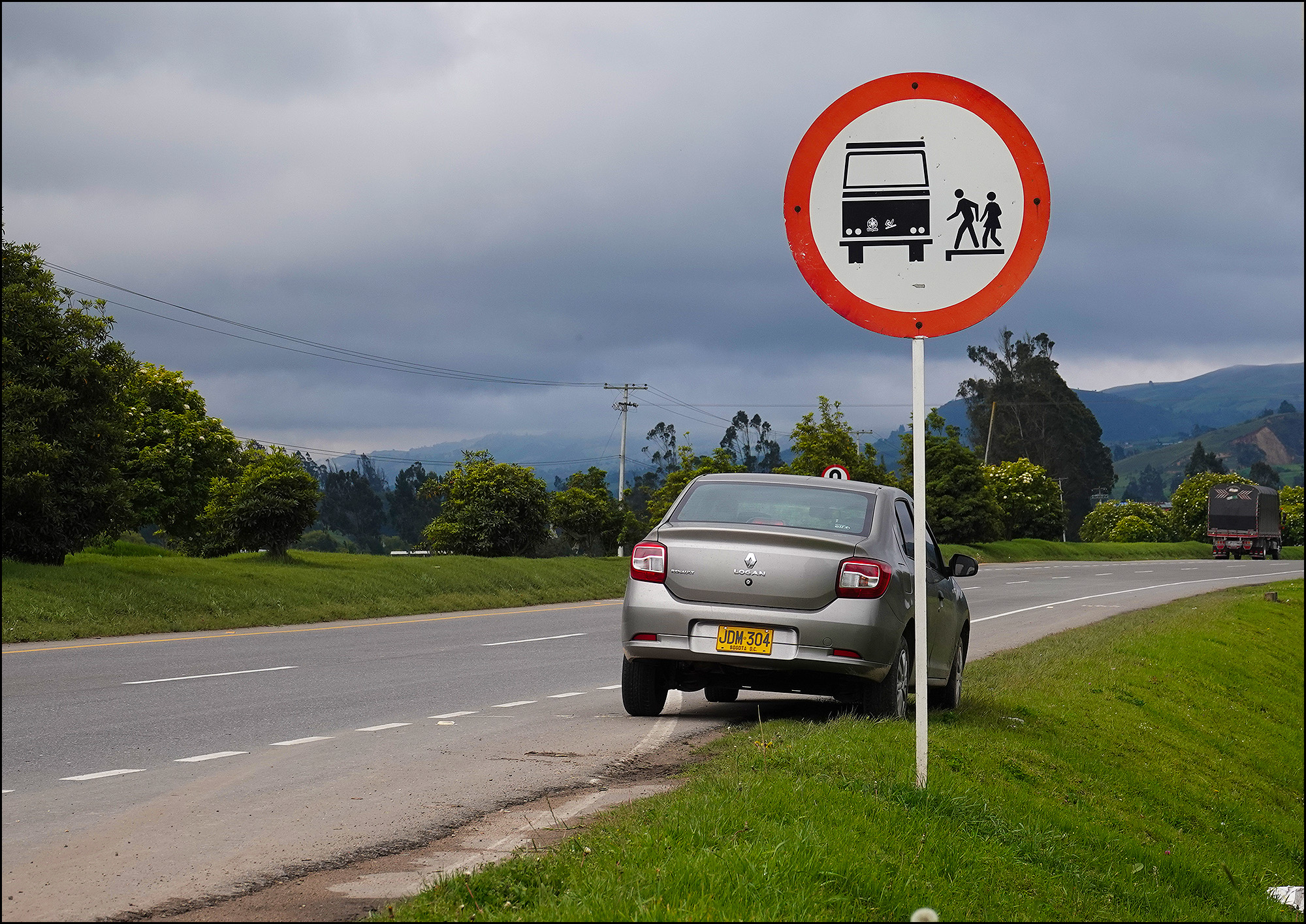
Speed limits are very low in Colombia. On the Autopiste Norte, a very nice multi-lane highway (though not a full restricted-access superhighway) the highest speed limit is 80 km/hr. For you Yankee imperialists, that’s 48 mph. What’s worse, a lot of people tool along at 40 mph or less. I’m not talking about trucks or motorbikes, just ordinary passenger cars that are happily backing up traffic behind them at 40 mph.
Nor does there seem to be an official concept of a fast lane and a slow lane. On a two-lane highway, there are just two equal lanes. Trucks hang out in the left lane if they feel like it, as do the pokers driving 40 mph. The only exceptions are the motorbikes, which reliably stay in the right lane.
The upshot of all this is that you should double the time you think it will take you to get anywhere. The autopistes are limited to 48 mph in theory, and in practice you’ll be lucky to sustain 35-40 mph for all but a few wide open sections. And when you exit the main highway, all bets are off. The road you choose might turn out to be perfectly nice, but still twisty enough to keep you from going more than 30 mph. Then again, it might turn out to be mostly unpaved and you’ll be lucky to sustain 20 mph.
Traveling Outside Bogotá
This was the most mysterious part of my trip. I am very much hoping that someone will chime in with some trick that I was missing the entire time I was driving through small towns in Colombia.
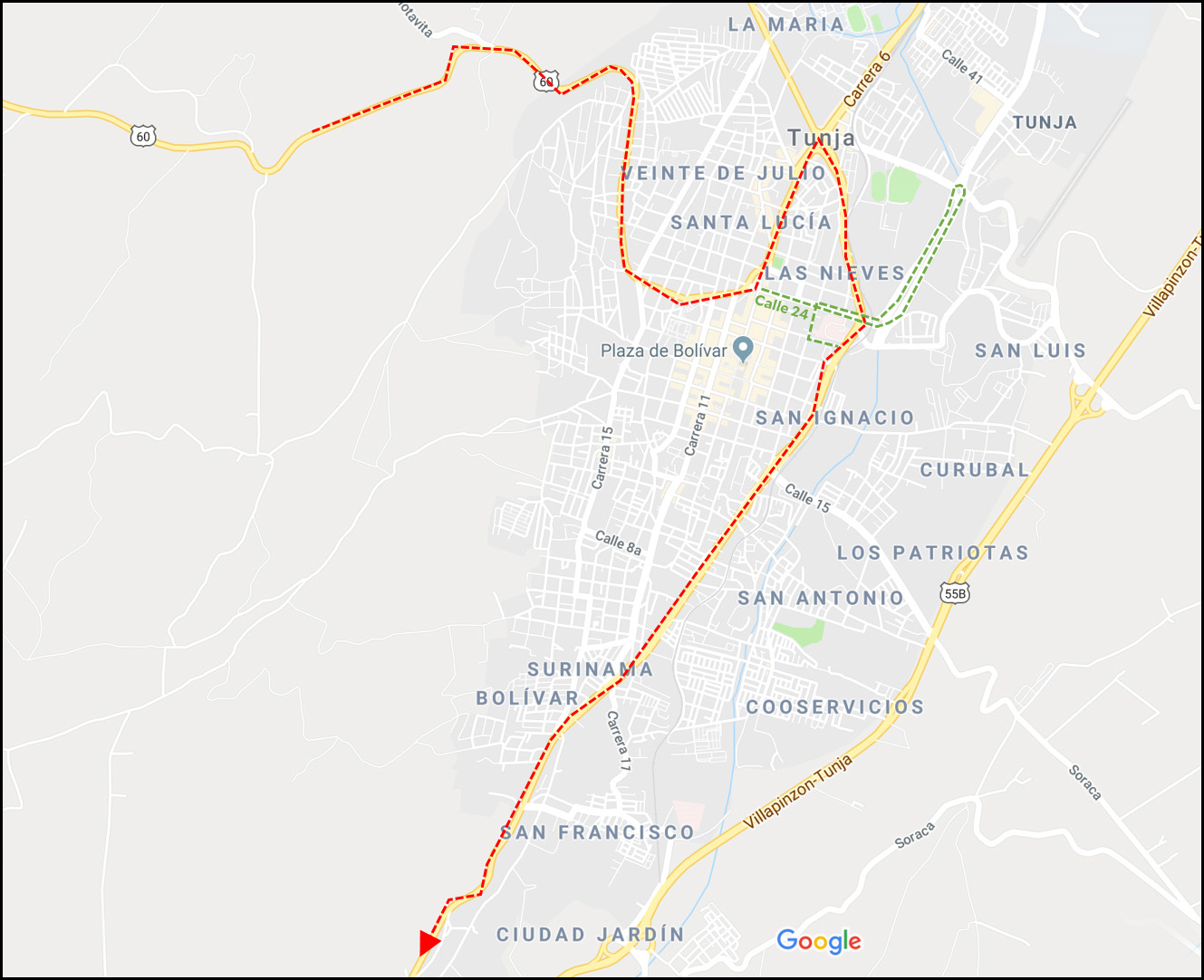
Here’s an example. Suppose you’ve reached the town of Tunja and want to exit to the south to continue home to Bogotá. Here’s a map that tells you how to do it:
Coming in from the west, there’s no way to get through Tunja except to snake a path directly through the center of town.
You’re coming in on Highway 60, which becomes Carrera 19 in town. Keep going south and it becomes Calle 22. Make the left onto Avenida Colon and follow it around a curve to Carrera 10. This will take you to a roundabout that allows you to turn south onto Avenida Oriental, which become Oriental 21, then Oriental 20, 19, 18, 17, 14, 10, 8—at which point it becomes highway 55—and then Oriental 7, 6, 5b, 5, and finally Oriental 4, which merges into Carrera 14. Then it truly becomes Highway 55 and heads you home.
Is there a way to shortcut this mess? I tried. I figured I was due for some good luck, so when I got to Calle 24 I turned east toward Avenida Oriental. This is the green dashed line. Unfortunately, Calle 24 was a bridge that went completely over Avenida Oriental on Viaducto Norte. A couple of miles later there’s a roundabout that allowed me turn around onto Viaducto Sur. This takes me over Avenida Oriental again and becomes good old Calle 24. Google Maps suggests a quick left on Carrera 7 and another left on Calle 22, and that finally gets us to Avenida Oriental and south out of the city.
This was pretty typical. It’s one thing to have a weird route that shunts everyone through the busiest part of town, and it’s yet another to have “shortcuts” that don’t work but aren’t obvious on Google maps. But it’s a whole nother level of fucked-ness to have no signage anywhere along the way to assure you that you are indeed still on Highway 60 until it transitions to Highway 55.
If anyone has traveled in Colombia and can crack this code for me, I’d appreciate it. Don’t worry about making me look like an idiot. I don’t mind.
Bottom Line and Most Important Rule
Put all of this together and the upshot is that it will probably take you twice as long to get anywhere as you think. It’s a minimum of an hour just to get out of Bogotá and after that you’ll be driving pretty slowly and almost inevitably making mistakes that might take one minute to fix or 20 minutes to fix. Don’t let it bother you. If you need to pay an extra toll, pay it. 8,000 pesos is only three bucks. Just pay it and keep moving. If you stop for lunch, make it someplace quick. The food is probably just as good.
Where to Stay?
Without knowing any of this, I chose to stay in Central Bogotá. That was probably a mistake because it takes too damn long to get from centro to anywhere outside the city. My tentative guess now is that you might actually be best off staying at an airport hotel on the west side of town. From there you can exit the west end of town in a few minutes and hook up with roads leading north, south, and west. If you want to go east to drive over the mountains—which I recommend—even that’s not too hard. You just follow the airport highway east and it will take you to Carrera 1 and then over the mountains. And if you want to visit the city the TransMilenio will whisk you right in. If I had it to do over again, that’s probably what I’d do.
TOMORROW: Friday, Kevin’s last day in Bogotá. But it will be surprisingly photogenic thanks to a business class seat with a clean window.
This is the very last of the pictures from my visit to New York City last year. Somehow I’ve just never gotten around to using it, but today’s the day! This was, of course, taken at the Prospect Park Zoo, and came at the tail end of a sea lion show.
September 14, 2018 — Prospect Park Zoo, Brooklyn, New York
The Trump administration is vastly expanding the scope of condominium purchases eligible for lower-down-payment loans. The move, to be announced Wednesday by the Federal Housing Administration, could help revive the entry-level condo market for first-time buyers because FHA-backed loans require only a 3.5% down payment and lower credit score than conventional loans.
It also loosens financial-crisis-era rules and could expose the government to a higher likelihood of loan default if the housing market continues to slow and prices fall.
What could go wrong?
In fairness, the housing market is nowhere near the bubbly levels of the aughts, and there’s no special reason to expect a big crash. But a little crash? That’s entirely possible.
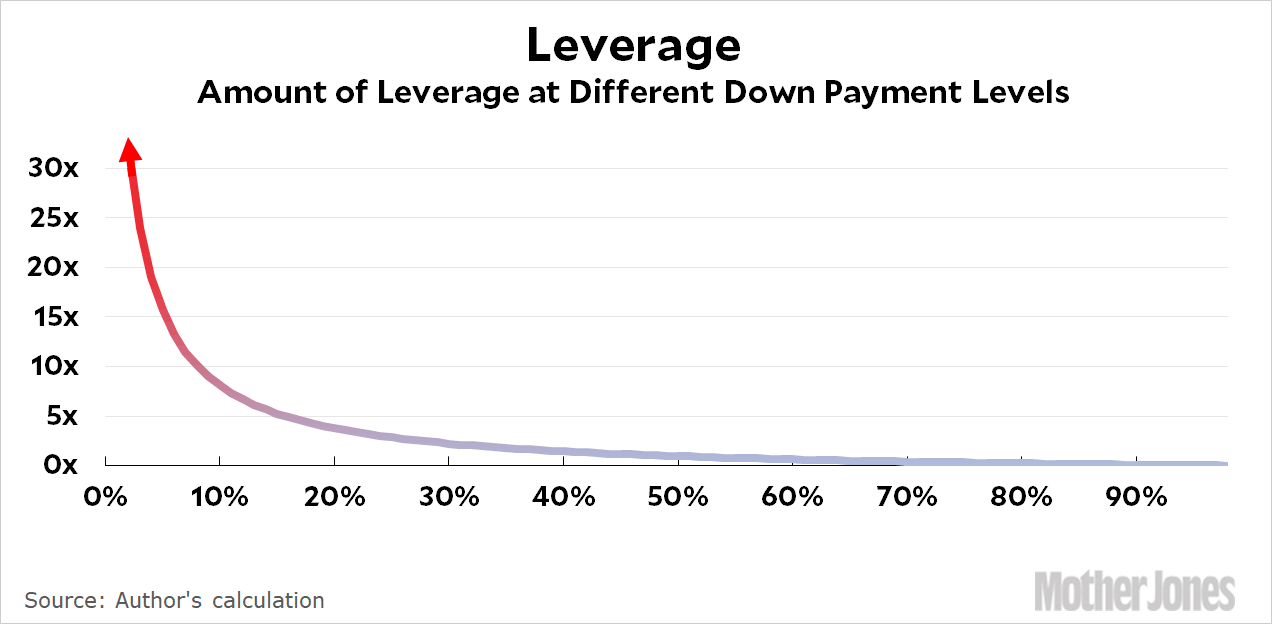
I’m something of a leverage obsessive, and I’m generally willing to put up with a lot of weird financial stuff if only the various arms of the government keep leverage under control everywhere and at all times. We mostly think of this in terms of banks, but it shows up in all sorts of places. Minimum requirements for buying stocks on margin, for example, or down payment requirements for homes. If the FHA wanted to loosen credit requirements a bit, I’d probably shrug if they’d pair it up with a 10 percent down-payment requirement. That would change the leverage from 27x to 9x.
But that’s not to be. After all, the financial crisis happened more than ten years ago. Things are totally different now, right?
Let’s be honest. Most of the time presidents don’t deserve a whole lot of credit or blame for the economy. There are modest exceptions here and there, but the economy is mostly outside their control.
And then you have Donald Trump. He supported a bad tax bill. He ginned up a trade war. He threw oil markets into turmoil by abrogating the Iran treaty. And now Germany is heading toward recession, China is hurting, the yield curve has inverted, and financial markets are in a tizzy.
I can’t predict the future any better than anyone else, but if Trump ends up losing in 2020 because the economy went sour, he’ll deserve it. It’s too bad all the rest of us have to pay the price too.
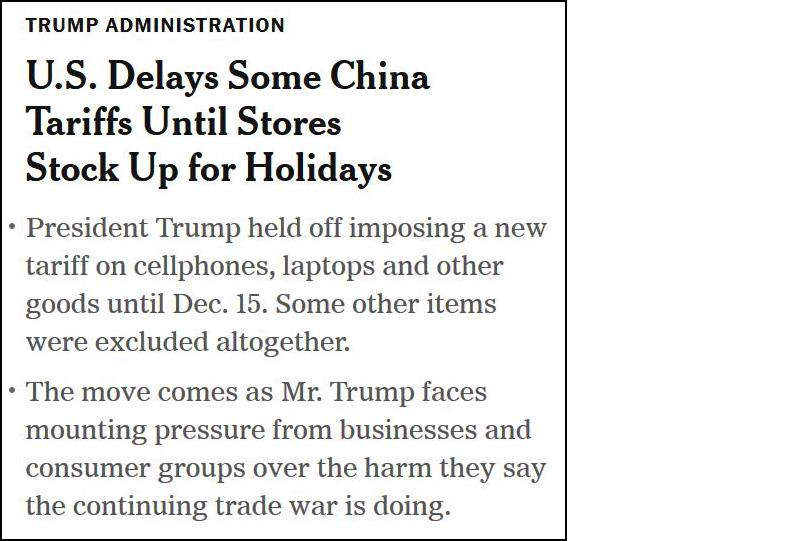
Wiping out America’s soybean farmers? Sure, not a problem. Increasing the price of Christmas gadgets a few percent? No can do.
The political calculation here is pretty transparent. Trump figures that Midwest farmers are going to vote for him no matter what. What’s more, they can be bought off with some targeted subsidies. But suburban soccer moms forced to pay more for their kids’ presents? They were already on the fence and this might push them right over.
Besides, the economy is looking a little iffy these days. A bad holiday selling season is the last thing Trump needs. Once again, it looks like winning trade wars isn’t quite as simple as Trump thought. Who knew?
Billionaires own the media,
but they don’t own us.
At Mother Jones we know these aren’t conventional times, and they require unconventional coverage. That’s what deliver every day: fierce, independent journalism you can’t find elsewhere. Perhaps never in the history of our country has that been more necessary than now. But we can’t do it without reader support—your support. Please chip in today.
Billionaires own the media,
but they don’t own us.
At Mother Jones we know these aren’t conventional times, and they require unconventional coverage. That’s what deliver every day: fierce, independent journalism you can’t find elsewhere. Perhaps never in the history of our country has that been more necessary than now. But we can’t do it without reader support—your support. Please chip in today.