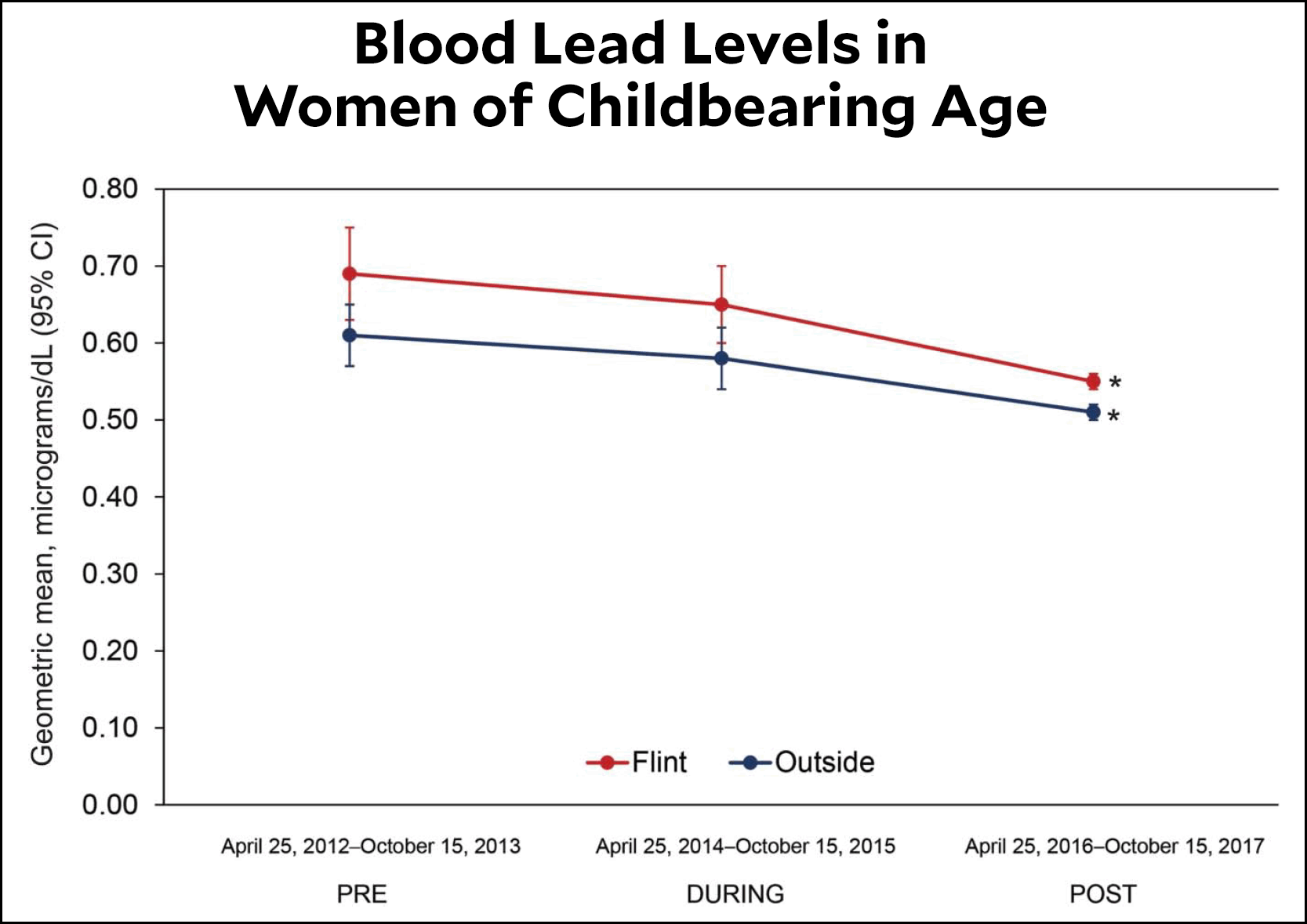
A couple of years ago I wrote about a paper claiming that the fertility rate of women in Flint, Michigan, plummeted during their water crisis. Today I got a copy of a newly published study of lead levels in women of childbearing age during the Flint water crisis. It’s very carefully done and uses reliable data. The sample sizes are fairly small, but the results are nonetheless convincing. Here they are:
The lead levels of young women in Flint didn’t increase at all during the water crisis. In fact, they might have decreased. What’s more, the absolute levels are so low that it’s nearly impossible that they could have had any effect on stillbirths or spontaneous abortions, which no one has ever reported for BLLs under 5 ug/dl, the current reference standard for high lead levels. In Flint, it turns out that virtually no one in any of the time periods studied had a BLL over 5 ug/dl:
There is little debate that high maternal blood lead levels can result in the occurrence of spontaneous abortion and preterm birth. In a small study, although Shannon reports a significant number of preterm births in 15 pregnant women with severely elevated blood lead levels (range 40–104 micrograms/dL), there were no spontaneous abortions….Review of the literature reveals no study showing an association with either spontaneous abortion, late fetal deaths, nor preterm births with maternal blood lead levels below the CDC reference value of 5.0 micrograms/dL.
….Available Flint perinatal data from the Michigan Department of Human and Health Services indicate stillbirth rates were not significantly different before compared with after the water switch time period. The Michigan state data reveal 2,348 live births, and 25 stillbirths before the water switch (July 1, 2012–December 31, 2013) compared with 2,121 live births, and 24 stillbirths during the water switch (July 1, 2014–December 31, 2015).
In other words, the rate of stillbirths was 1.06 percent before the water switch and 1.13 percent during the water switch.
What happened in Flint was horrible. That said, Flint is now one of the most heavily studied cities in America, and virtually every credible study suggests the same thing: not only did the switch to Flint River water have no effect on public health, it never significantly increased blood lead levels in the first place. This might be because Flint water was never heavily lead poisoned to begin with, or it might be because Flint residents started using bottled water and tap filters fairly quickly after the alarms were sounded.
Either way, both parents and children in Flint should by now feel confident that their water debacle, as outrageous as it was, is vanishingly unlikely to have had any noticeable health effects. That’s a good thing.
The Wall Street Journal, in its persistent quest to mislead people about financial statistics, has this to say today:
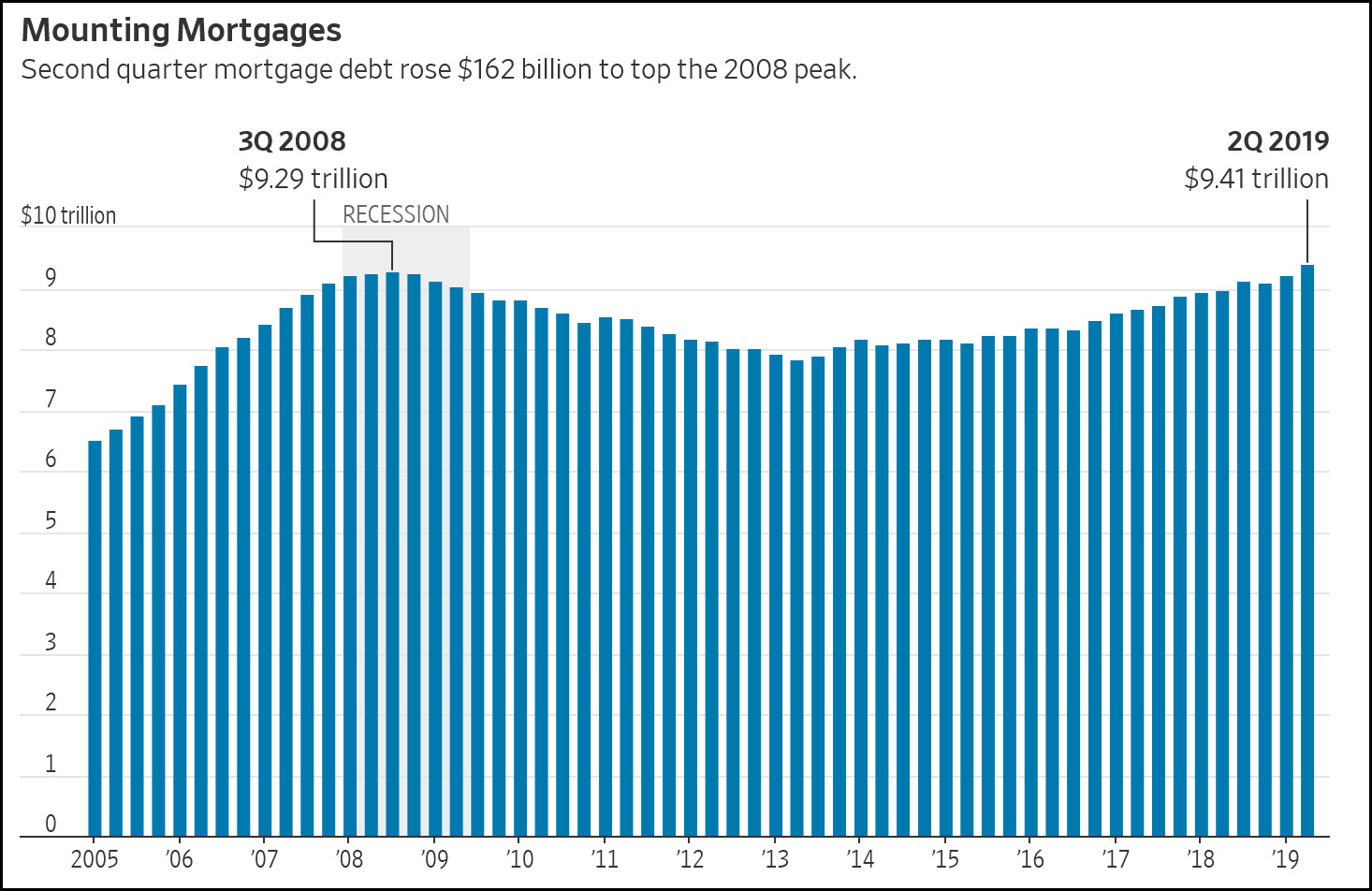
U.S. Mortgage Debt Hits Record, Eclipsing 2008 Peak
U.S. mortgage debt reached a record in the second quarter, exceeding its 2008 peak as the financial crisis unfolded. Mortgage balances rose by $162 billion in the second quarter to $9.406 trillion, surpassing the high of $9.294 trillion in the third quarter of 2008, the Federal Reserve Bank of New York said Tuesday….The figures are nominal, meaning they aren’t adjusted for inflation.
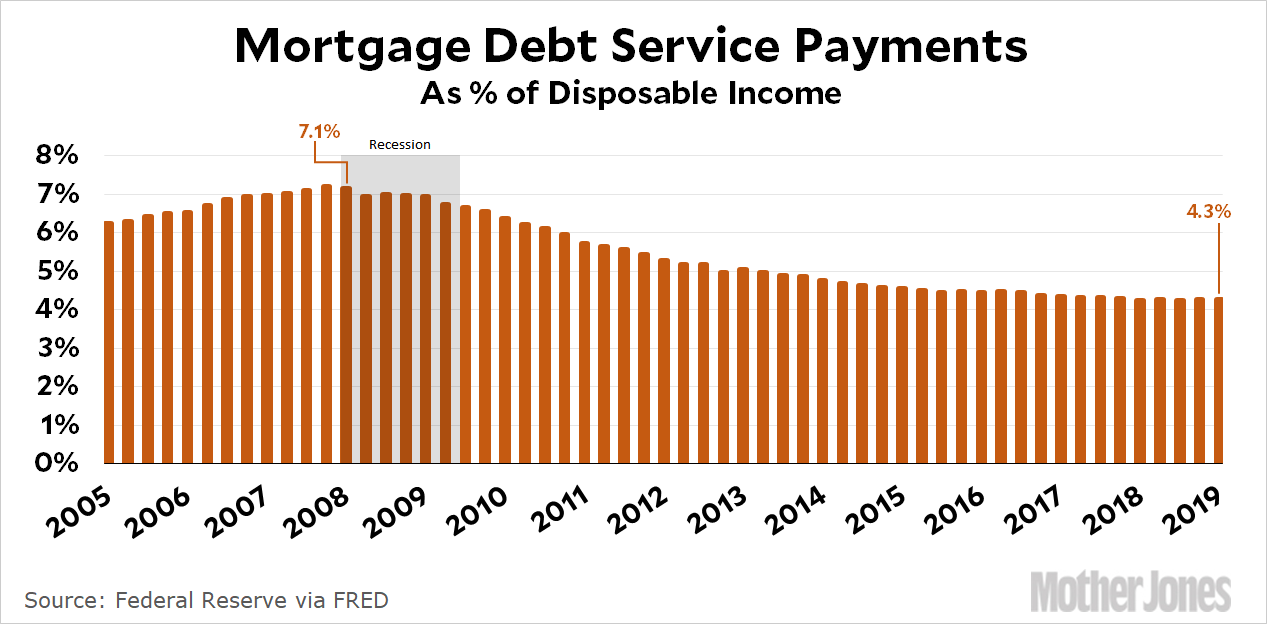
Nominal, you say? How about if we go ahead and correct for inflation, just for laughs? In fact, let’s take the advice of Diane Swonk, chief economist at Grant Thornton, who told the Journal, “What’s more interesting is when you look at the service burden, we don’t have more debt.” Here it is:
That sure doesn’t look like a new record, does it? It’s true that much of this decline is due to low interest rates, which can always change. But there’s sure no hint of that on the horizon. The Fed just lowered policy rates and certainly shows no inclination to raise them anytime soon.
The fact that some government agency reports a number that happens to be higher than some previous number is not necessarily a good hook for a story—and it’s definitely not a good reason for a big headline that screams “mortgage debt hits record.” At the absolute least, you need to correct a time series like this for inflation, and at best you need to present it in a way that actually makes sense. Percentage of income is usually the most sensible way to present debt.
But if you did that you wouldn’t have a story. Can’t have that, I guess.
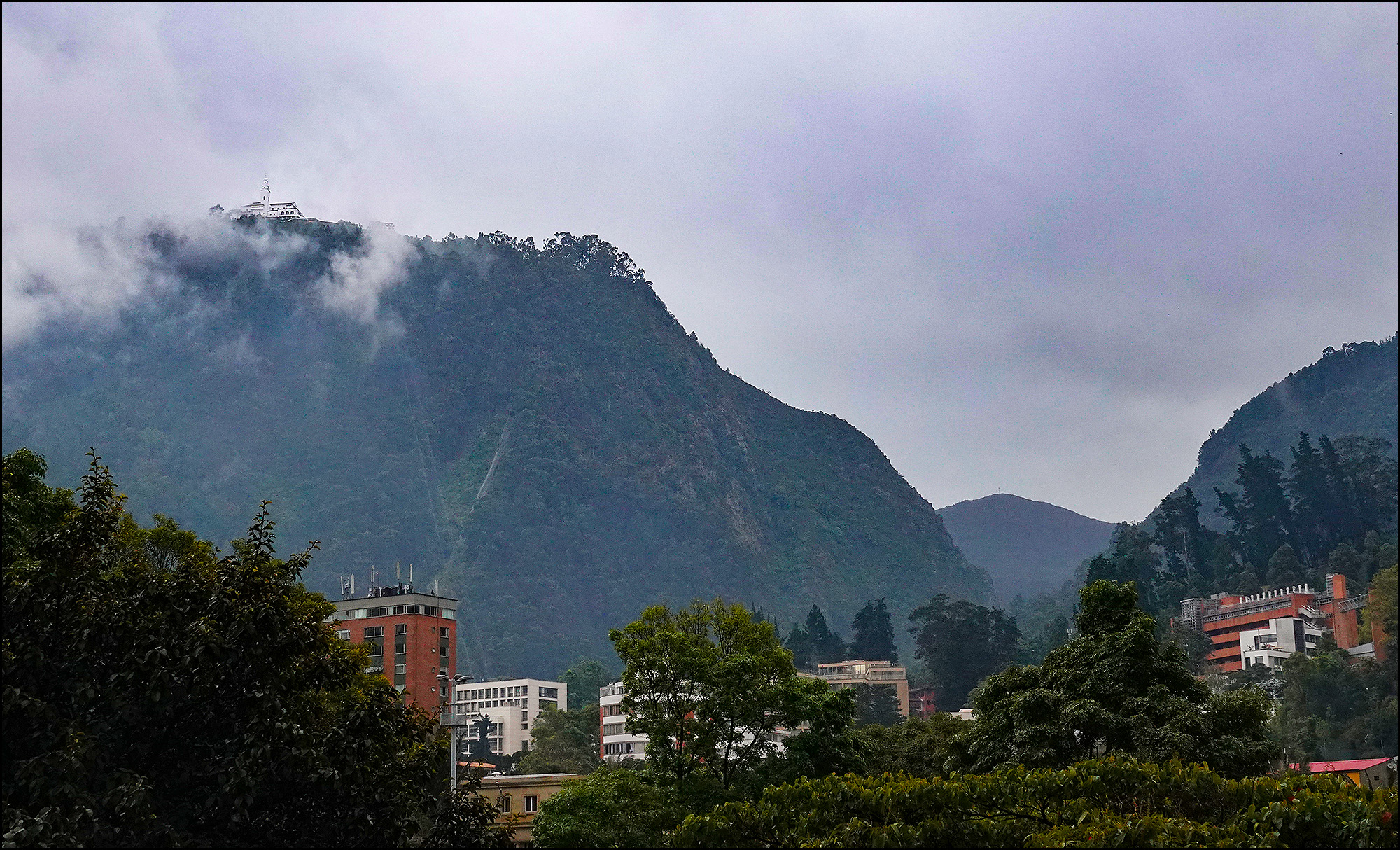
Before my trip to Colombia, when I was back home looking at a guidebook and pondering where to go, I hatched a partially formed plan to visit the Parque Nacional Natural El Cocuy. However, apparently you need to apply for permission; and it requires a bunch of hiking; and once I had spent a day driving around in Colombia it was clear that Cocuy would be a five or six hour drive. So I looked around for something closer and decided to visit the Parque Nacional Natural Sumapaz, which is about a two-hour drive south of Bogotá. The day started out overcast. Here’s the view of Monserrate from my hotel window:
My hotel window faced east toward Monserrate and the church at the top.
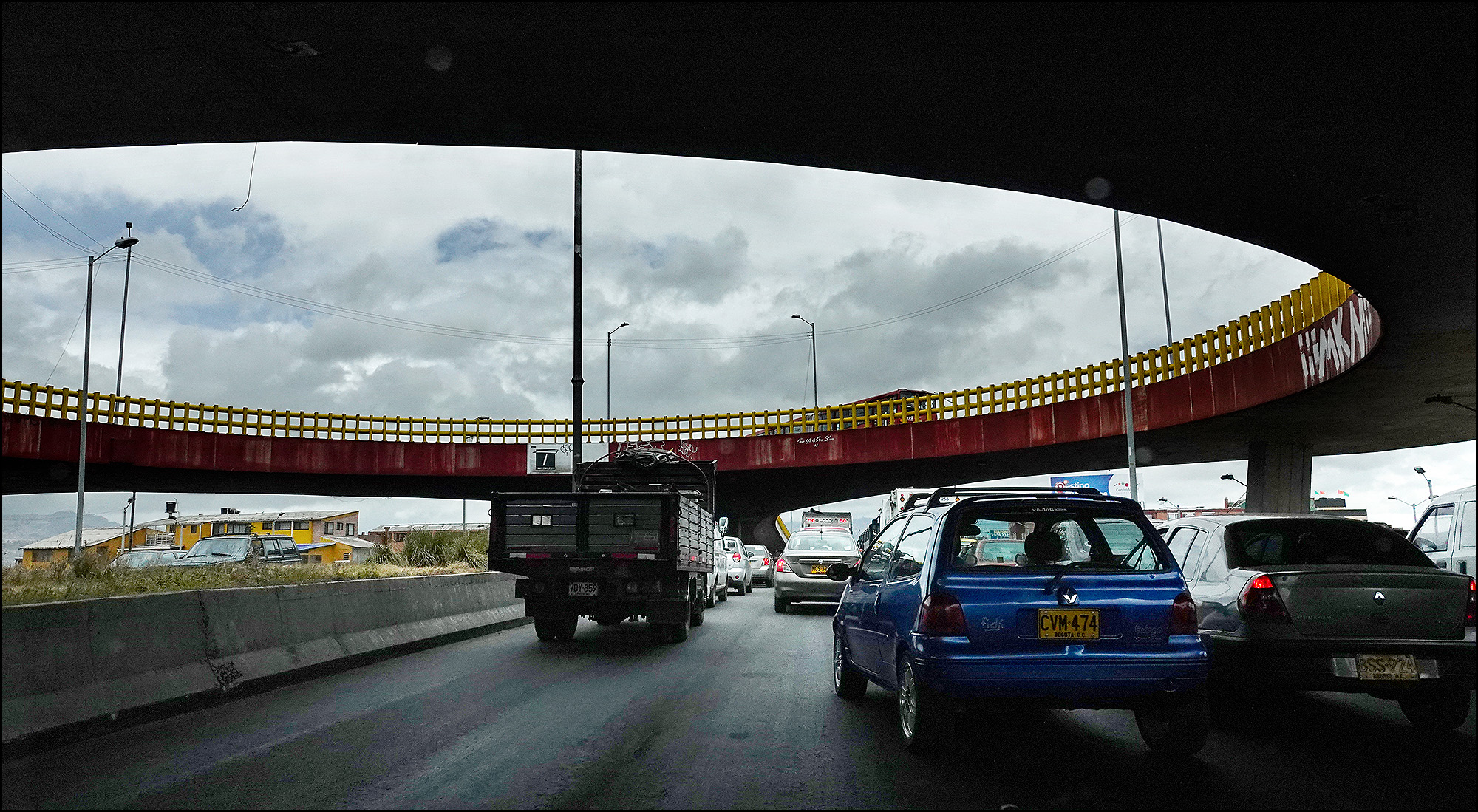
I drove through Bogotá on Avenue NQS, which I had finally googled the night before. It stands for Norte-Quito-Sur because “The avenue is formed from the union of three old avenues, Avenida Ciudad de Quito, Avenida Novena, and Autopista Sur.” Here’s a gigantic flying roundabout for the TransMilenio where NQS crosses Calle 6.
An overhead roundabout reserved for TransMilenio buses.
A couple of decades ago Bogotá gave up on the idea of ever constructing a subway and instead ripped up the center lanes of several wide avenues to build the TransMilenio network, an extensive set of reserved bus lanes with subway-like stations. I never had a chance to ride it since I spent all my time outside the city, but apparently it’s been a huge success. It was a huge pain for me, for reasons I’ll elaborate on later, but if you know what you’re doing it probably doesn’t bother drivers too much—though it obviously wiped out quite a few lanes formerly dedicated to auto traffic. More on that later too.
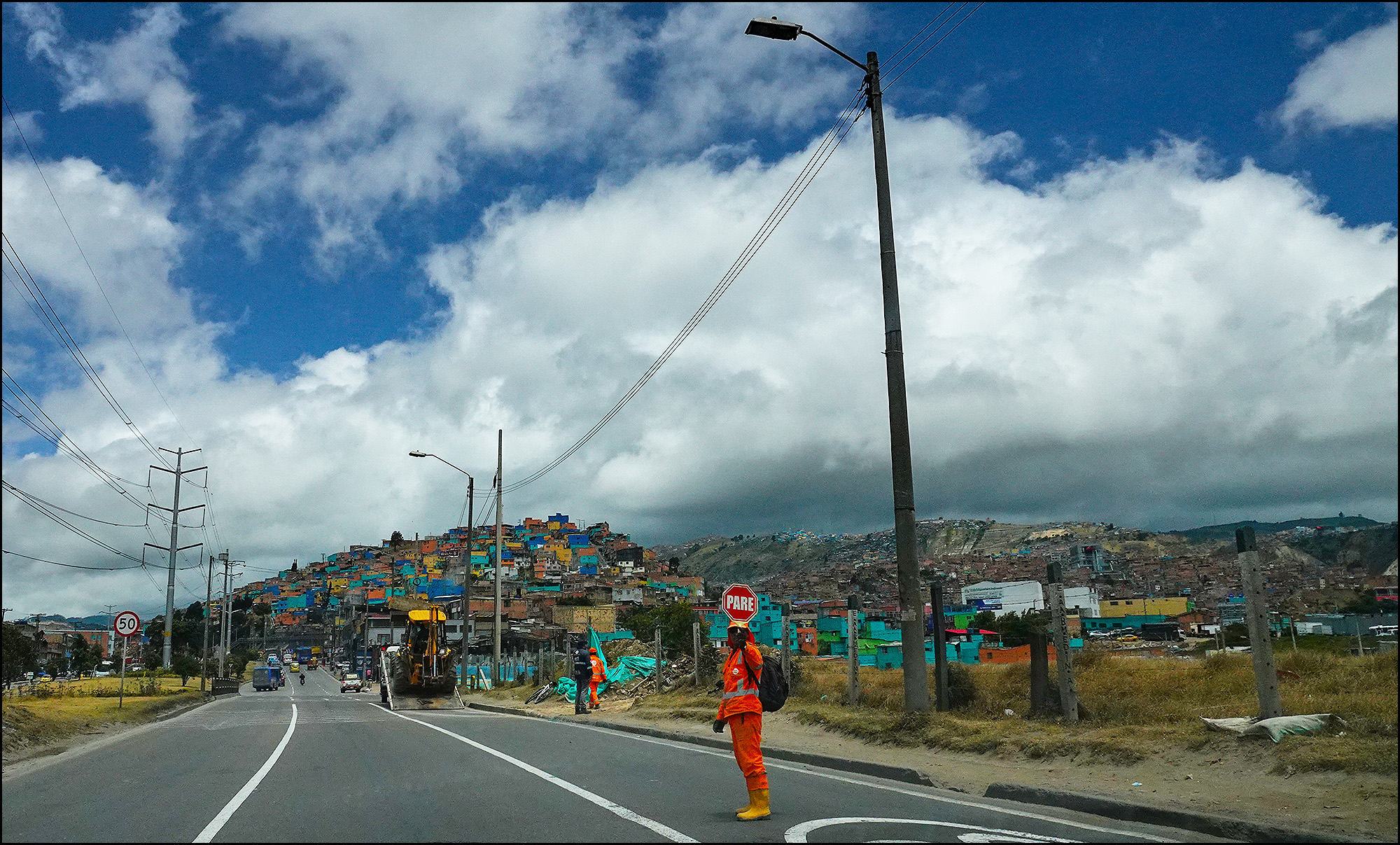
I turned south on Avenida Boyacá and passed through Ciudad Bolívar, one of Bogotá’s famous mega-slums.
Ciudad Bolívar, definitely not a place you want to wander around at night.
Apparently the city has taken to painting its slums. On Google Maps this apartment block is all just plain brick, but when I passed through the apartments were all painted in various bright colors. Does that help anything? I don’t know, but I suppose it doesn’t hurt.
I exited south at Usme, drove through Usme Centro—where I found a cat—and then continued toward Sumapaz, another 45 minutes away. The road is very nice and smooth until you hit the sign telling you that you are entering the park. At that point the pavement disappears and turns into a seriously potholed gravel road. You need to pay attention to your driving here, but it’s not something you need a four-while drive for. Just drive slowly and swerve around the potholes.
IMPORTANT NOTE: This was my experience on a day when there had been only a little bit of recent rain. If you visit during the wet season, you should probably be pretty careful about visiting Sumapaz in anything less than a big Jeep.
The upside of all this is that, at least when I was there, the place is completely empty and you just drive in. There’s no fee and no appointment needed or anything like that. You just drive along the road and pull over whenever you want to see something. Sumapaz is alleged to be (a) one of the largest moorlands in the world and also (b) within the moors, one of the largest system of paramos in the world. According to my dictionary, a paramo is a “high treeless plateau in tropical South America.” That doesn’t sound especially moorish to me, so maybe I’m a little confused about this.
Sumapaz is not a Yosemite kind of park with breathtaking vistas. Rather, it’s a park that rewards a slow look and careful study. It is grandeur on a micro scale. About a mile in, for example, small lagoons form alongside the road. These lagoons are about 10 feet by 30 feet and if you step out to look closely at them they will take your breath away. They look like a master Japanese gardener spent years crafting an exquisite tiny world.
I’m almost reluctant to post a picture because it simply doesn’t do justice to these natural wonders. And I’m saving the best one for later. However, this should give you at least a sense of what I’m talking about.
A tiny lagoon fed by a tiny waterfall in Sumapaz Natural Park. This entire thing is about 20 feet on a side.
So if you go to Sumapaz will you be able to see this? Probably not. It was a product of the day and the recent weather—a bit of rain but no deluges—and a month from now it will look completely different. I found some of these locations on Google maps, for example, and the lagoons weren’t there. They were just dry patches of moss and cactus. If you go, you’ll most likely miss some of the beautiful things I saw, but you’ll make up for it by seeing beautiful things that I missed.
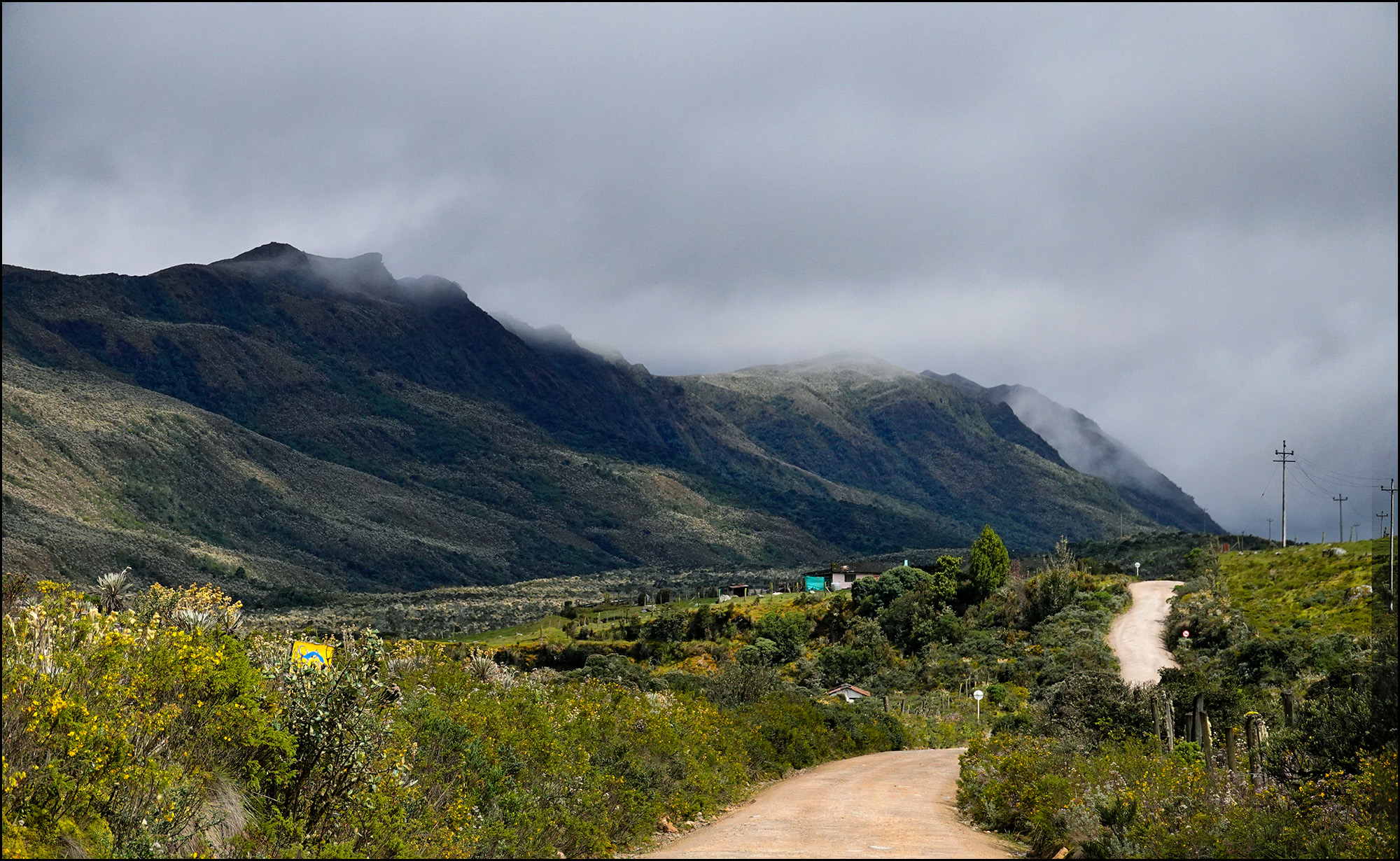
Earlier in the day the sun had come out, but by the time I got to Sumapaz the weather had turned overcast. It looked like this the entire time I was there:
A typical view of Sumapaz on an overcast day.
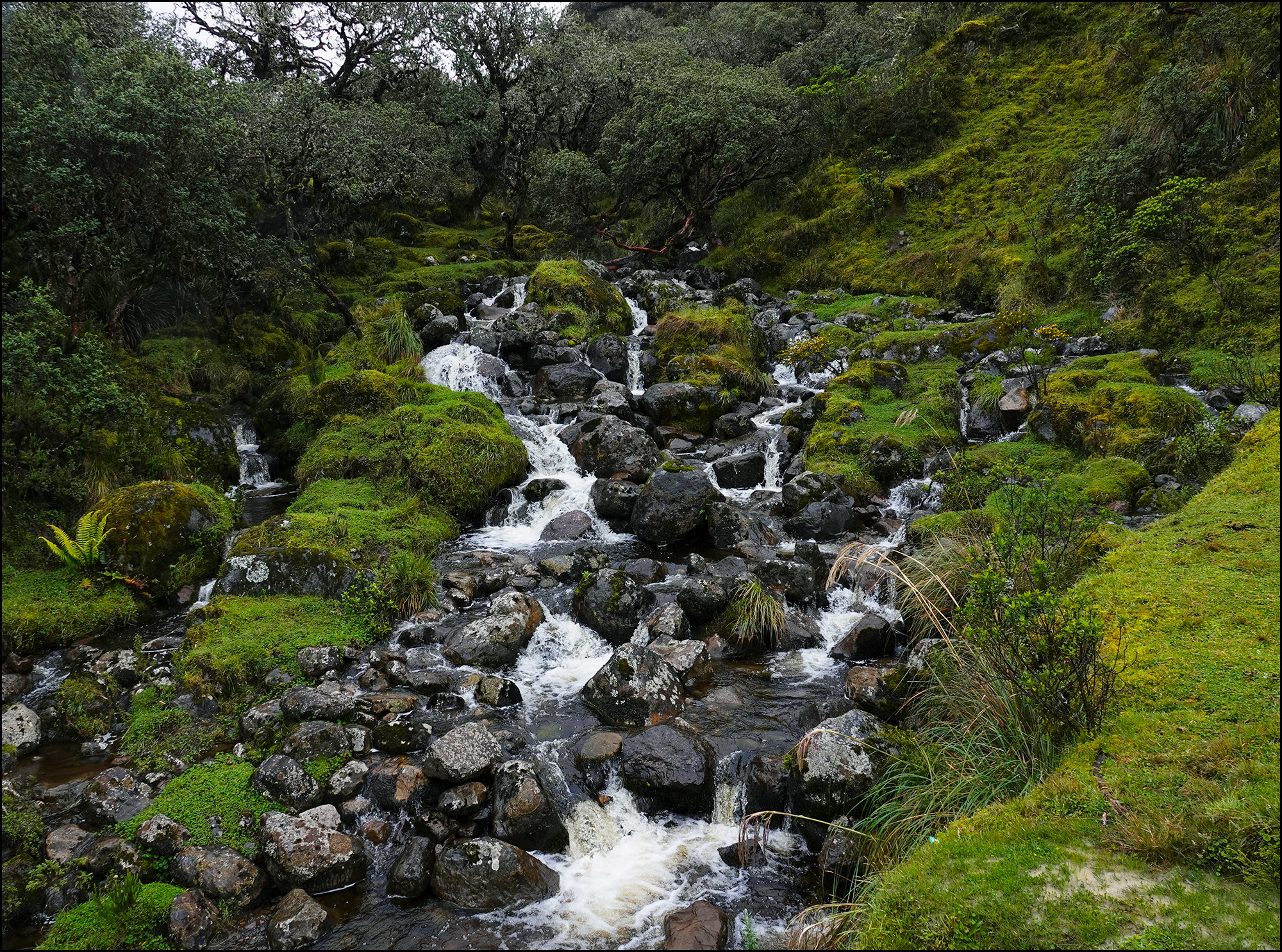
At this point I assume I’ve passed from the moors to the paramos. About half an hour into the park there’s a little store, and the road is dotted by houses and small farms. I continued for about an hour, but when it started to rain I took that as a sign to turn back. It’s just too hard to keep the camera lens dry when the rain is sheeting down at an angle blown by the wind. On the way back the rain eventually subsided and I saw this:
A small watercourse off the side of the road in Sumapaz.
On the way out I saw lots of cows, dogs, and one cat. I got back to Usme Centro around 5 pm and decided to stop since it was early and I had plenty of time. Usme Centro is a small, dusty little town, full of donkeys and small shops. It has half a dozen butcher shops, all of which sell roasts that are spectacularly large and delicious looking.
A couple of butcher shops in Usme Centro. Check out the size of those roasts.
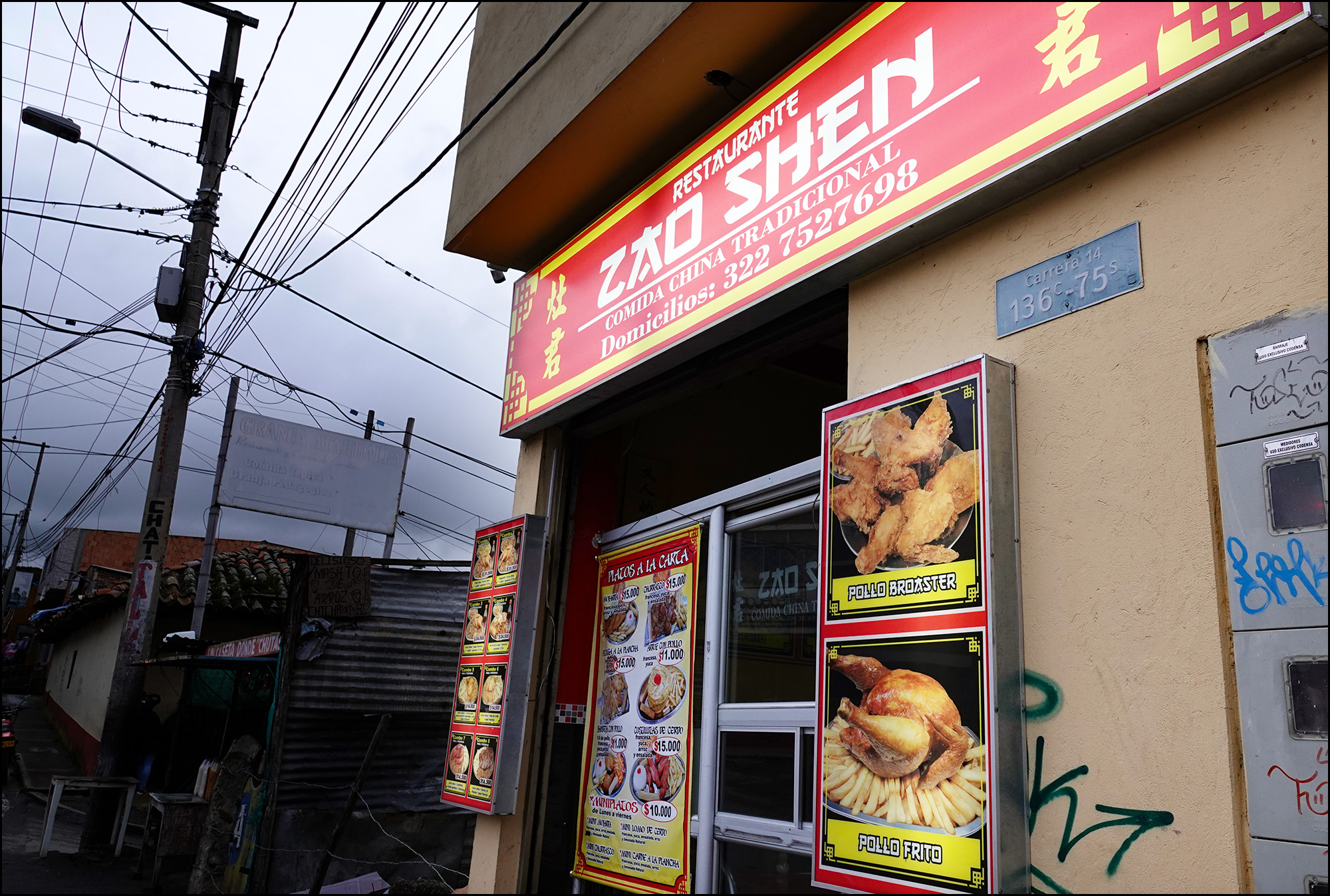
There was also this at the south end of town just before I got back to my car:
A “traditional” Chinese restaurant in Esme Centro.
Now, I admit I’ve never been to China, but this sure doesn’t seem very authentically Chinese to me. I guess it’s one of those fusion dishes I hear so much about.
I left Usme Centro around 6 and thought I was in great shape timewise, but the gods always punish hubris and I was soon to suffer for my arrogance in thinking it was early and I had “plenty of time” to get back to my hotel. You see, it turns out that when you’re going northbound on Avenida Boyacá there’s no exit ramp to NQS. After a good 20 minutes of wandering around with the help of Google Maps I found the right set of surface streets to get back on track. Unfortunately, I was not paying enough attention to the road and overshot my offramp by about 80 calles. Once you’ve done this it’s not easy to turn around, but eventually I did and made my way back to Calle 19. Smooth sailing now, since I had driven this exact route the day before and knew precisely what to do.
Hah! What I needed to do was turn right on Carrera 5, but Thursday is apparently shopping night or something, and Septima Carrera is closed to auto traffic. There’s nothing special on Carrera 5, but it does connect eventually to a street that connects to Septima Carrera, so it was closed off too. My reaction is not suitable for a family blog, but I had no choice except to inch my way through the traffic to Carrera 4 and turn there instead—even though I knew I couldn’t get to my hotel parking structure from Carrera 4.
But I did anyway. The parking structure is a right turn off Carrera 4, but you have to go the wrong way on a one-way street to get there. So I did. It was only a hundred feet or so, so I checked for traffic and gunned my way to the driveway. All told, I had wasted a good two hours with this stuff, which is why I ended the night by getting takeout from McDonald’s—a double cuatro con queso but sin queso for me. Go ahead and mock me. But I just wanted something quick to eat back in my hotel room while I started packing for the flight home on Friday.
NEXT: Should you even bother trying to drive a car in Colombia? It depends. Then the trip home.
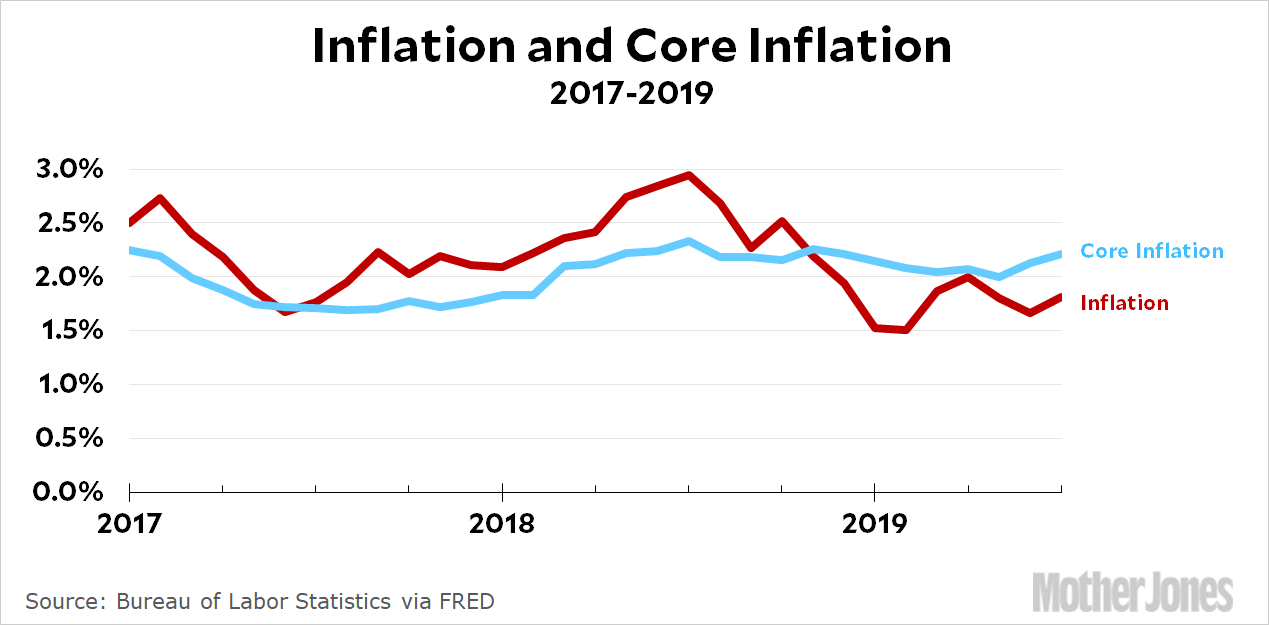
The inflation rate ticked up slightly in July, but it’s basically been flat since the end of last year and is considerably under the peaks of 2018. However, the core inflation rate, which excludes erratic food and energy prices, continued its yearlong level above the headline rate as well as its two-year resistance to falling below 2 percent:
The Fed pays primary attention to the core inflation rate under the theory that the headline rate will eventually move toward it. It’s a pretty good theory, but at the same time, a two year-average just a hair above 2 percent is still not something to worry too much about. And more to the point, even though core inflation has increased for the past two months in a row, it shows no real sign of acceleration.
A core inflation rate above 2 percent is one reason the Fed is being cautious about stimulating the economy. If I were king of the world I’d suggest the Fed get cautious only when the core rate rises above 3 percent for a while or shows signs of significant acceleration. But I am not king of the world.
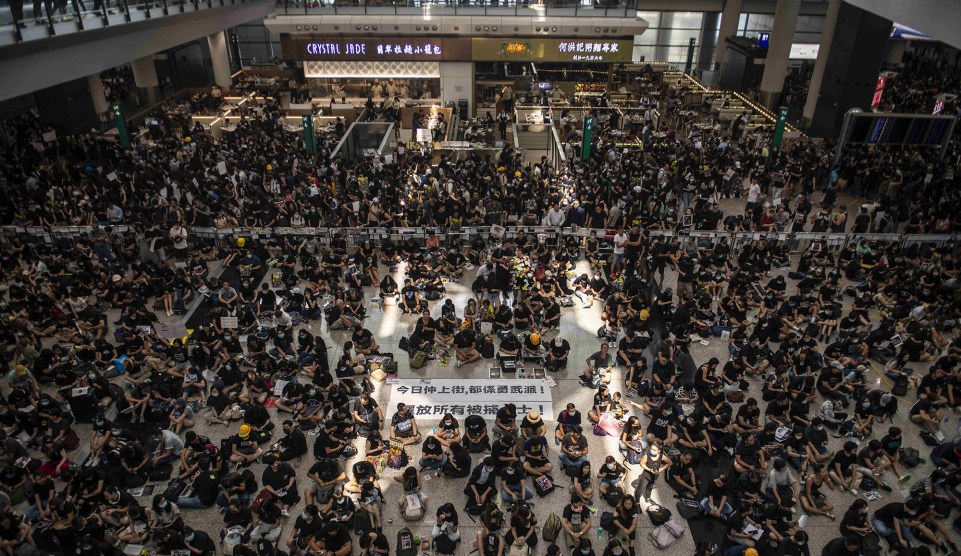
The protests in Hong Kong started in June over opposition to an extradition bill that would allow Hong Kong residents to be tried in China. If, like me, you haven’t followed events closely since then, you might wonder what the protest has morphed into now that the extradition bill is effectively dead. The Washington Postprovides a brief list:
The movement now has five key demands for Hong Kong’s government:
to withdraw the extradition bill
to officially retract descriptions of the protests as a “riot”
to drop charges against protesters
to launch an investigation into police force during the protests
“universal suffrage,” which would allow Hong Kong voters to directly pick their leaders rather than the current process that includes Beijing’s involvement.
The last two are the key ones. The protests are now focused primarily on police reform and on the steadily increasing influence of Beijing on Hong Kong policies and politics.
In recent days, China has more aggressively stirred up nationalist and anti-Western sentiment using state and social media, and it has manipulated the context of images and videos to undermine the protesters. Chinese officials have begun branding the demonstrations as a prelude to terrorism.
The result, both in mainland China and abroad, has been to create an alternate version of what, seen from Hong Kong, is clearly a popular demonstration movement. In China’s version, a small, violent gang of protesters, unsupported by residents and provoked by foreign agents, is running rampant, calling for Hong Kong’s independence and tearing China apart.
In fact, the protests have been mostly peaceful—there have been exceptions—and the protesters are not calling for Hong Kong’s independence. Just for starters, they know this would be a true red line for Beijing that would produce a no-holds-barred response. But it’s what the Chinese authorities would like the population of China to think so that they continue to approve of whatever China does end up doing.
And what about the United States and the West? It’s an “internal” issue and everyone is staying pretty quiet about it. Partly this is legit: the last thing the Hong Kong protesters need is any excuse, no matter how thin, for China to be able to claim that their protests are driven by “foreign elements.” But partly it’s also about not drawing China’s wrath. There have been scattered demands that China “respect” the right of peaceful protest, but not a whole lot else. Trade deals, Brexit, and North Korean missiles are using up everyone’s allotment of concern for East Asia, and there’s just little appetite left over for yet another confrontation.
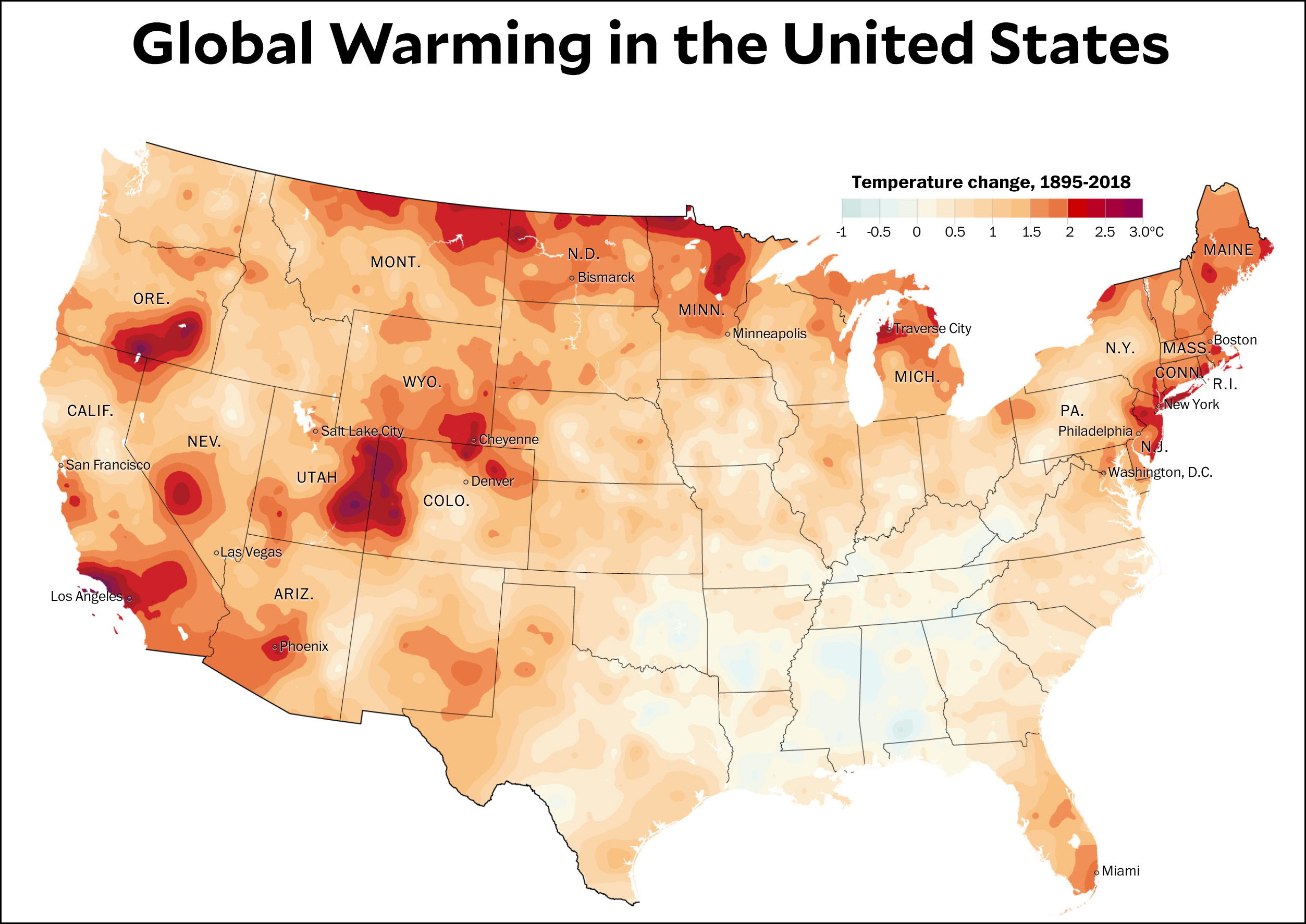
Very roughly speaking, global warming is worse as you go toward the poles: The arctic and antarctic are warming faster than the equator. But there are plenty of local exceptions and the Washington Post has created a map showing them for the continental United States:
Right now, scientists would like us to hold warming to 2ºC, but as you can see there are quite a few areas that are already well above that. Orange County, where I live, is at about 2.3ºC. Central Los Angeles is at 3ºC. Northern New Jersey and New York are both above 2ºC.
Conversely, the deep south, where climate denialism is strong, has barely warmed at all. Alabama and Louisiana, along with parts of Oklahoma, Arkansas, Georgia, Tennessee, and Kentucky have actually seen their temps decline by as much as 1ºC.
I will leave as an exercise for the reader what the political implications of these geographical differences are.
As many of you already know, we have been testing a new commenting system called Coral over the past couple of months, and on Tuesday morning it goes live. To be specific, it goes live at 6 am Eastern time.
If you want to know more about Coral and our plans for it, there’s a short writeup here. There’s even a test site if you want to play with it a little bit before it goes live. Once you’ve used it for a bit, feel free to email comments to comments@motherjones.com. I hope you like it!
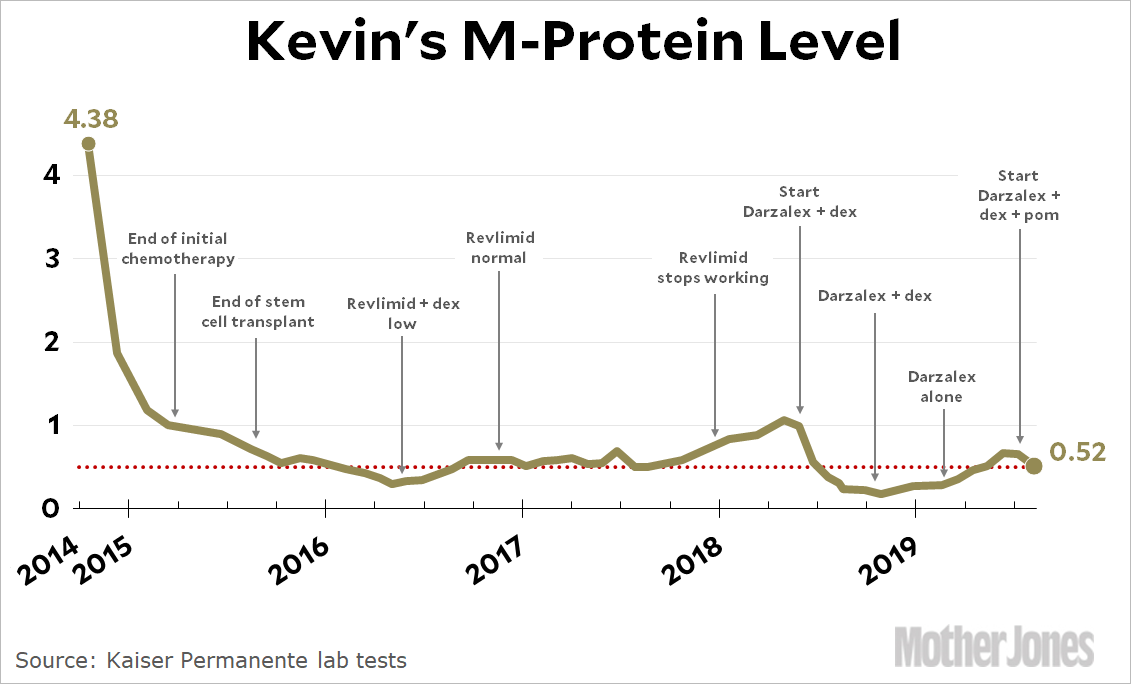
I’ve been back on the Evil Dex for a few weeks now, and the results are in:
Hooray! I may not like the dex, but in a short time it’s turned around my rising M-protein numbers. This means the cancer load in my blood marrow is declining and will likely continue to decline before it flattens out in a few months. And that, in turn, means the new treatment cocktail is likely to last another year or two before it starts to lose effectiveness.
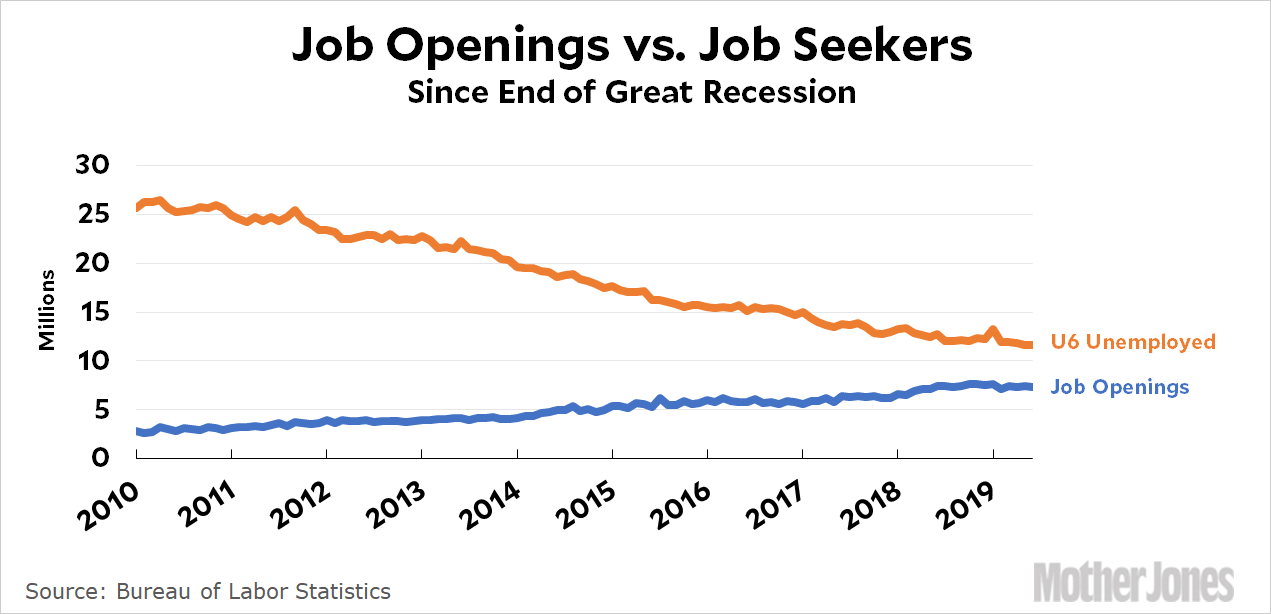
Alexia Fernández Campbell points out today that there are more job openings than there are unemployed to take them, something that’s been true for the past year and a half. Just to provide a slightly different perspective, however, here’s a chart that shows job openings vs. a broader measure of unemployment:
The orange line is the U6 unemployment level, which includes those who are “marginally attached” to the labor force as well as those who are working part-time for economic reasons. There are still more of these folks out there than there are job openings for them.
Part of the U6 pool encompasses the least skilled workers, who employers will be loath to hire even if they’re desperate. Another part of the pool, however, are people who are on the fence about wanting a job and who can be lured into the labor force with higher pay. In other words, if employers are willing to pay more there’s still some headroom for the economy to grow.
That said, there’s no question that both trendlines started to flatten out a couple of years ago. Employers aren’t generating new job openings and the U6 crowd is no longer being drawn back into the labor force in large numbers. This suggests that employers aren’t especially bullish about future demand for their products continuing to increase.
And we respect that! But maybe you’re of a mind to support our work directly instead? We have until December 31 to raise the last $400,000 we need to keep our nonprofit newsroom running at full strength into 2026. Will you make a gift today?
We noticed you have an ad blocker on. Can you pitch in a few bucks to help fund Mother Jones' investigative journalism?
Billionaires own the media,
but they don’t own us.
At Mother Jones we know these aren’t conventional times, and they require unconventional coverage. That’s what deliver every day: fierce, independent journalism you can’t find elsewhere. Perhaps never in the history of our country has that been more necessary than now. But we can’t do it without reader support—your support. Please chip in today.
Billionaires own the media,
but they don’t own us.
At Mother Jones we know these aren’t conventional times, and they require unconventional coverage. That’s what deliver every day: fierce, independent journalism you can’t find elsewhere. Perhaps never in the history of our country has that been more necessary than now. But we can’t do it without reader support—your support. Please chip in today.