I’m sitting in the Bogotá airport about an hour away from returning home. I haven’t written much about my visit to Colombia, mostly for reasons outside my control, but I will!
For now, I’d just like to say that the first thing everyone said to me when I told them where I was going was some version of But is it safe? I assured them it was, but that was based only on what I’d read about Bogotá. I admit I had a few bouts of nervousness myself.
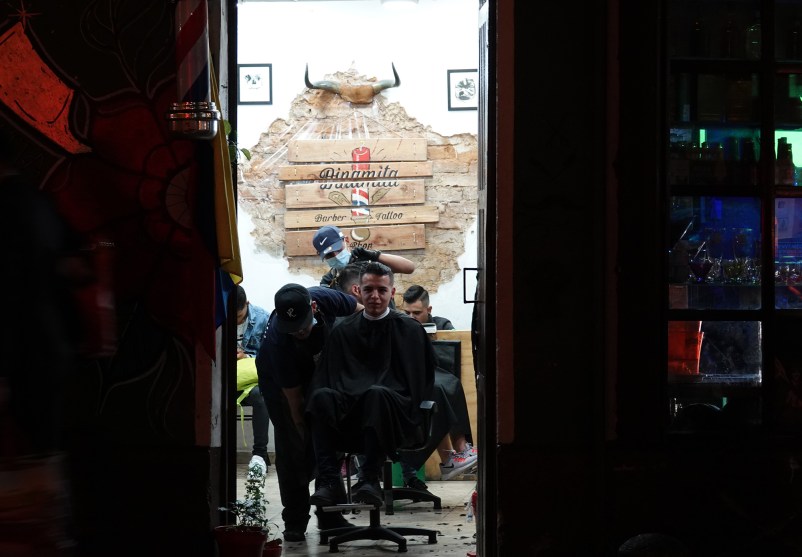
Having been here for a week, though, I can say that everything I read was right. I simply never sensed a moment of danger during the entire visit. The adults were all just going about their business, the teenagers were all having a good time, and there wasn’t the slightest sense of threat anywhere or anytime. I felt safer than I do in Rome.
On the other hand, the Bogotá airport is the only one I’ve been to that has no signage telling you where to return a rental car. Weird.
The Wall Street Journal, in its everpresent quest to show that millennials are screwed in every possible way, says this today:
Investing in a college degree still pays off for most students with higher salaries and greater wealth, but in recent years it has become riskier, splitting graduates more widely into haves and have-nots.
….There are three related shifts causing economists to re-examine the returns of college. First, the wages of college graduates have remained mostly flat this century, after inflation. Second, the cost of attending college has soared. Third, even with higher salaries, significant numbers of college graduates in recent years are failing to build the kind of wealth that previous generations did.
….The question of higher education’s value has gained urgency because so many more Americans are going to college than before, and because they are paying far more to do so. The share of Americans between ages 25 and 29 with a bachelor’s degree rose to 37% last year from 29% in 2000, Education Department data show.
This is basic math, guys. If you expand the college pool, you’re drawing almost exclusively from people who wouldn’t have gone to college before and are only barely qualified. These people are likely to do worse even if they graduate, and will naturally add to the low end of the bell curve. There’s nothing surprising about this.
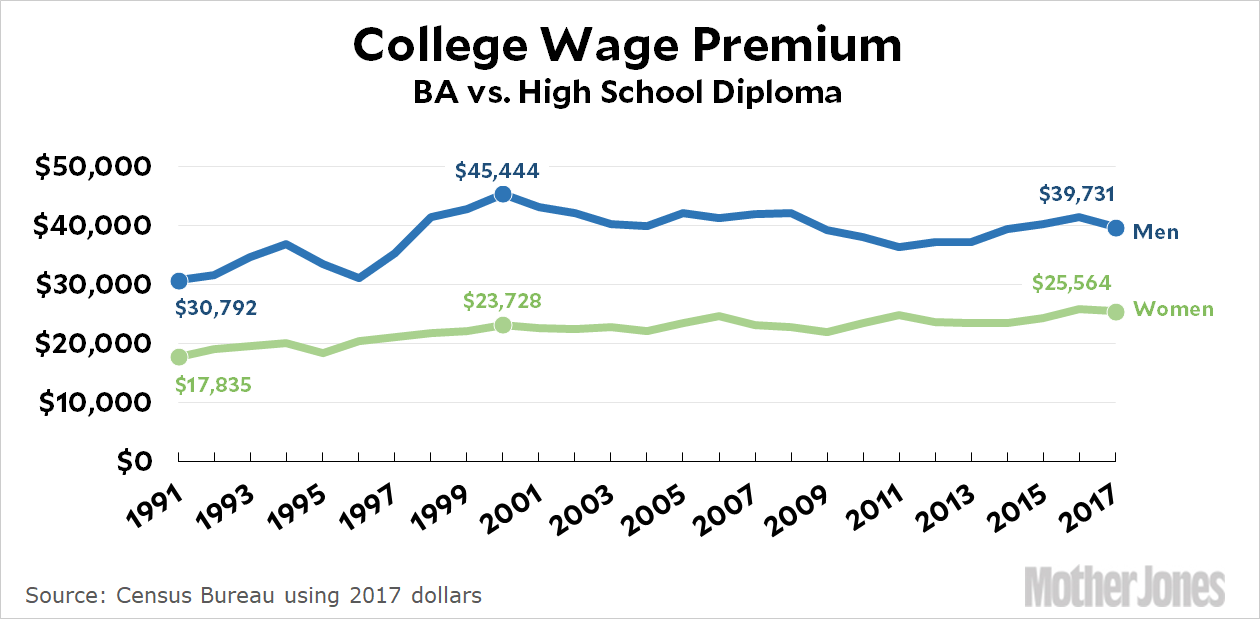
But if this is true, it should pull down the average wage premium too. It hasn’t:
If you cherry pick the peak of the dotcom boom, then sure, it looks like men have indeed gotten less out of a college education lately. But that was a four-year bubble. If you look at a longer timeline and discount the dotcom years, the wage premium for men grew steadily through the start of the Great Recession, took a hit, and then recovered. That’s the story for almost everyone.
College-educated women, by contrast, were apparently left out of the dotcom bubble but also didn’t suffer much from the Great Recession. Their wage premium has grown steadily for the past quarter century.
Getting more kids into college is generally a worthy goal, even if it artificially pulls down the average. That’s not something to worry about. Likewise, the wealth of college grads is still about double that of nongrads. However, it has declined substantially among millennials. This is likely due at least in part to skyrocketing student debt, which is currently a topic of considerable conversation. For my money, I’d wait a while to see how much is due to student debt and how much is due to other factors related to the Great Recession, but your mileage may vary.
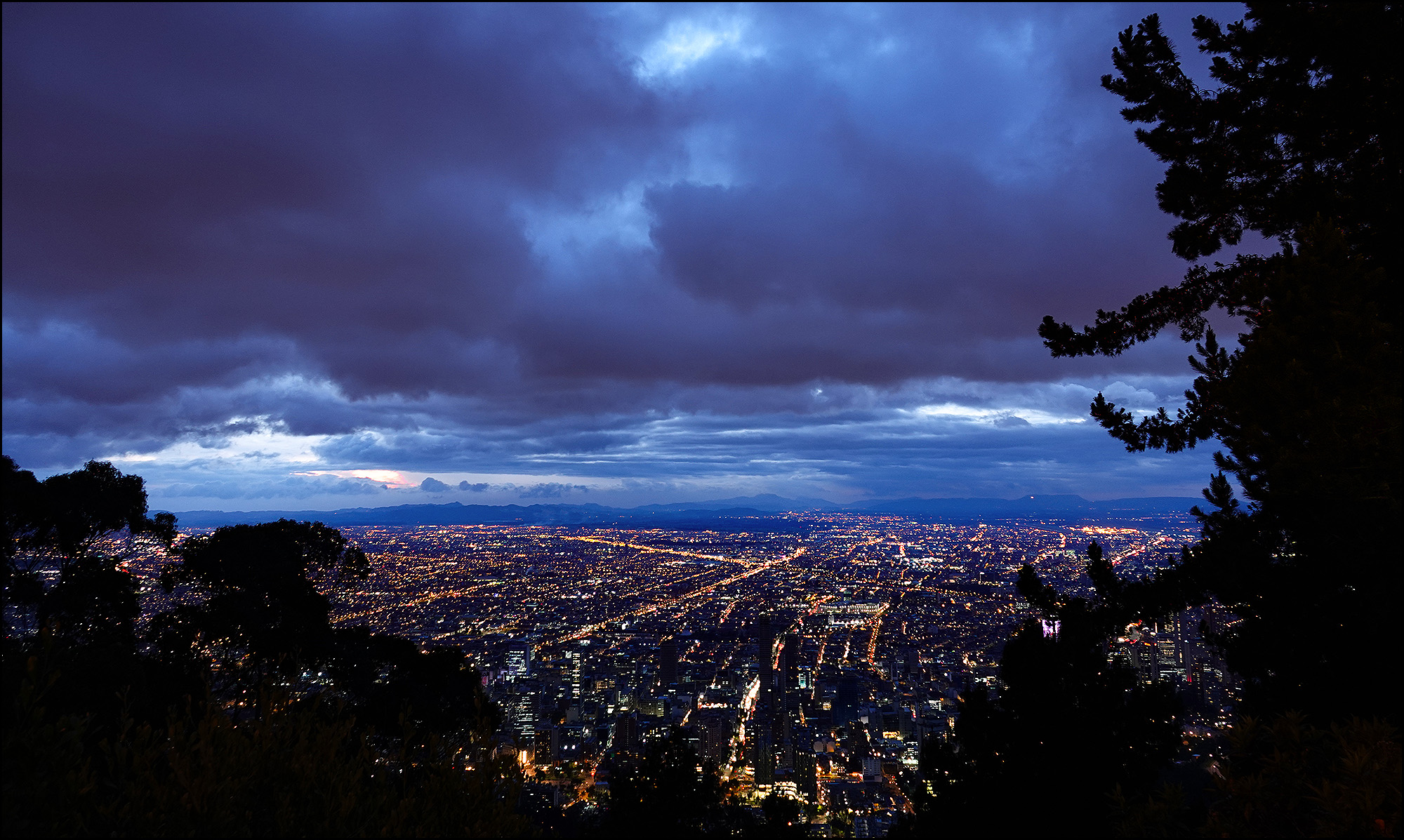
Today is my last day in Colombia, so here’s a nighttime version of Bogotá from above. This was not shot from the top of Monserrate. On Tuesday I drove out Calle 10, which turns into an eastbound road over the mountains and out to Choachí and points beyond. I returned around sunset and got this stunning view as my reward.
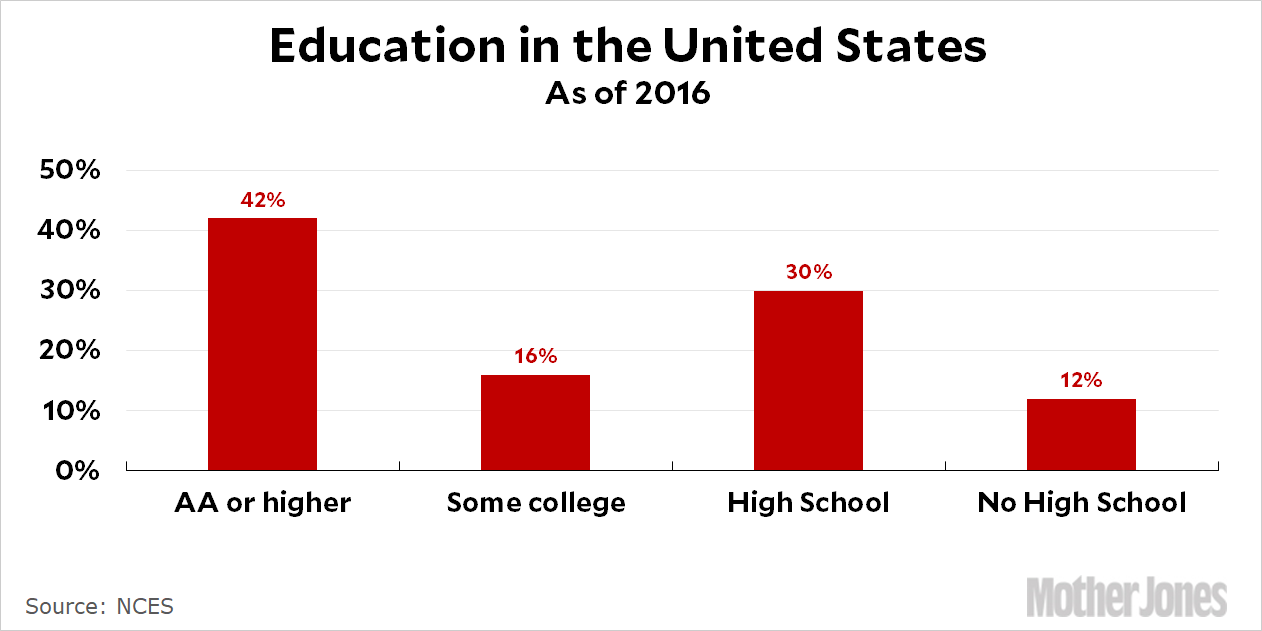
I don’t have any special reason for posting this. But during this season of political campaigns and the white working class and beer track vs. wine track and all that, I sometimes wonder if everybody truly knows who the “real Americans” are these days.
The answer is that we are all real Americans, but those with a postsecondary degree considerably outnumber those with only a high school diploma. That doesn’t make them any more real than anyone else, but it sure doesn’t make them any less real either.
My hotel room looks out on the Parque de Los Periodistas Gabriel Garcia Márquez. On Tuesday morning, when I looked out, there was a huge marching band massing for some event or another, so I went down and took pictures. Half an hour later I went back down and they were gone. I have no idea what they were up to or where they went.
The U.S. is now on a pace to generate $72 billion in tariffs annually, and could well hit the $100 billion mark Mr. Trump has touted if new 10% tariffs on $300 billion in untaxed imports take effect on Sept. 1, as threatened….Although the U.S. had relatively low tariffs before the Trump administration’s latest actions, it still collected about $30 billion annually in pre-existing tariffs assessed against imports from China, Europe, Japan and other countries.
That’s $70 billion in new tariffs. The US has about 130 million households. So this comes to about $500 for every household in America.
Normally Republicans would be up in arms about higher taxes, but tariffs are a regressive tax so it’s OK. Anything that hits the rich more lightly than the poor is always worth a sympathetic look. And if it’s an invisible tax that screws the poor without them even knowing it? Now that’s a tax a Republican can love.
The LA Times reports today that local governments typically charge developers high fees if they want to build new housing and that these fees may slow the growth of new housing stock. This will come as a surprise to exactly no one in the state. But you have to read down to literally the last paragraph to find out why California’s fees are so high:
While the study recommends that lawmakers examine ways to reduce fees, it warns that cities and counties often need the revenue to pay for services because of property tax restrictions put in place by Proposition 13 in 1978. The initiative limits taxes for homes and businesses to 1% of a property’s taxable value.
….“If the state wishes to lower impact fees but also ensure sufficient infrastructure funding, it should consider pathways to adjust Proposition 13 in order to expand the capacity of localities to generate their own revenue,” the report says.
Ha ha ha. The state should “consider pathways” to “adjust” Prop 13. Good luck with that. In the past 40 years, Californians haven’t even been willing to adjust the ridiculous way that Prop 13 allows businesses to keep their assessed property values at 1978 levels forever. There’s no way they’ll be willing to adjust it for their own precious houses.
In the end, Prop 13 accomplished little except to prompt an explosion of fees; move budgeting power almost entirely to Sacramento; and allow businesses to pay lower property taxes.¹ One way or another, though, everything has to be paid for. Taxes, fees, or fines, take your pick. Would reducing one and increasing another really do much to spur housing development in California?
¹The alleged justification behind Prop 13 was that skyrocketing property values were forcing seniors on fixed incomes to sell their lifelong homes because they could no longer afford to pay the taxes on them. I don’t know how widespread this problem really was, but I hardly need to point out that if this was the real issue, there were lots of easy ways to deal with it that didn’t destroy local budgets.
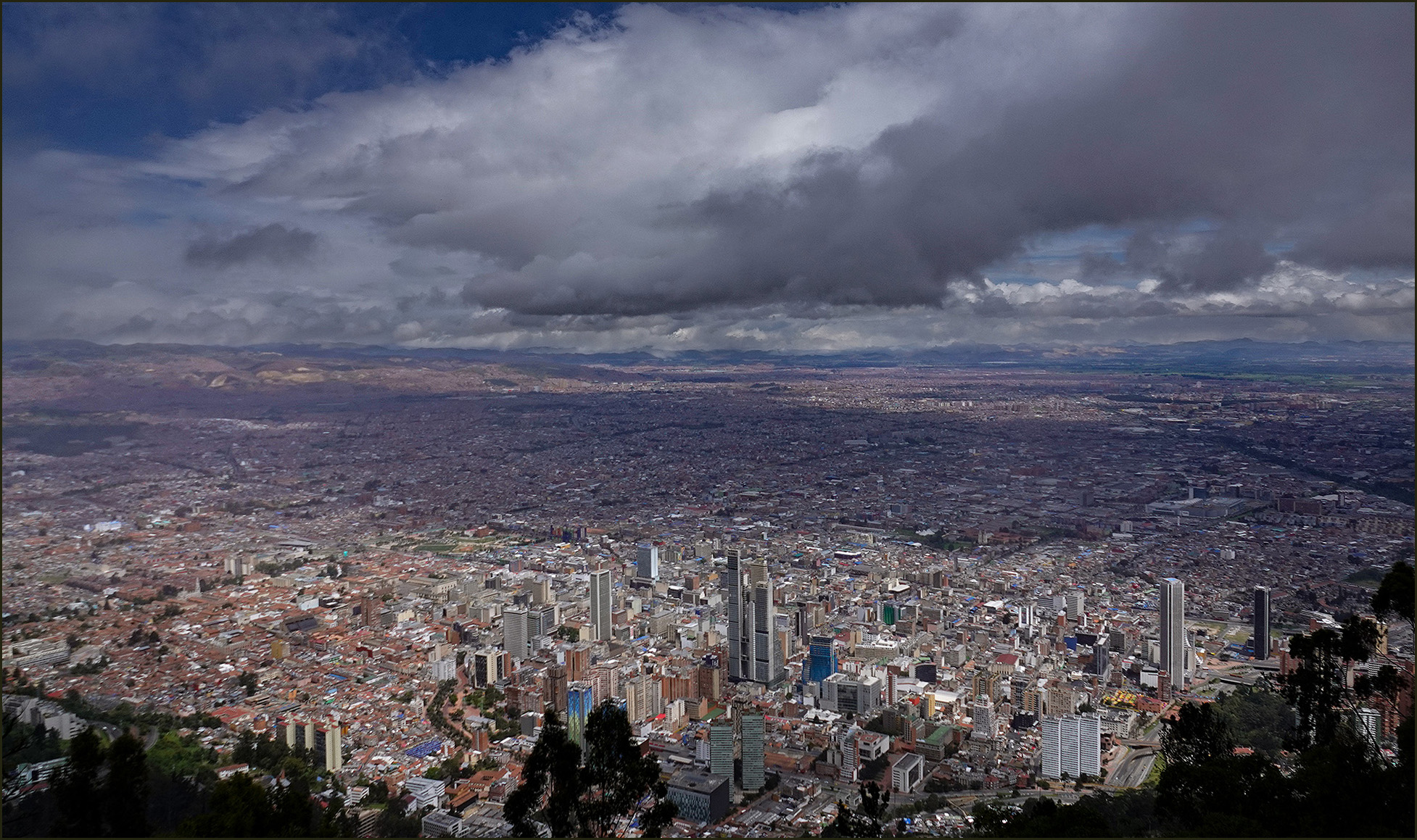
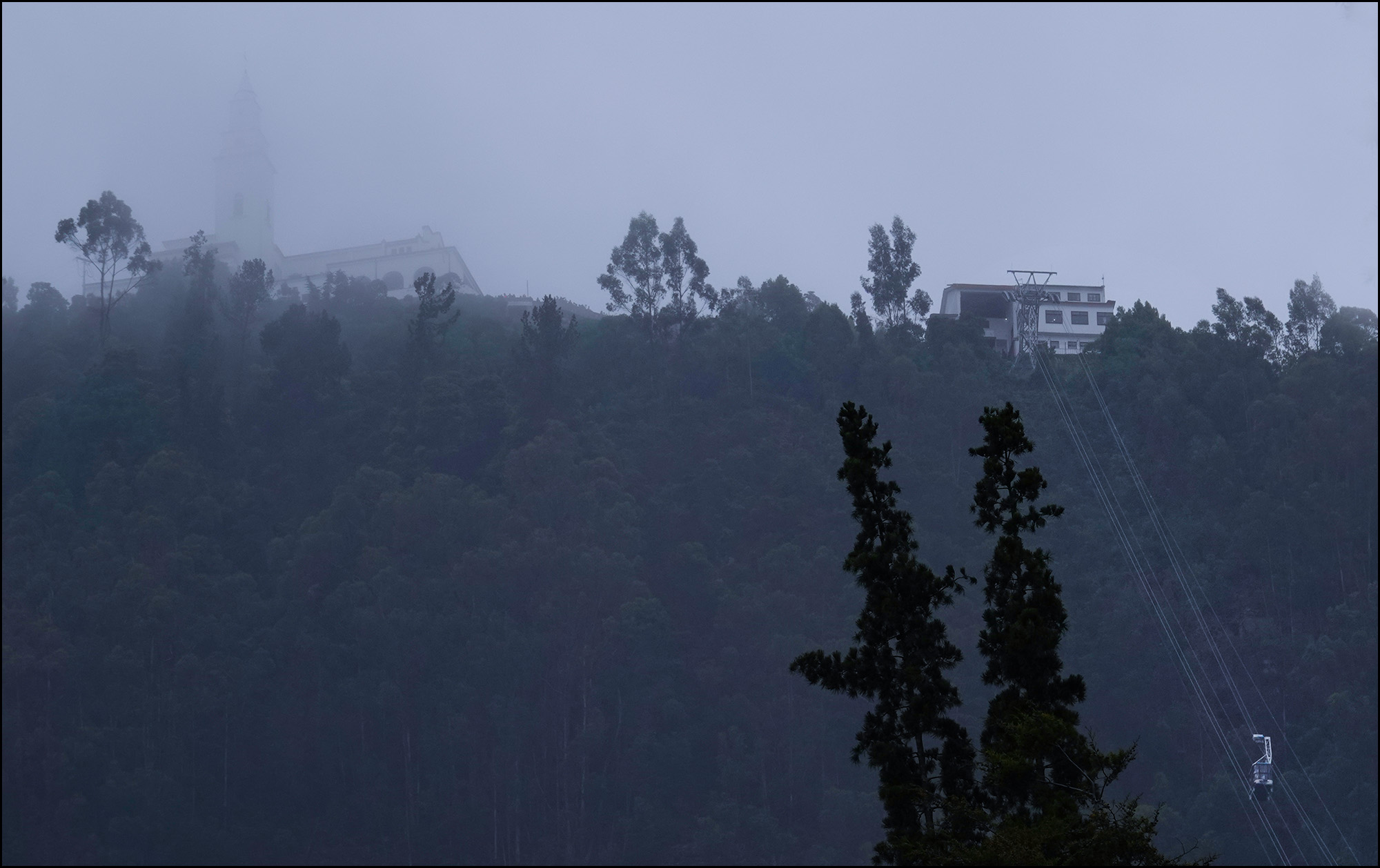
I thought my “central time zone” misdirection would fool you all, and my plan would have worked if not for that meddling Ray Herrick, who correctly figured out that I’m in Bogotá. Yesterday’s photo was a picture of the cable car that ascends Monserrate. Here is Bogotá from the top:
August 4, 2019 — Bogotá, Colombia
Why Bogotá? It’s probably Joan Didion’s revenge. After mocking her description of Bogotáa couple of weeks ago, I guess it was stuck in my mind when I was pondering where to go. I drew a circle around Los Angeles looking for places not too far off, and as I looked South there it was. Nice, cool weather, an easy nonstop flight, and fairly cheap. So here I am.
I will resume normal lunchtime photoblogging tomorrow, but today, to make up for the lack of normal blogging I’ll regale you all with a long photo essay about how I spent Sunday. I got in at 5:30 in the morning, so I had the entire day to wander around.
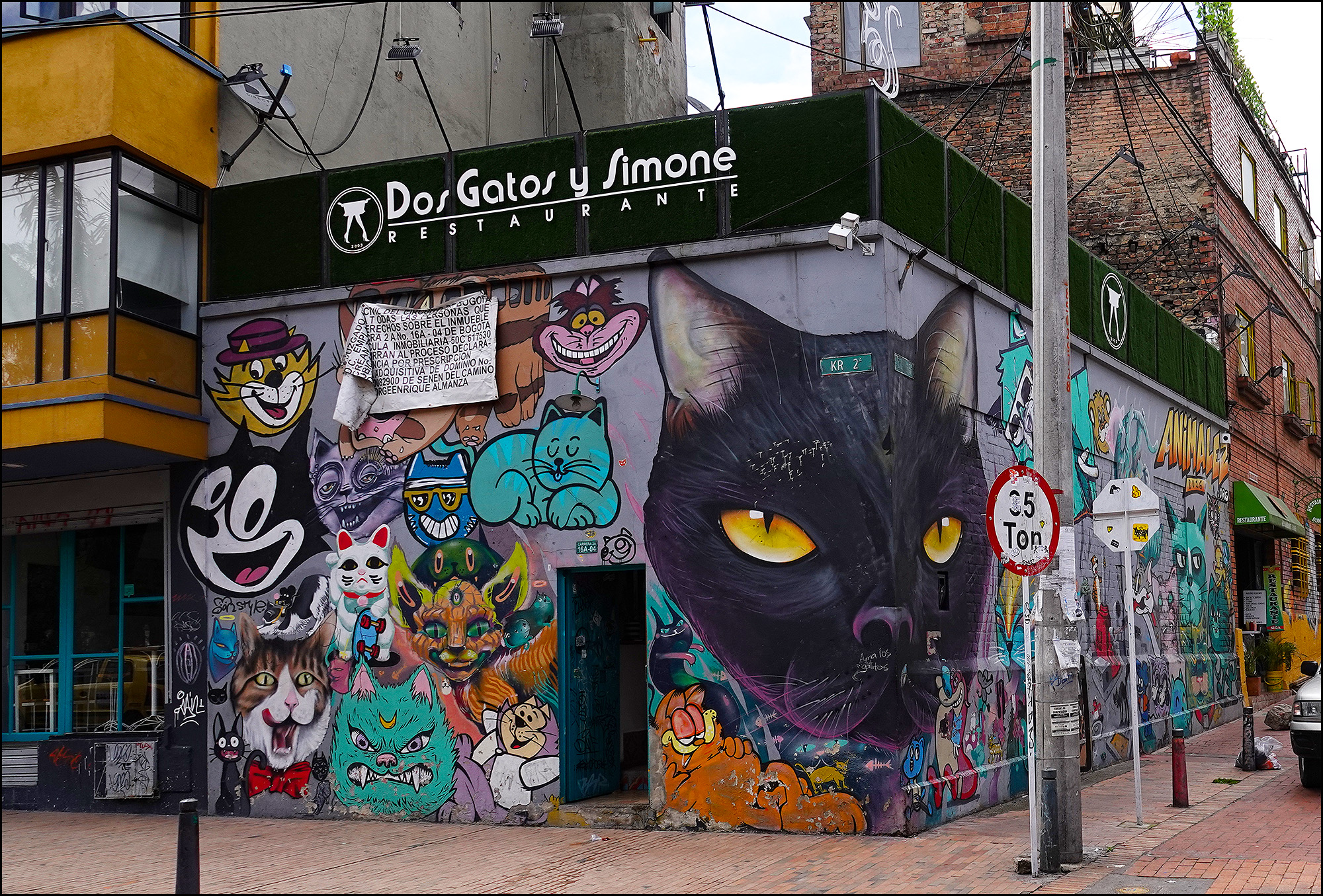
My hotel is right across the street from Dos Gatos y Simone. Naturally I approve.
I haven’t eaten there yet, but I probably will. I want to check their truth-in-advertising status. After visiting Monserrate I ate lunch at Toro Burger, which is also right around the corner from my hotel—as are a couple of dozen other burger joints. I thought Americans were crazy about burgers and fries, but we are nothing compared to Colombians. I swear there’s a hamburguesa place every hundred feet or so.
Travel tip: french fries are papa francesca.
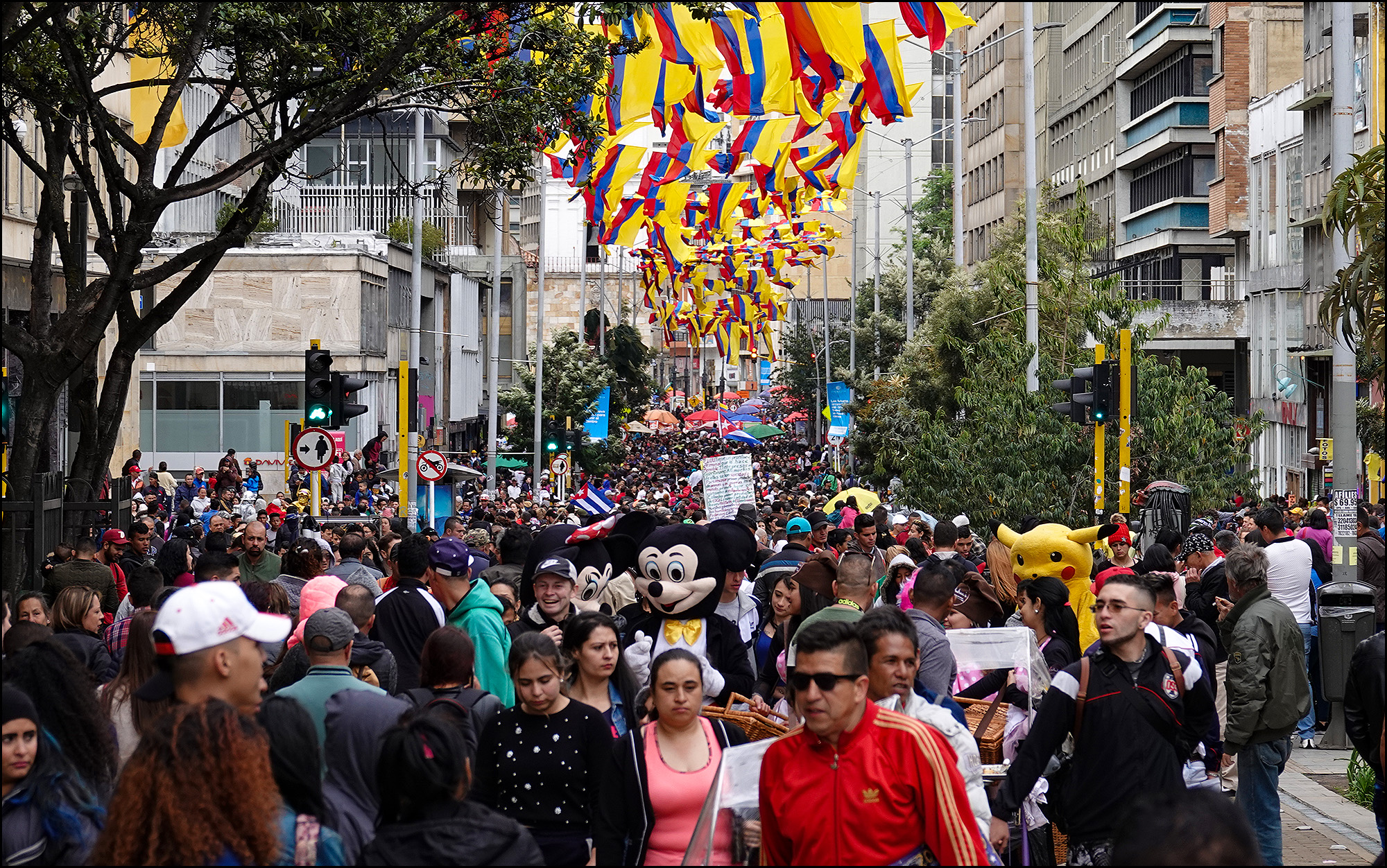
After lunch I wandered over to Septima Carrera, or Seventh Avenue, which is shut down on Sundays and attracts a horde of shoppers and the usual mix of street performers:
There were lots of dancers. And when you dance for donations, it all starts with the feet:
The festival extends all the way down to Plaza Bolívar. Here is the man himself:
Pigeons make ordinary mortals of us all. The Cathedral of Colombia is here, and although the exterior is fairly ordinary, the interior is quite beautiful:
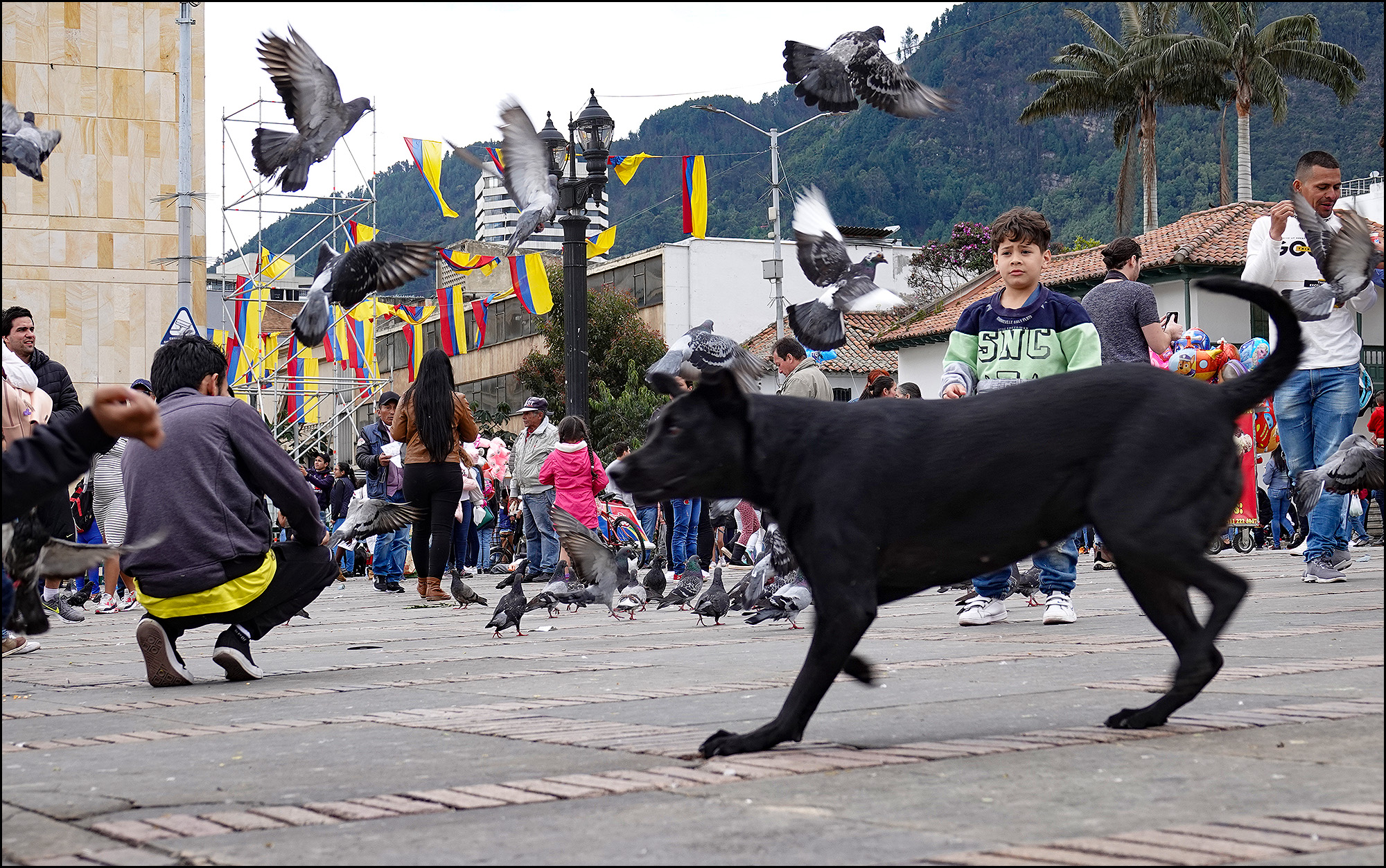
The plaza itself is full of little kids feeding the pigeons.
But someone always has to bust up the party:
Colombia is a very dog-friendly place. There are zillions of them everywhere, mostly pretty good size dogs like this one. Either Colombians aren’t too fond of small dogs or else they keep them indoors most of the time.
Can anyone tell me the status of selfie sticks these days? I have the feeling that their popularity has been fading, but that’s not the case in Bogotá. They’re all over the place, and selfie stick vendors are everywhere.
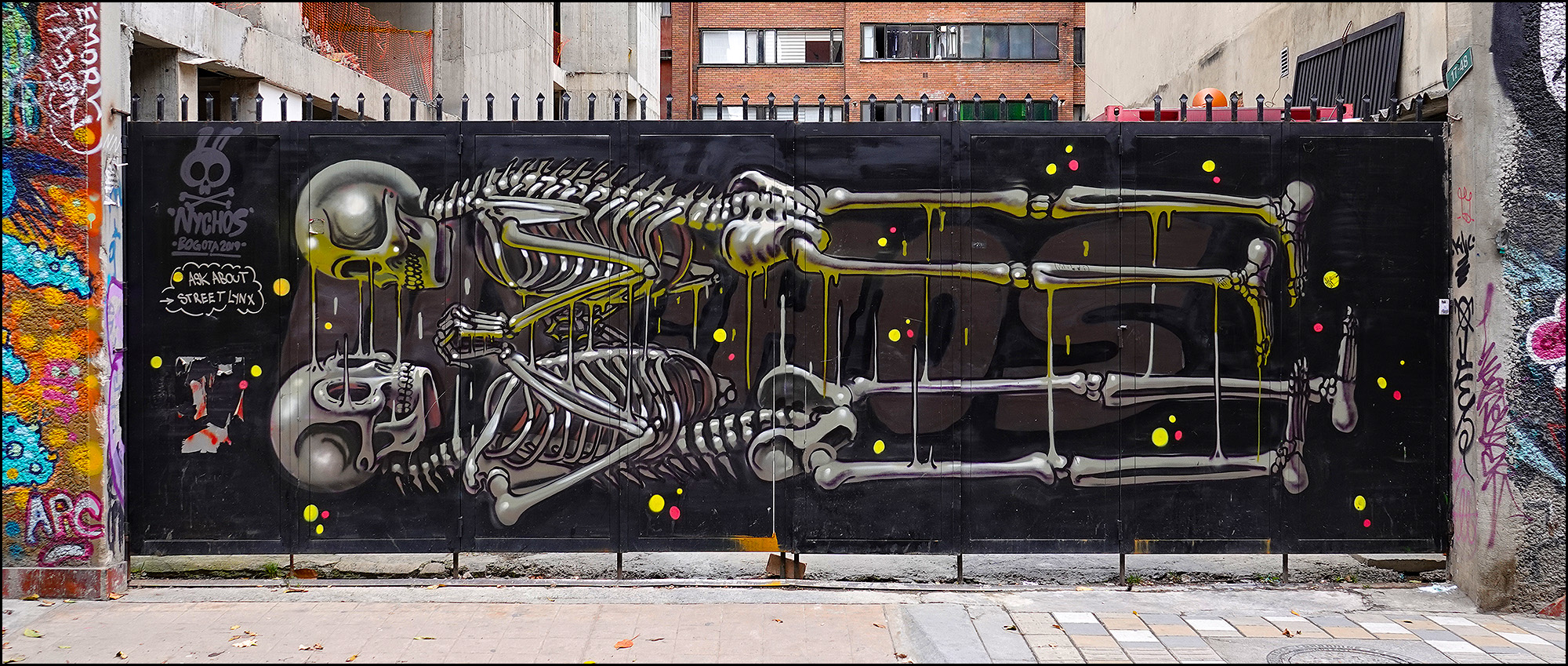
Graffiti is officially tolerated in Bogotá, and it’s all over the place. I didn’t take the graffiti tour, which shows off the finest street art in the city, but here’s a more common sample:
The graffiti ranges from the ordinary to the quite beautiful. Overall, Bogotá has been a nice place so far. The weather has indeed been cool, varying between overcast and sunny. As I’m writing this on Tuesday morning, the sun is just starting to peek out from the clouds and it looks like it’s going to be a nice day.
Surprisingly for such a large city, the traffic isn’t really that bad. I guess this has something to do with their even/odd system of driving restrictions. My car happens to have an even-numbered license plate, so I’m not allowed to drive in the city on even-numbered days.
Even after the various tariffs it put on soybeans and other farm products, China is still importing about $5 billion worth of US “food and animal products” annually, according to the Census Bureau. But now that’s ending:
The U.S. Farm Belt braced for deeper pain from the escalating trade battle between the world’s two biggest economies after China said it would suspend all imports of U.S. agricultural goods.
….China’s suspension of U.S. farm purchases is a “body blow” to U.S. farmers and ranchers, said Zippy Duvall, a Georgia farmer and head of the American Farm Bureau Federation. “We urge negotiators to redouble their efforts to arrive at an agreement, and quickly,” he said.
China really does appear to be the party at fault for blowing up negotiations earlier this year. Nonetheless, it’s pretty obvious that they have no intention of giving in to President Trump’s demands, and they’ve dedicated themselves to causing him as much electoral pain as they can. This trade war is going to be neither short nor easy to win.
I’m on vacation again. I’ll be spending this week in the central time zone.
But wait. Wasn’t I just on vacation a couple of months ago? Yeah, I was. But I know from experience that the Evil Dex gets worse over time, so I figured I should go ahead and take some time off now before it starts to seriously kick in.
Anyway, here’s a picture I took on Sunday. Can you guess where I am?
And we respect that! But maybe you’re of a mind to support our work directly instead? We have until December 31 to raise the last $400,000 we need to keep our nonprofit newsroom running at full strength into 2026. Will you make a gift today?
We noticed you have an ad blocker on. Can you pitch in a few bucks to help fund Mother Jones' investigative journalism?
Billionaires own the media,
but they don’t own us.
At Mother Jones we know these aren’t conventional times, and they require unconventional coverage. That’s what deliver every day: fierce, independent journalism you can’t find elsewhere. Perhaps never in the history of our country has that been more necessary than now. But we can’t do it without reader support—your support. Please chip in today.
Billionaires own the media,
but they don’t own us.
At Mother Jones we know these aren’t conventional times, and they require unconventional coverage. That’s what deliver every day: fierce, independent journalism you can’t find elsewhere. Perhaps never in the history of our country has that been more necessary than now. But we can’t do it without reader support—your support. Please chip in today.