• We Are Living Through the Twitterization of the Progressive Movement

    John Nowak/CNN via ZUMA

    I think it’s safe to say that John Judis has more established lefty bona fides than I do. So it’s a little disturbing to read this from him:

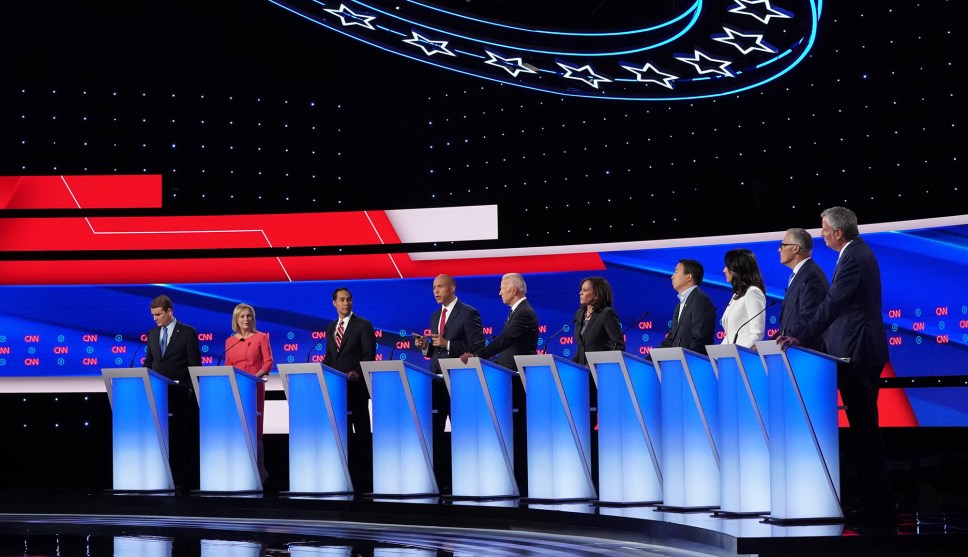
    I found the first two series of Democratic presidential debates painful to watch, and I don’t think it was simply the result of the format or of the questions asked. It was because in their preoccupations, I don’t think the Democratic candidates have developed the message and the language that can win the White House for the party.

    Medicare for All has all the problems of past plans: it threatens higher taxes; and it comes across as another welfare program in which the middle class will have to subsidize the non-working poor….Trump’s nativist attacks against immigrants from South of the Border and his administration’s inhumane treatment of asylum seekers has had the perverse effect of pushing the Democrats toward a virtual endorsement of open borders….Senator Elizabeth Warren and several candidates, while bemoaning growing economic inequality, called for increases in legal immigration based on family reunification, which in the past has brought millions of unskilled workers into the labor market who compete for jobs with unskilled native-born and first-generation Americans.

    ….Trump has played upon a politics that could be described as “white supremacist.”…But in responding to Trump’s racism, Democrats have been using these terms in every other sentence — and add to that Senator Gillibrand’s high-toned blast against “white privilege.” In doing so, they are implicitly attacking not merely Trump but his past supporters and — even more important — people who are queasy about the Democrats for one reason or another. The terms also suggest that white voters have little to complain about, a message that won’t play very well in November 2020.

    I also fear they think that in reiterating these terms — or in promoting reparations — the Democrats think they are courting black voters. In my experience — and I hope this won’t seem like some kind of weird racism — black adult voters are among the most sophisticated in the electorate. You could see it in Virginia after the various Democratic presidential candidates fell over each other to call for Governor Ralph Northam’s resignation for a 36 year old yearbook photo of questionable origin that had been publicized by a rightwing website angry about the governor’s stand on abortion. Virginia’s black Democrats, cognizant that Northam had not run a racist administration, or had a record of racism as a legislator, continued to back him. You see it in the continued African-American support for former Vice President Joe Biden in spite of Senator Kamala Harris’s attack against him for his decades-old stances on busing. Biden’s support might disappear, but again I think it is based currently on a reasoned assessment of who among the candidates is best equipped to get rid of Trump.

    This usually gets treated by reporters as a big “Dems in disarray” kind of thing, but I’m genuinely not sure that’s the real fault line here. Rather, I think it’s the Twitterization of the left. No matter how carefully you curate your Twitter feed, and no matter how much you try to take Twitter with a grain of salt, it will inevitably overexpose you to a very specific subset of the progressive movement. This is not just the activist subset. It’s a group that’s way leftier, way louder, way less tolerant, way woker, way younger, and way whiter than the Democratic Party as a whole. Even if you think you’re sophisticated enough to understand this and account for it, spending time on Twitter almost certainly skews your view of the progressive movement.

    This is what accounts for some of what Judis is talking about. Many of the Democratic candidates seem like they’re in thrall to the lefty twitterverse, deathly afraid of doing anything that might bring down a viral storm on their heads. And it’s hard to blame them, since campaign reporters also love Twitter, and will turn these viral shitstorms into page A1 stories in the New York Times.

    I am more and more convinced that Twitter is a curse. We have met the enemy and it is us.

  • Should We All Be Ashamed for Using Airplanes?

    Kevin Drum

    Umair Irfan describes one of my pet peeves today about climate change advocacy. The subject is air travel, and the story starts when Maja Rosén takes a trip to the Lofoten Islands:

    Air travel is a huge contributor to climate change. A new global movement wants you to be ashamed to fly.

    “It felt so wrong that my flight there was contributing to destroying that place,” Rosén, now 38, said. Soon after, she drastically curbed her flying, but in 2008, she concluded it wasn’t enough….She founded a group called We Stay on the Ground in 2018 to recruit people to pledge to give up flying for one year. But the pledge only kicks in once 100,000 people in a given country have committed to doing the same….The Swedes have even coined a word for the shame that travelers are beginning to feel about flying: flygskam, pronounced “fleeg-skahm.”

    ….For regular flyers, air travel is often the dominant contributor to their greenhouse gas footprints….“Euro for euro, hour for hour, flying is the quickest and cheapest way to warm the planet,” said Andrew Murphy, aviation manager at Transport & Environment, a think tank in Brussels….Global emissions reached a record high last year, and so did atmospheric concentrations of carbon dioxide. Air travel is a big reason why.

    I kept waiting to find out how big a problem air travel really is. I already knew the answer; I just wanted to know if this piece would ever get to it. It did:

    Around the world, aviation emits about 860 million metric tons of carbon dioxide every year, or about 2 percent of total global greenhouse gas emissions.

    As it happens, the net climate impact of air travel is probably a little higher than this. Still, even if this shame campaign were a wild, overwhelming success, it might reduce flying by a quarter. At most that would reduce climate forcing by about one percent.

    Is it really useful to harangue people into making a serious sacrifice for something that, even if successful, will have only a minuscule effect on global warming? I just don’t see it. Going after low-hanging fruit is useful. Asking people to sacrifice for something big might be useful. But hauling out the whole liberal guilt trip performance over something this small? It’s really hard to see how this helps move public opinion in the right direction.

  • Homeownership Revisited — One Last Time

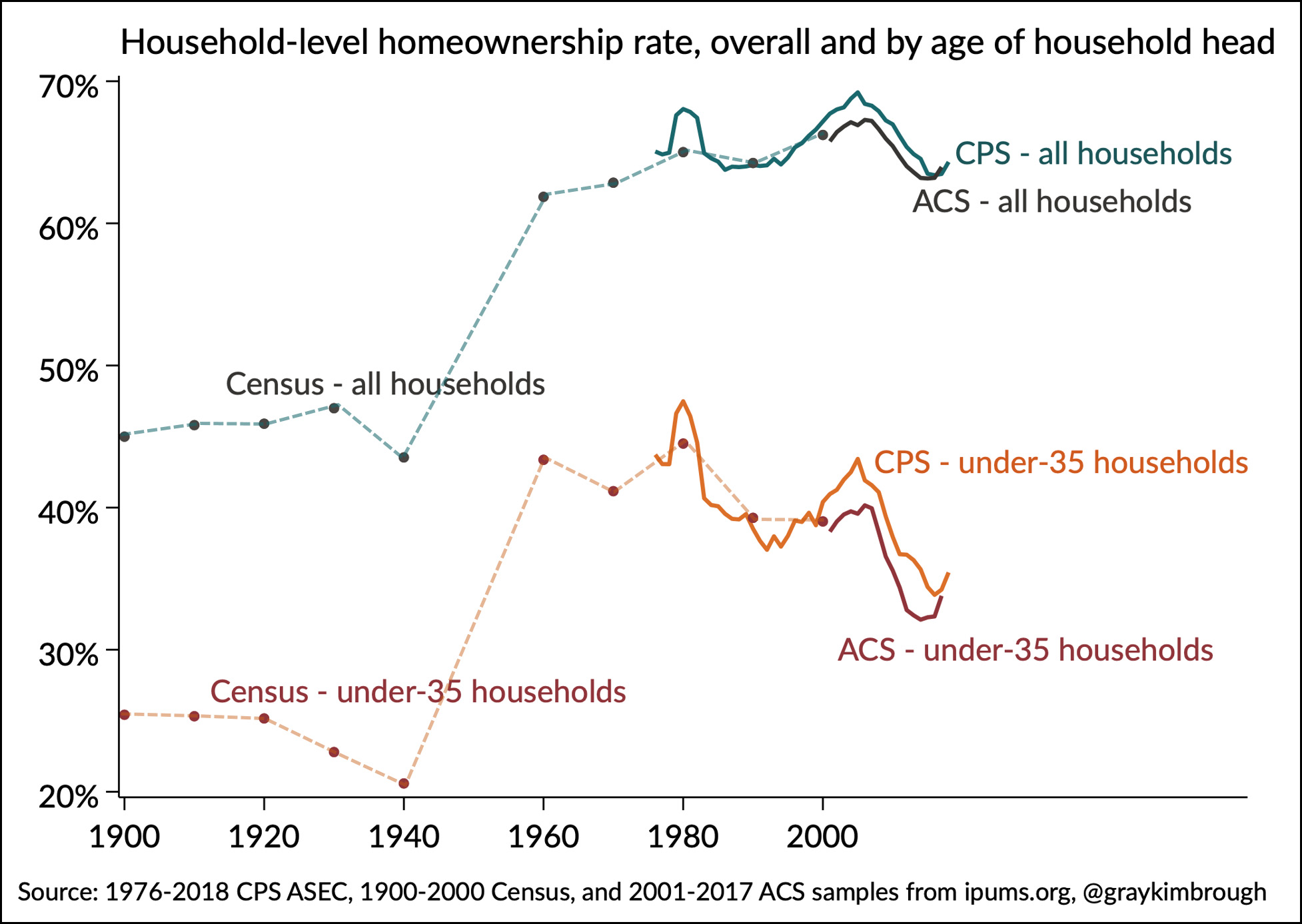
    On Monday I posted a second look at homeownership among households under age 35. Ever since then I’ve been emailing with Gray Kimbrough to discuss various issues and to come up with solid data that goes back a long way. The reason for wanting a long time series is that homeownership goes up and down with recessions and bubbles and so forth, so it’s hard to pick any single year as a base value to compare with current homeownership rates. It’s better to simply look at the whole series.

    As it turned out, Kimbrough was able to extract decadal census data going back to 1900, which I asked him to include in a chart. This is not because it sheds any light on current homeownership rates, but because I’ve never seen anything that goes so far back and I thought it would be interesting for its own sake. He kindly agreed, and his chart of the data is below. Note that I’ve added light dashed lines to the decadal data to make it a little easier to see.

    Looking at the postwar era (1960-2018), there are a few things to say:

    • For overall homeownership, there’s a steady upward trend prior to the housing bust. For under-35s there’s a small downward trend. This divergence is most likely due to the long-term trend toward later household formation among the young.
    • There’s a noticeable difference between the CPS data and the ACS/census data. I’m not sure which one is best, but the ACS uses a much larger sample size than the CPS, so I imagine it’s a less noisy series. Compared to CPS, ACS shows a much smaller increase in under-35 homeownership during the housing bubble and a much bigger drop during the bust.
    • I originally used data from the Census Bureau’s annual tables of homeownership (Table 19 here), which shows that under-35 homeownership has gone from 37 percent in 1994 to 36 percent in 2019. In other words, young households have recovered almost entirely from the housing bust. This comes from the Census Bureau’s quarterly Housing Vacancies and Homeownership survey.
    • However, both the CPS and ACS data in Kimbrough’s chart show something a bit different. The 1994 figure is still about 37 percent, but the 2017 ACS figure is a little under 34 percent and the 2018 CPS figure is a little over 35 percent. In other words, still several percentage points less than the 1994 figure. However, that’s probably gone up a point or two through 2019.

    The upshot of all this is that it looks to me like the under-35 homeownership rate really has gone from about 37 percent in 1994 to 36 percent in 2019. However, 1994 turns out to be something of a low point, which is the whole reason I wanted to see a longer time series in the first place. If you look at the 1960-2010 data as a whole, under-35 homeownership appears to have declined from around 41 percent to 39 percent—and then it fell off a cliff during the Great Recession. Today it’s around 36 percent compared to a postwar average of around 40-41 percent. Conversely, the homeownership rate for all households is currently at about the same level as its pre-bubble average.

    I’m really happy to see solid data for all this, and I want to thank Gray Kimbrough for working through it with me. He’s more than proved his point that millennial homeownership really was hit a lot harder by the Great Recession than other age groups.

  • No, Joe Biden Didn’t Cause Mass Incarceration

    Over at Vox, Tara Golshan writes this:

    Ahead of the debate, Booker signaled he planned to attack the former vice president over his role in the 1994 crime bill, which Biden helped write and, as Vox’s German Lopez has reported, experts now see as one of the major contributors to mass incarceration in the 1990s.

    Huh. Did Lopez really say that? Let’s click and find out:

    The 1994 law didn’t really cause mass incarceration

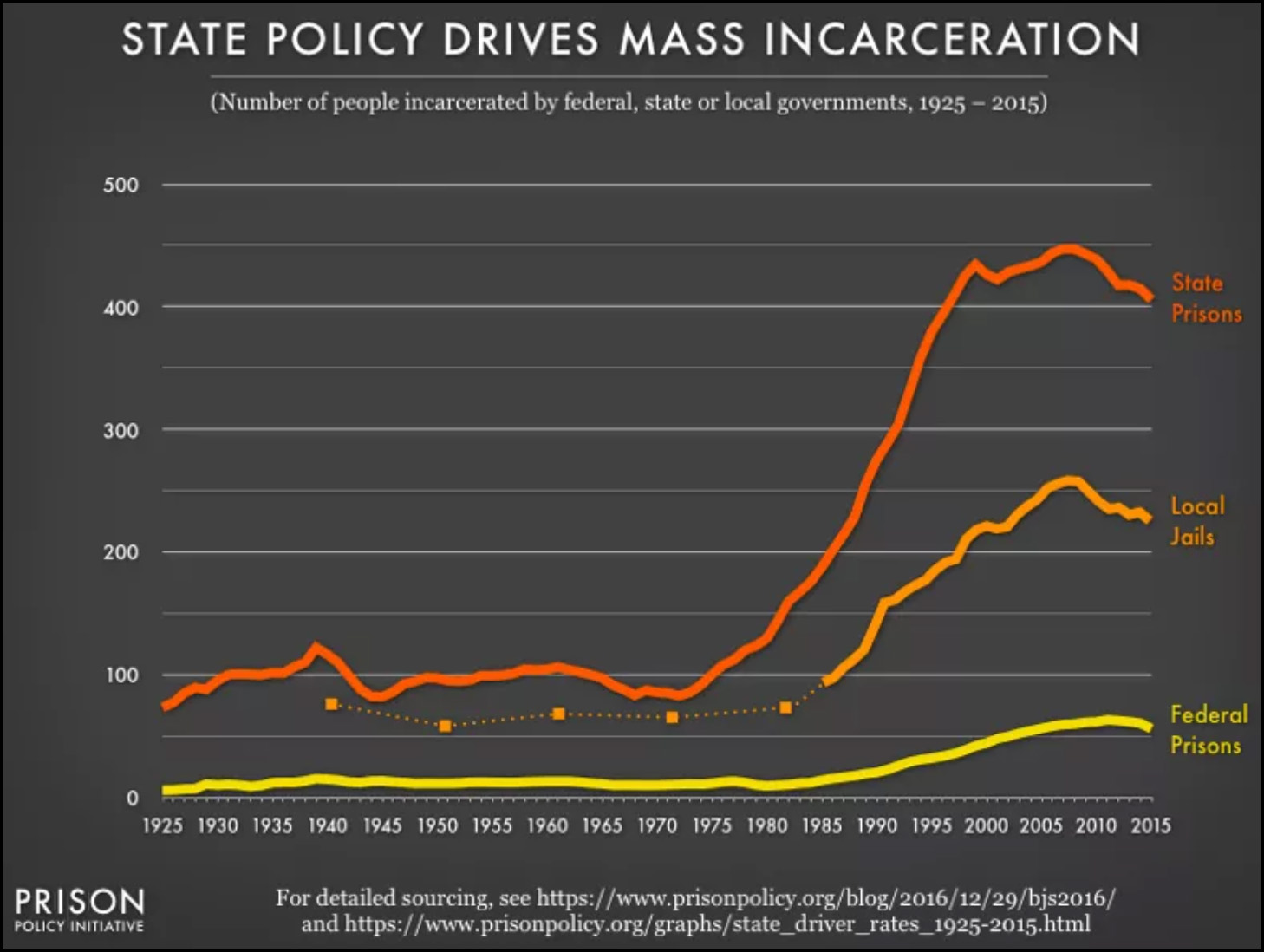
    ….That’s reflected in the statistics, which show that incarceration rates were climbing rapidly before the 1994 crime law and actually started leveling off a few years after.

    Incarceration rates approximately quadrupled between 1970 and 1994, and flattened almost immediately thereafter. The 1994 crime bill simply didn’t have anything to do with it.

    I realize this is politically impossible, but sometimes I wish Joe Biden would just flat out defend the 1994 bill. “You know what happened after that bill passed?” he should ask. “Crime went down, that’s what.” This would be pretty misleading since we all know what really caused the crime decline,¹ and it’s unlikely the 1994 bill had much impact on its own. Still, it’s at least a true statement.

    ¹The phaseout of leaded gasoline. But you already knew that, right?

  • Housekeeping Note

    My internet service has gone from unreliable to just plain unusable. Cox tech support, naturally, is able to do nothing except reboot my router, which hasn’t worked in the past and isn’t likely to work on the 17th try either. So . . . I dunno. I guess I’ll go buy a new cable modem and see if that does any good?

    Anyway, that’s the reason for this morning’s radio silence. I’m posting this from my cell phone, but I don’t think that’s a viable long-term blogging strategy.

  • Debate Night 2: Better Than Night 1, But a Little Too Nasty

    Hey, maybe the 15-second rule and the constant interruptions from the CNN anchors weren’t as bad as I made them out to be yesterday. By staying tough on the time guidelines, the anchors made it clear to everyone that they needed to play by the rules, and tonight they mostly did. So maybe it was the right call.

    Also, I thought the anchors were a little bit less harsh than they were last night. But I might just be imagining that.

    Poor Joe Biden. You almost have to feel sorry for the guy. He just stood there taking incoming from every person on the stage. Unfortunately, I don’t think that was his real problem. His real problem is that he was noticeably hesitant and unsure on multiple occasions. Nobody had to make even a veiled reference to his age because it was obvious that he wasn’t at peak sharpness all the time. I suspect this is going to become more and more obvious as time goes by, and it will doom him.

    Was Cory Booker the big winner? The CNN anchors seemed to think so, but I didn’t. He was hardly the target of any attacks—and did poorly on the one big attack he got from Biden—but nonetheless never really got a consistent vision across. At least, I didn’t think so.

    Kamala Harris did OK, but I’m surprised she didn’t have better answers to attacks on her record as California attorney general. It’s not like she hasn’t had months to prepare for them.

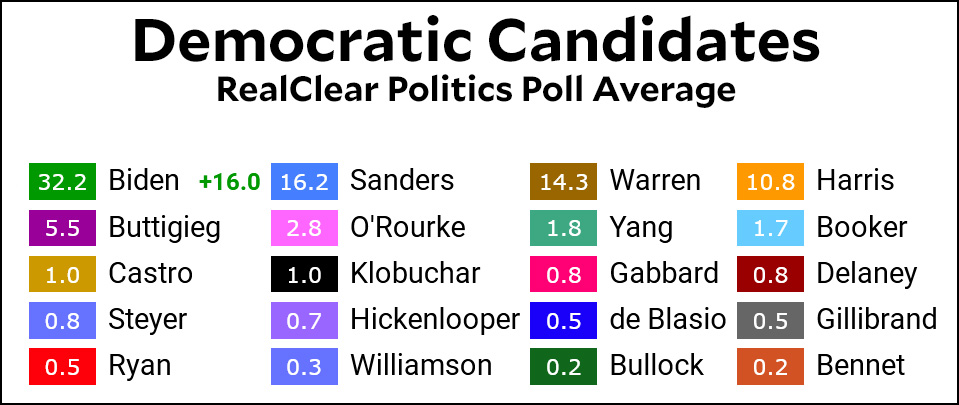
    All told, I found the whole thing sort of dispiriting because I hate to see Democrats engaged in such personal attacks. But that’s politics, I guess. In any case, I sure wish they could start winnowing down the field. If you can’t even manage to poll at 1 percent after two national debates, it’s not clear to me that anyone owes you any more TV time.

  • Democrats Need to Stay Serious About Race

    Politico says that Democrats are having a moment on race:

    A reckoning inside the Democratic Party on racial identity is underway, as President Donald Trump unleashes racist tweets, attacking lawmakers of color and stoking fear among his base about primarily Latino immigrants. But Democrats are being forced to examine their own pasts, too — namely the party’s role in implementing policies that disproportionately hurt minorities for generations.

    ….The discussion around racial identity has reached a turning point this cycle. Most of the Democratic presidential hopefuls are speaking explicitly about how their proposals would address minority communities affected by the racial wealth gap, higher maternal mortality rates, and the threat of deportation after living in the United States for years. Biden and Booker dueled last week over their own records on criminal justice, with Booker calling Biden the “architect of mass incarceration” and Biden criticizing Booker for a federal investigation into the Newark Police Department during Booker’s tenure as mayor.

    ….New York City Mayor Bill de Blasio has already signaled he will attack Biden over past comments on working with segregationist senators and may mention, as he did in the first debate, that he is the only one on stage with a black son.

    I sure hope everyone manages to restrain themselves tonight, Bill de Blasio very much included. It’s great to be talking about racial issues in a substantive way, but playing woker-than-thou with fellow Democrats is a recipe for catastrophe. It’s almost impossible to imagine a way in which this ends well.

    Joe Biden has lots of vulnerabilities, and it’s still only July. There’s plenty of time to take him down on other fronts. Dems should treat race seriously, not get into food fights over who can best prove their purity bona fides.

  • Lunchtime Photo

    Some nice, fat bumblebees have been buzzing around in our front yard lately, so I figured I should go out and take some pictures. The best of the lot is this one, which is better than the ones I took last year because I shot it in blindingly bright sunlight. This allowed me to use a fast shutter speed without the camera spiking up to a high (and noisy) ISO. Don’t you just want to reach out and pet the little guy?

    July 29, 2019 — Irvine, California
  • A Conservative Calls Out Donald Trump

    Patrick Semansky/AP

    Over at Bloomberg, Ramesh Ponnuru tells conservatives they’re selling their souls:

    Support for Trump and opposition to his critics are making them less willing to condemn behavior as racist and more inclined to dismiss accusations of racism as moves in a political game. Just compare the way Senator Lindsey Graham used to talk about Trump and race to the way he talks about it today.

    ….Each apparent provocation has an innocent explanation. When Trump said that Representative Elijah Cummings’s Baltimore congressional district was a land of filth and misery, he was … standing up for the poor misgoverned people of that city! When he said that a federal judge could not be fair to him because he was “Mexican,” Trump was … making a profound, nay Lincolnian, point about identity politics. There is certainly no pattern to see here, save that of his being plain-spoken and his critics reading him uncharitably.

    ….Because our culture has defined racism as wholly unacceptable, very few people are willing to step forward and say, “The president keeps making racist comments, but what’s more important is that he is delivering on taxes and judges and regulation.” (Kris Kobach waffled rather than say it.) The evidence of his bigotry has to be ignored, wished away, re-interpreted.

    Ponnuru and I have had some harsh words for each other in the past, and I suppose we will again in the future. But I appreciate this. Ponnuru hasn’t left the Republican Party or become an apostate. He’s an active conservative in good standing, and there’s not much for him to gain by telling his fellow conservatives that they need to quit pretending that Trump isn’t deliberately stoking racial fires. But he did anyway.

    The problem is that this leaves conservatives stuck with what Ponnuru calls the “transactional case” for Trump: admit that he’s a bigot but argue that it’s important to support him for other reasons. This is, obviously, not a viable electoral strategy.

    At the beginning of Trump’s term, conservatives could have avoided this problem entirely if they had made it clear to Trump that they wouldn’t put up with racist comments, veiled or otherwise. Even a guy as feral as Trump eventually would have gotten the message and cut it out. But as time went by, it became less and less possible to suddenly turn around and criticize something they’d been OK with for months or years. Now they’re trapped. They have a president whose public bigotry is completely out of control, but no matter how far he goes they can’t say anything. It’s too close to next year’s election. And the whole country is trapped with them.