The Wall Street Journal reports today on the big-company CEOs who made the most money in 2018. The big winner is David Zaslav, CEO of Discovery, whose TV channels are apparently doing pretty well. He raked in $129.4 million last year. The highest paid woman was Mary Barra of General Motors, who earned $21.9 million. This puts her in about 40th place.
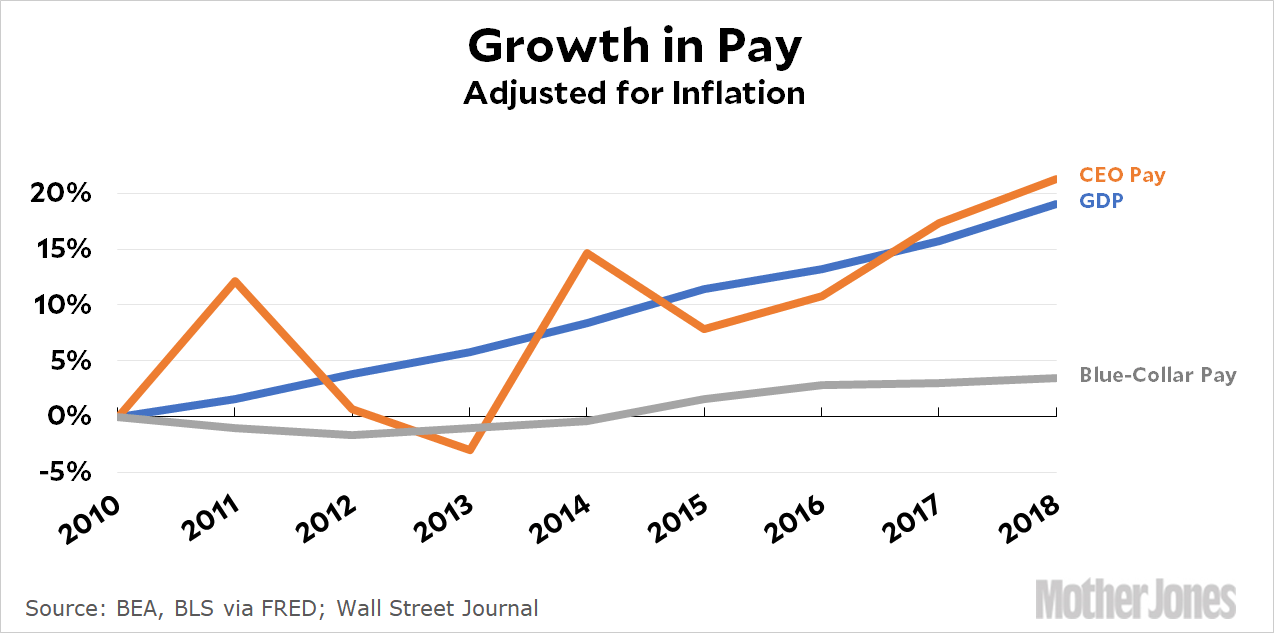
Anyway, this seems like a good excuse to revisit CEO pay. Based on the Journal’s data, here it is from 2010 through 2018:
Adjusted for inflation, median CEO pay has increased by 21 percent since 2010. In other words, it’s pretty much tracked the growth in GDP. That might seem fair, but for some reason it doesn’t apply to the rest of us. Blue-collar workers have seen a pay increase of only 3.5 percent over the same period.
You might wonder why corporations are so willing to pay their CEOs big money for doing nothing but coasting along on an expanding economy, and you’d be right to wonder that. I’ve long thought that big-company CEO pay should be tightly tied to economic growth or something similar. If your company grows faster than the economy, then fine: you get a healthy raise for doing a great job. But if your company just grows at the same rate as the economy, why do you deserve anything more than a COLA increase? The company probably would have done just as well without you.
This is, of course, just another way of looking at wage stagnation for those of us who aren’t big-company executives. We’re looking at a period of only eight years, so it doesn’t matter much what inflation measure you use or whether you include fringe benefits or any other details. You’ll get the same results either way: Eight years of a steadily expanding economy and steadily declining unemployment has produced only the tiniest of pay raises for ordinary workers. This is why you should laugh at anyone who says ominously that worker pay is “starting to show signs” of acceleration. I should damn well hope so. If it accelerates for another decade or so it might make up a fraction of the ground it’s lost over the past decade.
In 2016, I would say that conservatives were more motivated than liberals by the Supreme Court as a campaign issue. But what about 2020? It seems almost certain that Alabama’s abortion ban—along with Georgia’s and a few others—will be moving its way through the judiciary. Who will this motivate more?
If it’s not liberals, we should probably all just give up and let Mitch McConnell run the country for the next few decades.
What is a wildflower? I maintain that if it’s a flower and I find it in the wild, it’s a wildflower. Marian thinks I’m nuts.
Anyway. I don’t know how things are in your neck of the woods, but around here lantana grows in great huge piles along the roads and freeways. There’s a big, scraggly patch of it near here at the Jeffrey onramp to the 405, so a few weeks ago I went out to take pictures. The results were great. The lantana blooms turn out to look a lot better in photographs than in real life, especially near sundown when the ambient light adds some character.
So is this a wildflower? I don’t know. But it’s pretty.
Just to get this straight up front, I’ve told Bob Somerby that I think he obsesses too much about the Al Gore campaign in 2000. So he knows how I feel. And in fairness, he does it way less than he used to.
But I admit that sometimes it’s useful to remind everyone of what things were like back then. Today Somerby does that, and it’s worth reading. It’s especially worth reading if you’re under, say, age 30 and don’t have any personal memories of that era. You can read it by clicking here.¹
I’m not even sure what lesson to draw from this. That the national political press is actually better today than it used to be? That it’s been unhinged for a long time? That stuff like this is why Donald Trump became president 16 years later? Decide for yourself.
¹And this is just a tiny smidgen of the whole story. There’s nothing in this particular post about Love Canal or inventing the internet or Love Story or any of that. But you can always google for more if you want.
This is practically the only known photo of White House Counsel Pat Cipollone. But I'm sure there will be lots more soon.SMG via ZUMA
Donald Trump’s usual MO is to make breathtakingly sweeping arguments and then dare anyone to disagree. And that’s exactly how he plans to treat Congress:
The White House’s top lawyer told the House Judiciary Committee chairman Wednesday that Congress has no right to a “do-over” of the special counsel’s investigation of President Trump and refused a broad demand for records and testimony from dozens of current and former White House staff.
White House Counsel Pat Cipollone’s letter to committee Chairman Jerrold Nadler (D-N.Y.) constitutes a sweeping rejection — not just of Nadler’s request for White House records, but of Congress’s standing to investigate Trump for possible obstruction of justice….“Congressional investigations are intended to obtain information to aid in evaluating potential legislation, not to harass political opponents or to pursue an unauthorized ‘do-over’ of exhaustive law enforcement investigations conducted by the Department of Justice,” Cipollone wrote.
My, my. Congress has no right to perform an “unauthorized” investigation. Who exactly does Cipollone think should authorize such a thing? Trump himself? Can you imagine how Trey Gowdy or Jason Chaffetz would have reacted to a similar statement from President Obama’s White House counsel?¹
As I’ve said before, this is all a delaying action. It’s going to end up in court and Trump will appeal it all the way to the top. It doesn’t matter all that much whether he wins or loses, only that the final decision happens after November 3, 2020. After that, he’ll either continue stonewalling and provoke a constitutional crisis, or else he’ll be out of office and assumes that President Biden or President Harris will decide that “healing” is the order of the day, not further investigations. That’s how it usually works when Democrats win the White House, after all.
¹And it’s worth noting that in the case of Hillary Clinton’s emails, Republicans continued investigating even when there really had been a law-enforcement investigation that reached an unequivocal conclusion. No such thing has happened this time. Robert Mueller explicitly said he was not exonerating Trump on obstruction-of-justice charges and would leave that up to others based on the evidence he laid out. Needless to say, Congress has every right to take him up on that.
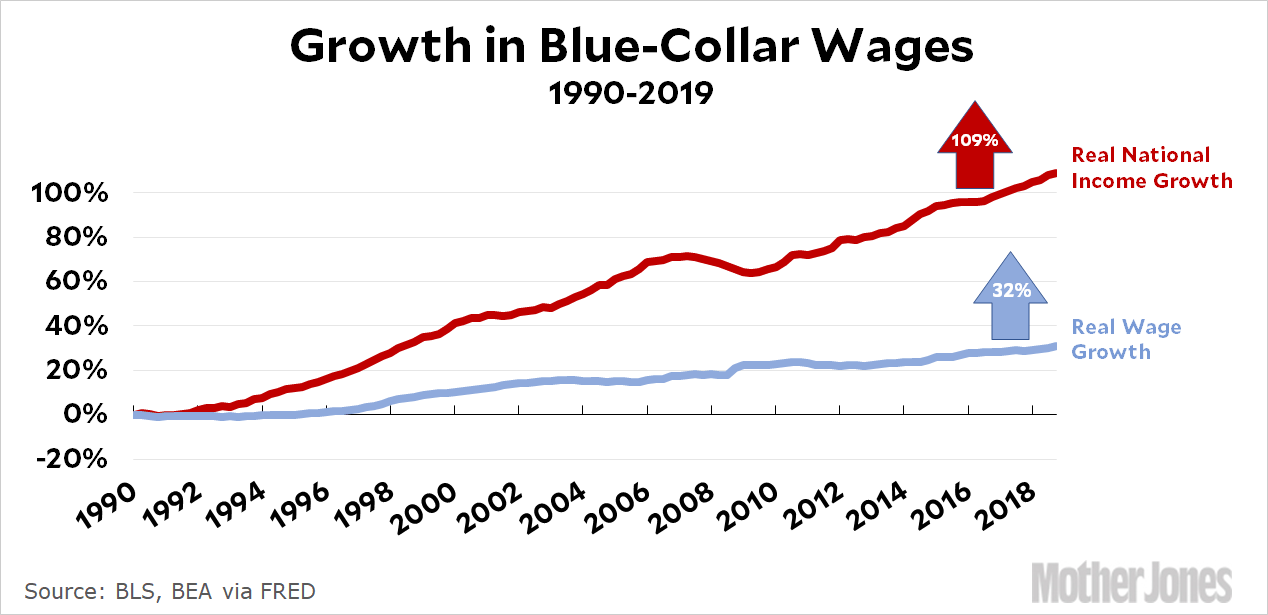
Michael Strain says that wages have grown more than people think. The usual figures from lefties are rigged, he says, by starting in 1973 and using the CPI to calculate inflation. If you start in 1990 and use the PCE index instead, wages of blue-collar workers¹ have gone up 32 percent. Not bad!
Strain’s math is correct. But let’s take him up on his choice of starting date and inflation index. Here’s the chart he doesn’t show:
It’s true, using Strain’s measures, that worker pay has increased 32 percent since 1990. That’s about 1 percent per year. But overall national income has grown three times as fast. Where is all that extra income going? Here is Strain:
I’m not trying to be sanguine here. Americans have high expectations for wage and income growth, and we shouldn’t be satisfied with the gains we’ve enjoyed over the past three or five decades….But messages matter. If all people hear is that wages have been stagnant for decades as part of a game rigged to benefit people at the top — well, they might believe it.
I’d say that people have every reason to believe this. If national income has gone up 109 percent since 1990, why hasn’t the income of ordinary workers also gone up that much? I think we all know the answer.
¹As usual, I’m using “blue-collar” as shorthand for what the BLS calls “production and nonsupervisory workers.” This includes about 80 percent of the population.
As president he named himself negotiator-in-chief and tried to cajole North Korea’s Kim Jong Un to abandon nuclear weapons. He reimposed tough economic sanctions on Iran, betting he could force the ayatollahs to change their ways. He vowed to force China, Canada, Mexico and the European Union to give up what he called unfair trade practices. He backed an uprising in Venezuela aimed at toppling its leftist president, Nicolas Maduro. He declared victory against Islamic State and ordered U.S. troops home from Syria. In his spare time, he asked his son-in-law, Jared Kushner, to arrange peace between Israel and the Palestinians.
He has achieved none of those outcomes.
But he might declare war on Iran. And impose tariffs on European cars. And commit the United States to Israeli annexation of whatever territory Bibi wants. And keep us in an endless trade war with China. Who knows?
I wonder when we’ll finally get tired of all the winning?
Have you heard of the “replication crisis”? It’s mainly a thing in the social sciences, and it’s just what it sounds like: when researchers try to replicate results from previous studies, they can’t. Vast swaths of recent social science research appear to be completely bogus.
But what about medical science? That’s a whole different thing: it’s a hard science that has always demanded high standards because people’s lives can be at stake. This doesn’t mean that every study always pans out, but it does mean that it’s not susceptible to the kind of widespread bullshit crisis currently roiling the social sciences.
But what if it is? Here’s the nickel version of a story from the world of medical testing: Back in the 90s, a bunch of studies were done that showed promising results in the search for genes that are associated with depression. This year, a gigantic new study came out that basically overturned all of it.
Put like that, it doesn’t sound so bad. That’s how science works, after all. But if you sit still for the longer version, it starts to sound a lot worse.
First, here’s the background. Back in the 90s, before the rise of cheap, wide-scale genetic testing, the search for genetic associations was fairly simple. You’d put together a group of people—a few hundred or so—and test them all for the presence of a specific target gene. Then you’d compare that to the presence of depression, usually as a score on some kind of diagnostic test. If you found an association that was statistically significant, you’d conclude that changes in the target gene affected depression and would make a good subject of further research.
Quite a few of these targets were discovered. In particular, one of them, called 5-HTTLPR, became something of a star. The initial studies didn’t find too much, but then researchers started doing follow-up studies that checked to see if 5-HTTLPR became associated with depression if it was triggered by some kind of environmental cue. It turned out that it did. In fact, specific alleles of 5-HTTLPR appeared to be responsible for producing depression not in everyone, but specifically in people under stress. It also appeared to be associated with insomnia, anxiety, SAD, Alzheimer’s, and a variety of other things.
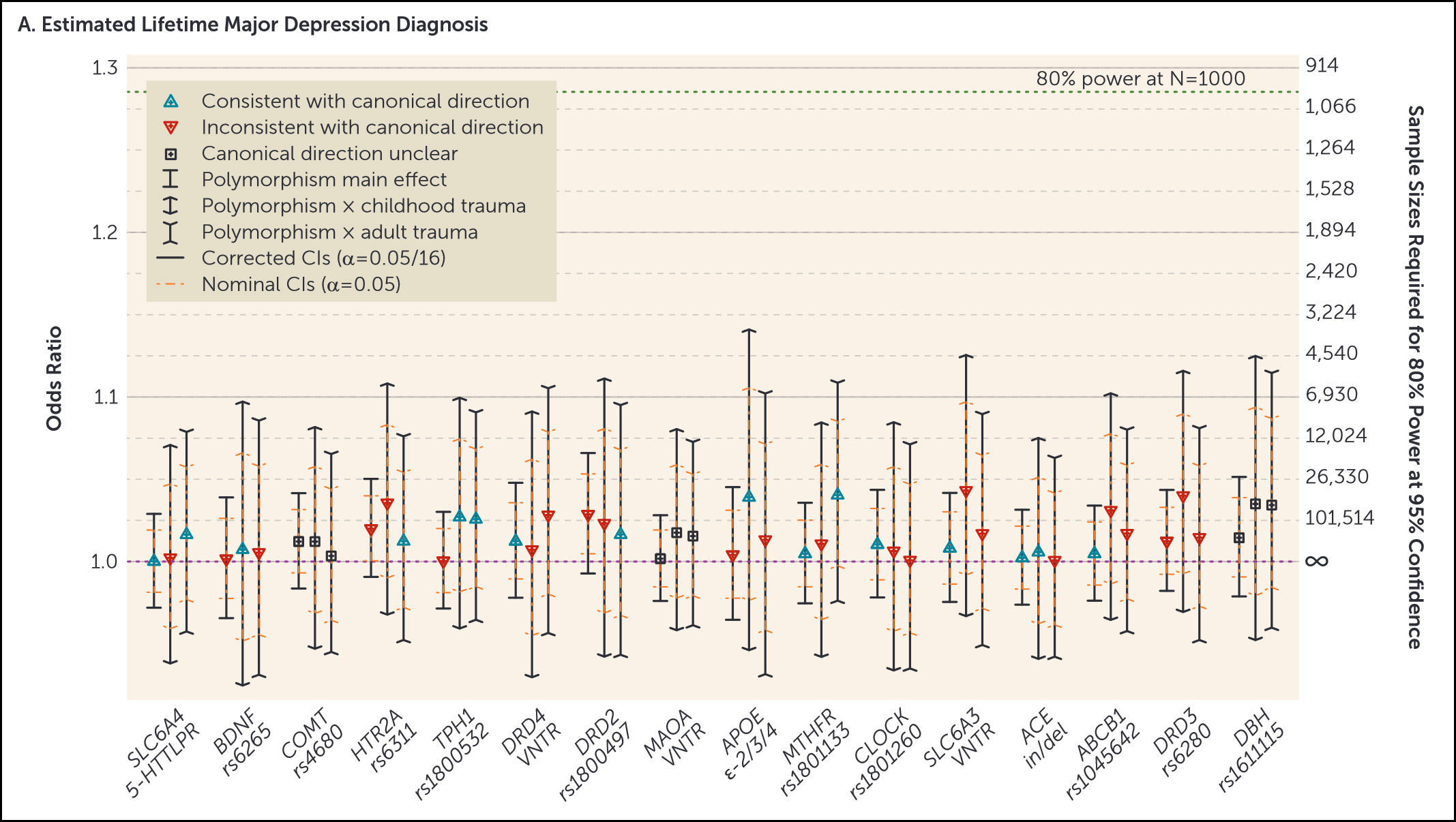
But there was a problem: recent research has shown that it’s wildly unlikely for a single gene variant to have a detectible impact on a complex disorder like depression. So a new study was done not just on 5-HTTLPR, but on all the other genes that were associated with depression, using modern tools that could work on samples of hundreds of thousands. Here are the results:
Don’t worry about the details of this chart. What’s important is (a) all of the red and blue triangles are close to 1.0, and (b) all of the confidence intervals cross 1.0. This means that (a) the effects of these gene variants are tiny, and (b) they’re so tiny we can’t say they really exist at all. There’s certainly no way that researchers with sample sizes of only a few hundred people had even a remote chance of discovering these effects, assuming they ever existed in the first place.
What bothers me isn’t just that people said 5-HTTLPR mattered and it didn’t. It’s that we built whole imaginary edifices, whole castles in the air on top of this idea of 5-HTTLPR mattering. We “figured out” how 5-HTTLPR exerted its effects, what parts of the brain it was active in, what sorts of things it interacted with, how its effects were enhanced or suppressed by the effects of other imaginary depression genes. This isn’t just an explorer coming back from the Orient and claiming there are unicorns there. It’s the explorer describing the life cycle of unicorns, what unicorns eat, all the different subspecies of unicorn, which cuts of unicorn meat are tastiest, and a blow-by-blow account of a wrestling match between unicorns and Bigfoot.
This is why I start worrying when people talk about how maybe the replication crisis is overblown because sometimes experiments will go differently in different contexts. The problem isn’t just that sometimes an effect exists in a cold room but not in a hot room. The problem is more like “you can get an entire field with hundreds of studies analyzing the behavior of something that doesn’t exist”. There is no amount of context-sensitivity that can help this.
A whole lot of scientists appear to have gotten on the bandwagon and figured out all the details of a thing that didn’t actually exist in the first place. How did that happen? It’s a good question, and it provides some evidence that it’s not just the social sciences that are susceptible to lousy studies.¹
There are plenty of other problems with medical and pharmaceutical testing, not least of which is the habit of hiding all the studies that turn out to be negative for your particular drug. But the 5-HTTPLR debacle suggests that things go much deeper than this. The replication crisis has already told us that there’s a lot of shoddy work going on, and apparently that shoddy work goes well beyond the social sciences.
¹This fiasco also provides some additional support for those who think the whole p<.05 standard for statistical significance is way too lax. In theory, meeting that standard means there’s only a 5 percent possibility that your results were just due to chance, but in reality it seems to suggest more like a 20 or 30 or 40 percent possibility.²
²Yes, yes, I know that p levels are more complicated than that. But this is the basic textbook definition, and it’s good enough for a blog post. Besides, the experts still can’t decide among themselves how p should be defined, and until they do there’s not much point in my taking a side.
When I was at the zoo last month, the beaver in the beaver tank was swimming right up front where I had a lovely view of him. Back and forth, back and forth. As near as I could tell, the way he figured out that it was time to turn around was to bump into the wall. This happened over and over. I’m guessing that aside from all the dam building stuff, beavers aren’t really very bright, are they?
April 6, 2019 — OC Zoo, Orange County, CaliforniaApril 6, 2019 — OC Zoo, Orange County, California
And we respect that! But maybe you’re of a mind to support our work directly instead? We have until December 31 to raise the last $400,000 we need to keep our nonprofit newsroom running at full strength into 2026. Will you make a gift today?
We noticed you have an ad blocker on. Can you pitch in a few bucks to help fund Mother Jones' investigative journalism?
Billionaires own the media,
but they don’t own us.
At Mother Jones we know these aren’t conventional times, and they require unconventional coverage. That’s what deliver every day: fierce, independent journalism you can’t find elsewhere. Perhaps never in the history of our country has that been more necessary than now. But we can’t do it without reader support—your support. Please chip in today.
Billionaires own the media,
but they don’t own us.
At Mother Jones we know these aren’t conventional times, and they require unconventional coverage. That’s what deliver every day: fierce, independent journalism you can’t find elsewhere. Perhaps never in the history of our country has that been more necessary than now. But we can’t do it without reader support—your support. Please chip in today.