Professor Marc had the honor of curating the final Lunchtime Photo of the week, and he chose this picture of a serval at the OC Zoo. His name is Charlie. I love watching big cats at zoos because their mannerisms are so similar to housecats, and Charlie here could probably pass for a housecat in this photo. The keepers told us he was pretty lazy, and as near as I could tell, not too bright either. He spent quite a bit of time trying to track down a piece of meat that was right in front of him. He found it eventually.
I’ve included a second picture to give you a little better view of all of Charlie.
April 6, 2019 — OC Zoo, Orange County, CaliforniaApril 6, 2019 — OC Zoo, Orange County, California
Joan of Arc finished off the English hardliners in the 15th century. Who will do it in the 21st?Carl Dreyer, "La Passion de Jeanne d'Arc"
In 1346 the English longbowmen won a famous victory against the French at the Battle of Crécy. Sadly for them, the English didn’t realize that this was just the start of a century of fighting, to be ended when they foolishly burned Joan of Arc at the stake and spurred a French revival that ended in a complete English defeat.
Is history repeating itself? The English Brexiteers¹ won a famous victory in 2016 when they passed a referendum demanding that the UK exit the European Union, but now they’re worried that perhaps time is not in their favor. The Wall Street Journal tells the story of the hardliners starting with a meeting last month:
Several lawmakers in the wood-paneled room insisted the U.K. should leave the European Union in days, without any deal, rather than accept the package Mrs. May negotiated with Brussels to smooth its exit. The meeting was organized by the decades-old European Research Group, a collection of euroskeptic lawmakers dedicated to ending Britain’s membership in the EU. It has no website, no office, one researcher and only around 15 full members.
….Now, as Brexit spins into further disarray, some euroskeptics worry their campaign was too effective: By insisting on a complete break with the EU and voting consistently against Mrs. May’s deal on the terms of the breakup, the anti-EU hard-liners risk ending up with no break at all.
On Wednesday, the EU agreed to postpone Brexit until Oct. 31. The extra time removes the chance of the U.K. exiting the EU on Friday with no deal, an outcome several euroskeptics favored. It also buys time for the government to water down its Brexit proposals to try to get a deal through Parliament, which has already voted no three times. The delay represents an “abject surrender” that undermines the U.K.’s democracy, said Bill Cash, a 78-year-old Conservative lawmaker, in the House of Commons Thursday, while calling for the prime minister’s resignation.
The hardliners were always asking for the impossible: either a treaty that the EU would never accept or a hard crash, which the British public wouldn’t accept. One way or another, they almost certainly had to lose. The only question now is what the precise terms of their surrender are going to be.
¹I use the term advisedly since neither Scotland nor Northern Ireland were ever in favor of Brexit.
TMZ reported earlier this week that prosecutors will only accept plea deals that include prison time, but People noted that [Lori] Loughlin and Giannulli resisted agreements that came with jail time. But then things got more serious: The U.S. Attorney’s office announced on Tuesday that Loughlin and Giannulli were among 16 parents indicted on additional charges, including conspiring to launder bribes and other payments for the scheme. TMZ reports that the U.S. Attorney’s office went to a federal grand jury with the additional charges after Loughlin and others refused to take a plea deal.
A source told E! News that Loughlin had been in “denial” and thought she could “skate by” without getting jail time. The source added, “She is seeing the light that she will do jail time and is freaking out.”
Yeah, um, about that. I agree that this whole thing reeks of elite privilege, and I suppose it’s satisfying to see these elites facing the same jail time that petty crooks face every day. On the other hand, do we really need to toss people in jail for cheating their kid’s way into USC? I mean, I can see why USC might care about this, but why should the rest of us?
The Ecuadorean government finally got tired of WikiLeaks founder Julian Assange and kicked him out of their London embassy this morning. He was promptly arrested by British police, and shortly thereafter the United States unsealed an indictment against him for hacking a classified US government computer. Nancy LeTourneau comments on the timing:
When it comes to Trump and his campaign, it is clear that the Justice Department is ignoring the role Assange played in Russian attempts to interfere in the 2016 election. It might also be a coincidence that, after more than a year of rumors that Assange was about to be ejected from the Ecuadoran embassy, it actually happened after Robert Mueller delivered the report on his findings to the Justice Department. But if Assange is extradited to the U.S. to face these charges, it’s too late for the special counsel to question him about his role in Russia’s interference. That is very convenient for the president.
The wildflowers are blooming and the swallows are returning to Capistrano, but spring isn’t truly here in Southern California until our refineries all mysteriously shut down at the same time:
The price of gas in Southern California has climbed rapidly over the last few weeks as oil refineries across the state experience maintenance problems. The average pump price for regular gas in the Los Angeles-Long Beach area stood at $3.946 on Wednesday, up about 22 cents from a week ago and 70 cents, or 17%, from a month ago, according to the American Automobile Assn.
It’s good to see that some traditions are still observed.
His victory contains a warning for any Democrat still imagining that the 2020 election will bring an easy victory over Donald Trump. The Netanyahu playbook will be President Trump’s next year. Gather nationalist and religious voters in your camp, add in a strong economy, dose with fear, sprinkle with strongman appeal, inject a dash of racism and victory is yours — whatever indictments are looming.
It’s not that this could happen. It will happen, absent some decisive factor to upend the logic of it. Netanyahu is savvier than Trump, but they share a shrewd assessment of how to control and manipulate the politics of spectacle, as well as a fierce determination to stay out of jail. They campaign ugly.
Well . . . I think it’s safer to stick with could happen. It’s worth keeping in mind that Israel has been upended demographically over the past three decades. It started with the great diaspora of mostly conservative Jews from Russia and Eastern Europe in the 1990s, which coincided with the beginning of a startling increase in the ultra-orthodox population. Among those over 18, these two groups now account for more than 20 percent of Israel’s population, up from nearly nothing in 1990. Along with the failure of the 1990s peace process and the second Palestinian intifada, this decimated Israel’s liberal parties and turned Israel permanently onto a hardcore conservative path.
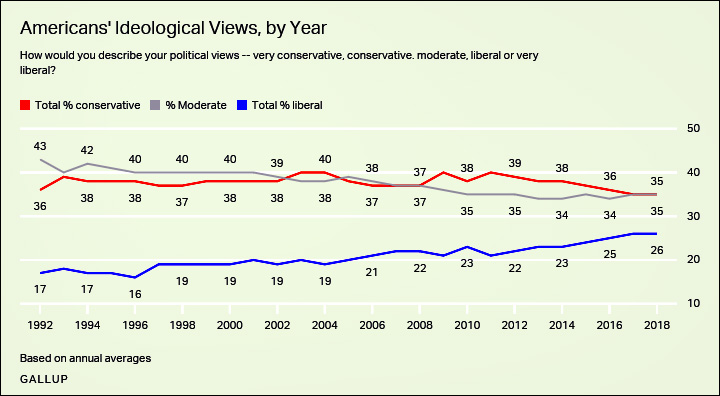
Whatever else you can say about Donald Trump’s appeal, nothing like this has happened in the United States. In fact, just the opposite: the nonwhite share of the population has increased from 25 percent to 40 percent since 1990. This may have produced a short-term white backlash in recent years, but in the long run it’s likely to have exactly the opposite effect of Israel’s demographic change. Trump’s white base may not like it, but America is getting more liberal, not more conservative. See here for a more detailed look at this.
I was browsing through old editions of the Federal Register—who doesn’t, after all?—and learned that the Revenue Act of 1924 set a tax rate of 43 percent on incomes over $100,000 and 46 percent on incomes over $500,000. That’s about the equivalent of $1.5 million and $7 million, respectively, today, compared to a top marginal rate of 37 percent in current law. It’s remarkable, isn’t it, that even a conservative Republican administration in the era of small government taxed the rich more than we do today? It’s also worth noting that the 1924 Act set up 43 tax brackets. Apparently it never occurred to them to invent a dumb canard about lots of brackets having anything to do with the complexity of filing a return.
Oh, and there’s also this. Just thought I’d post it for no particular reason.
A while back I promised you some photos from my visit to the Watts Towers, so why not today? Here are a pair of pictures of the towers in the early morning light, along with two close-ups that show how the towers are constructed. I oversaturated the top photo on the left to show off some of the color of the towers, but it’s hard to get it right at such a small size and in such brilliant light. An overcast day probably would have been better.
December 15, 2018 — Watts, CaliforniaDecember 15, 2018 — Watts, CaliforniaDecember 15, 2018 — Watts, California
How much has rent gone up over the past few decades? Yesterday I put up several posts showing national averages, and while that’s useful to see it doesn’t tell us much about the urban areas that have obviously seen the biggest increases. The problem is that data specific to urban areas is hard to come by. In this post, I want to give you a sense of just how hard it is to find reliable figures on this.
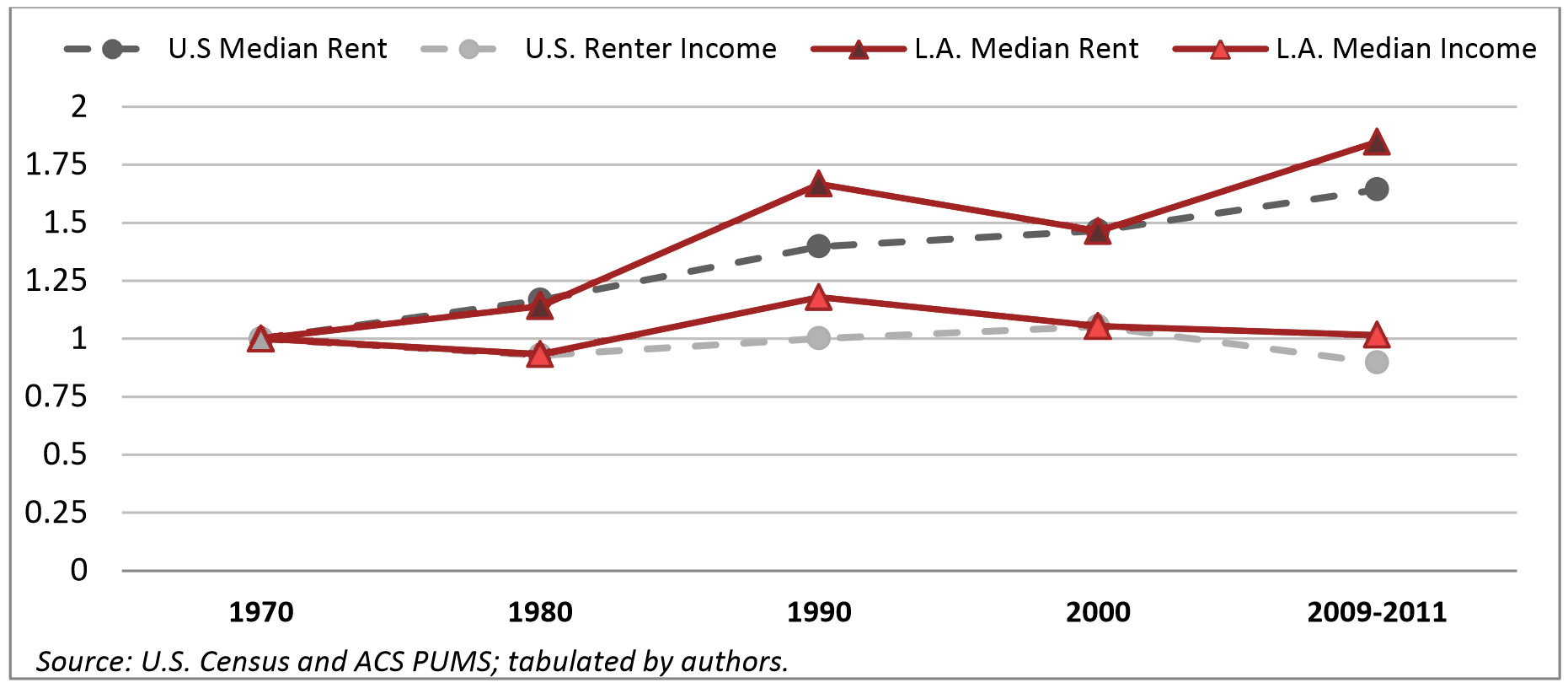
Exhibit A is a report out of UCLA from a few years ago. It’s typical of the reports you see on this subject, and it’s billed as showing that rent burdens have increased substantially in Los Angeles since 1970 (all figures are adjusted for inflation):
If you do a little arithmetic, this chart shows that, relative to income, rents in LA increased about 80 percent between 1970 and 2010 (red lines). However, it also shows that rents nationally increased about 80 percent too (black lines).
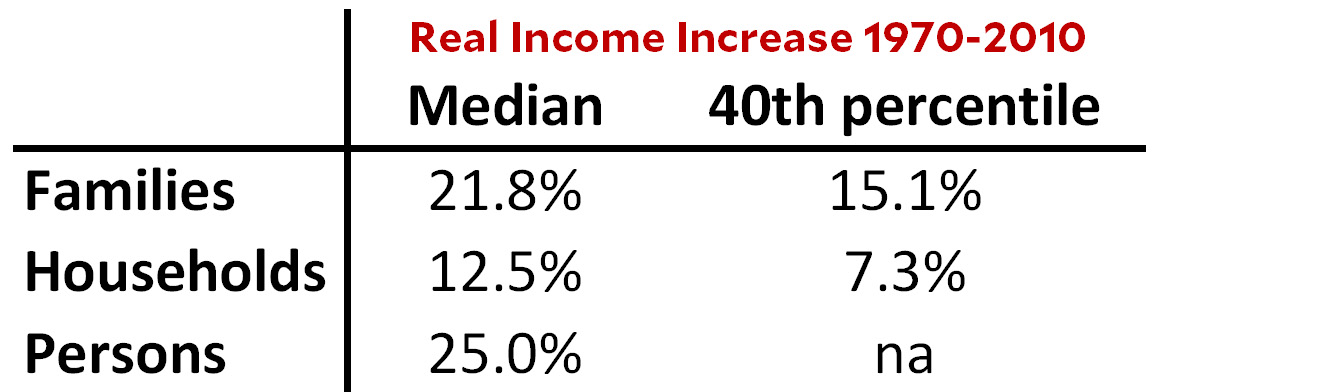
There are several things that should make you suspicious here. First, rents have gone up 80 percent? That’s not a crisis, that’s a catastrophe. Second, rents in LA have increased at the same rate as rents nationally? That doesn’t seem likely. Third, rents in LA increased 50 percent from 1980 to 1990? Yikes! Fourth, median incomes have decreased since 1970? That hardly seems right. In fact, all of these things seem questionable, but it’s difficult to know for sure. Take incomes, for example. Here are several different measures of how much real income grew between 1970 and 2010:
These are all straight from the standard Census Bureau series, and they range from 7 percent growth to 25 percent growth. So which is the best measure? Households or families? Median or the 40th percentile, which is (maybe) more representative of renters? There’s no way to say for sure, but my best guess is that real incomes went up about 15-20 percent between 1970 and 2010.
So why do the UCLA folks show national income decreasing by about 10 percent? And if they’re that far wrong about national income, do we trust their estimates of income for Los Angeles? And anyway, is that an estimate for Los Angeles, or for the Los Angeles SMSA, which includes Riverside and Orange County?
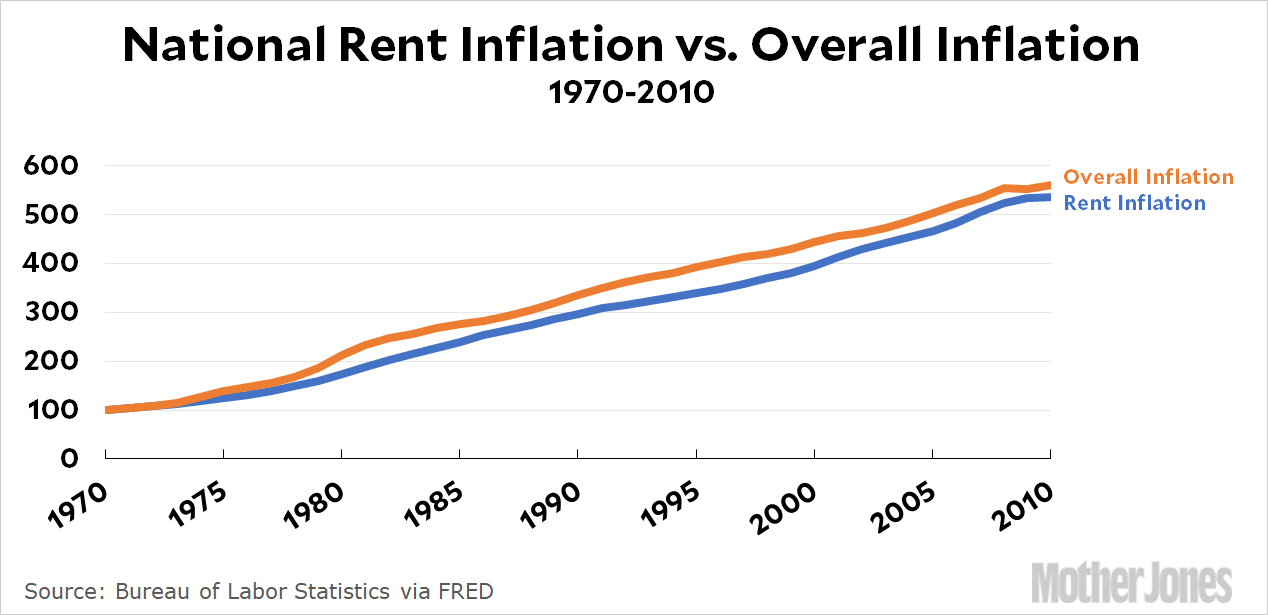
For that matter, do we trust their numbers on rent? They say that rent went up nationally by about 65 percent between 1970 and 2010. But here’s a chart of national rent inflation:
The BLS says that, nationally, rent has increased less than overall inflation. If the authors of this report are off by 70 percent on national rent, are they also off by 70 percent on rent in LA? But wait. Should we compare rent inflation to the CPI (as I’ve done) or to the PCE inflation index? Or, given the stickiness of rents, should we only measure new rents, not rents from people who have been in the same place for years? And maybe we should measure only true rents, not “imputed” rents from homeowners. But then we end up with messy composition effects.
In other words, I’m not even saying the authors are wrong. There are so many ways to measure this stuff that it’s impossible to say there’s a “right” way. That said, they claim in several places that, relative to income, rents in Los Angeles have grown about as much as they have nationally—and there are some pretty standard inflation figures that suggest rents nationally have been stable for a long time. So if it’s true that LA isn’t an outlier, then rents in LA have been stable too.
I’m not saying I believe that. I might believe it, but it’s just too hard to know which figures are the most representative of real life. Caveat emptor.
POSTSCRIPT: It’s worth adding that nothing here implies that housing prices in LA (or elsewhere) are fine. I’m actually sort of agnostic about that. But it’s worth knowing whether housing prices are high but have always been high or higher than they’ve ever been before. One is bad, but the other is potentially a crisis.
And we respect that! But maybe you’re of a mind to support our work directly instead? We have until December 31 to raise the last $400,000 we need to keep our nonprofit newsroom running at full strength into 2026. Will you make a gift today?
We noticed you have an ad blocker on. Can you pitch in a few bucks to help fund Mother Jones' investigative journalism?
Billionaires own the media,
but they don’t own us.
At Mother Jones we know these aren’t conventional times, and they require unconventional coverage. That’s what deliver every day: fierce, independent journalism you can’t find elsewhere. Perhaps never in the history of our country has that been more necessary than now. But we can’t do it without reader support—your support. Please chip in today.
Billionaires own the media,
but they don’t own us.
At Mother Jones we know these aren’t conventional times, and they require unconventional coverage. That’s what deliver every day: fierce, independent journalism you can’t find elsewhere. Perhaps never in the history of our country has that been more necessary than now. But we can’t do it without reader support—your support. Please chip in today.