Over the past decade, the state’s numerous expanded juvenile halls have become near-empty monuments to a costly miscalculation — a mistake compounded each year as the number of young offenders plummeted. Some California counties are spending $1,400 a day to incarcerate each juvenile, or $500,000 annually, up from $400 a day or $150,000 annually just eight years ago….Unlike the surge of violence a generation ago, the plunge in juvenile crime has received relatively little attention and has spurred few demands for action.
My, that is a mystery, isn’t it?
With bigger facilities and fewer wards, the costs of juvenile detention spiked. The Chronicle requested and reviewed juvenile hall and camp populations and spending data from 14 diverse counties, and found that the annual cost of detaining youths increased in each one since 2011, ranging from 29 percent to 214 percent. “It’s really the opposite of what we thought it would be,” Varela said. “We’re all kind of scratching our heads over what we’re going to do with all the extra space.”
….Systemically, there is no clear explanation for why the crime rate dropped, and continued to decline through the 2008 recession and to the present day. Though there’s no consensus, many are eager to offer theories and take credit. Possible reasons include a decline of lead poisoning in children, which reduced the toxic effects on young brains, and pivotal shifts in the street drug trade, including diminishing demand for crack cocaine and strict laws that sent dealers who might recruit young people away for decades.
Give it up, folks. It’s lead. And that’s a very good thing, since it means the drop in juvenile crime is permanent. It’s time to scuttle all that extra space in juvenile hall.
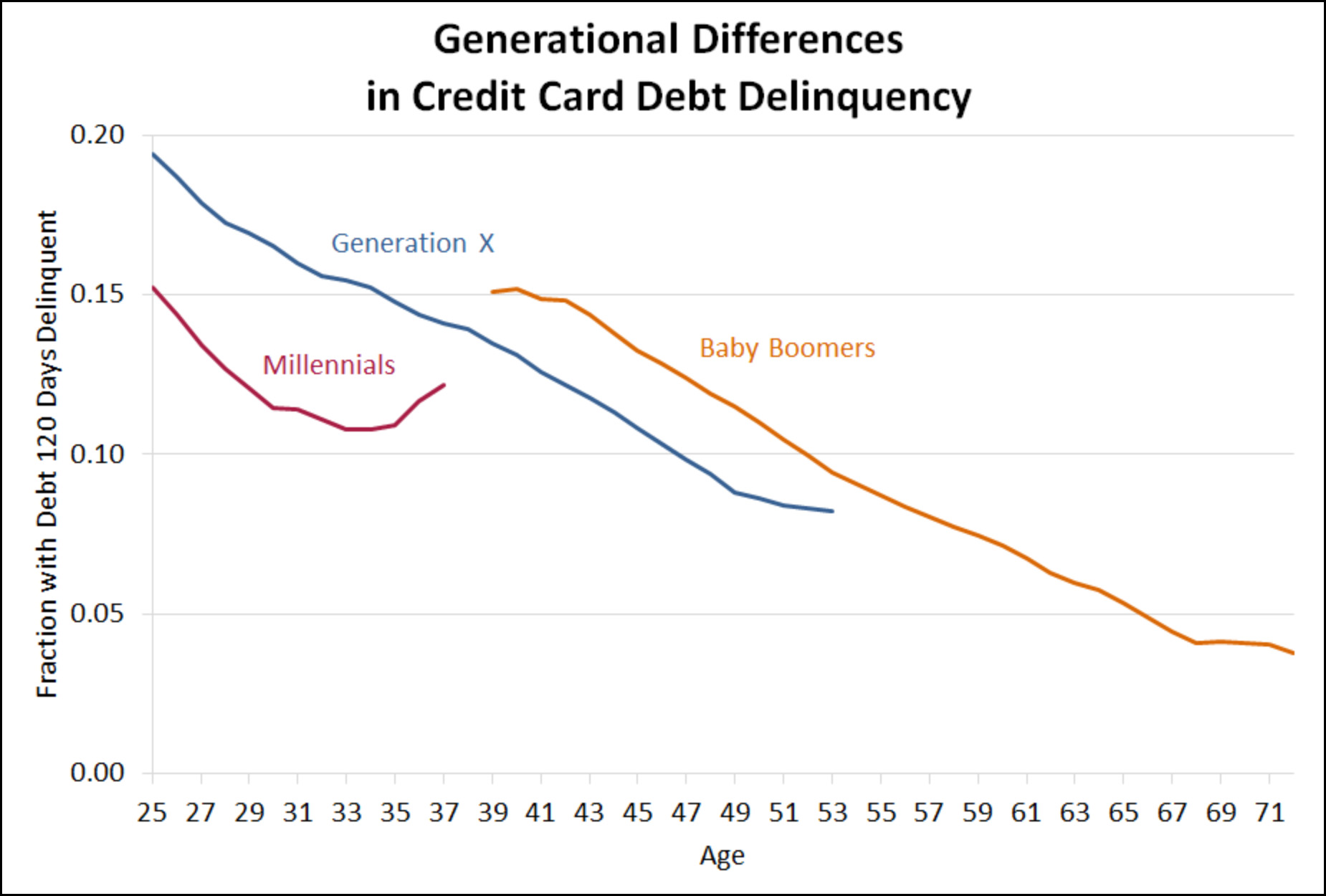
The St. Louis Fed recently republished a note from last November about credit card delinquency. First, they note that millennials have the highest rate of delinquency. But then they make the obvious point that this is because millennials are younger than other generations, and young people always have higher delinquency rates than middle-aged folks. So what happens when you look at different generations when they were the same age?
This is interesting. First, it shows that millennials actually have the least credit card delinquency among recent generations. The authors even suggest that “their relative financial trustworthiness will persist throughout the remainder of their lives.”
But what about that uptick at the end? Starting around age 33, the credit card delinquency of millennials suddenly flattens and then starts to rise. That’s never happened with any other generation, or with younger millennials. What’s up with that? It’s quite prominent and doesn’t look like an artifact, but I can’t even think of a snarky guess about what might be causing this, let alone a serious guess.
The commandant of the Marines has warned the Pentagon that deployments to the southwest border and funding transfers under the president’s emergency declaration, among other unexpected demands, have posed “unacceptable risk to Marine Corps combat readiness and solvency.”
….Neller, a four-star general, said because of the problems, Marines will not participate in planned training exercises in Indonesia, Scotland and Mongolia, and will reduce their participation in joint exercises with Australia and South Korea. Marines “rely on the hard, realistic training” of the training exercises “to develop the individual and collective skills necessary to prepare for high-end combat,” Neller said.
Military folks are notorious for complaining that reducing their budgets by so much as a dime will be a readiness catastrophe. So I guess I’d take this with a grain of salt. Still, it’s yet another sign that the Pentagon is justifiably unhappy about committing both funds and manpower to what they know is a fake national emergency on the border with Mexico.
Hey, who needs a government account to communicate official business? That’s so fuddy duddy:
BREAKING: In letter to WH, Rep. Cummings reveals that KUSHNER was routinely using WhatsApp to conduct official business as recently as Dec. 2018. Kushner’s lawyer told lawmakers he screenshots messages to preserve them.
K.T. McFarland, it turns out, used an AOL email account while she was deputy national security adviser, but I’m sure it was just for trivia, not important stuff like—
Cummings also told Cipollone that the committee obtained a document showing that McFarland was using an AOL.com account to conduct official White House business. Cummings said the document shows that McFarland was in communication with Tom Barrack, a longtime Trump confidant and the chairman of the president’s Inaugural Committee, about transferring “sensitive U.S. nuclear technology to Saudi Arabia.” Barrack pitched the plan to Bannon through Bannon’s personal email account, according to Cummings.
Well, no worries. Nobody cares what anyone but Trump says anyway, and he seems to be very careful in his communications habits.
This is the world’s greatest strip mall. Check it out. It has a smokes store, a wig store, another wig store, a tattoo store, a bail bondsman, and a pawnshop. And if the billboard is to be believed, cheap pot is right around the corner. It’s everything you could possibly want all in one convenient location.
January 2, 2018 — Santa Ana, California
But wait. What’s that at the far end? It looks like a barber shop. If you go around to the side, you can see what makes them famous:
March 19, 2019 — Santa Ana, California
I dunno. They’re still around, so at least a few people must know about them.
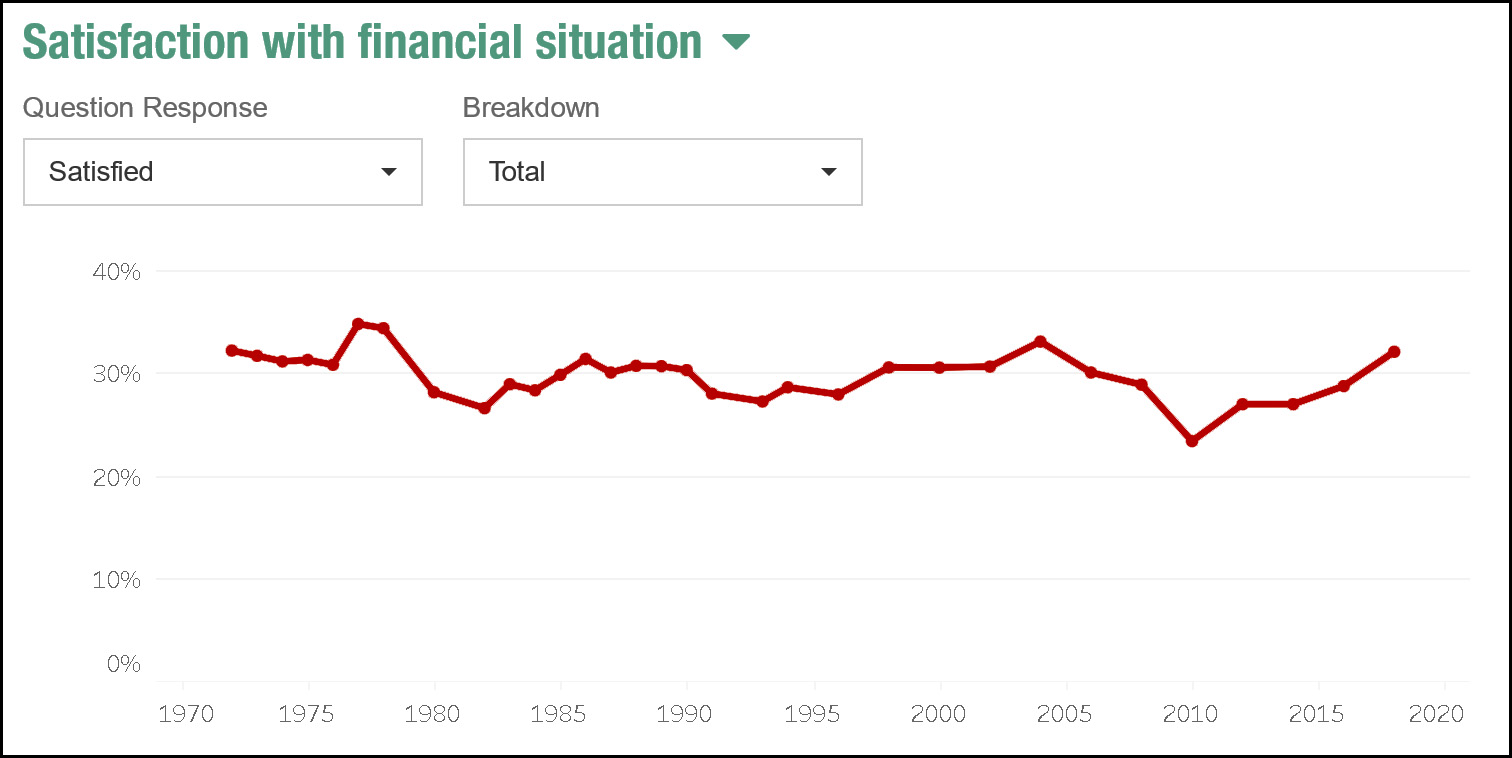
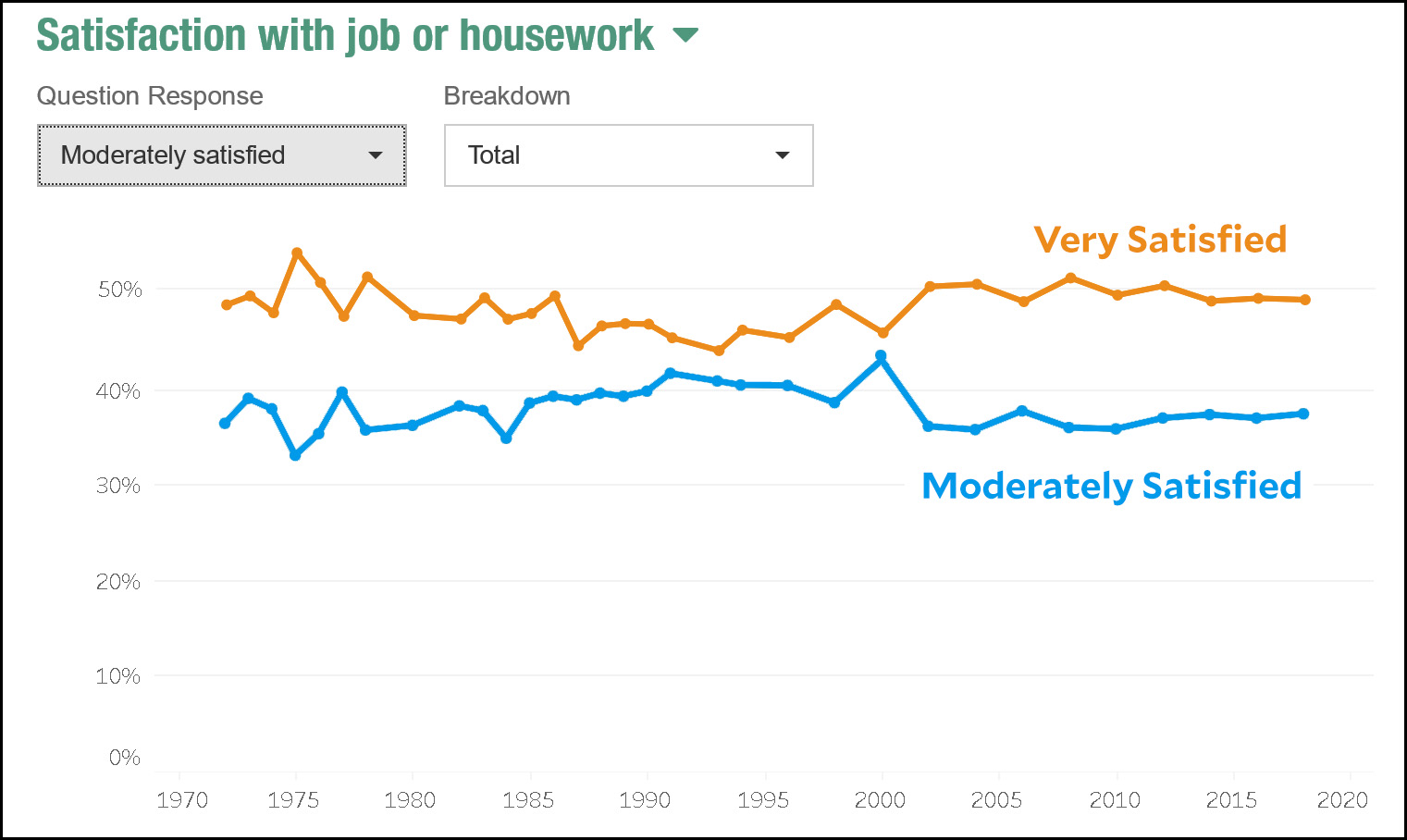
Here are a couple of additional charts from the recently released GSS 2018 data. They relate to a longtime hobbyhorse of mine:
This is another and more up-to-date take on how angry people are, which is often cited as the reason Donald Trump won the presidency in 2016. But are people really angrier than they used to be? Overall financial satisfaction has been rising steadily since 2010, just as you’d expect during an economic expansion. By the end of 2016, financial satisfaction was basically at the same level as it had been since 1990.
As for job satisfaction, it’s been dead flat for well over a decade. There’s just no movement there at all.
Now, people might not always tell pollsters the bare truth. And political campaigns can sometimes unmask emotions that are held in check most of the time. Still, as best we can tell from a broad read of the data, people aren’t any angrier than they have been in the past, nor are they less satisfied with their economic situation. There are plenty of people who will gripe to reporters who parachute in to do a “sense of the nation” piece, but there are always people who will gripe to reporters if they get the chance. The question is whether they’re griping more than usual, and the GSS data suggests they aren’t now and weren’t in 2016.
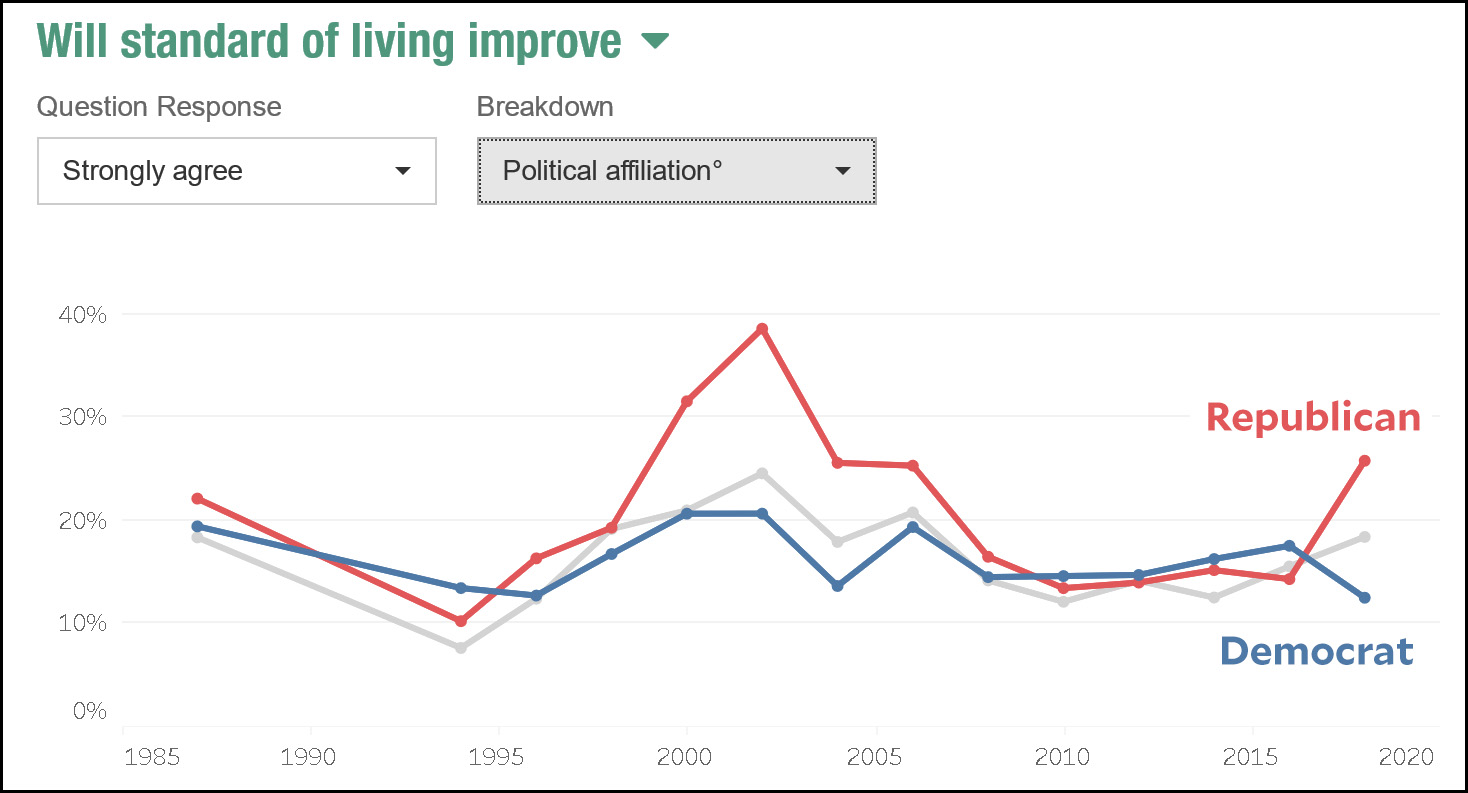
And now, a chart I’m posting just because it amuses me:
With the exception of a couple of years around 2000, everyone is actually pretty close on this question. Until now, that is. With Donald Trump in office, Republicans are giddy about their standard of living going up, while Democrats are certain they’re headed to the poorhouse. By this metric, there’s not much question that Trump is the most polarizing president of the past three decades.
The truth is that good public policy can actually be elegant and simple to understand, even when the social problem that it’s addressing is complex. Social Security, Medicare, bans on indoor smoking, the “do not call” list (when it worked) and public libraries are examples of government solutions that are easy to understand and to benefit from.
Avoidance of complexity and minimizing choices are hallmarks of good design, as we have learned from the technological revolution in user interfaces. The age of impossible-to-use computers and incomprehensible TV remote controls has given way to the sleek and intuitive interfaces offered by pioneers like Steve Jobs of Apple. What progressives most need now is not more brains, but better policy designers.
His go-to example, of course, is Obamacare, and that’s fair enough. There are lots of reasons for the complexity of Obamacare, but that doesn’t change the fact that for most people it requires a “navigator” to walk you through all the options. That’s bad.
On the other hand, it’s not as if Republican policies are simple either. How many health care plans did they go through in 2017? Did you understand all of them? Any of them? How about their tax cut? Do you have any idea what taxes it cuts? Republicans also have a “deregulation” agenda, and I doubt that one person in a hundred could tell you what it really involves.
Obamacare aside—health care really does seem to be a special case until we manage to pass a universal program—the real problem isn’t the grim details of policymaking, it’s the fact that progressives have historically been bad at making bumper stickers for their policies. But that’s changed recently:
Medicare for All
$15 minimum wage
Higher taxes on the rich
Break up Google and Facebook
etc.
These may or may not be good ideas, but they’re pretty simple to understand even though many of them would end up being very complex to design and implement. In any case, this is the key: simple marketing slogans even if the underlying policy might require a fair amount of expert work.
And one more thing: one of the reasons for the complexity of progressive policy is our belief that government programs have to be fair to everyone. Unfortunately, this is really hard, and there are diminishing returns as you desperately try to eliminate every last bit of unfairness. The Green New Deal, for example, would be about one-quarter its size if it just concentrated on climate change instead of tossing in dozens of other items about environmental and social justice. So these are genuinely competing imperatives. Simplicity is good, but so is fairness. It’s hard to get both at the same time.
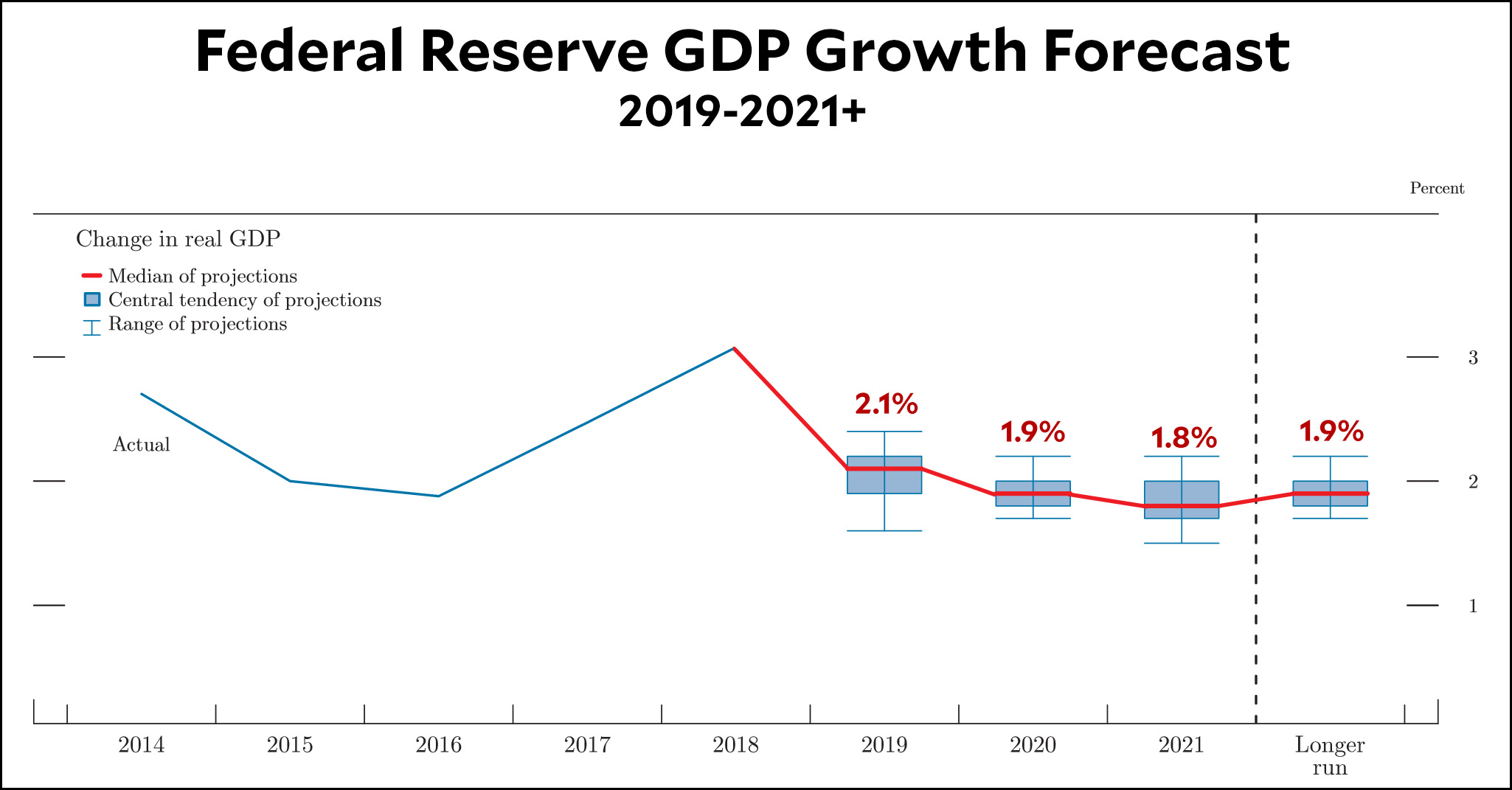
Trump is the only human being on the planet who believes that growth will be over 3 percent this year. It’s true that his staffers are playing along, but only because there’s no other way to remain employed in Trump’s White House. I don’t think even they’re quite dumb enough to actually believe what they’re saying.
Trump, though, is a different story. I have no doubt that he believes. It’s what the voices in his head tell him, after all.
This is a sunset picture of the Sutter Buttes, the smallest mountain range in the world. That may seem an odd claim, since there are plenty of peaks that are far smaller. However, apparently something is a “mountain” only if it’s created by a specific type of geological activity. Your average foothill doesn’t qualify. However, the Sutter Buttes do, and no other genuine mountain range is smaller.
In his latest budget plan, President Trump proposed substantial cuts to Medicare even though he had promised repeatedly on the campaign trail never to do this. Over at NRO, Michael Strain thinks this is fine:
I’m with the president on this one. Three cheers for slowing the growth of Medicare.
Some of the cuts are very well designed because they would change the structure and underlying incentives of certain Medicare components. For example, physicians working in offices owned by, but not located in, hospitals would no longer be paid more for services than physicians working in offices not owned by hospitals. Other cuts are simply blunt reductions in payments to providers. The proposed budget is awarded 1.5 cheers for the way the overall cuts are designed.
I’m not going to comment on every single aspect of Trump’s cuts. Some of them might be reasonable reforms that are worth supporting. But three cheers for slowing the growth of Medicare? How much does Strain want it to slow down?
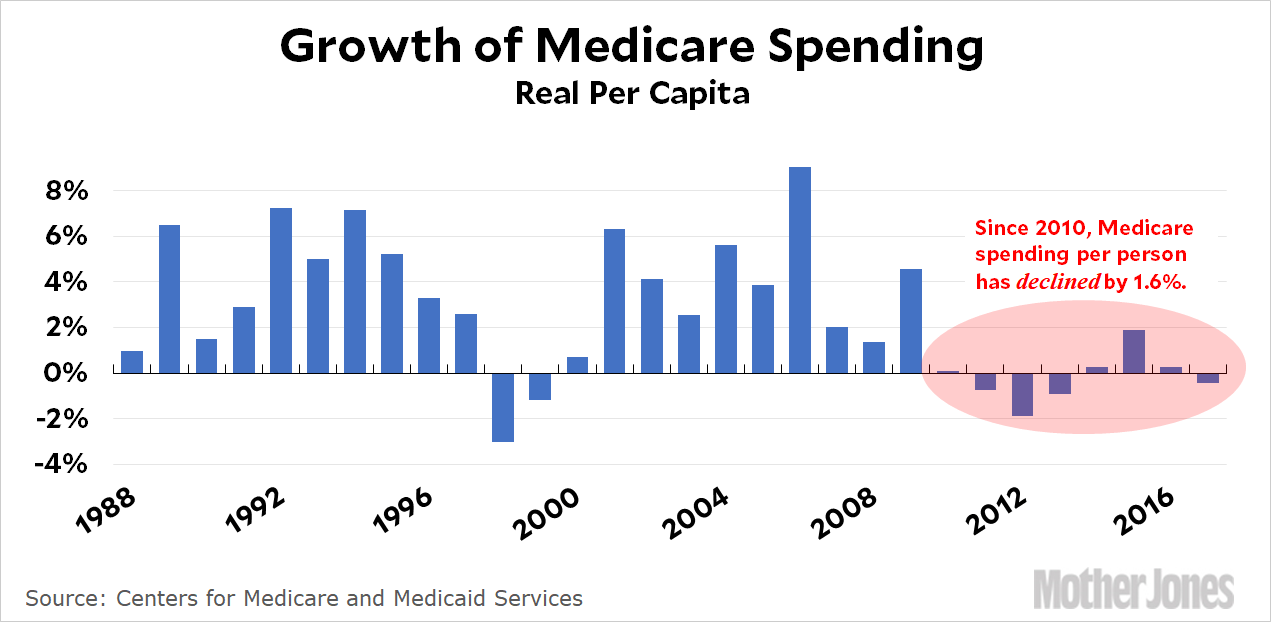
Medicare spending per person grew substantially up through 2009, with an especially big increase in 2006 when the prescription drug benefit kicked in. But since 2010 it hasn’t grown at all. In fact, Medicare spending per person has gone down by 1.6 percent.
That’s eight consecutive years of flat spending, and it’s consistent with the slowdown in private health care spending that we’ve seen over the same period. Medicare just isn’t the big, bad budget killer that it used to be.
Now, total Medicare spending will still go up as the baby boomers retire and more people are enrolled in Medicare. But that’s not a bad thing. People who retire over the next decade deserve Medicare coverage as good as it’s been in the past, don’t they? It’s one thing to oppose Democratic plans to expand Medicare, but it’s quite another to pretend that traditional Medicare spending is still spiraling out of control. It just isn’t.
And we respect that! But maybe you’re of a mind to support our work directly instead? We have until December 31 to raise the last $400,000 we need to keep our nonprofit newsroom running at full strength into 2026. Will you make a gift today?
We noticed you have an ad blocker on. Can you pitch in a few bucks to help fund Mother Jones' investigative journalism?
Billionaires own the media,
but they don’t own us.
At Mother Jones we know these aren’t conventional times, and they require unconventional coverage. That’s what deliver every day: fierce, independent journalism you can’t find elsewhere. Perhaps never in the history of our country has that been more necessary than now. But we can’t do it without reader support—your support. Please chip in today.
Billionaires own the media,
but they don’t own us.
At Mother Jones we know these aren’t conventional times, and they require unconventional coverage. That’s what deliver every day: fierce, independent journalism you can’t find elsewhere. Perhaps never in the history of our country has that been more necessary than now. But we can’t do it without reader support—your support. Please chip in today.