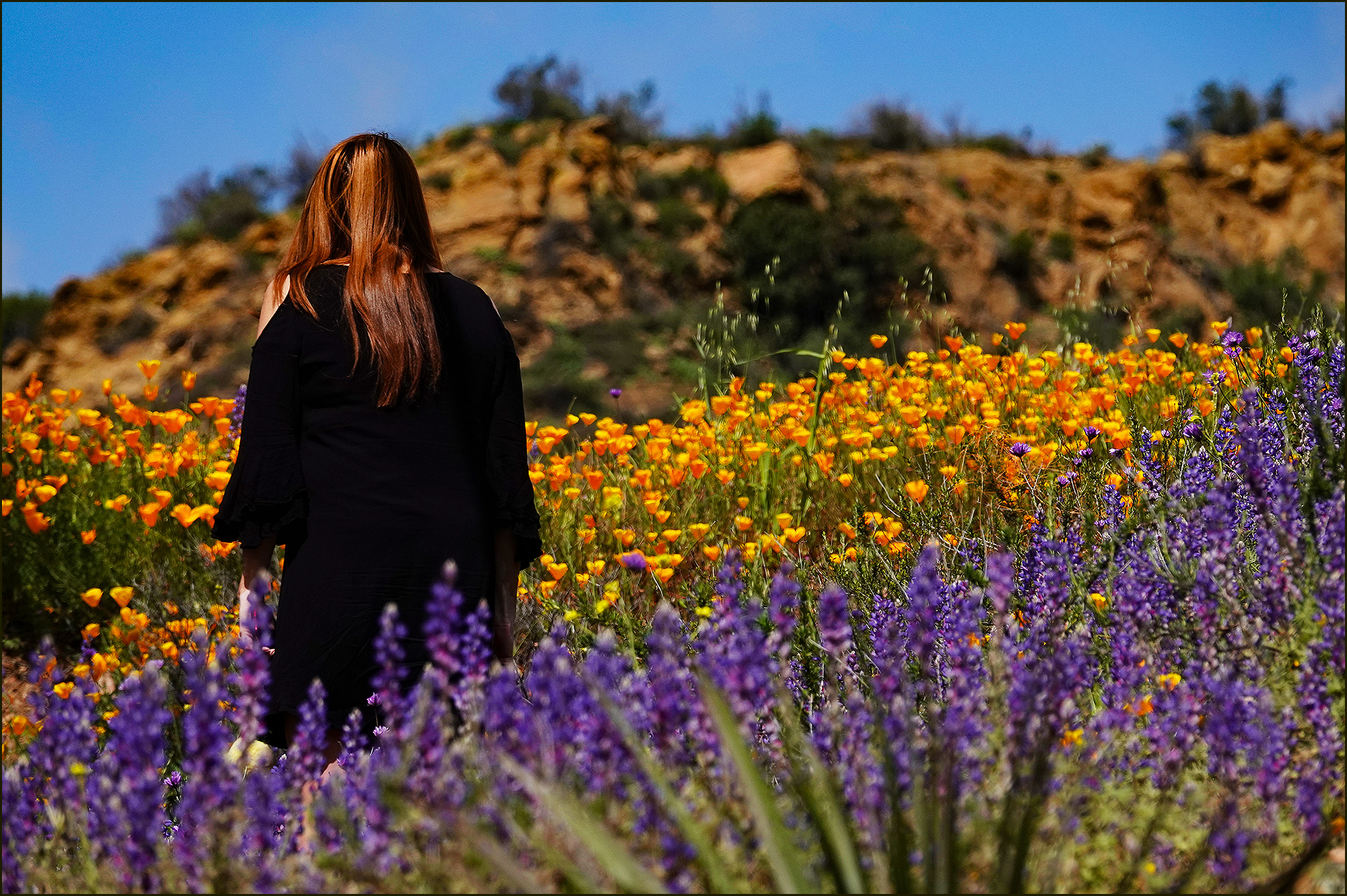
Well, maybe not the superbloom. More like a very commendable bloom, I suppose. However, this bloom is about 20 minutes from my house and has no crowds, so I’ll take it. For you locals, these pictures were all taken at a very nice poppy bloom on Silverado Canyon Road near the post office:
March 24, 2019 — Orange County, CaliforniaMarch 24, 2019 — Orange County, CaliforniaMarch 24, 2019 — Orange County, California
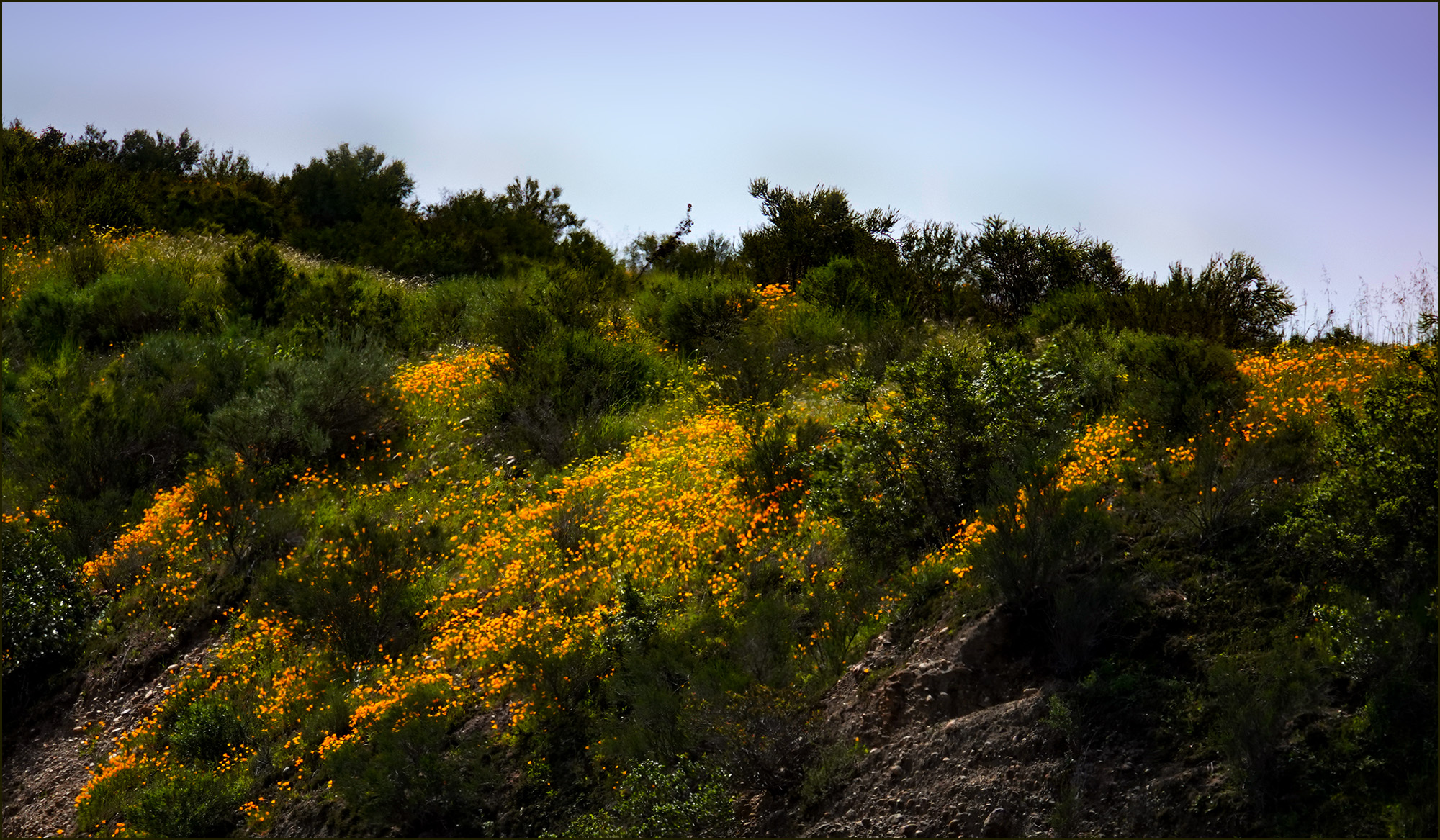
And here’s what the bloom looks like from a distance. This is not the one on Silverado Canyon Road, which is easily accessible even for pitiful couch potatoes like me. It’s on a hillside to the west of Santiago Canyon Road, and probably not accessible at all. I didn’t even try to find out.
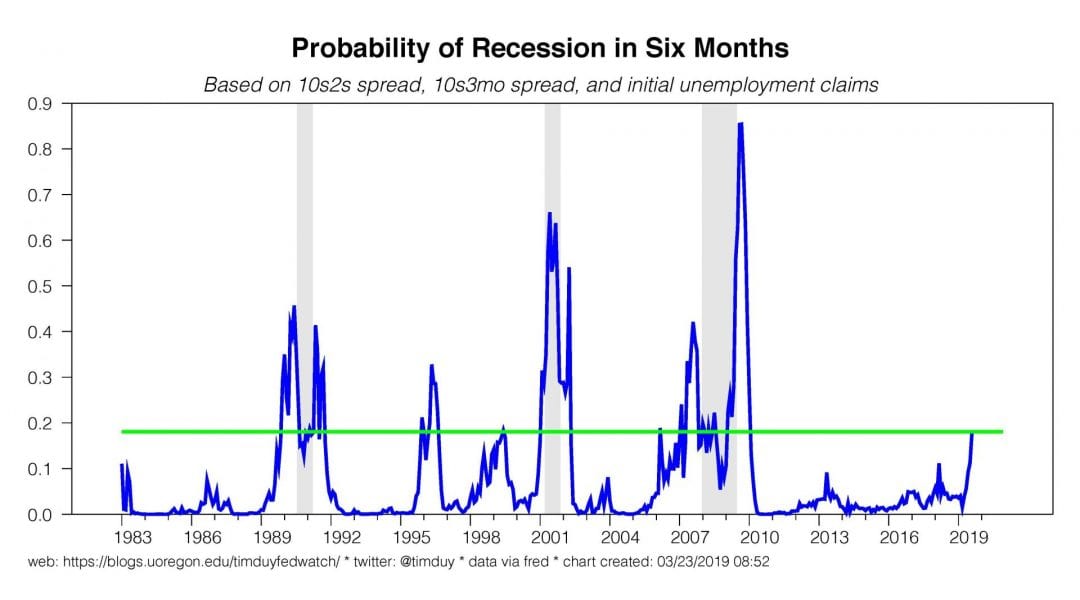
Fed expert Tim Duy is getting seriously worried. Based on the movement of short-term and long-term interest rates, he thinks the chance of a recession in the next few months is getting very high:
Duy thinks the Fed needs to cut interest rates sooner rather than later:
So now I switch from analyst to commentator: The above leads me to the conclusion that the Fed needs to get with the program and cut rates sooner than later if they want to extend this expansion. Given inflation weakness and proximity to the lower bound, the Fed should error on the side of caution and cut rates now. Take out the insurance policy. It’s cheap. There will be plenty of opportunity to tighten the economy into recession should inflation emerge down the road.
This is probably pointless, but I’d like remind everyone that we know precisely one (1) thing about the Mueller report:
Mueller did not find sufficient evidence to think he could convict Trump or his campaign staff of direct criminal collusion with Russia’s social media and hacking operations.
That’s it. There’s obviously far more than this in the full report, which we’re (so far) not being allowed to see. Until we are, everyone on all sides would be well advised to avoid making sweeping statements about what we know. The truth is that we barely know anything more today than we did a week ago. It’s likely there’s a reason for that.
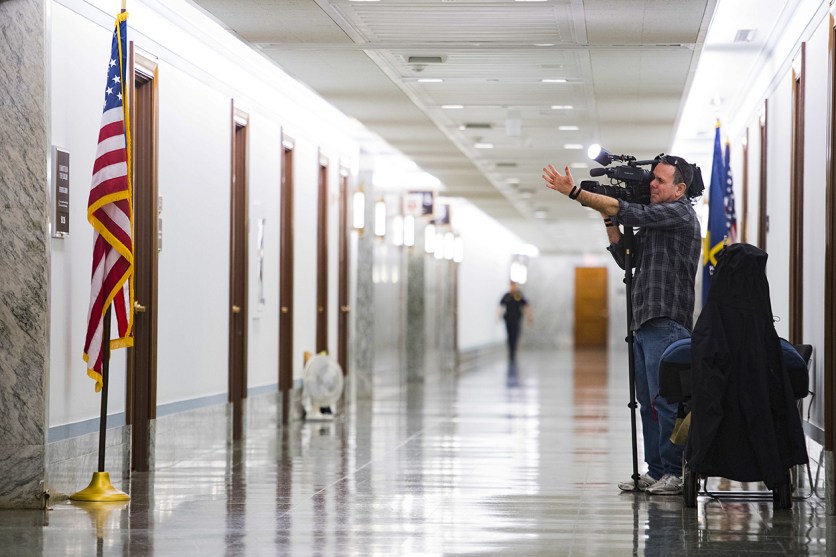
A cameraman stakes out the Senate Judiciary Committee office hoping that someone will pop out with a copy of the Mueller report. But it never happened.Tom Williams/Congressional Quarterly/Newscom via ZUMA
The spin machine is in full gear today. Instead of simply releasing Mueller’s summary of the Mueller report, Attorney General William Barr has decided to release his own summary. I can’t think of any good reason for doing this aside from the possibility that Mueller’s own summary contains some conclusions that Barr and his boss would just as soon not reach the public ear.¹ Apropos of my warning yesterday, then, you should consider Barr’s summary to be the rosiest possible interpretation of the Mueller report.
The Special Counsel’s investigation determined that there were two main Russian efforts to influence the 2016 election. The first involved attempts by a Russian organization, the Internet Research Agency (IRA), to conduct disinformation and social media operations in the United States designed to sow social discord….The second element involved the Russian government’s efforts to conduct computer hacking operations designed to gather and disseminate information to influence the election.
That’s it? But I don’t think anyone has ever seriously suspected that Trump (or his staff) was directly involved with the IRA disinformation campaign or the Russian hacking operations. The suspicions of coordination have mainly revolved around more personal contacts: Manafort’s friends in high places; the Trump Tower meeting with Don Jr. and others; the Carter Page weirdness; the Moscow real estate deal that went south; and so forth. It’s possible, of course, that Mueller concluded in his report that none of this amounted to collusion in any criminal sense, but surely he at least addressed this stuff? So why doesn’t Barr mention it?
On the subject of obstruction of justice, Mueller punted. “While this report does not conclude that the President committed a crime,” he says, “it also does not exonerate him.” Needless to say, this did not stop Trump from tweeting his take on “does not exonerate”:
No Collusion, No Obstruction, Complete and Total EXONERATION. KEEP AMERICA GREAT!
As usual, this is a lie aimed at his followers, who will not read the Barr summary and will instead rely on outlets like Fox News and Breitbart for their news. I think we can safely assume that the conservative media will ignore Mueller’s words and will instead promote Barr’s conclusion that there was no obstruction. However, since Barr was hired specifically to come to this conclusion no matter what, it’s hard to take it very seriously.
Anyway, I am now more eager than ever to see the Mueller report. I never thought that Trump was directly connected with Russian hacking, so Mueller’s conclusion on that front doesn’t surprise me. Nonetheless, if even Barr’s summary was forced to tiptoe so conspicuously around Mueller’s conclusions, I think we can assume that the Mueller report itself is at least moderately damning. Let’s see it.
¹It’s true that the Mueller report probably needs to be redacted here and there, but surely the report’s summary could be redacted pretty quickly?
I don’t have anything to say about the Mueller report because, like everyone else, I haven’t yet seen the Mueller report. But I will offer one warning: for at least the next few days, the only public information will be leaks—official or otherwise—from the Justice Department. These leaks will almost certainly be calculated to present the report in the most favorable light. The goal is to influence the initial news reporting and thus influence the public before we see any of the details.
So: take the reporting over the next few days with a big grain of salt. It’s almost certain not to be a balanced account. Wait for the whole report to come out before you conclude anything one way or the other.
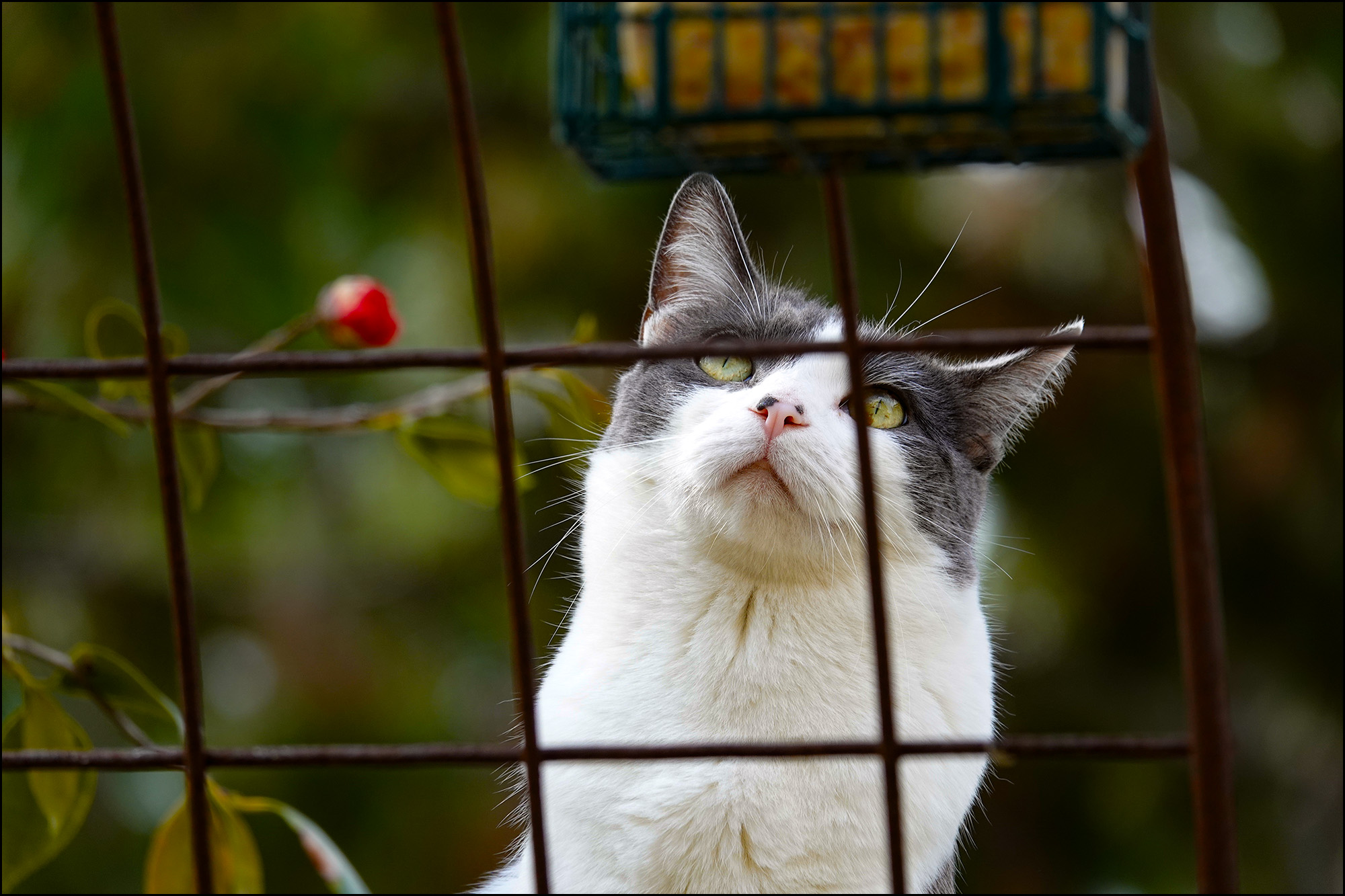
Hopper is smart enough to figure out that birds like to congregate at the bird feeder. However, she’s not smart enough to figure out that they will decline to congregate if she’s sitting there staring at it. This produced something of a bird feeder fiasco, so we’ve now moved it out to the front yard. It seems to work better there.
New York City Mayor Bill DeBlasio has been pushing a plan to change the way students are selected for New York’s elite academic high schools. His plan is probably dead (it requires approval at the state level), but it got a push this week when it was announced that only seven black students were accepted into Stuyvesant High School, one of those elite campuses. Overall, the incoming freshman class at the eight elite schools was only 3 percent black in a school system that’s a quarter black.
None of this is by accident….New York State passed the Calandra-Hecht Act in 1971 which stated that “admissions to [these specialized high schools] shall be solely and exclusively by taking a competitive, objective and scholastic achievement examination.”…Essentially, these schools enshrined into law the right to ignore school performance, grades, interviews, standardized state exams, or any other qualification in favor of a test that rarely aligns with the standards they learn in school, tacitly keeping these schools out of reach for under-resourced students and schools. The specialized high schools continue to exemplify why New York City has the most segregated school system in the country.
The Specialized High School Admission Test, much like the IQ tests of yore and the SAT or ACT of the present, has been gamed since its inception. Everything from expensive test prep centers concentrated in specific neighborhoods to private tutors who spend hours with students across the city helps exacerbate admissions, and with it racial disparity.
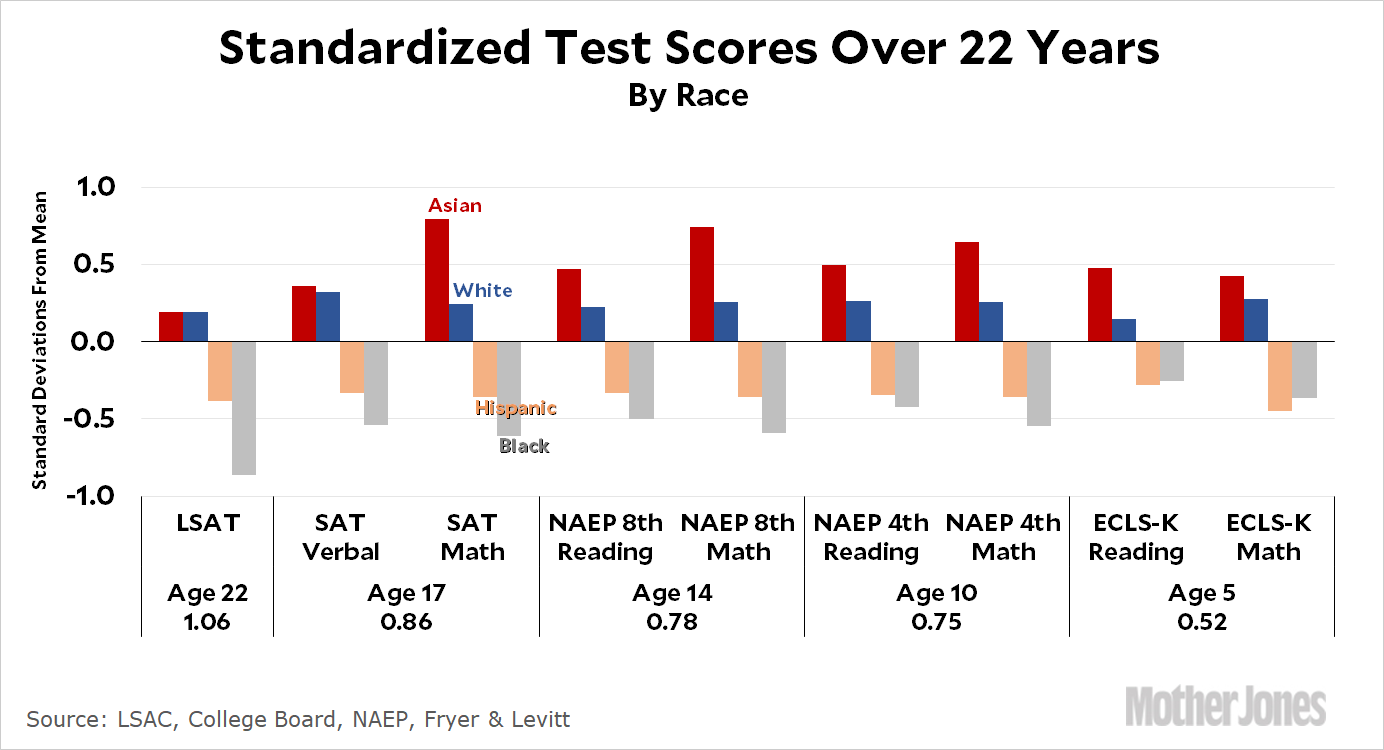
I think progressives are ill-served by the continuing notion that the black-white gap is mostly due to things like test prep and biased tests. Over the past several decades, the organizations that create these tests have gone to considerable lengths to address racial bias, and they’ve been largely successful. The tests aren’t perfect, and they have flaws quite aside from any questions of race, but they aren’t terrible either. They also show a consistent but complicated pattern. Here’s a chart showing racial gaps for a lifetime of student testing:
There are several things to understand about these results:
The black-white gap shows up as early as kindergarten and primary school—long before test prep classes come into play—and continues all the way through graduate level tests like the LSAT.
Since every test has a different scale (120-180 for the LSAT, 400-1600 for the SAT, etc.), you can’t compare them using raw scores. Instead, you have to convert the scores to standard deviations from the mean. The chart above does this, with the black-white gap shown for each age group, and you can see that the black-white gap increases over time. Very roughly, the gap is 0.5 SD in kindergarten, 0.7 in fourth grade, 0.8 in eighth grade, 0.9 in high school, and 1.1 at the graduate level.
With the possible exception of the initial kindergarten gap, these gaps continue to show up even after you control for income, class, parental education, test prep, etc.
These gaps are real effects of education, not just an artifact of test-taking, and the fact that the gaps increase over time is good evidence that much of the fault lies with our schools and the communities they serve. We miss this if we insist that standardized tests are useless. After all, if there’s no “real” gap at all, then our schools must be doing fine.
I’m no expert in how to close this gap, though I can say that there have been many dozens of serious efforts—some aimed specifically at schools, others aimed at parents and communities—and virtually all of them have failed. In any case, we shouldn’t pretend there’s nothing here except a bunch of racist test constructors. The black-white performance gap in America is real; it’s a national disgrace; and we can’t give up trying to fix it. If we could figure out how, no matter how much it cost, I’d take it over the mythical hope of reparations any day.
UPDATE: I have replaced the original chart with one that shows test results as standard deviations from the mean. This is a way of comparing different tests with different raw scale scores.
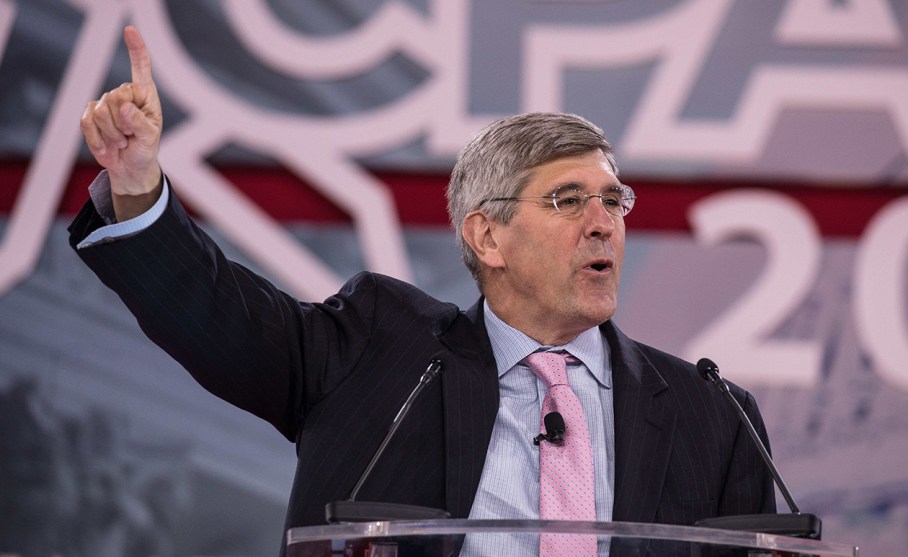
Donald Trump has nominated Stephen Moore, a TV buddy of Larry Kudlow, to serve on the Federal Reserve Board of Governors. This is about like nominating Dr. Phil to run the CDC. Or, come to think of it, like choosing Larry Kudlow as director of the National Economic Council.
Mr. Trump spoke to Mr. Moore to compliment the economic commentator on an opinion article he co-authored last week calling the Fed Chairman Jerome Powell’s policy moves a threat to the U.S. economy….Moore for many years argued against the Fed’s postcrisis policies to keep rates low and to buy long-term bonds to stimulate growth, warning that the measures would stoke high inflation. But he has recently said the Fed is making money too tight, echoing Mr. Trump’s criticism of Mr. Powell and the Fed.
Moore is a hack who argued—absurdly—for high interest rates as long as a Democrat was in office, but then made a sudden U-turn when a Republican president needed to be sucked up to. And it’s paid off. It’s impossible to flatter Donald Trump so much that he figures out what you’re doing, and sure enough, Moore’s willingness to abase himself to Trump’s beliefs has earned him a big promotion.
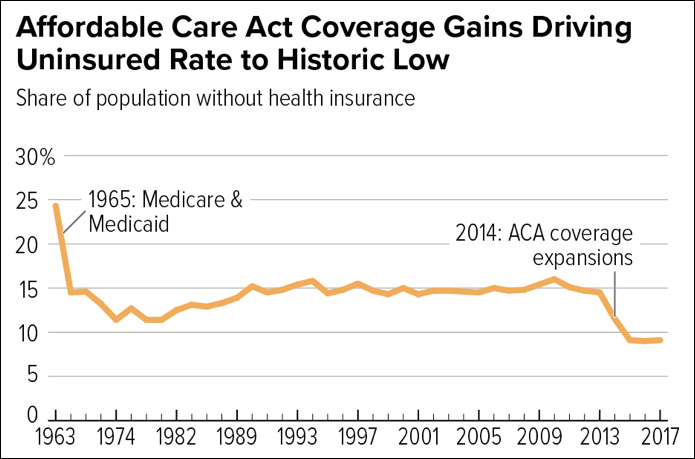
This looks great to me aside from the fact that we still have 10 percent of the country to go. But conservatives were dead set against Medicare and Medicaid in the 60s, and they’re dead set against Obamacare today. They just hate the idea of poor people getting medical coverage. I wonder why that bothers them so much?
And we respect that! But maybe you’re of a mind to support our work directly instead? We have until December 31 to raise the last $400,000 we need to keep our nonprofit newsroom running at full strength into 2026. Will you make a gift today?
We noticed you have an ad blocker on. Can you pitch in a few bucks to help fund Mother Jones' investigative journalism?
Billionaires own the media,
but they don’t own us.
At Mother Jones we know these aren’t conventional times, and they require unconventional coverage. That’s what deliver every day: fierce, independent journalism you can’t find elsewhere. Perhaps never in the history of our country has that been more necessary than now. But we can’t do it without reader support—your support. Please chip in today.
Billionaires own the media,
but they don’t own us.
At Mother Jones we know these aren’t conventional times, and they require unconventional coverage. That’s what deliver every day: fierce, independent journalism you can’t find elsewhere. Perhaps never in the history of our country has that been more necessary than now. But we can’t do it without reader support—your support. Please chip in today.