• Angry Uncle Review: The Angry Uncle Bot

    Perhaps I will dedicate myself today to reviewing other people’s advice about how to deal with angry uncles at Thanksgiving. First up is Karin Tamerius, a former psychiatrist and the founder of Smart Politics. She recommends a five-step process:

    1. Ask open-ended, genuinely curious, nonjudgmental questions.
    2. Listen to what people you disagree with say and deepen your understanding with follow-up inquiries.
    3. Reflect back their perspective by summarizing their answers and noting underlying emotions.
    4. Agree before disagreeing by naming ways in which you agree with their point of view.
    5. Share your perspective by telling a story about a personal experience.

    In order to practice, Tamerius has created the Angry Uncle Bot, which allows you to simulate a conversation with your Trump-loving uncle. That’s handy!

    Unfortunately, the “correct” answers are pretty obvious, and it’s not clear if this technique has been tested in the real world. The Uncle Bot is an innovative idea, but I’m afraid the all-too-conventional 5-step process reduces its usefulness. I give it three uncles out of five.

  • Angry Uncle Review: Mad Politics

    Forget about arguing with your angry uncle this Thanksgiving. Your best best is to become your angry uncle. Donald Trump recommends this book as a primer:

    Step 1: Read this book. Step 2: Absorb its lessons. Step 3: Buttonhole your angry uncle as soon as he walks in the door and start talking. He’ll be excited to learn that you’ve finally seen through the fake media and now understand things. Much conversation will ensue and he’ll leave everyone else alone. Step 4: At the end of the evening, drink. A lot. Step 5: Wake up the next morning with a killer hangover but no memory of what happened.

    Just think of the service you’ve done for your family! That said, the sheer difficulty and post-Thanksgiving pain this causes makes it suitable only for the hardiest and most dedicated Thanksgiving warriors. For those people—and only those people—I give it four uncles.

  • A Question About All Those Angry Uncles

    Things are a little slow aside from the usual deluge of “Donald Trump is a moron” stories, and I’m not in the mood right now. So with Thanksgiving fast approaching, I have two questions for the hive mind:

    First, what’s with the angry uncles? Every year, the news media is crammed with stories about how every Thanksgiving dinner is dominated/ruined by a cranky, elderly, Fox-watching uncle who, for some reason, can’t be ignored and turns the entire event into a hideous battle royale. Just how true is this? I don’t doubt that it’s sometimes true, but how many of you have to suffer through this every year? Lots of you? Just a few of you? Does it only happen on Thanksgiving? What about Christmas? Or Passover? Or Independence Day?

    Second, assuming that these angry uncles exist in nontrivial numbers, has anyone ever gotten any good advice from those “How to handle your angry uncle” advice columns that festoon the internet? Or are they as clueless as I suspect them to be, written by people who have only a theoretical knowledge of what an angry uncle is like?

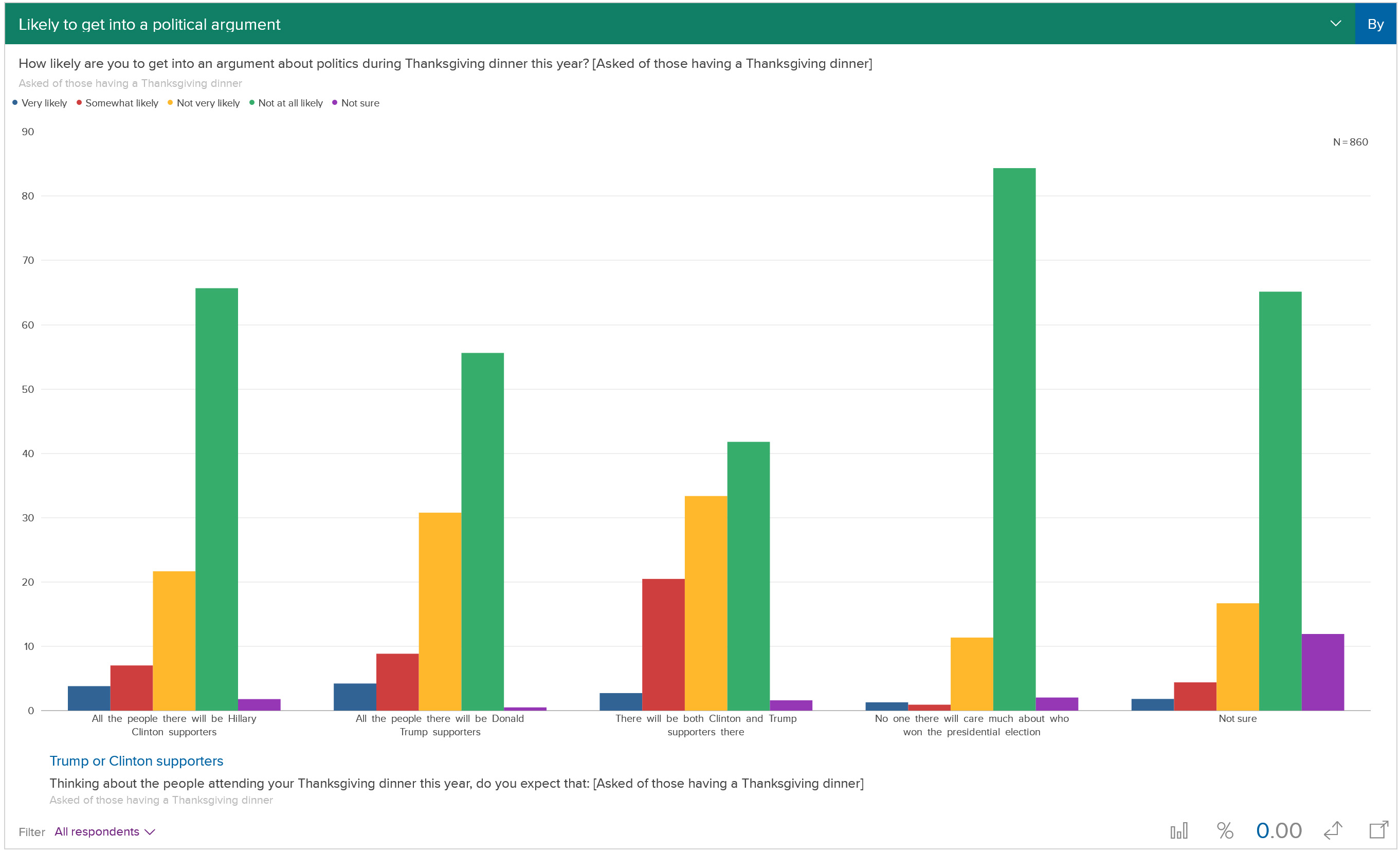
    UPDATE: We have some scientific evidence! According to a poll of 860 people conducted last year by HuffPost’s Ariel Edwards-Levy, very few people argue about politics at Thanksgiving. Eyeballing the chart, it looks like dinner-table fights break out at about 10 percent of all Thanksgiving dinners.

  • Lunchtime Photo

    We’re getting near the end of my Overexposed LA™ series, and I can feel the sadness in the air. But there are still a couple more to go. This one is the Eli Broad Museum, which is really hard to get a good picture of because there’s so damn much crap in the way. So I turned it into a Photoshop lesson for myself, taking the picture from across the street and then removing the traffic light that covers the front corner. (It sprouts up from the green light in the photo below.) If you look closely you can see where I cloned bits of the facade, but for the most part everything lines up fairly well. And I get better at this every time I do it.

    Coming soon: an open pit in downtown LA. Exciting!

    June 22, 2018 — Los Angeles, California
  • New Study Says EITC Expansion Would Be 87% Self-Financed

    The Earned Income Tax Credit is, in theory, everyone’s favorite form of social welfare. It’s plain old money that recipients can spend on whatever they want, but it’s only available to people who have a job and file income taxes. Thus, it encourages work and provides help to people who are really trying to claw their way out of poverty.

    But in recent years, conservatives have decided they don’t like the EITC so much after all. Sure, Milton Friedman liked it and Ronald Reagan liked it, but that was a long time ago. For today’s movement conservatives, it’s just more welfare money that’s funded out of higher taxes on rich people, and they have a lot less tolerance for that than old-school conservatives did.

    But perhaps they should rethink this. Reihan Salam points me to a job market paper by Jacob Bastian, a postdoc at the University of Chicago, and Maggie Jones of the Census Bureau, which suggests that the EITC costs a lot less than anyone thinks. Back in the old days of blogging we used to call the key finding of a piece the “nut graf,” but in this case I think we have a nut chart. Here it is:

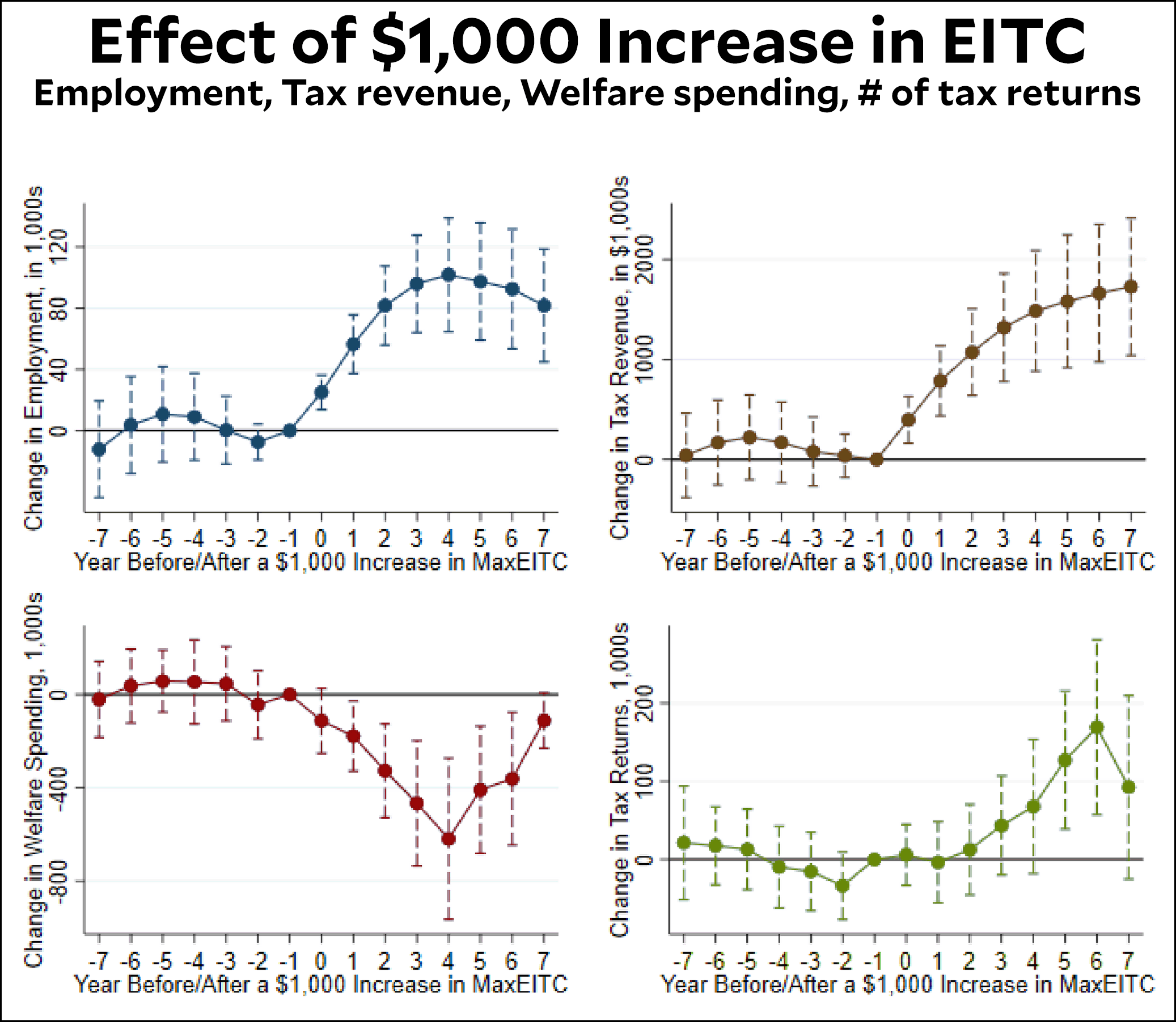
    Bastian and Jones find that an increase in the EITC leads to higher employment, higher tax revenue, and reduced spending on other welfare programs. Here’s how that works out:

    In a nutshell: For every $1,000 increase in EITC, there’s an average takeup of $350. Of that, $306 is recouped in the form of higher taxes paid and reduced welfare payments from other programs. The net cost is not $350, but $44. This means that EITC is 87 percent self-financing.

    Now, as Bastian and Jones point out, this presents an obvious question: If EITC mostly just takes the place of other welfare programs, does it really help the poor all that much in the first place? This question is not answered. However, I’d score it a strong yes for several reasons. First, replacing in-kind assistance with cash provides the working poor with more flexibility. Second, EITC is relatively cheap and easy to administer. Third, EITC encourages work, which is a positive benefit for everyone. Fourth, there’s voluminous research that EITC produces a variety of positive effects on crime, health, education, children’s earnings, and so forth.

    The positive effect of the EITC is higher for unmarried women than for married women, and Bastian and Jones estimate that it would also be highly positive for women without children, who are currently extremely limited in the amount of EITC they can claim. Changing the EITC to provide benefits regardless of whether you have children would be good public policy and, in the end, would cost very little.

  • Tech Stocks Are Getting a Comeuppance

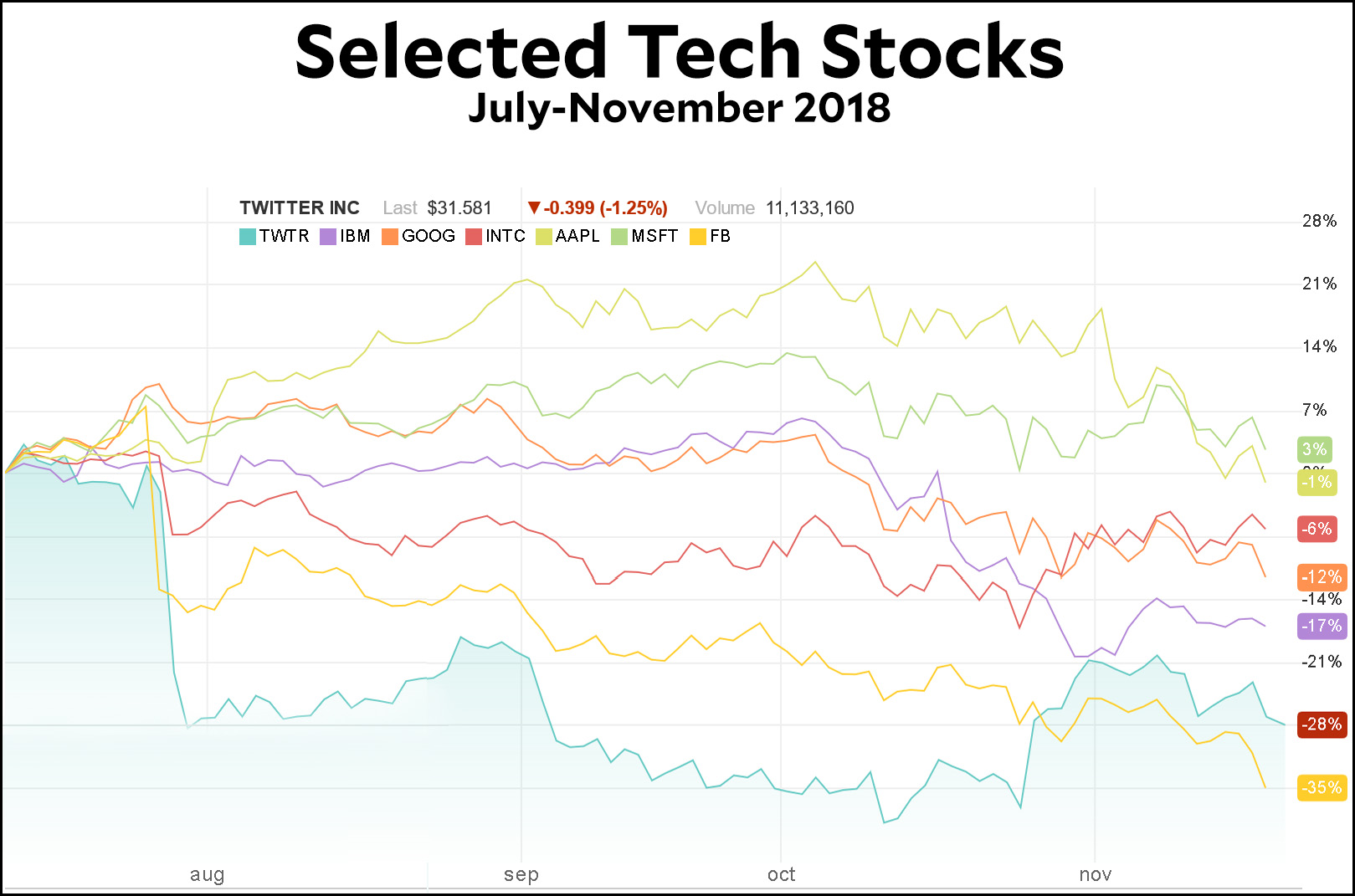
    “Tech selloff spreads,” says the Wall Street Journal. But just how bad is it? Here’s the performance of a few selected tech stocks since summer:

    Microsoft is up 3 percent, but that’s about it. Everyone else is down, even mighty Apple—which has further problems on its hands since apparently its new line of iPhones isn’t selling very well. As for Facebook, well, it’s now on a steady, inexorable decline. No wonder Mark Zuckerberg thinks they’re at war. Any company that loses a third of its value in half a year is sure at war with somebody.

  • Soybean Exports Have Crashed in 2018

    Apropos of nothing in particular, I thought I’d check in and see how US soybean exports are doing. As you’ll recall, we ship a lot of soybeans to China, but in July China levied a 25 percent tariff on American soybeans in retaliation for our tariffs on steel, aluminum, and other products. Here are exports to China in 2018 compared to 2017:

    Exports to China dropped to nearly zero as soon as the tariffs were put in place. But maybe exports to the rest of the world have made up for this. Let’s take a look:

    Nope. Summer exports weren’t too far from normal, but the big fall soybean season has crashed completely. September shipments were down by a quarter, while October and November shipments (through 11/18) were down by nearly half. This is the price of stupid trade wars.

  • Wall Street Is Still Not Happy With the Economy

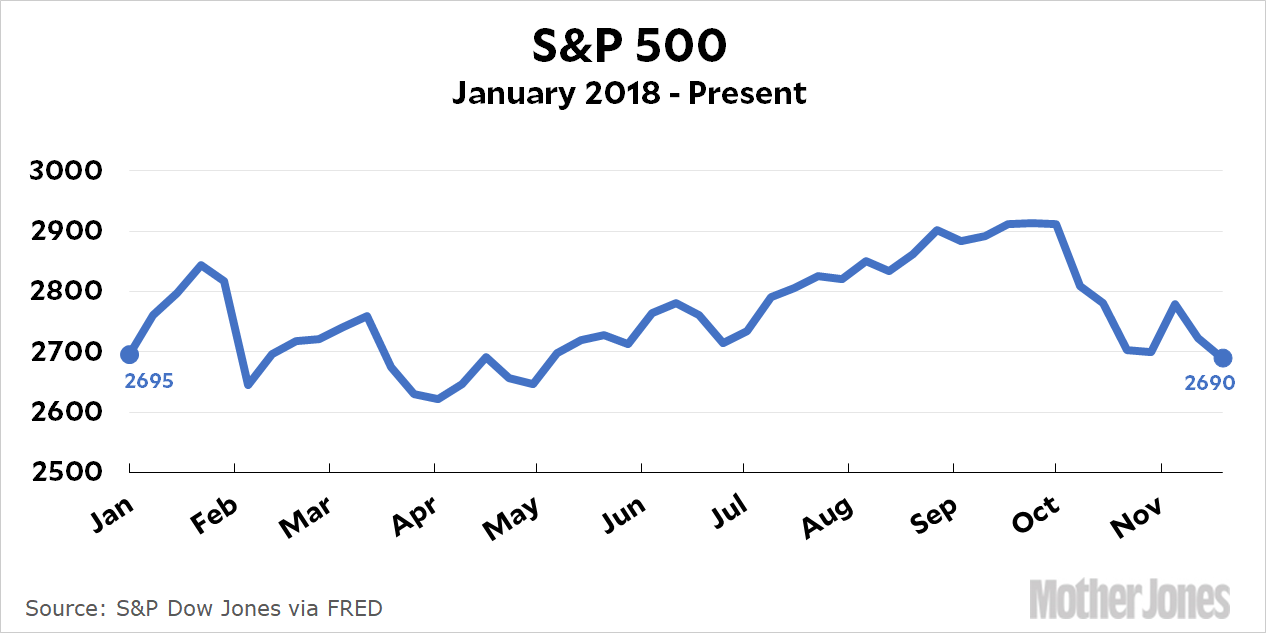
    The stock market just can’t make up its mind whether 2018 is a good year or a bad one. Corporate America has gotten a tax cut; rising earnings; protectionist tariffs; and very moderate pay increases for workers. You’d think that would be enough, but investors are still dithering. I guess they know that this is all short-term stuff and Republicans have, so far, done precisely zero to provide a foundation for a strong economy going forward.

  • Lunchtime Photo

    This is a scarlet ibis at the Prospect Park Zoo. It’s quite a handsome creature, and seems to know it.

    September 14, 2018 — Prospect Park Zoo, Brooklyn
  • When Will Conservatives Admit That Racism Exists?

    Richard Tsong-Taatarii/ZUMA

    Over at National Review, Kyle Smith recommends a new article in the Claremont Review of Books about the evolution of racism:

    William Voegeli does yeoman’s work in teasing out the various ways the Left has redefined racism to mean something other than the dictionary meaning. “‘Racism,’ then turns out to be opposition to, or merely skepticism about, the entire social justice project. Social justice leftists doubt their ability, for the foreseeable future, to win assent to that project by advocating its merits.” So they resort to calumny instead.

    Indeed, Voegeli has a 6,000-word essay about exactly this. Its hook is the Sarah Jeong affair of a few months ago, and it’s fairly predictable: a mishmash of anecdotes from the farthest reaches of the social justice left combined with an insistence that their attitudes are taking over the entire liberal project. For example:

    In Developing New Perspectives on Race (1970), the academic psychologist Patricia Bidol-Padva appears to have been the first to distill these thoughts and sentiments into the declaration that racism equals prejudice plus power….For social justice leftists indoctrinated in this viewpoint, it is now self-evident that racism has nothing to do with a person’s attitudes about racial groups, and everything to do with where one stands on questions of redistributive justice among such groups. The words of one blogger reflect the resultant bullying certitude: “Your first step is to accept that ‘a hatred or intolerance of another race’ is not the definition of racism. The dictionary is wrong. Get over it.”…Some of [Sarah Jeong’s] defenders drew out broader implications of these critiques. For journalist Tiffanie Drayton, writing for the pop culture website the Daily Dot

    Let’s take a short break to assess things. Voegeli provides, as examples, an academic text that’s 50 years old; a “blogger”; and someone who writes for the Daily Dot. I am not, so far, feeling overwhelmed by the mainstream power of these folks. Nor does the rest of the essay help. Some of the people Voegeli calls out are better known, but it’s still just an aimless mishmash of lefty quotes that are mildly extreme or highly debatable or something similar. To my ear, they’ve been curated by Google—as so many essays are these days—and don’t really add up to much of anything. They certainly don’t add up to any kind of serious engagement with modern racism.

    Just the opposite, in fact. It’s pretty clear from the start that Voegeli has no intention of, say, providing us with an idea of what he thinks racism is and how it should be fought. His job is merely to provide intellectual cover for Donald Trump’s jeremiads against political correctness and leave it at that. You could easily read his whole essay and come away with the notion that racism in America barely even exists anymore, while the real threat comes from all the lefties who oppose racism and occasionally go a little too far for his comfort. This belief is now so standard on the right that it barely even needs to be defended with anything like a coherent argument: just toss out a few examples here and there and everyone will understand exactly what you’re saying. So why bother with more?

    It’s too bad, because the truth is that some of the more extreme precincts of the left could use a serious challenge on this score in order to sharpen their thinking. Essays like Voegeli’s, by contrast, are totally ignorable. I mean, does he seriously think that power has nothing to do with racism in practical terms? That hardly seems possible. So why not mount an argument that takes racism seriously and then reflects on how power intersects with racial fears and attitudes in America? The sad part is that Voegeli actually takes a brief stab at this:

    A good place to begin evaluating the social justice Left’s redefinition of racism is to point out that power is far too variegated and complex to align so neatly with a simple racial hierarchy. By any measure, a Korean-American journalist with a J.D. from Harvard, who joins the editorial board of one of the world’s most influential media outlets, is a powerful person. The same cannot be said of the online adversaries who trolled her, or the white working-class Trump voters she berated as “literal Nazis.” Jeong, like the social justice leftists who deride the idea that her anti-white tweets were racist, wants things both ways, to exercise power while retaining the moral authority and expressive latitude that come from claiming oppression. An unemployed factory worker in the Rust Belt, by contrast, is obliged by his vast white privilege to self-censor constantly, lest some unguarded remark betray his bigotry and fortify the power structure that victimizes non-whites. If he proves too obtuse to recognize this duty, or too hateful to discharge it, that’s only further proof of racism—his and America’s.

    There is an essay worth spinning out here, but only if it starts with a mutual understanding that white racism is still endemic in America; still mostly hurts people of color; is mostly pretty quotidian; and continues to demand action from those of us with the power to do something about it. Start there, and a look at the changing nature of America’s power structure might be useful and provocative. Start anywhere else, as conservatives almost all do these days, and you’re just making excuses for Donald Trump and his pals.