Saudi Aramco, the giant oil company, has plans to buy a majority stake in Saudi Basic Industries Corp., the giant petrochemical manufacturing firm. But now they’re thinking twice:
Saudi Aramco no longer plans to launch what would have been one of the world’s largest-ever corporate-bond sales to fund a roughly $70 billion stake in the kingdom’s national petrochemical firm….People familiar with Aramco’s financing discussions say the oil firm is now worried about the level of disclosure required for a bond issue and whether the uncertain outlook for the oil market might damp demand for debt or increase the cost of borrowing.
Isn’t that intriguing? I wonder what Aramco is so eager to hide? Might it have anything to do with the actual size of their proven reserves?
The cats have been super interested in the fence this week, which they’ve been using as a launching pad for explorations of nearby rooftops. Here is Hilbert, showing off his manly frame a couple of days ago. There’s also a bit of tongue action here for you tongue enthusiasts.
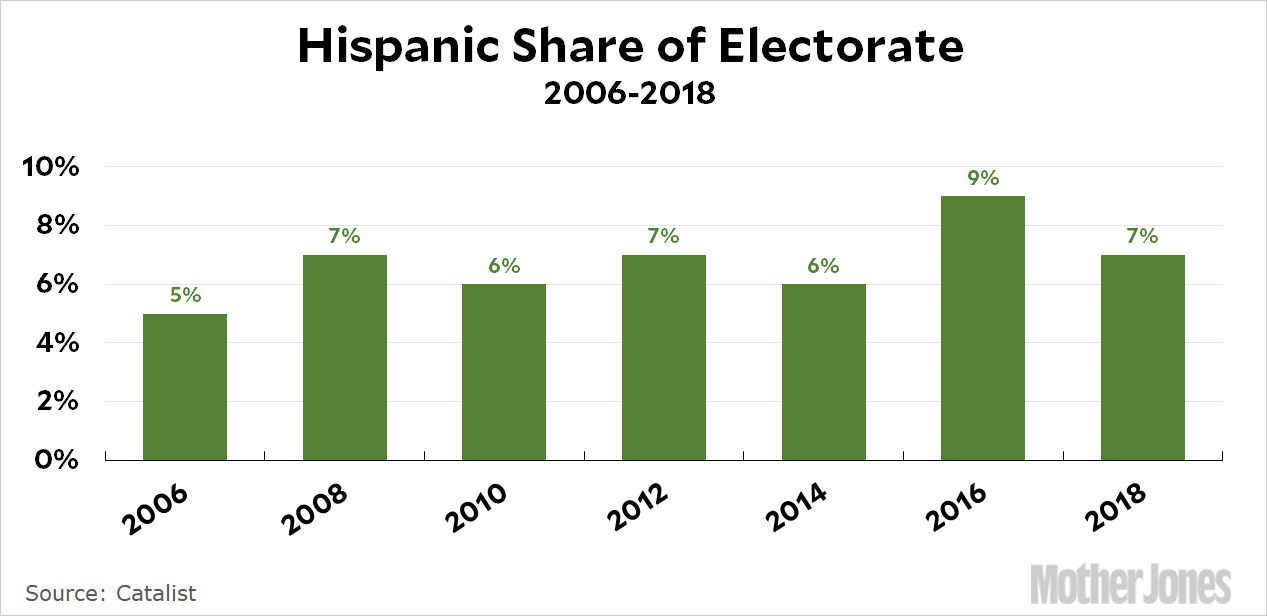
Did Hispanics turn out in greater numbers this year than they did in 2014? I didn’t even bother looking at the exit polls for this, since virtually no one seems to trust them anymore. However, before the election Yair Ghitza at Catalist promised a super-sophisticated analysis that would give us the real straight dope. I looked for it the day after the election, but I guess it took a few days to get the numbers together. Here they are:
If Ghitza’s numbers are correct, all of Donald Trump’s very public hostility to Hispanic issues had pretty much no effect on Hispanic voting. In raw numbers, turnout was up among all groups, but Hispanic turnout wasn’t up any more than anyone else. They’ve been at 6-7 percent of the electorate since 2008, and actually dropped from an all-time high of 9 percent in 2016. What’s more, Andrew Gelman points out that their support for Republicans was actually a bit higher than it was in 2016 (though lower than in 2014).
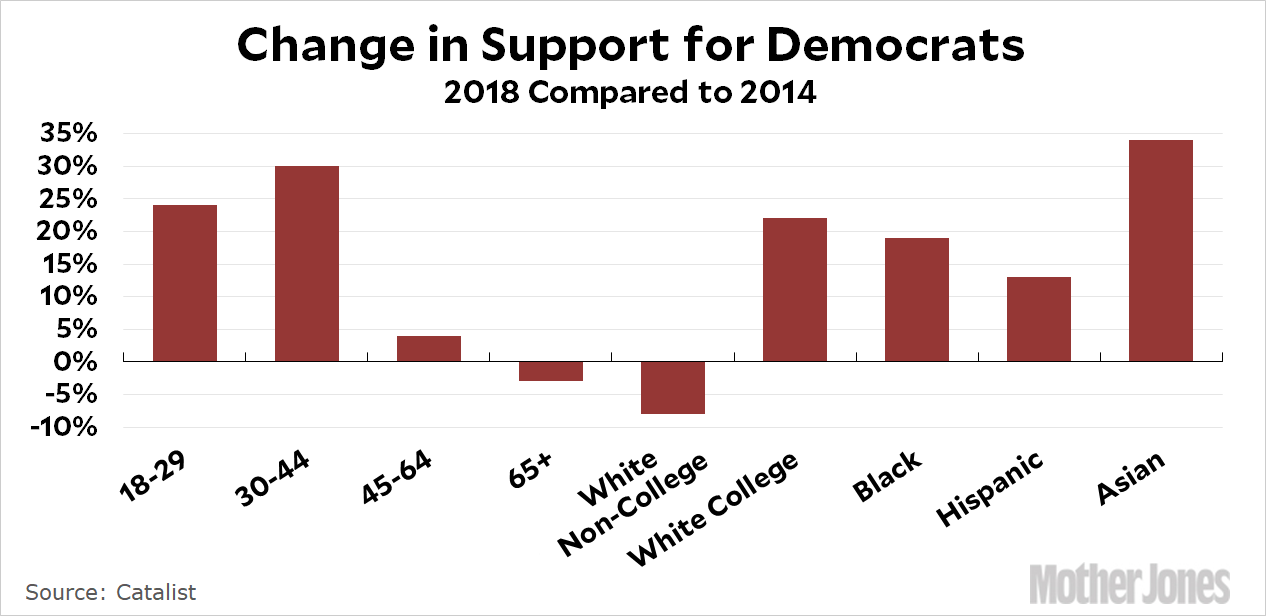
Ghitza’s post about the demographics of 2018 is here, and it contains lots of interesting stuff. Here are Catalist’s estimates for the change in support for Democrats among various demographic groups:
Interestingly, the biggest Democratic pickup among age groups wasn’t the youngest voters, but the 30-44 group. Less surprisingly, the Catalist data confirms that the rift between college and non-college whites has turned into a chasm: compared to 2014, support for Democrats went up 22 points among college whites while it went down 8 points among non-college whites. That’s a net 30-point change in just two years.
My guess is that the Catalist data is the best we have at the moment. As usual, truly good data will have to wait a year or two.
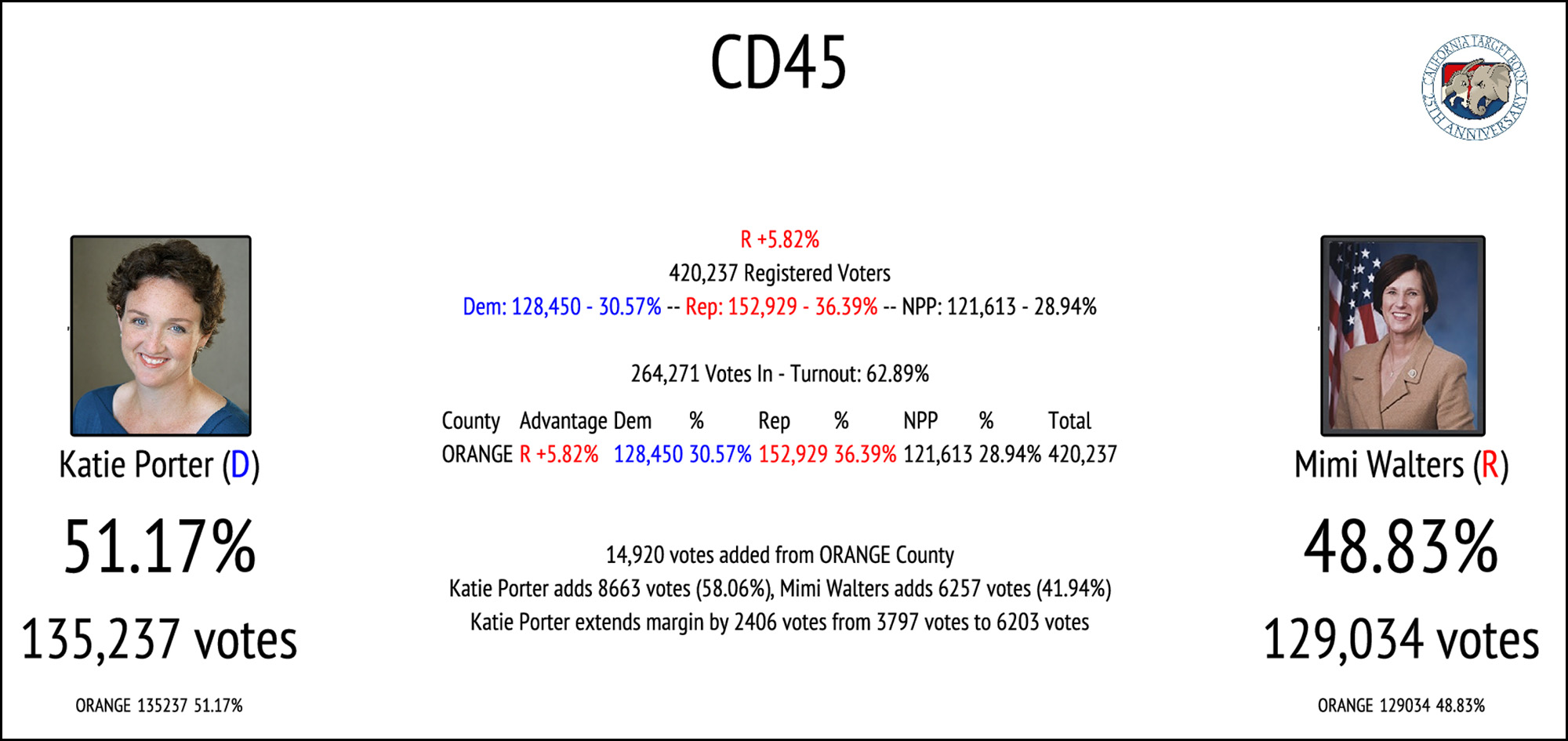
I don’t know how this slipped my mind yesterday, but Katie Porter has beaten Mimi Walters to win my home district in Irvine:
Porter is now 6,000 votes ahead and rising. CA45 has been officially called.
The sad part of this is that a couple of days ago, as it became clear which way the wind was blowing, Mimi Walters pulled a Trump and started claiming that the vote count was corrupt. “I’m currently up by 1 point, but the Democrats are already preparing for a recount to try and steal this Republican seat after the fact,” she wrote in a fundraising email. This is a shameless and reprehensible thing to say. She knows perfectly well that Neal Kelley is a very well regarded Registrar of Voters and that there’s no evidence at all of even the slightest fraud or incompetence in his office.
But I guess that’s how things go in the GOP of the Trump era. If you lose, you lash out. Yesterday I said I had nothing special against Walters other than the usual disagreement of a liberal toward a conservative. Now I do. What a terrible way to go out.
POSTSCRIPT: On a possibly interesting note, I wavered on who to vote for in the Democratic primary this year. It was a fairly nasty race between Porter and Dave Min, who was the more centrist candidate.¹ For that reason he seemed more likely to win a general election fight here, which is, after all, still a pretty Republican place even if Orange County as a whole voted for Hillary Clinton in 2016. In the end, though, I decided to support the more progressive candidate and hope for the best. In any other year that probably wouldn’t have paid off, but this year it did.
¹This is a new thing for us. Normally, the local party has to beg to get even one person to run, and doing so is considered a good deed, not a serious effort to win the district. Thanks to Donald Trump, though, it looked like there was a real chance of winning this year, and that brought out the nastiness.
I know I’m probably trying your patience, but the state auditor’s report of California’s LA-San Francisco bullet train was released on Thursday:
[Elaine] Howle suggested that much of the spending so far may have been an outright waste….The audit, ordered by the Legislature this year, found extensive mismanagement, including serious problems tracking contracts, reviewing invoices for payment and monitoring construction progress….The project is 13 years behind the schedule set in the bond act approved by voters in 2008 and has grown in cost by $44 billion over its original $33-billion price target.
….Shortcomings in the agency’s ability to monitor progress on its existing $5.6 billion of construction, engineering and environmental contracts have been well known to the authority. Howle noted that the authority’s in-house audits in 2014 and 2015 identified those problems but that the authority was unable to implement corrective action….For five years, rail authority executives have told The Times that they recognize a need for bolstering the ranks of state managers and relying less on outside advisors. The authority reiterated a plan to the auditor to rely less on consultants.
Gov. Jerry Brown has been an ironclad supporter of the bullet train, but he leaves office in January and Gavin Newsom will take over. Newsom has been pretty lukewarm about the project, which produces my favorite paragraph in the story:
The 87-page audit gives Newsom the basis for almost any kind of restructuring he would want to make, though support for the train remains high among its key constituencies: construction companies, labor unions and Californians who have traveled by bullet train in Europe or Japan.
Construction companies and labor unions, sure. Of course they support it. But if the best you can dig up for #3 is folks who have traveled on bullet trains once or twice on vacation—well, you’re in trouble, aren’t you?
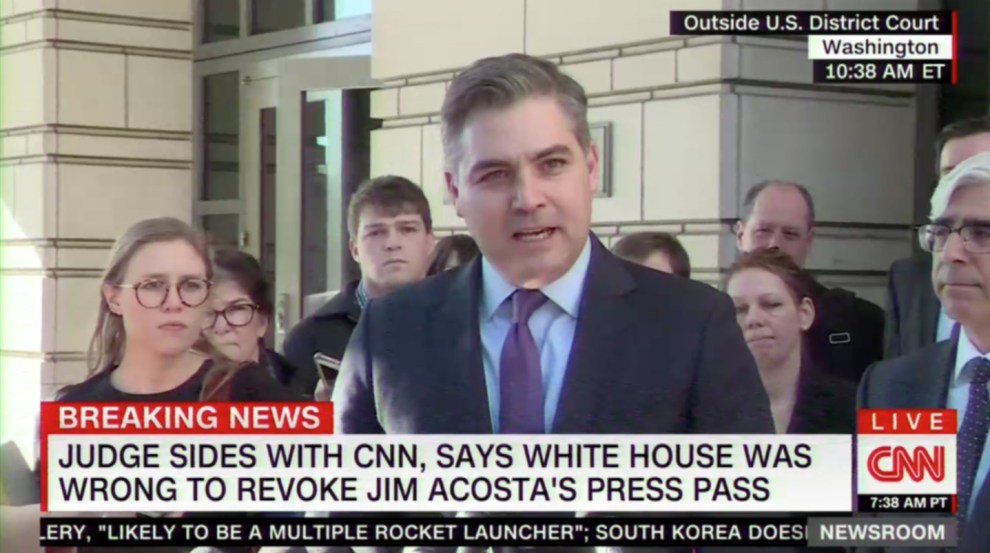
Federal judge Timothy J. Kelly sided with CNN on Friday, ordering the White House to reinstate chief White House correspondent Jim Acosta’s press pass….Kelly did not rule on the underlying case on Friday. But he granted CNN’s request for a temporary restraining order. This result means that Acosta will have his access to the White House restored for at least a short period of time. The judge said while explaining his decision that he believes that CNN and Acosta are likely to prevail in the case overall.
I wonder if the White House will even continue wasting money on this fight? Trump hates to lose, and he might prefer declaring some kind of bogus Trumpian Twitter victory right now—“Judge refuses to uphold Acosta claim of discrimination!!!”—instead of waiting for real-world defeat later. We’ll see.
Hold on. An hour ago I wrote about mortgage applications being down 22 percent in 2018. “Off the top of my head, I can’t think of any other important economic indicator that’s down 22 percent over just the past year,” I said. “In fact, I can’t think of anything that’s close.”
Well, a few minutes after I wrote that the Federal Reserve set me straight:
A 20+ point drop in the business activity index is roughly a decline of a third. A 40-point drop in the business climate index—that is, from 40 to zero—is about a 100 percent decline. Now, these numbers obviously bounce around a lot, and even a 100 percent decline is fairly common. Still, it ain’t good.
I don’t really understand this, unless it’s nothing more than a decline from an unsustainable burst of optimism at the beginning of the year. In any case, it’s pretty obvious that the Republican tax cut hasn’t been well received by the business community. Sure, any tax cut is good, but after watching it in action for the past year they’re really bearish on the future business climate. They’re obviously seeing something that the rest of us aren’t.
Mortgage applications have been falling all through the fall, they are now down 22 percent from year-ago levels, with purchase applications down 3 percent. This matters because if people aren’t taking out mortgages they are not buying homes. Residential construction has been a drag on GDP in the last three quarters. Also, when people buy a new home they typically buy appliances and other items associated with moving. This means less consumption spending as well.
That’s a big number. Off the top of my head, I can’t think of any other important economic indicator that’s down 22 percent over just the past year. In fact, I can’t think of anything that’s close. So what’s the problem? Here’s Neil Irwin:
When you look closely at the data, it appears this paradox of a strong economy and a weak housing market is, at its core, an illustration of a fundamental rule in economics: If something can’t go on forever, it won’t.
Home prices in a given location are ultimately tethered to the incomes of the people who either live there or want to. But for much of the last six years, that relationship has come undone. Nationally, personal income per capita has risen 25 percent since the end of 2011, while the S&P/Case-Shiller national home price index is up 48 percent (neither figure is adjusted for inflation). The gap is even larger in the big coastal cities with high wages and booming job markets, but where legal and other barriers make it hard for builders to add to the supply of homes. In the San Francisco metro area, per capita personal income rose 40 percent from 2011 to 2017, while home prices rose 96 percent. Similar patterns are evident in Los Angeles, Seattle, Boston, New York and Washington.
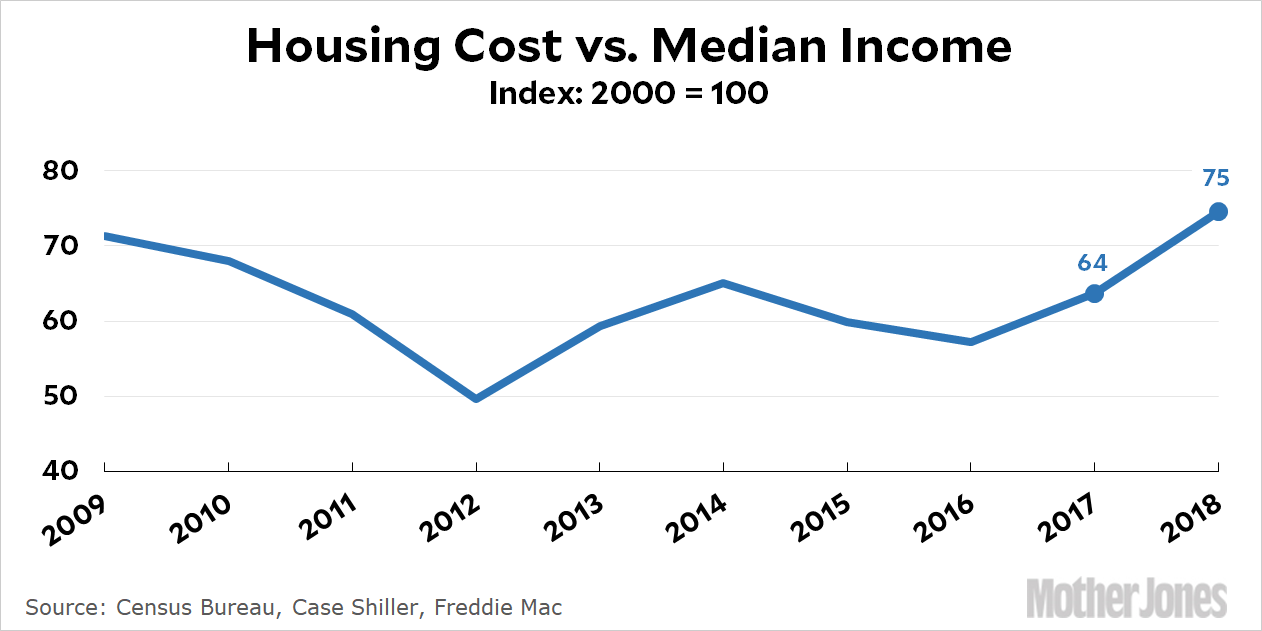
Irwin is right, except that the real disconnect has come over the past year. It’s true that housing prices went up relative to income starting in 2011, but they bounced up and down in about the same range as they had before. It was only in 2018 that they shot up above their recent level:
Note that this is an index of my own creation, so the numbers themselves don’t have any special meaning. The index merely takes the Case-Shiller housing index, multiplies it by the average 30-year fixed mortgage rate, and compares it to median household income. Then I normalize it to 100 for the year 2000. What it shows is that the effective cost of homebuying—when you account for both housing prices and interest rates—is about 17 percent higher than it was in 2017 even when you account for higher incomes. This makes sense since the downturn in mortgage applications started about a year ago, not in 2011.
There may be more to the story, but a 17 percent rise in house prices is enough to mostly explain a 22 percent decline in mortgage applications. This is especially true when you don’t have a bubble mentality driving homebuying, as we did when house prices were increasing in the mid-aughts.
So how important is the housing market to the broad economy? There’s no firm consensus on this, aside from the fact that a declining housing market isn’t good for the economy. Beyond that, the next year or two should tell us.
Turkish President Recep Tayyip Erdoğan.Turkish Presidency/Depo Photos via ZUMA
Does the name Fethullah Gulen ring a bell? Maybe not. Gulen is a 77-year-old Turkish cleric who has been a resident of the United States for the past 20 years—and who has been a mortal enemy of Turkish president Recep Tayyip Erdoğan for the past five years or so. The question of just what Gulen and his movement of Gulenists have been up to during that time is complicated, but what matters for now is that, rightly or wrongly, Erdoğan is convinced that Gulen wants to overthrow his government and was behind the failed coup attempt of 2016. Erdoğan would like Gulen extradited from the US, but has been unable to get the Justice Department to agree thanks to his thorough inability to produce credible evidence that Gulen is responsible for any kind of terrorist activity. Because of this, Gulen continues to cool his heels in his Pennsylvania home.
That’s the nickel background—but I’ll add one more thing you might have forgotten about. A year ago the Wall Street Journal passed along a remarkable story about Michael Flynn, the crackpot National Security Advisor appointed by Donald Trump in late 2016 and then fired in early 2017. According to the Journal, Flynn and his son met in 2016 with some associates of Erdoğan who proposed to pay the Flynns $15 million to secretly kidnap Gulen and fly him to Turkey. This was in September, while Flynn was a top campaign surrogate for Trump. A second meeting was held in December, after Flynn had already been appointed NSA.
Now, is this kidnapping story for real? We’ll probably never know for sure. But keep it in mind as you read this from NBC News:
The White House is looking for ways to remove an enemy of Turkish President Recep Erdoğan from the U.S. in order to placate Turkey over the murder of journalist Jamal Khashoggi, according to two senior U.S. officials and two other people briefed on the requests. Trump administration officials last month asked federal law enforcement agencies to examine legal ways of removing exiled Turkish cleric Fethullah Gulen in an attempt to persuade Erdoğan to ease pressure on the Saudi government, the four sources said.
The effort includes directives to the Justice Department and FBI that officials reopen Turkey’s case for his extradition….“At first there were eye rolls, but once they realized it was a serious request, the career guys were furious,” said a senior U.S. official involved in the process.
So. The Saudis murder a critic of their regime on Turkish soil.¹ Trump declines to do or say much about it, which naturally pisses off Erdoğan. Trump has to come up with a plan to deal with this, and apparently taking the murder seriously is out of the question. Instead he concocts a crazy scheme to bypass the career officials in the Justice Department and simpy order Gulen to be extradited whether he’s guilty of anything or not.
By the way, this would effectively be a death sentence for Gulen. Welcome to Trumpocracy.²
¹Yes, I know.
²One of the problems with this whole affair is that there are no good guys. Trump, Erdoğan, and Crown Prince Mohammed bin Salman of Saudi Arabia are all despots or wannabes with hardly any redeeming features, while Gulen is something of a mystery. That makes it easy to shrug and write the whole thing off as a kind of gangland feud between Turkey and Saudi Arabia, but you shouldn’t. Trump’s actions are reprehensible no matter what, and one of his worst character faults is his relentless attempt to treat the Justice Department as a personal fiefdom dedicated to defending Donald Trump and taking revenge on Donald Trump’s enemies. This needs to be exposed and stopped at every possible opportunity.
As the week nears its close, here’s something to relax by. This is my last photo from our Yosemite trip earlier this year, but as I told you, it’s a good one: Half Dome and Point Ahwiyah taken in the warm, red glow of sunset. Beautiful, isn’t it?
February 14, 2018 — Yosemite National Park, California
And we respect that! But maybe you’re of a mind to support our work directly instead? We have until December 31 to raise the last $400,000 we need to keep our nonprofit newsroom running at full strength into 2026. Will you make a gift today?
We noticed you have an ad blocker on. Can you pitch in a few bucks to help fund Mother Jones' investigative journalism?
Billionaires own the media,
but they don’t own us.
At Mother Jones we know these aren’t conventional times, and they require unconventional coverage. That’s what deliver every day: fierce, independent journalism you can’t find elsewhere. Perhaps never in the history of our country has that been more necessary than now. But we can’t do it without reader support—your support. Please chip in today.
Billionaires own the media,
but they don’t own us.
At Mother Jones we know these aren’t conventional times, and they require unconventional coverage. That’s what deliver every day: fierce, independent journalism you can’t find elsewhere. Perhaps never in the history of our country has that been more necessary than now. But we can’t do it without reader support—your support. Please chip in today.