Was I too tough on President Trump yesterday? After all, his new Medicare policy on pharmaceuticals will lower prices if he follows through with it. But will he? And will it really make much of a difference even if he does?
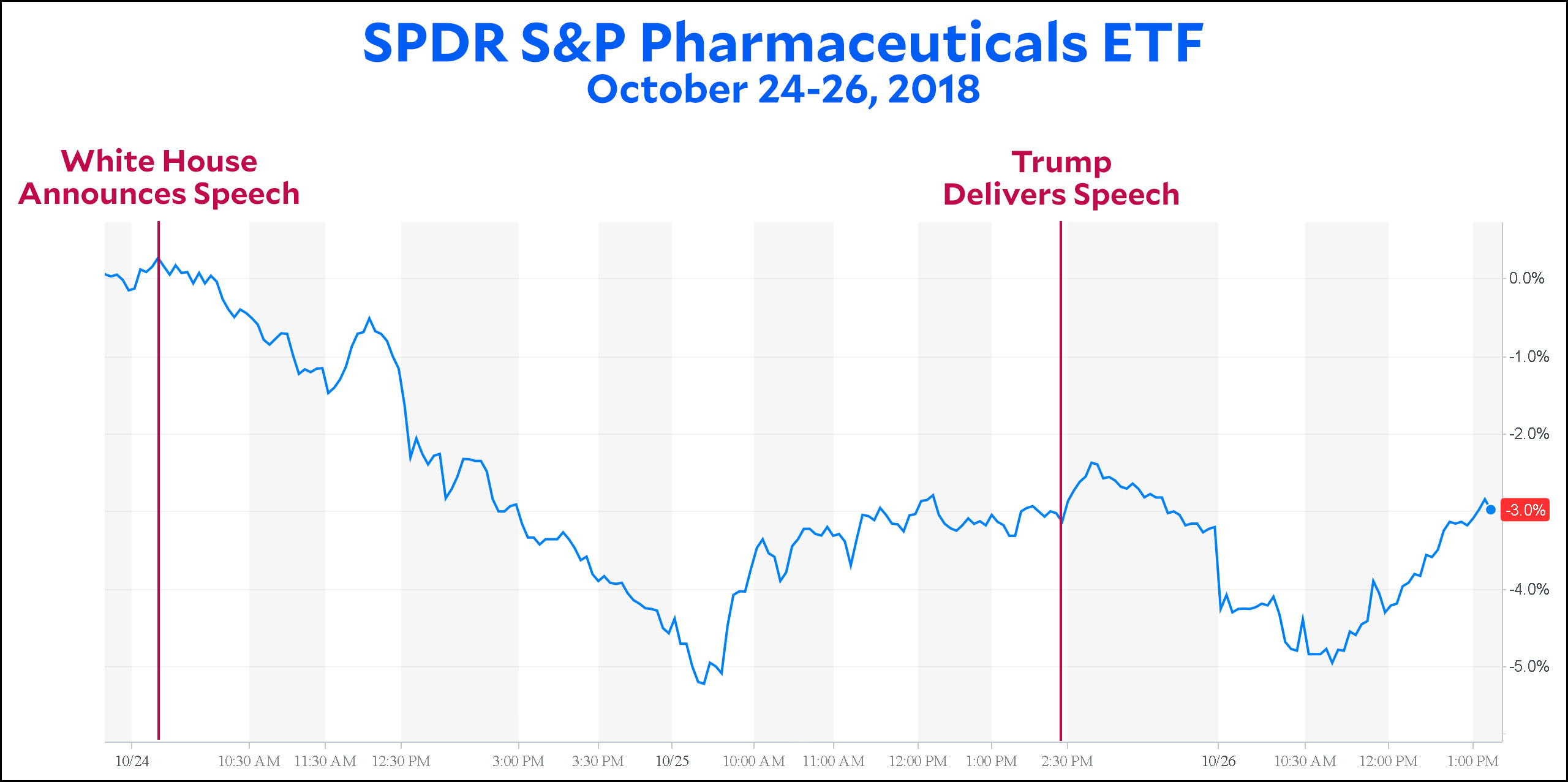
Well, there’s one group of experts who don’t seem too worried: Wall Street investors. Here’s how the stock market reacted over the past few days:
On Wednesday, when the White House announced Trump’s speech, investors were nervous and pharmaceutical stocks dropped. But on Thursday they started hearing soothing rumors, and a little after 2 pm they heard the speech itself. Pharmaceutical stocks spiked up as everyone realized that nothing bad was happening. Then they drifted down a bit until the market closed and drifted up after the opening bell today.
None of these movements were huge. But that’s the point: it’s pretty obvious that investors and analysts aren’t very worried about things. They simply don’t believe that Trump’s new Medicare policy is going to have much effect on either sales or profits in the pharmaceutical industry.
And while we’re on the subject of Trump and health care, check this out:
New analysis: ACA benchmark premiums will be 16% higher in 2019 than they would have been without termination of cost-sharing payments, repeal of the individual mandate penalty, and expansion of short-term plans. https://t.co/2GgxCFowuO
The complete analysis from the Kaiser Family Foundation is here. If Trump had left everything alone, silver-level premiums would have dropped about 16 percent this year. But because of his deliberate efforts to try to ruin Obamacare, premiums will remain about the same. More than likely, this means Trump has failed: despite his best efforts, he hasn’t done enough to have a serious impact on the overall use of Obamacare. “Staying the same” doesn’t give him much of a hook to claim that Obamacare is failing,¹ and he’s obviously lost the fight over pre-existing conditions. This severely limits what he and Republicans can do in the future.
¹Not that he won’t try. And in fairness, this gives liberals a tough PR message too. People don’t get mad at premiums staying the same no matter how much you tell them that without Trump they probably would have gone down.
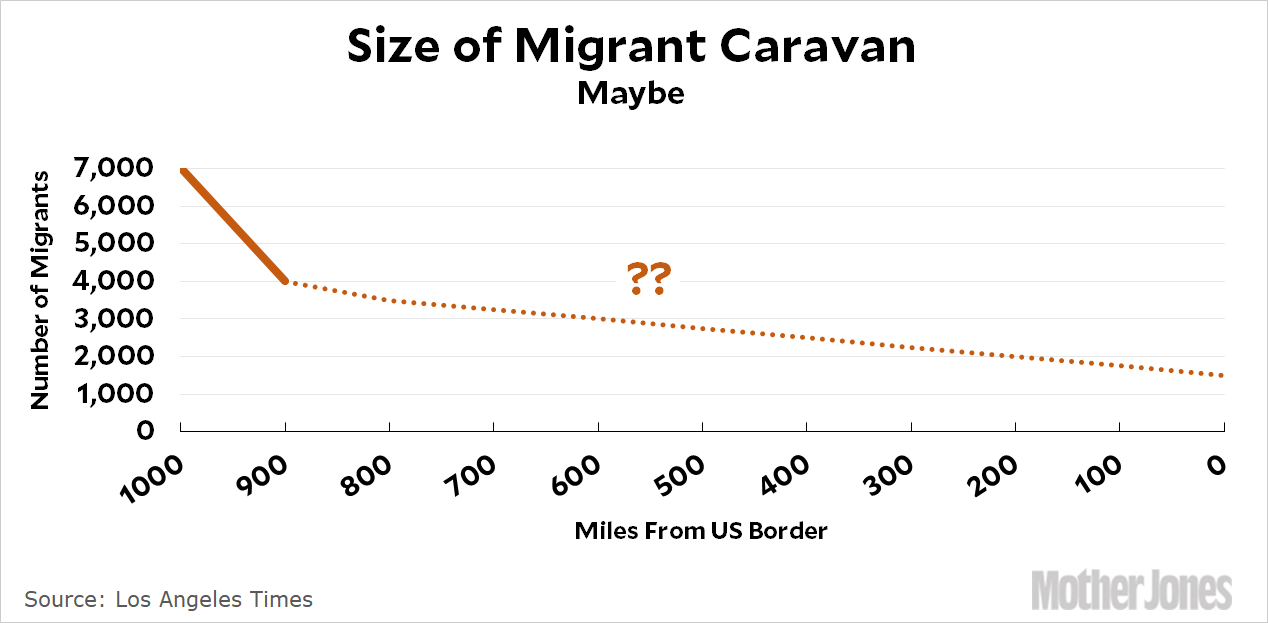
The caravan, mostly composed of people from Honduras, many on foot, has thinned since about 7,000 people crossed into southern Mexico from Guatemala in recent days. Many people crossed illegally on rafts across the river that marks the border between the two nations. Unofficial estimates indicated that some 3,500 to 4,000 people were in the caravan when it reached Mapastepec, about 90 miles north of the Mexico-Guatemala border.
In chart form, it looks like this:
I guess the Soros money must be running out.
That’s a joke. The chart is sort of a joke too. Still, as President Trump tries his best to panic the nation over all these brown people headed for the US border, it’s worth wondering just how many will be left by the time they get here. It won’t be 4,000, I’ll bet.
Of course, Trump will say that’s because of his tough policies, and there could even be some truth to that. But I wonder just how much all these Hondurans really know about Donald Trump’s latest policy or what he said at his latest rally? Not much, I’d think, but in this era of ubiquitous cell phones I suppose it might be more than I think.
The FBI has made an arrest in the bombing case. That’s pretty fast work.
This will blanket cable news today, I’m sure, with endless speculation about who the suspect is. At the moment, though, we don’t know a lot: It’s a white man in his 50s who’s made terror threats before. The arrest was made in south Florida. And the guy’s van is covered in apparently pro-Trump stickers:
The van that appears to be connected to the suspected bomber is covered in pro-Trump stickers, including the presidential seal, and what MSNBC says investigators referred to as other “right-wing paraphernalia.” pic.twitter.com/gjIleeu3yb
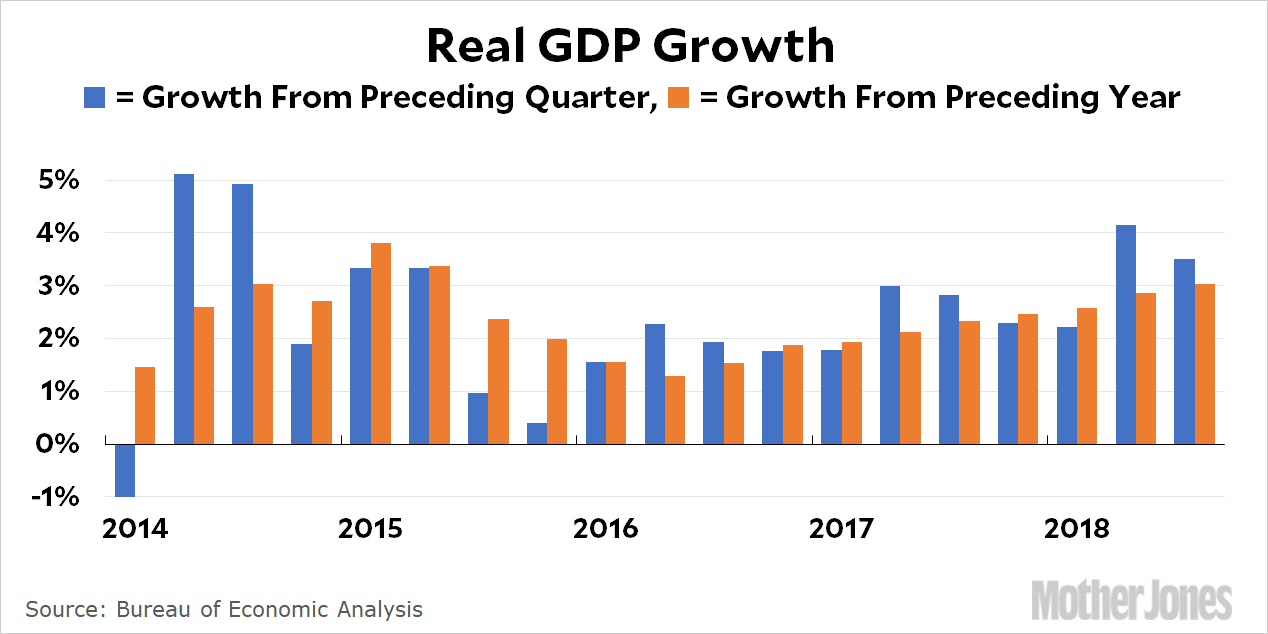
This is a good number, but it’s down from last quarter. However, personal consumption was up (4.0 percent), gross private investment was up (12.0 percent), and government consumption was up (3.3 percent). That’s a nice, even spread. Oddly, however, business fixed investment was up only 0.8 percent. Given the recent tax cut and the strong showing of corporate earnings last quarter, you’d think business investment would be stronger. Do they know something the rest of us don’t?
Maybe. More likely, though, this is just noise. A single reading for a single quarter doesn’t mean a whole lot. Overall, the economy still looks pretty good.
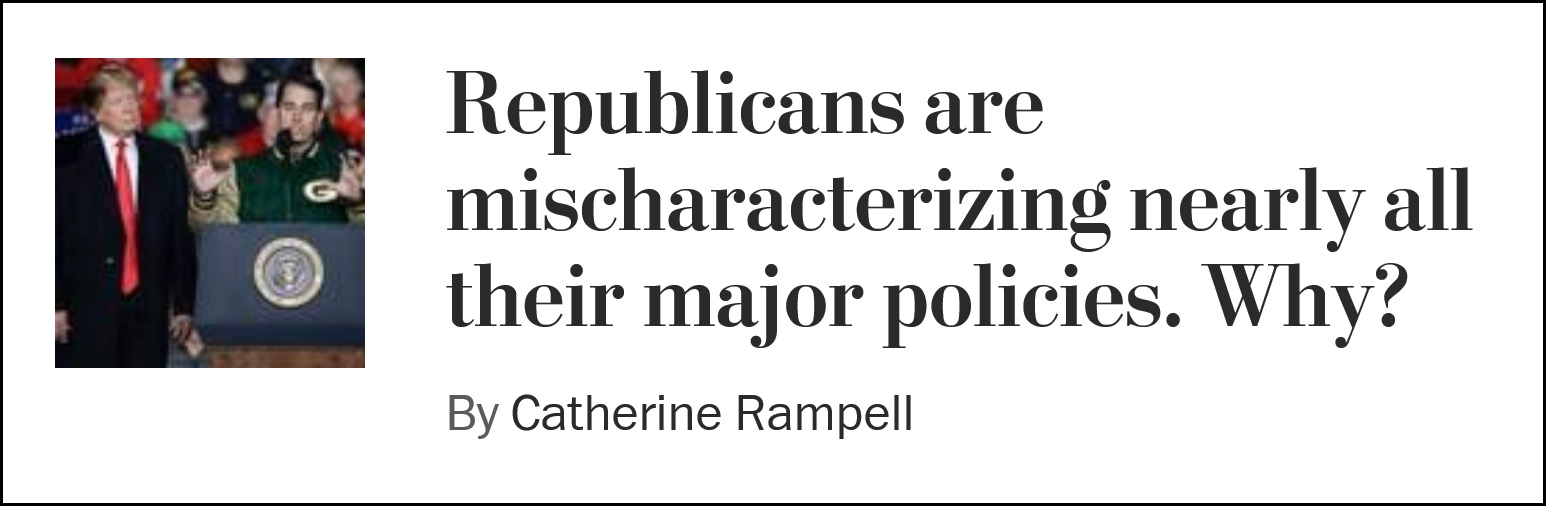
Maybe this was just tiredness on my part, but I read about half this piece thinking that Rampell was making some kind of policy critique of Republicans. It wasn’t until the second half, when her sarcasm became stronger, that I realized she was merely saying that Republicans are lying about nearly all their policies. I don’t know if the choice of “mischaracterizing” was hers or the copy desk’s, but it shows the danger of getting too fond of euphemisms. There’s a point at which it tiptoes around your meaning so much that readers have a hard time understanding you.
Anyway, yes: Republicans have systematically and obviously lied about the rationale for their tax cuts, their family separation policy, and their support for protection of pre-existing conditions. Why? That’s pretty obvious too: their real reasons are unpopular and, in some cases, loathsome. Of course they have to lie about them.
But if you just can’t bring yourself to use the word lying—either because of company policy or because you think it turns off too many readers—at least use something close:
deceiving
BSing
fabricating
faking
misleading
falsifying
fibbing
There are plenty of others. There’s really no reason to be coy about this anymore.
You probably heard today that President Trump announced a new program that will slash prescription drug prices for seniors by allowing Medicare to negotiate prices with pharmaceutical companies. “This is a revolutionary change,” Trump exulted. “Nobody’s had the courage to do it, or they just didn’t want to do it.”
But you want details. No problem. Here’s a Q&A between you, an excited senior citizen looking forward to saving money, and me, a grizzled veteran of Trumpistan who enjoys kicking puppies and shattering the dreams of our most vulnerable citizens.
Q: This is great! Right now I pay about $400 in annual premiums and another $1,800 in deductibles and copays for my prescription drugs through Medicare. This could really make a—
A: Hold on, cowboy. Just settle down. Let’s get one thing straight right off: Trump’s announcement has nothing to do with your prescription drug plan.
Q: Wait. What?
A: You’re thinking of Medicare Part D, which was passed in 2003. It covers prescription drugs for seniors, but Republicans specifically prohibited Medicare from negotiating prices on Part D and there’s nothing Trump can do about that. Democrats tried to pass a bill changing this a few years ago, but Republicans filibustered it and it failed.
Q: So Trump is asking them to take another look?
A: Nope. Democrats proposed yet another bill last year that would have allowed Medicare to negotiate drug prices, but Republicans killed it and Trump just shrugged. He was too busy trying to dismantle Obamacare. Nothing is changing there.
Q: Then what is changing?
A: Medicare Part B. This is the ordinary part of Medicare that pays for doctor visits.
Q: Doctor visits?
A: Yep. You see, sometimes doctors directly dispense infused or injected drugs to patients. Trump’s announcement was about a pilot plan to reduce the prices of those drugs to make them closer to what European countries pay.
Q: And this is brand new? Nobody’s had the courage to do it before?
A: Don’t be silly. That’s just Trumpspeak. President Obama proposed a Part B pilot program a couple of years ago that was very similar to this one, though somewhat more limited. Republicans killed it anyway, but the basic skeleton has been around for a while.
Q: So this is a plan that’s been around for a long time. All Trump had to do was get it down on paper to his liking and put his signature to it?
A: Pretty much. And it covers a tiny fraction of all drugs.
Q: Fine. I get it. It’s not much. But it’s something. How much can I look forward to saving?
A: I’m not sure you want to hear this.
Q: I’m not a baby. Tell me.
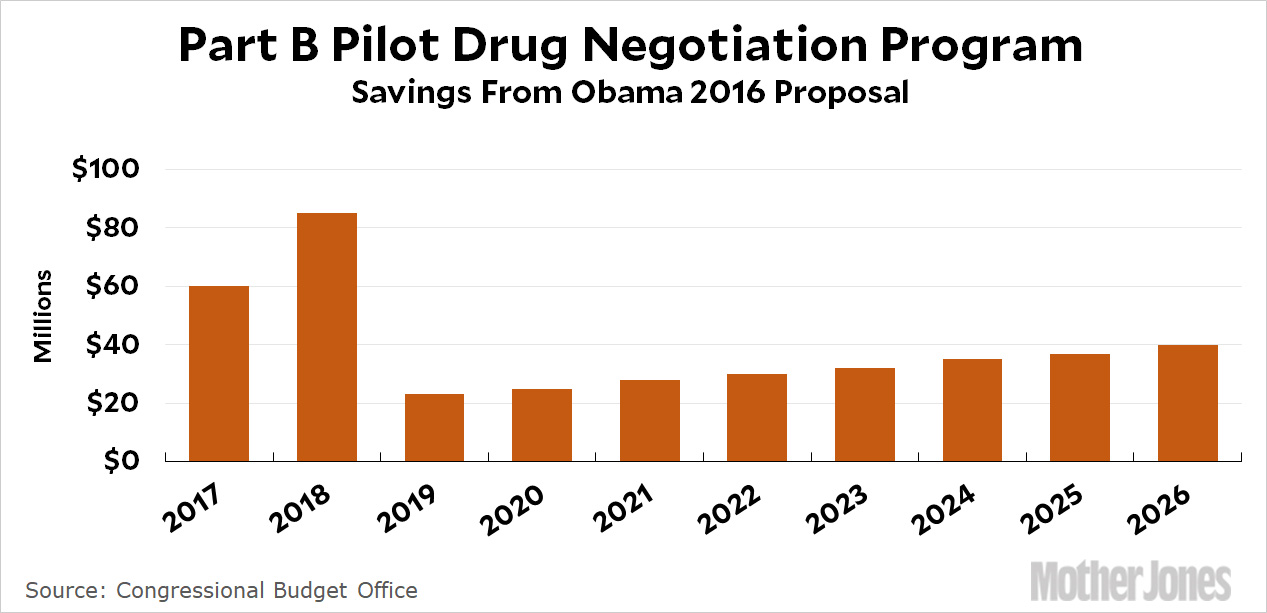
A: OK. Remember Obama’s Part B proposal? Republicans killed it, of course, but the Congressional Budget Office took a whack at estimating how much it would save. The answer was about $40 million per year.
Q: You mean $40 billion, don’t you?
A: No. Here’s a chart that repeats the “M” just to make sure everyone gets it:
Q: Is that a lot of money?
A: No. CBO estimated that Obama’s program would save $23 million in 2019 and Trump’s program is similar. Give or take a bit, total Medicare spending on pharmaceuticals will be about $130 billion next year. So the total savings will be about—
Q: Oh fuck.
A: Well, hold on. HHS claims that Trump’s program would save Medicare $3.4 billion over five years—about half a billion dollars in 2019. You just have to decide if you believe them. In any case, this means total government spending on prescription drugs might be reduced as little as 0.018 percent—roughly a hundredth of a cent per dollar—or as much as 0.4 percent—a little less than half a penny per dollar. For reasons I’ll get to in a minute, I’d guess the real answer is higher than it was for the Obama program, which was fairly limited, but less than the HHS estimate for Trump’s program. Call it savings of 0.2 percent, which is roughly a quarter of a penny per dollar. [UPDATE: I’ve revised the numbers in this paragraph a couple of times as I’ve gotten a better handle on the Trump proposal.]
Q: So the whole thing is a waste of time?
A: No, that wouldn’t be fair either. It’s a pilot program, and pilot programs are always kind of small. What’s more, there’s been surprisingly little research about whether this kind of program would work. It’s not a bad idea to test it out.
Q: Wait. We don’t know if it will work? Why wouldn’t it work?
A: Well, it’s one thing to say we’re going to negotiate prices. But as the dealmaker-in-chief himself knows, you can only negotiate successfully if you have leverage. In the case of prescription drugs, this means that Medicare has to have the authority to remove a drug from its formulary and refuse to cover it at all if the drug companies don’t play ball. But they don’t have this authority. They’re required to cover nearly all drugs. What’s more, there are some drugs where there are no alternatives anyway. So it’s possible that the drug companies could just tell Medicare to pound sand: either pay our price or take a hike. If they do that, Medicare would be required by law to pay their price.
Q: Um….
A: That puzzled look on your face says you think you’re missing something. You aren’t. Medicare has to cover everything and Trump’s program doesn’t allow Medicare to walk away if they don’t get a lower price. Drug companies have no reason to accept lower prices unless they want to play along for PR reasons.
Q: And even if they do, the aggregate savings will be something like a quarter of a penny per dollar.
A: You’re getting it! The savings might be more than that for some treatments, especially expensive cancer regimens, but overall, yeah: a quarter of a cent per dollar is a decent guess.
Q: This sounds pretty complicated and unlikely to produce much. Isn’t there an easier way?
A: Oh sure. Of course. The Veterans Administration has a simple list of how much they’re willing to pay for pharmaceuticals. It runs about half the Medicare rate, and drug companies either pay the listed price or they lose out on the entire VA market. With the approval of Congress, Medicare could adopt the VA list and immediately cut its spending on prescription drugs in half.
Q: So we’re doing something almost entirely symbolic instead of something that’s simple and super effective. Why? I don’t get it.
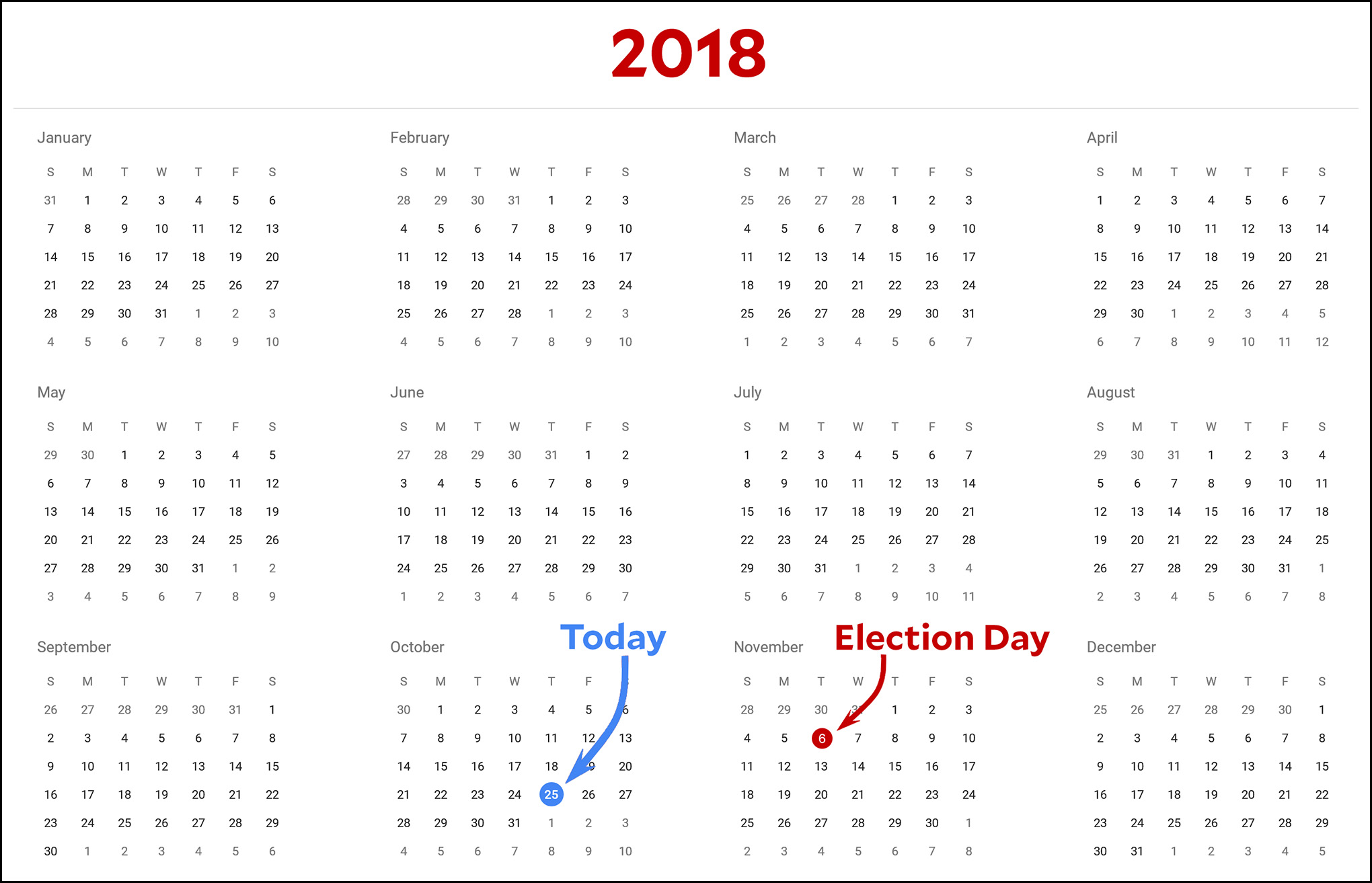
A: Please. You know why. But just in case, here are two illustrations to make it extra clear:
While I wait for someone to deliver a bomb to my door,¹ I have been distracted once again by somebody pointing me to Merriam Webster’s list of words that first appeared in a given year. I’ve looked at this before, but it must have been a while ago because I didn’t notice one word in particular that’s been living in my head rent-free for the past four years:
dexamethasone: a synthetic glucocorticoid C22H29FO5 used especially as an anti-inflammatory agent
The evil dex turned 60 this year, just like me! Well, 61, anyway, according to Wikipedia. But nobody wrote about it until 1958.
Merriam Webster also claims that 1958 was the first time that several mathematical terms were seen in print: Cartesian product, linear regression, multiplicative identity, multiplicative inverse, percentage point, and two’s complement. I can buy the last one, but the others seem unlikely to have first been written down in 1958.
Allegedly, my birth year also lays claim to sex kitten, software, tesla, prequel, and stackable. I wonder what prequel was written in 1958 that gave rise to this neologism? I suppose that these days it takes less time to look it up than it does to actually ask the question. And here it is:
According to the Oxford English Dictionary the word “prequel” first appeared in print in 1958 in an article by Anthony Boucher in The Magazine of Fantasy & Science Fiction, used to describe James Blish’s 1956 story They Shall Have Stars, which expanded on the story introduced in his earlier 1955 work, Earthman Come Home.
And there you have it.
¹Marian does not appreciate this joke, by the way.
Patrick Caldwell reports that tobacco companies are spending a huge amount of money on a campaign to prevent a cigarette tax increase that’s aimed at funding Medicaid expansion in Montana:
A new set of filings in the state’s campaign finance database show that tobacco companies Altria (the parent company of Phillip Morris in the US) has now contributed more than $17.1 million to Montanans Against Tax Hikes, the group opposed to ballot question I-185. The measure would raise taxes on cigarettes in order to fund the continued operation of the state’s Medicaid expansion program. RAI Services (the parent company of RJ Reynolds) has also contributed $295,000 to campaign.
Wait. Philip Morris has contributed $17.1 million while RJ Reynolds has contributed $295,000? That hardly seems fair, does it? I wonder how the tobacco industry divvies up the work of undermining public health throughout the country?
And we respect that! But maybe you’re of a mind to support our work directly instead? We have until December 31 to raise the last $400,000 we need to keep our nonprofit newsroom running at full strength into 2026. Will you make a gift today?
We noticed you have an ad blocker on. Can you pitch in a few bucks to help fund Mother Jones' investigative journalism?
Billionaires own the media,
but they don’t own us.
At Mother Jones we know these aren’t conventional times, and they require unconventional coverage. That’s what deliver every day: fierce, independent journalism you can’t find elsewhere. Perhaps never in the history of our country has that been more necessary than now. But we can’t do it without reader support—your support. Please chip in today.
Billionaires own the media,
but they don’t own us.
At Mother Jones we know these aren’t conventional times, and they require unconventional coverage. That’s what deliver every day: fierce, independent journalism you can’t find elsewhere. Perhaps never in the history of our country has that been more necessary than now. But we can’t do it without reader support—your support. Please chip in today.