• Schrödinger’s Cat Is Alive! (One-Twelfth of the Time)

    Bear with me for a second while I check to see if there’s any obvious outrageousness this morning that I need to comment on right away. [checks LAT, NYT, WSJ, WaPo] Nah, not really. So let’s talk science.

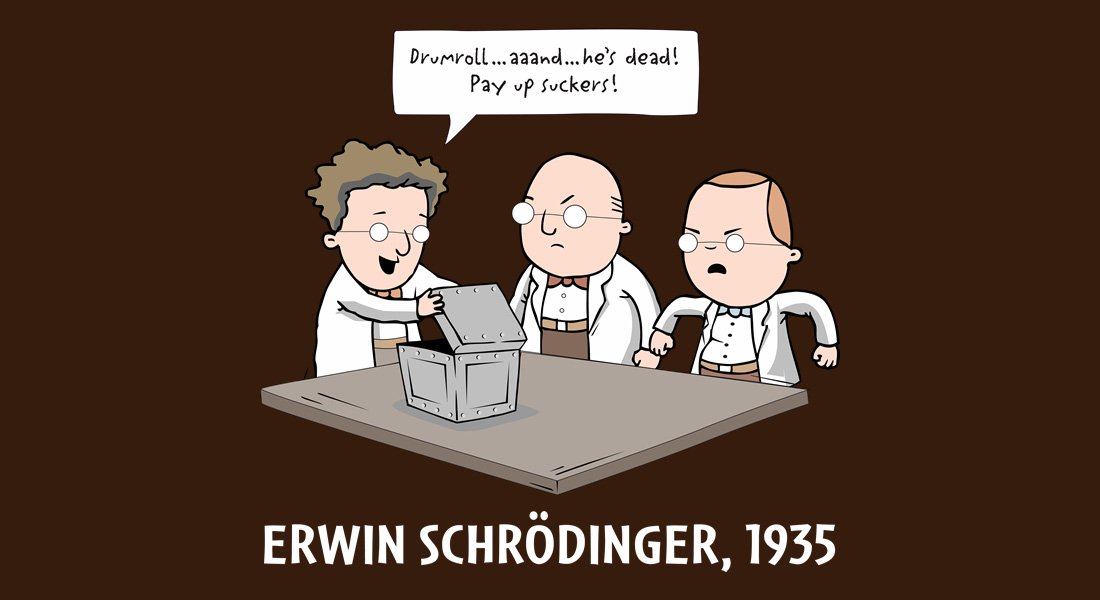
    You all know about Schrödinger’s cat, poor thing, don’t you? The basic idea behind the experiment is that in the quantum world of particles we don’t know if a particle changes state until we observe it. Before that, it’s in an indeterminate state doing nothing in particular. So Erwin Schrödinger proposed that we put a cat in a box along with a particle that has a 50 percent chance of turning radioactive and killing the cat. Eventually we open the box and find out what happened.

    But what about the cat before we open the box? It’s one thing to say that the particle is all smushed out and we don’t really know what state it’s in. But a cat? Come on. The cat is either dead or alive. But no: Schrödinger says that the cat too remains in a mysterious smeared out state, neither dead nor alive, until we open the box. At that point “the wave equation collapses” and the cat’s fate is determined.
    That sounds weird, but whatever. Not as weird as plenty of other stuff in quantum mechanics. The thing is that no one really, truly believes quantum mechanics. Even physicists. Oh, they’ll do the math and produce answers accurate to ten decimal points. And the math always produces correct answers. But the answers are weird, so there’s long been a cottage industry in trying to “break” quantum mechanics to figure out what’s really going on below all the weirdness. These attempts are often very clever (physicists, right?) but they always fail.

    Recently we’ve gotten a new one. In this one we’ve got the usual box with the cat, along with a physicist named Alice who’s also inside the box keeping the cat company. Then there’s a second box: this one contains a physicist named Bob, but that’s all. No cat. Finally, there’s a physicist named Ted standing outside Alice’s box and a physicist named Carol standing outside Bob’s box.¹ The precise details of what happens next don’t matter for laymen, but here’s the basic shape of things:

    • In Alice’s box, she sends a particle to Bob that gives him a rough idea of whether the cat died.
    • In Bob’s box, he measures the particle as either spin-up or spin-down, “which creates a complicated entangled state of Bob’s mental state, Alice’s mental state, and the state of the cat.” This is according to Chad Orzel, author of How to Teach Quantum Physics to Your Dog.
    • Meanwhile, outside the boxes, Ted and Alice do their own measurements. In both cases, the measurements are weird and complicated, but basically Ted has a 50 percent chance of returning “OK” if Alice has detected a dead cat, while Carol has a 50 percent chance of returning OK if Bob has detected a spin-up particle.

    Once all the complicated math is done, everyone agrees that a double-OK means the cat is dead. But that’s not true. If you ran this experiment a hundred times, a double-OK would indicate a live cat one-twelfth of the time. Chad Orzel comments:

    There are a bunch of things that I don’t really follow about this, though. For one thing, given that I can grind through the math to show that the cat lives one time in twelve, I’m not sure why this is supposed to be a surprise to any of our intrepid experimenters. It seems like reasoning about the results from quantum mechanics ought to lead them to the same conclusion– that the cat’s survival is unlikely but not impossible.

    It’s also not clear to me why everyone talking about this says that the experiment isn’t feasible because it requires Alice and Bob to be either humans or complex computers. Their role in this scheme seems pretty mechanical, so I’m not sure where the complexity is coming from.

    Yeah, I agree with both those things. The first one just means that, as usual, someone has made a subtle error in reasoning. Maybe when Alice sends the particle to Bob, the time it spends in between the boxes affects things somehow. Maybe measuring the cat’s pulse affects the state of Alice’s box. Who knows? But there’s always something.

    As for humans being necessary, it sure doesn’t seem like it. Alice sends either a spin-up or spin-down particle depending on whether the cat has a pulse. Bob measures the particle. Those are both things a pretty simple machine could do. As for Ted and Alice, they do a “complicated” measurement, but I doubt it’s so complicated that it requires some super artificial intelligence machine from the future. In any case, getting all these folks out of the picture would eliminate that possibility that the superposition of Alice’s original particle as measured by Bob represents “a complicated entangled state of Bob’s mental state, Alice’s mental state, and the state of the cat.”

    Meh. Someone made a mistake. Eventually someone else will figure it out. It’s quantum mechanics. It will never make sense to us meat machines.

    ¹Bob and Carol and Ted and Alice. Get it? Physicists are hilarious.
  • Apartment Rents Have Been Flat Both Nationally and in LA County For Several Years

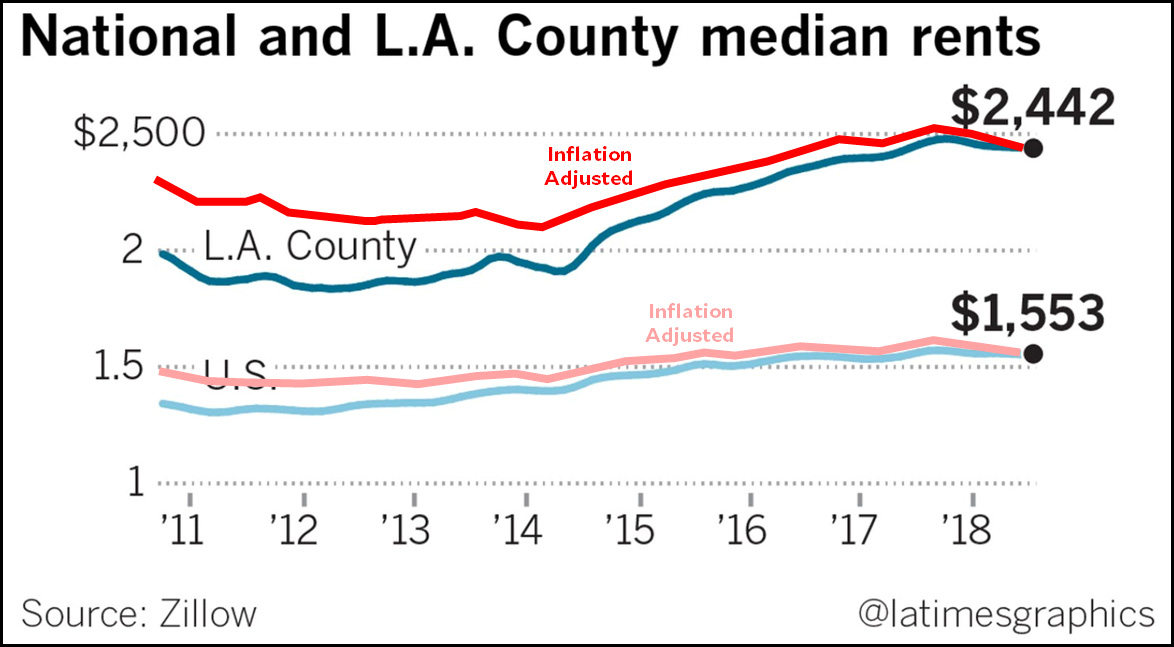
    The folks at the LA Times have been kind enough to provide a chart showing how much rents have skyrocketed both nationally and in Los Angeles County. They are, as usual, shown in nominal dollars, so I have been kind enough to draw some new lines showing rents in real, inflation-adjusted dollars: Here you go:

    Roughly speaking, since 2011 national rents have gone up from $1480 to $1553, an increase of 5 percent. In LA County, rents have gone up from $2,300 to $2,442, an increase of 6 percent. National rents have been flat since about 2015. LA rents have been flat from about 2017.

    You may draw your own conclusions from this data.

  • The Kavanaugh Affair Careened Off a Cliff Today

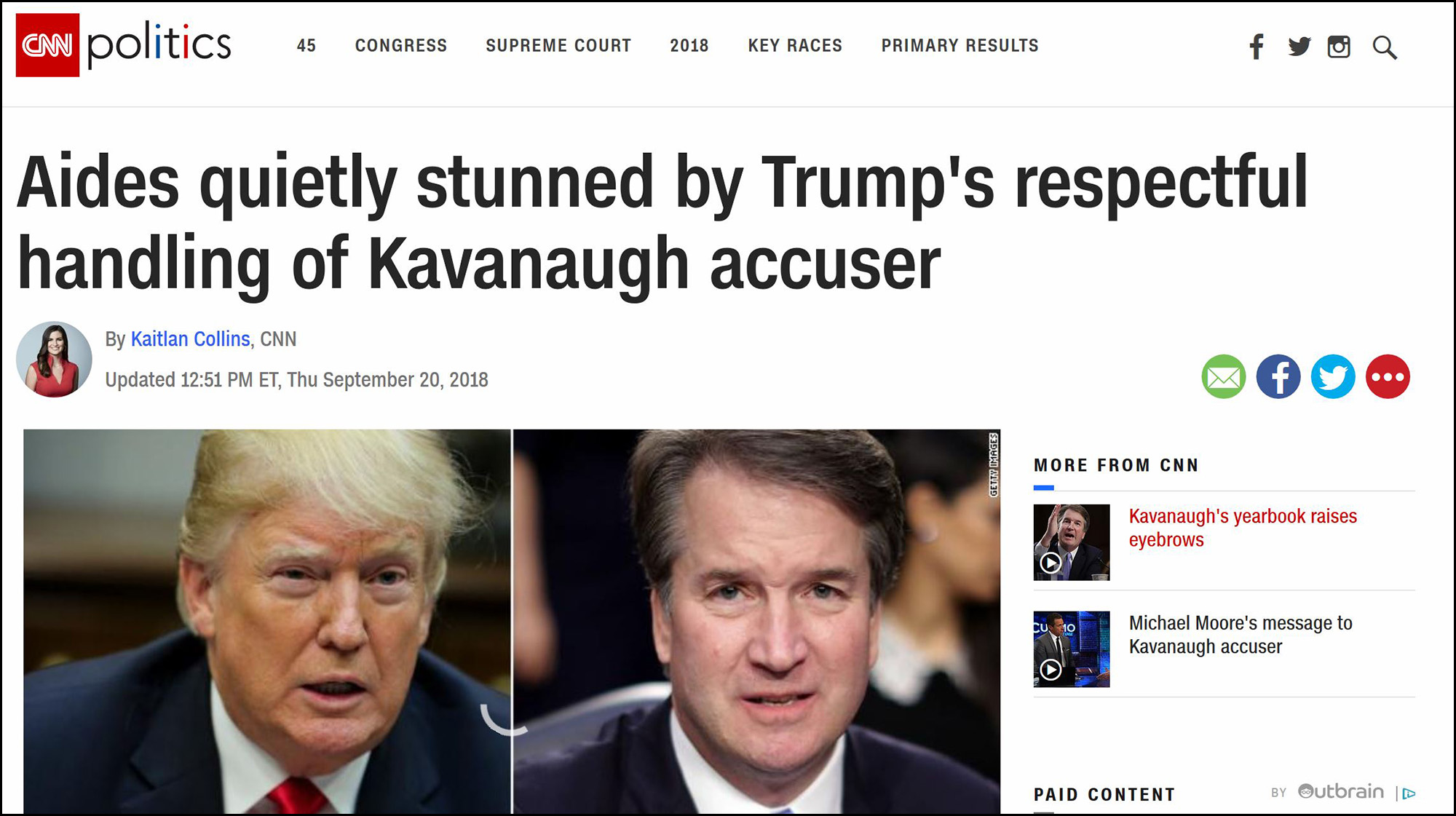
    Today has been beyond bizarre. The allegations by Christine Blasey Ford of attempted rape against Brett Kavanaugh continued to play out, but then in the late afternoon the whole story careened completely over a cliff. I am, literally, almost afraid to write about it, so I’ll let the Washington Post tell the story:

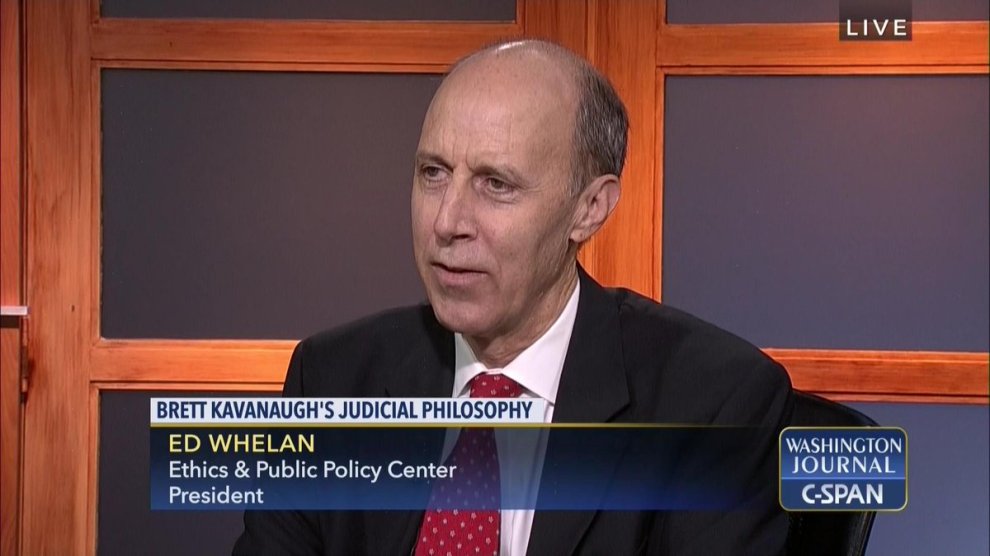
    The nomination was roiled further late Thursday by incendiary tweets from a prominent Kavanaugh friend and supporter who publicly identified another high school classmate of Kavanaugh’s as Ford’s possible attacker. Ed Whelan, a former clerk to the late justice Antonin Scalia and president of the Ethics and Public Policy Center, pointed to floor plans, online photographs and other information to suggest a location for the house party in suburban Maryland that Ford described. He also named and posted photographs of the classmate he suggested could be responsible.

    Ford dismissed Whelan’s theory in a statement late Thursday: “I knew them both, and socialized with” the other classmate, Ford said, adding that she had once visited him in the hospital. “There is zero chance that I would confuse them.”

    I gather that Whelan has been shopping this story around for a few days, but apparently no one was buying it. So he went ahead and tweeted it himself. What makes this weird beyond reckoning is that Whelan admits he’s just speculating:

    To be clear, I have no idea what, if anything, did or did not happen in that bedroom at the top of the stairs, and I therefore do not state, imply or insinuate that […] or anyone else committed the sexual assault that Ford alleges.

    Whelan can say this until he’s blue in the face, but it doesn’t matter: his tweetstorm is prima facie libelous unless he can deliver the goods. This is why I’m not mentioning the person’s name or linking to Whelan’s tweet. Unlike Whelan, I’m no lawyer, and there’s no way I’m taking any chances with this. What’s more, it’s wildly unfair to the non-famous person who Whelan fingered. And that’s not all. There’s more!

    Whelan has been involved in helping to advise Kavanaugh’s confirmation effort and is close friends with both Kavanaugh and Leonard Leo, the head of the Federalist Society who has been helping to spearhead the nomination. Kavanaugh and Whelan also worked together in the Bush administration. Kavanaugh and his allies have been privately discussing a defense that would not question whether an incident involving Ford happened, but instead would raise doubts that the attacker was Kavanaugh, according to a person familiar with the discussions.

    If Kavanaugh himself is even remotely involved in this, he’s toast.¹ It’s beyond belief that a Supreme Court candidate might have something to do with a wild allegation like this, but given the fact pattern in the Post account, it’s also a little hard to believe he wasn’t aware of what Whelan was up to. For what it’s worth, Steve Schmidt, who was George Bush’s communications strategist for Supreme Court nominations, seems to agree:

    I have no idea how this is going to develop. Ford has categorically denied that she could have mixed up the two men. Will Whelan deliver something more on Friday? Will the guy he named speak to the press? Will someone else pop up with something to say? Will Anthony Kennedy withdraw his resignation from the Supreme Court? I’m just dumbfounded and disgusted by this whole affair.

    ¹Unless he can prove it, of course. Both Whelan and Kavanaugh are in the clear if they can demonstrate the truth of this allegation.

  • Why Are There So Few Blacks in Clinical Trials of Cancer Drugs?

    Waltraud Grubitzsch/DPA via ZUMA

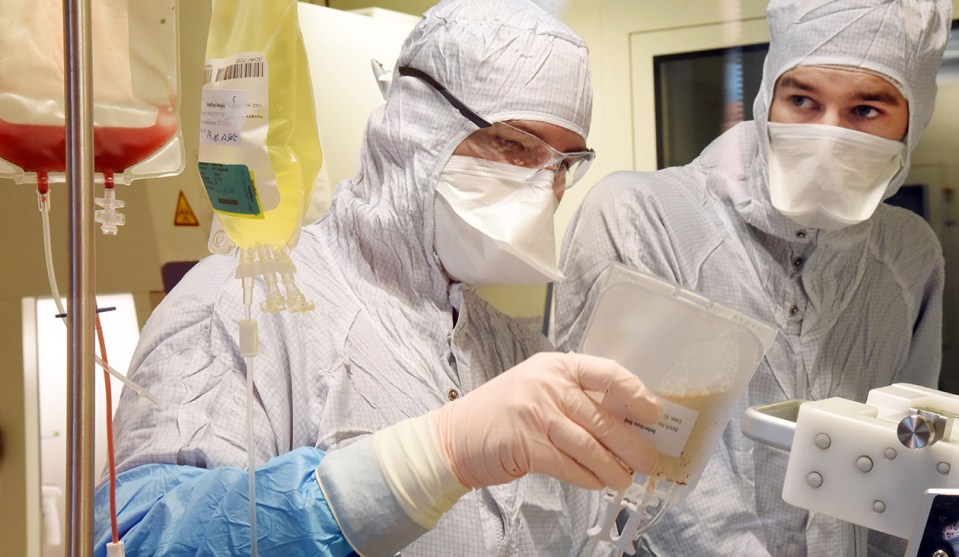
    Today brings two related articles that are right up my alley: they’re about possible new cures for multiple myeloma and other cancers. The first, by Ezekiel Emanuel, is about CAR-T treatments, in which cells are removed from your body, genetically altered, and then pumped back in. If this works, it holds out the promise of actually curing cancers that today can only be controlled:

    But there’s a hitch: CAR-T’s list price…anywhere from $500,000 to $850,000 per patient….We may soon have a miracle drug for cancer whose cost, when multiplied across the population that needs it, could bankrupt the country.

    Hmmm. As much as I agree with the spirit of what Emanuel is saying, he’s comparing apples to orange: the negotiated price of current treatments vs. the list price of new treatments. The right way to do this is to compare list prices across the board, and while the list price of current treatments for multiple myeloma varies, it can easily top $500,000. This is not just because the treatments are expensive. It’s because they go on for many years since they never produce a complete cure. My own treatment, which is ongoing since late 2014, has almost certainly cost more than half a million dollars. I don’t know for sure, of course, since insurance companies never make that kind of information public, but based on a few tidbits I’ve seen here and there I’d say $500,000 is probably a conservative figure. And needless to say, I’m still alive. It’s pretty likely that my insurance company will be spending a lot of money on me for years to come. Because of that there’s a good chance they’d welcome a single CAR-T treatment at a negotiated price.

    The second piece is from ProPublica and focuses on the low number of blacks who participate in clinical trials for new cancer drugs. For example:

    It’s a promising new drug for multiple myeloma, one of the most savage blood cancers. Called Ninlaro, it can be taken as a pill, sparing patients painful injections or cumbersome IV treatments. In a video sponsored by the manufacturer, Takeda Pharmaceutical Co., one patient even hailed Ninlaro as “my savior.”

    The U.S. Food and Drug Administration approved it in 2015 after patients in a clinical trial gained an average of six months without their cancer spreading. That trial, though, had a major shortcoming: its racial composition. One out of five people diagnosed with multiple myeloma in the U.S. is black, and African Americans are more than twice as likely as white Americans to be diagnosed with the blood cancer.

    Yet of the 722 participants in the trial, only 13—or 1.8 percent—were black.

    As it happens, this oversells the value of Ninlaro a bit. It’s basically an oral version of Velcade, a drug that’s been used to treat multiple myeloma for a long time. The reason Takeda likes it is not so much because it’s better than Velcade, but because Velcade will be coming off patent soon. This means that within a few years patients of all races will have access to Velcade at a fraction of the current cost.

    Still, a new drug is a new drug, and Ninlaro might react differently when tested on whites and blacks. So why were there so few black participants in the Ninlaro trials—as well as most other trials of cancer drugs?

    Dr. Kashif Ali, research head at Maryland Oncology Hematology, has spent seven years recruiting patients for about 30 cancer and blood disease trials a year. He said he’s often seen minorities, including African Americans, miss out on trials because of financial hurdles, logistical challenges and their lingering distrust of the medical community due to a history of being victimized by medical experimentation.

    This is just a guess on my part, but the reason I said these two articles are “related” is not so much because they’re both about multiple myeloma. It’s because the first one provides the answer to the second one: the underrepresentation of blacks in clinical trials is probably not due to overt racism, “lingering mistrust,” or to anything related to cancer per se. It’s all about the money. Clinical trials of cancer drugs can be especially expensive (it depends on what’s required and what share the patient has to pay) and that means cancer trials are likely to recruit very few low-income patients—of all races. However, since blacks, on average, have lower incomes than whites, it also means that most trials systematically underrepresent blacks.

    It would be pretty easy for the medical establishment to release data that would confirm this, but it’s pretty unlikely they ever will unless they’re forced to. After all, that would make it a little too clear that poor people are left to die because they can’t afford treatments that rich people can. That might upset folks.

    Generally speaking, the solution to all of this kind of stuff is simple, universal health care, but obviously that’s not going to happen anytime soon. In the meantime, I’m not sure what the answer is.

  • Donald Trump Is the Biggest Middle-Class Tax Raiser of All Time

    Ha ha ha:

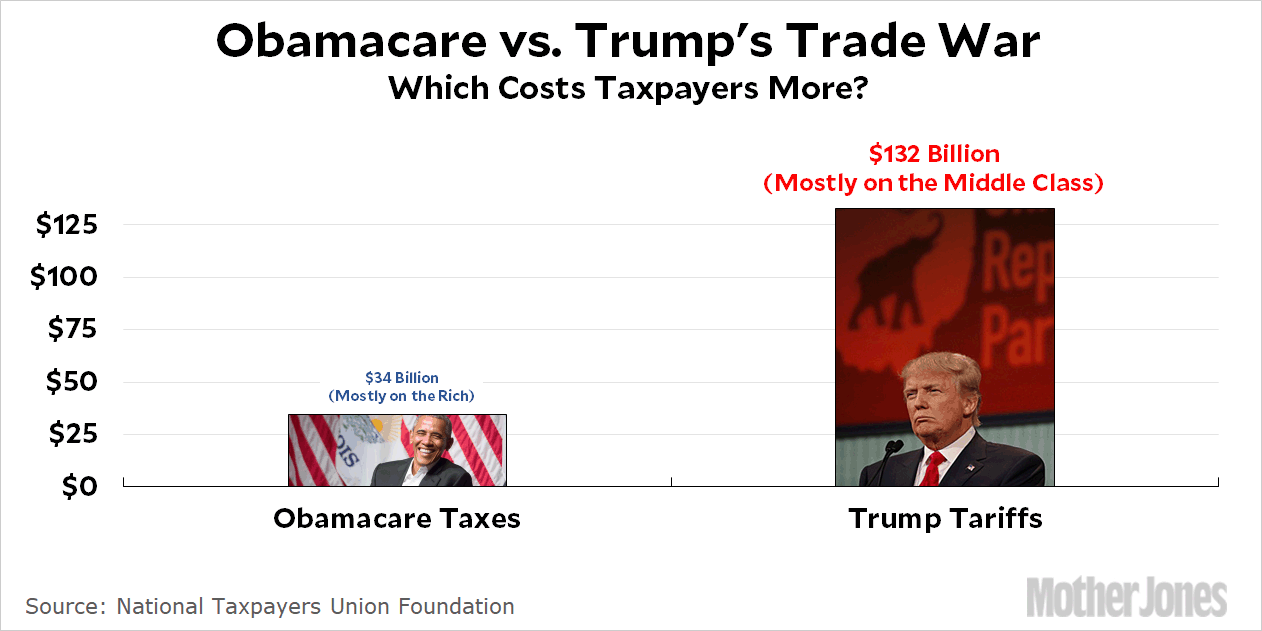
    President Trump recently announced plans to impose a 10 percent tax on $200 billion of imports from China effective September 24, escalating to 25 percent effective January 1, 2019. When added to tariffs that have already been implemented, total trade taxes imposed on American consumers and businesses via unilateral executive action exceed all the taxes included in President Obama’s Affordable Care Act (ACA).

    That’s from the National Taxpayers Union Foundation, a conservative outfit that favors low taxes and low spending. Their methodology is a little aggressive since they include $60 billion in automobile tariffs that haven’t actually been implemented yet, but then again, Donald Trump keeps yammering about raising car tariffs, so maybe it’s fair after all. When you add it all up, here’s the total in colorful chart form:

  • Women: Getting to the Top Is Tougher for Women. Men: Nah.

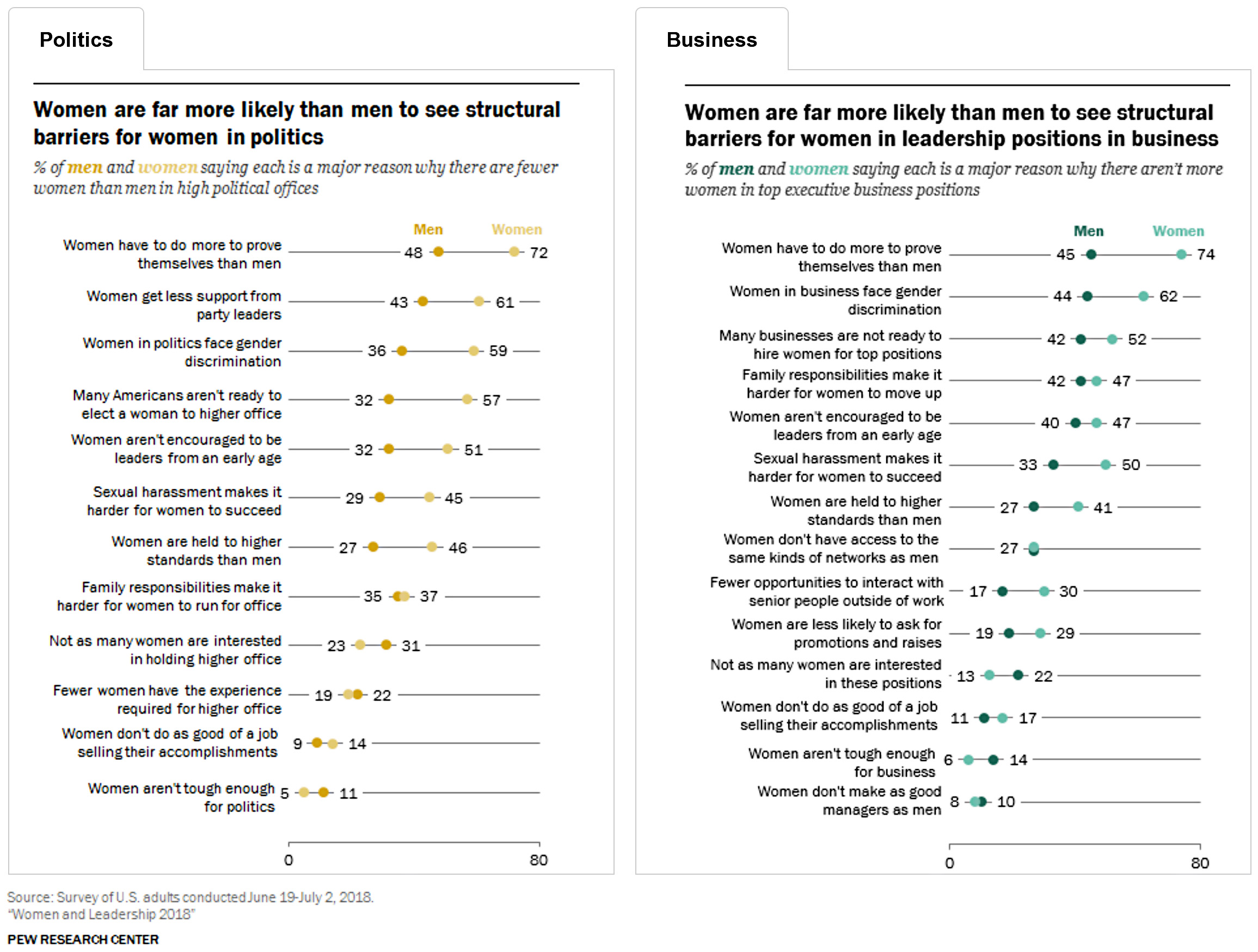
    Why do women have a hard time making it to the top in America? Let’s ask them! And while we’re at it, let’s ask men too:

    That’s a little small and hard to read. Sorry. You can read the entire survey here.

    But small or not, the results are pretty clear, and they’re pretty much the same in politics and business: women believe there are lots of structural issues holding them back: they have to do more to prove themselves, they face more gender discrimination, they get less support from higher-ups, sexual harassment makes it hard to succeed, etc.

    But men? By 20 or 30 points, they believe a lot less in these structural issues. Less support? Sexual harassment? Nah. Not really an issue. There’s a pool of men, maybe a quarter to a third of the total, who just don’t believe in any of this fem-lib nonsense. Women face no more problems than men—hell, maybe less these days, amirite?—and they should stop whining about it. Now, who wants a beer?

  • Lunchtime Photo

    Continuing with my Overexposed LA™ series, this is one of my favorites—although it’s not especially overexposed, is it? In any case, you may recall a story a couple of months ago about going up to Griffith Observatory, taking a wrong turn, and then stopping because I saw a picture I had to take right away. This is it. While I was looking for a spot to turn around, I looked out the car window and saw the observatory with the moon rising right above it, so I pulled over at my first opportunity and ran back with my tripod in hand to get this picture. I really like it.

    As it turned out, my “first opportunity” to pull over was a spot that didn’t allow parking. Luckily for me, another guy saw me parking and apparently figured that if I was parking there, it must be OK. Not so. When I huffed and puffed my way back, his car was being towed away. If he hadn’t been there, it probably would have been me being towed away. Needless to say, I hopped into my car and took off before anyone had a chance to get a second tow truck up there. Then I zipped over to the observatory and took this picture, another of my favorites. It was a very productive half hour of photography.

    June 28, 2018 — Los Angeles, California
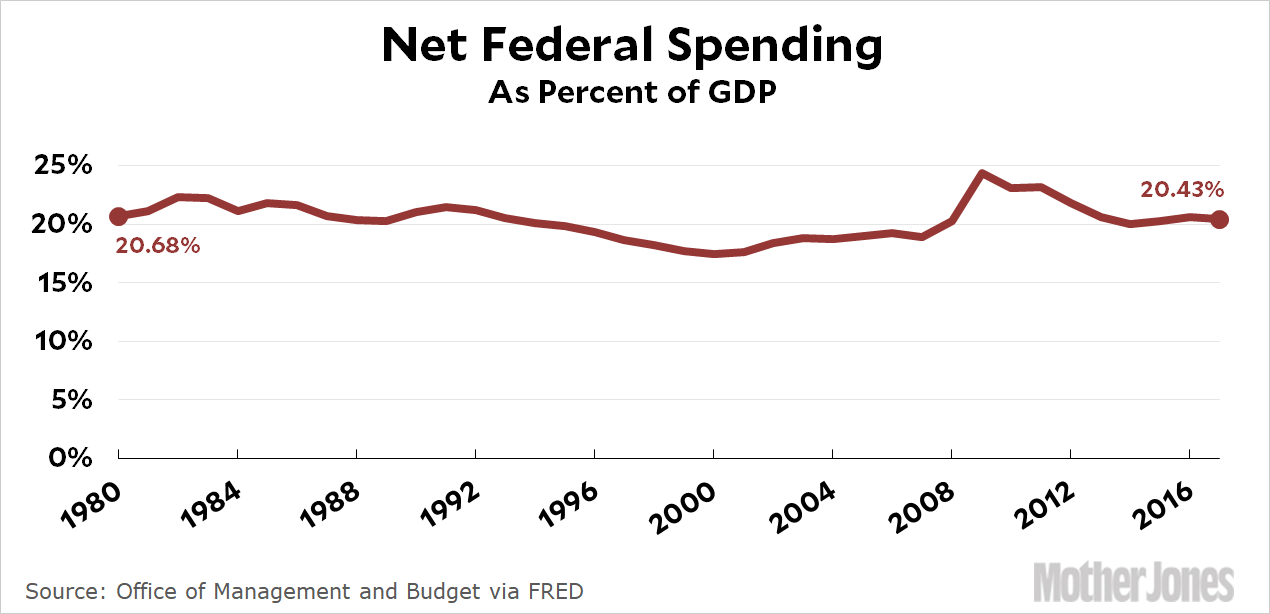
  • Chart of the Day: A Taxpayer’s Guide to Skyrocketing Federal Spending

    Republicans are gearing up for their latest round of deficit fever. Larry Kudlow previewed this yesterday with the usual blueprint ready at hand: deficits have nothing to do with tax cuts. It’s all about out-of-control spending.

    We’re going to be hearing a lot more about this in the coming months, I’m sure, so I figured everyone would welcome a simple chart to help guide our way in this highly complex and technical debate. So here it is: our skyrocketing federal spending. Whatever will we do?