• My Right to Die


    Several years ago, my father-in-law was in the end stages of multiple myeloma. He was a retired doctor, and he knew what was coming. So one night he called us all over to his house, said his last goodbyes, and then went into his bedroom and took his own life.

    But Harry died before he had to. Assisted suicide was illegal in California at the time, and he was afraid he might soon lose the physical ability to take his life. And he almost died alone. Until a friend talked him out of it, he had decided not to tell any of us beforehand, out of fear that we might be held responsible for assisting him.

    Now I’m the one with multiple myeloma. I’m still years away from having to make the decisions Harry did, but when my time finally does come, I have an option that he didn’t: legal, doctor-assisted suicide thanks to a right-to-die bill that Gov. Jerry Brown signed last year:

    When I’m within six months of death, I can ask my doctor for a prescription sedative that will kill me on my own terms—when I want and where I want. Will I ever use it? I don’t know. I suspect that taking your own life requires a certain amount of courage, and I don’t know if I have it. Probably none of us do until we’re faced with it head-on.

    But either way, I won’t have to die before I want to out of fear that I’ll lose the capacity to control my own destiny if I wait too long. Nor will I have to die alone out of fear that anyone present runs the risk of being hauled in by an overzealous sheriff’s deputy. I’ll be able to tell my wife I love her one last time. I can take her hand and we can lie down together on our bed. And then, slowly and peacefully, I’ll draw my last breaths.

    I don’t want to die. But if I have to, this is how I want it to happen. I don’t want a “suicide party,” but neither do I want to suffer needlessly for months. Nor do I want to cause other people any more pain than I have to. I want to go out quietly, with my loved ones at my side.

    Please read the whole thing. Doctor-assisted suicide is not a simple issue. There are legitimate fears about how it will be used and what it might lead to—and it’s not for everyone. In fact, the evidence suggests that it will never be used by more than a few percent of terminal patients. But I’m convinced that, for those who do want it, it’s simply a better, more humane way to treat our fellow human beings.

  • Good News: The Fed Is Finally Going After Leverage in the Shadow Banking Sector


    Here’s some welcome news. The Fed is bringing back an old tool to regulate leverage in the financial market: increased margin requirements. And in even more welcome news, these requirements will apply to everyone, not just banks:

    A little-noticed global agreement recently paved the way for the central bank to move forward with plans to alter margin requirements. Under the accord announced Nov. 12, regulators representing 25 economies agreed to adopt rules similar to ones the Fed is developing, a united front intended to prevent financial firms from moving transactions offshore in response to tighter Fed rules.

    ….Unlike earlier Fed margin rules, which focused largely on stock purchases, the new rules being crafted by the central bank would apply to securities-financing transactions, a multitrillion dollar market involving repurchase agreements, or repos, for stocks and bonds, as well as lending of securities.

    ….Unlike most of the central bank’s regulatory authority, this rule would reach beyond banks and across the entire financial system, affecting investment funds and other nonbank players, reflecting the Fed’s growing concern about what has been called shadow banking.

    The tighter that regulations become on banks, the more incentive there is to move transactions into the shadow banking sector.1 That’s why we need rules that apply everywhere. As we learned in 2008, a run on the shadow banking sector is every bit as dangerous as a run on ordinary banks. In fact, since shadow banks are so loosely regulated, shadow runs can be even more dangerous than normal runs.

    In any case, this is basically an effort to reduce leverage in yet another corner of the financial industry. That’s a good thing. Pretty much any effort to reduce leverage in any part of the financial sector is a good thing. As I’ve mentioned before, I’d trade pretty much every financial regulation we’ve put in place since 2008 for a simpler, more robust restriction on leverage everywhere and anywhere it occurs. This stuff is boring, but it’s important.

    1Commercial banks take short-term deposits and make long-term loans. They are inherently vulnerable to runs since depositors can remove their money anytime they get scared, but banks can’t just call in their loans at will in order to fund all the depositors who want their money.

    A shadow bank is any entity that isn’t a commercial bank but acts just like one (borrows short, lends long). By 2008, the shadow banking sector was about as big as the ordinary commercial banking sector, and the shadow banking run in that year was responsible for a large part of the Great Meltdown.

  • Does My Mother Deserve Reparations For Raising Me?


    In the New York Times today, Judith Shulevitz makes an argument in favor of a Universal Basic Income. She puckishly frames this as “reparations” for the work that stay-at-home mothers do without compensation—work necessary to keep the human race going and which the rest of us free-ride on. But if that’s the case, why propose a UBI for everyone, even men and childless women? Here’s the answer:

    Politically, the U.B.I. looks a lot more plausible than a subsidy aimed only at mothers, because, as Social Security and Medicare make clear, policies have more staying power when perceived as general entitlements rather than free cash for free riders.

    Hmmm. Politically I’d say it’s a nonstarter no matter how it’s framed. But Shulevitz’s essay prompts me to write about something that’s been in the back of my mind for a while. She is, of course, echoing a sentiment so widespread on the left that it has its own catch phrase: “programs for the poor are poor programs.” As Shulevitz says, the idea here is that means-tested benefits are unpopular and constantly under attack. Conversely, universal programs like Social Security and Medicare are beloved and politically invulnerable.
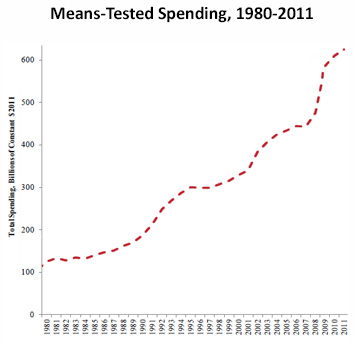
    But is this really true? I think it fails on two counts. First, although means-tested benefits (EITC, food stamps, Medicaid, etc.) are, indeed, often under attack from conservatives, they’ve nevertheless increased rather smartly over the past few decades. The chart on the right, from Brookings, shows the growth of means-tested benefits since 1980. It comes from Ron Haskins, a conservative, but it pretty closely matches a more recent analysis from the CBO. Adjusted for inflation, means-tested benefits over the past 30 years have increased steadily; have never decreased; and even before the Great Recession were more than 4x higher than in 1980. And this chart accounts only for the ten biggest federal programs. If you add in the rest, and then include state and local programs, total spending is about 50 percent higher.

    So in terms of spending, it doesn’t really seem to be the case that means-tested programs are disastrous for either participants or for the liberal project more generally. The public may or may not be thrilled about safety-net programs, but one way or another they seem to tolerate assistance to the poor pretty well.

    Second—well, we don’t really need a second way the familiar aphorism fails, do we? If means-tested programs do, in fact, have plenty of staying power, then there’s no need to support a UBI if your real intent is to pay stay-at-home parents. We should just pay the stay-at-home parents. But here’s the second point anyway: just as it’s not really true that spending on the poor is precarious, it’s not clear that universal programs are all that beloved. The two usual examples of this are Social Security and Medicare, which share three characteristics:

    1. They are universal.
    2. They are aimed at the elderly.
    3. They are perceived as benefits that retired people have paid for during their working lives.

    I’d argue that the first is irrelevant. It’s #2 and #3 that make these programs beloved and politically untouchable.1 Is there a way to test this? Is there a universal benefit that’s not aimed at the elderly and not perceived as paid for? Not really. There are tax credits that fall into this category, like the mortgage interest deduction, but I can’t think of any actual cash payouts that do. The closest, I suppose, is unemployment insurance, which is semi-universal. But is it beloved? Is it politically invulnerable? Based on events of the past few years, I’d say it’s at least as vulnerable as other safety net programs. Maybe more so.

    Bottom line: it’s time to retire the ancient shibboleth about programs for the poor being poor programs. It doesn’t really seem to be the case. That doesn’t mean there aren’t plenty of good arguments for a UBI. There are. I don’t really buy them at the moment, but I probably will in the future when the robots take over.2 In the meantime, if you say something like this:

    The feminist argument for a U.B.I. is that it’s a way to reimburse mothers and other caregivers for the heavy lifting they now do free of charge. Roughly one-fifth of Americans have children 18 or under. Many also attend to ill or elderly relatives. They perform these labors out of love or a sense of duty, but still, at some point during the diaper-changing or bedpan cleaning, they have to wonder why their efforts aren’t seen as “work.” They may even ask why they have to pay for the privilege of doing it, by cutting back on their hours or quitting jobs to stay home.

    ….Society [is] getting a free ride on women’s unrewarded contributions to the perpetuation of the human race….I say it’s time for something like reparations.

    Then you just need to make the case for reparations. Proposing a UBI instead won’t do any good and will just make the price tag higher.

    1Though it’s worth noting that for all their alleged untouchability, Republicans sure do spend a lot of time trying to suggest ways to pare them down.

    2No, I’m not joking.

  • The CARD Act Has Saved Us $12 Billion Per Year


    Who do credit card companies make the most money from? Answer: the poor, by far, because they rack up the highest fees and the highest interest expense. Card issuers also make some money on the rich, because they buy a lot of stuff. This generates interchange fees (usually 2-3 percent of the amount charged) that exceed the cost the reward points they dole out to attract these customers.

    It’s the customers in the middle who cost them. They don’t buy enough stuff to generate lots interchange fees, but they aren’t poor enough to get themselves stuck with lots of late fees and interest charges. The chart below shows this. Folks with FICO scores between 660 and 730 (representing about a third of all customers) are net losses for credit card companies.

    This comes from a paper written last year about the effect of the CARD Act, a law passed in 2009 that modestly regulated the credit card industry. The authors’ conclusion: “The CARD Act successfully reduced borrowing costs, in particular for borrowers with the lowest FICO scores. We find no evidence for offsetting increases in other costs or a decline in credit volume.”  All in all, the CARD Act saved consumers—mostly lower-income consumers—about $12 billion per year. For much more, see today’s Harold Pollack interview with one of the authors here.

  • Hip Hip Hooray For They!


    The Washington Post reports some terrific news:

    Singular “they,” the gender-neutral pronoun, has been named the Word of the Year by a crowd of over 200 linguists at the American Dialect Society’s annual meeting in Washington, D.C. on Friday evening.

    ….The Post’s style guide ratified this usage last month, which caused some grammar pedants to shriek. But as Post copy editor Bill Walsh explained, the singular they is “the only sensible solution to English’s lack of a gender-neutral third-person singular personal pronoun.”

    OK, so we can now say:

    • I talked to Pat, and they said the sofa was on its way.
    • Pat said their sofa had been promised for tomorrow.
    • Pat came over, and I talked to them about when the sofa would arrive.

    Takes some getting used to, doesn’t it? But I’m all for it. I will celebrate the day when gendered pronouns are gone for good.

  • Friday Cat Blogging – 8 January 2016


    The holidays just fly by, don’t they? At least, that’s what we all say after they’re over. This time, though, the inconvenient timing of Christmas means that you never saw the furballs in action on Christmas morning. As usual, the presents we bought them were dirt cheap, but they nonetheless enjoyed them far more than the humans did. The picture below is relatively early in the morning, when the cat presents were still in tolerably good shape. An hour later it was just a mountain of scraps.

    By the way, Hopper here is the reason we didn’t have a Christmas tree this year. It would have been a disaster. Maybe next year.

  • When Men and Women Work Together, Men Get All the Credit


    Anne Case and Angus Deaton recently wrote a paper that’s gotten a lot of attention. One of the minor ways it’s gotten attention is in the way a lot of people talk about it: as the Deaton paper, or the Deaton/Case paper, despite the fact that it’s traditional in economics to list authors alphabetically.

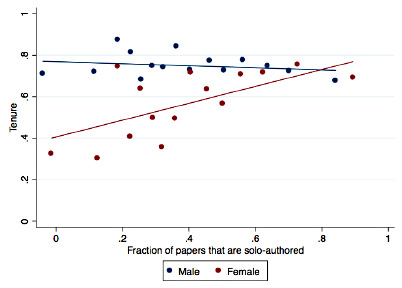
    Is this just because Angus Deaton recently won a Nobel prize? That probably didn’t hurt. But Justin Wolfers points today to a new working paper that suggests this is a widespread problem: when women coauthor papers in economics with men, it’s the men who get all the credit. The study is by Heather Sarsons, a PhD candidate at Harvard, who examined economics papers and tenure decisions at elite universities over the past 40 years. The chart on the right comes from her paper, and it shows the basic state of play. For men, it didn’t matter if they coauthored papers. They got tenure at about the same rate regardless of whether they coauthored or solo authored. For women, it mattered a lot. Solo authoring 80 percent of their papers doubled their chance of getting tenure compared to co-authoring most of their papers:
    The coauthoring penalty is almost entirely driven from coauthoring with men. An additional coauthored paper with a man has zero marginal effect on tenure. Papers in which there is at least one other woman have a smaller effect on tenure for women than for men (8% vs. 3.5%) but still have a positive marginal impact.

    Roughly speaking, Sarsons examines several possible explanations for this (maybe women are genuinely less qualified, maybe they pair up more often with senior people, etc.), and her conclusion is fairly simple: It’s none of that stuff. The ability of the female economists is, in fact, just as high as their male counterparts. Nevertheless, when women work in mixed-gender teams, people tend to think men did all of the actual work. Women get essentially no credit at all. The only way for them to get credit is to work on their own or with other women. This has broad implications:

    Many occupations require group work. The tech industry, for example, prides itself on collaboration. In such male-dominated fields, however, group work in which a single output is produced could sustain the leaky pipeline if employers rely on stereotypes to attribute credit….Employers will rely primarily on their priors and women will be promoted at even lower rates. Bias, whether conscious or subconscious, can therefore have significant implications for the gender gap in promotion decisions.

    Note to managers: be aware of this! Just because the guys who work for you are more aggressive about touting their work doesn’t mean they actually did more of it. Dig a little deeper and figure out who really did most of the work if you’re not sure. You might be surprised.

  • How to Spend Less So You Can Afford to Save More


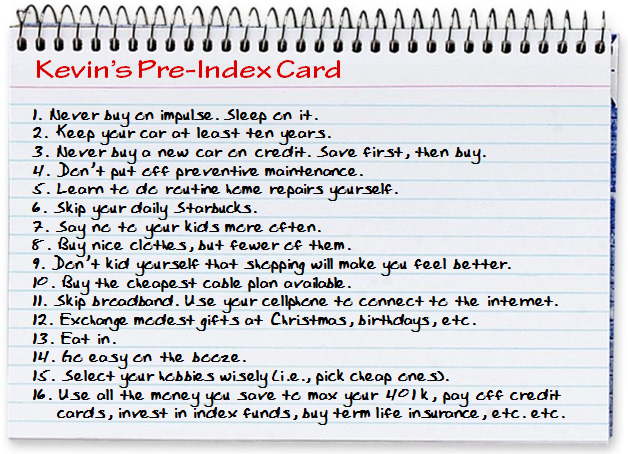
    Thanks to Harold Pollack, personal finance index cards are all the rage. Today, the New York Times even has an index of popular index cards. Many of them share the same suggestions: pay off your credit cards, max out your 401(k), invest in low-load index funds, etc.

    This is excellent advice. But how do you do it? Where do you get the money for this? For that, you need Kevin’s pre-index card. Not everything here works for everyone, but most of them will comfortably reduce daily expenses for most people without too much angst. And you can add your own ideas in comments. Enjoy!

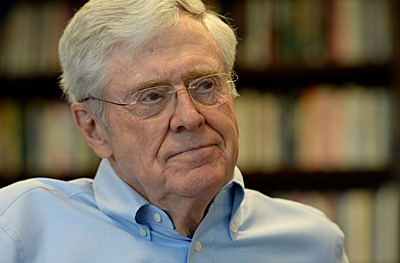
  • Charles Koch Is Disappointed That He Can’t Buy More Influence


    Stephen Foley talks to Charles Koch about the vast amounts of money he has raised to support conservative politicians:
    He says he is “disappointed” by the current crop of Republican presidential candidates, and resigned to having to support one with whom he agrees on only some issues. “It is hard for me to get a high level of enthusiasm because the things I’m passionate about and I think this country urgently needs aren’t being addressed.”

    The Kochs’ political machine has presented all the candidates with a list of issues it wants on the agenda but, says Koch, “it doesn’t seem to faze them much. You’d think we could have more influence.”

    So does the man that the left believes has too much influence in politics believe he in fact has too little? “I’m pleased that I can still speak and I’m pleased that it isn’t worse,” he says. “They haven’t nationalised all the industries like happened in the UK when the Fabians took over.”

    I ask him to put his businessman’s hat on and to tell me whether he thinks his political spending is generating a positive return on investment. “I’m not confident,” he says. “I’d say there are some benefits. Ask me in 10 years.”

    There are two interesting things going on here. First is Koch’s disappointment that his money doesn’t buy him more influence. It’s easy to laugh at that, but he’s probably right. He’s raised a lot of money. But it’s hard to see that Republican views have changed in his direction much. The entire party denies climate change and wants to lower taxes already, so there was no work to be done there. But a less aggressive foreign policy? An end to corporate welfare? Turning down the volume on social issues? Koch is right: all his money has had no effect on that. It’s only had a significant effect when he’s pushing in the same direction that the GOP wind is already blowing.

    Second is Koch’s fascinating observation about the Fabians. The way he mentions them, he sounds as if he’s genuinely surprised that he’s still allowed to say what he pleases. He’s genuinely surprised that Koch Industries hasn’t been nationalized. Here’s a man who has been fighting political battles for decades and is worth something north of $40 billion thanks to the growth of his business. If that doesn’t demonstrate America’s fundamental commitment to both free speech and capitalism, I don’t know what does. And yet, he still seems fearful that Marxism is just around the corner.

    It’s weird. What is it that makes a smart guy like him so paranoid?

  • How Much Do People Hate Ted Cruz? A Lot.


    I think that everyone—literally everyone—knows that Ted Cruz is a natural born citizen and thus eligible to become president. The whole issue is a complete crock. And yet, ever since Donald Trump brought it up, you can hardly swing a dead cat without running into someone jabbering about it. Even John McCain and Nancy Pelosi have gotten into the act. What’s going on? Here are some possibilities:

    • We are all bored. We are so bored that we’ll literally talk about anything. This is the true genius of Donald Trump: he recognizes how bored we all are and is willing to find stimulating topics for us to chatter about.
    • Everyone loathes Ted Cruz. They loathe him so much that they’re willing to discuss this ridiculous meme as a way of hurting him, even though they know perfectly well it’s ridiculous.
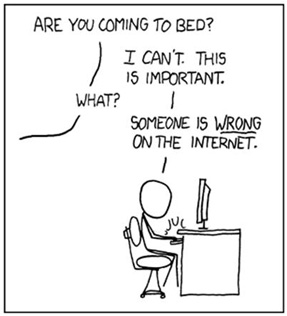
    • We can’t help ourselves. It’s the “someone is wrong on the internet” syndrome: when Trump suggests Cruz doesn’t qualify for president, we have to explicate it. We have to research it. We have to find constitutional experts who like being on TV to cite endless case law. In the end, we have to explain why it’s wrong. It’s what we do. This has lately earned the moniker “Voxsplaining,” which is a little unfair—it’s not as if Vox invented this phenomenon—but only a little.
    • We remain under the misguided notion that anything Donald Trump says is automatically newsworthy because he’s the Republican front-runner.

    That’s all I could come up with. Are there other possible explanations?