
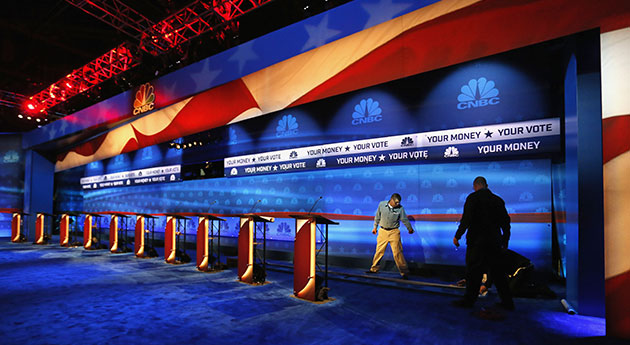
• We Are Live Blogging the GOP Presidential Debate in Colorado

    Brennan Linsley/AP


    This debate was a zoo. The candidates started yelling for attention after every question like a cage of howler monkeys, and spent about as much time accusing the CNBC crew of mopery and dopery as they did answering questions. Then, in an epic show of chutzpah, they all congratulated each other at the end for conducting such a civil, substantive debate.

    I honestly didn’t get a very good read on who did well and who didn’t. Jeb Bush seemed to fade into the woodwork. Donald Trump seemed kind of tired, as if he knew his act had gotten stale but he couldn’t really figure out how to freshen it up. Ben Carson was his normal sleepy self, basically promising over and over that sometime very soon he’ll release the kraken and everyone will see that all his weird plans really will work. Marco Rubio tried to sound energetic, but mostly sounded kind of manic and evasive. Chris Christie did pretty well, though probably not enough to do himself much good. John Kasich was obviously frustrated with the clown show. I’m not sure that helped him tonight, but it might down the road when everyone else gets tired of it too. Carly Fiorina spoke forcefully, but said virtually nothing of substance. Ted Cruz didn’t say anything that I can remember. Rand Paul and Mike Huckabee were equally forgettable.
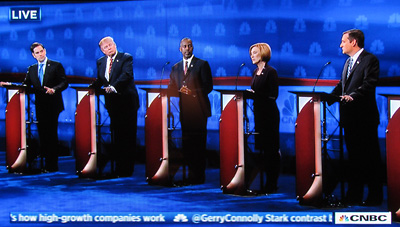
    I think that Bush, Trump, and Cruz will lose support in the next few polls. Carson might do okay, since his sleepy persona seems inexplicably attractive to a lot of people. However, he might have problems if this Mannatech thing blows up on him. Rubio might pick up a point or two, though I wouldn’t put money on it. Fiorina? She might pick up a few points. She speaks well if you don’t pay too much attention to what she’s actually saying, and she plays the Hillary card well.

    The truth is, I just don’t know. The whole thing seemed like a blur. These guys want to promise to cut taxes and slash regulations, and that’s about it. They all but refuse to take any other question seriously.

    My condolences to all the real reporters who have to come up with a thousand words of colorably serious analysis tonight on deadline. But you’re all pros. I know you can do it.

    Debate transcript here.


    7:20 – And that’s a wrap.

    7:19 – Huckabee doesn’t want to walk his grandchildren “through the charred remains of a country called America.” Okay.

    7:17 – Trump sounds tired. Just repeating his themes from two months ago. Now he’s rattling on about his great success at getting the debate reduced from three hours to two. Yeesh.

    7:15 – Oh wait. Carson just wants to thank everyone. Plus: Political correctness is bad.

    7:14 – Closing statements: Basically, they’re all riffs on who hates government the most.

    7:11 – Fiorina thinks the answer for Social Security and Medicare is…zero-based budgeting! Christ. People of a certain age are all banging their heads on the table right now.

    7:09 – Carson seems pretty proud that he knows how big the Medicare budget is. All that money goes to the private sector, but Carson seems to think the private sector would do a lot better if…something. I’m not quite sure what.

    7:07 – I think these candidates need shock collars or something.

    7:04 – Once again, Huckabee says the answer to our problems is to cure all diseases. I guess no one’s thought of that before.

    7:03 – Closing statements are coming up. So I guess Trump and Carson won half the argument over that.

    7:00 – Paul: The only way to save Social Security is to raise the retirement age. The only way, I tell you! Actually, there are lots of ways. Raising the retirement age is pretty much the worst and least fair.

    6:58 – The attacks on the moderators are really flying tonight.

    6:57 – Christie: Leave fantasy football alone!

    6:55 – Bush wants to regulate fantasy football betting. But he doesn’t want the federal government to do it. Then who?

    6:54 – Kasich: Ohio State made $500 million by selling a parking lot. That’s a campaign selling point? They probably had to do it because Kasich cut their budget.

    6:52 – Trump lied about criticizing Mark Zuckerberg. Carson lied about Mannatech. Fiorina lied about the size of the tax code. Rubio flatly refused to answer a question (“discredited attacks from Democrats”) that I guess he didn’t think he could just lie about. This is quite a debate.

    6:46 – Trump says he’s going to change the no-guns policy at his resorts. I can’t wait to see that.

    6:38 – Kasich hates drugs. Now let’s move on.

    6:34 – Q for Bush: Why does he want to tax labor at a higher rate than capital? Bush argle bargles for a while, but never addresses the question. Bush is really making zero impression tonight.

    6:32 – Huckabee is first to compare the federal government to today’s blimp fiasco. How is it that it took more than an hour for someone to do this?

    6:31 – Carson says he no longer supports ethanol subsidies. He just wants to kill all subsidies.

    6:27 – Trump says he never criticized Zuckerberg. Here’s the report from CNN: “‘Mark Zuckerberg’s personal Senator, Marco Rubio, has a bill to triple H-1Bs that would decimate women and minorities,’ Trump wrote in his immigration plan.”

    Trump says he never said this. Just more misreporting from the lamestream media. You can probably guess what’s coming next. Here it is from Trump’s own immigration white paper.

    6:21 – Here’s Jim Geraghty at NRO: “In March of last year, Dr. Ben Carson…appeared in a video for Mannatech, Inc., a Texas-based medical supplement maker. Smiling into the camera, he extolled the benefits of the company’s ‘glyconutrient” products.'” Apparently this goes back to 2004.

    6:18 – Carson says he had nothing to do with some shady company called Mannatech. Anyone care to fact-check this?

    6:17 – Carson: The PC culture is destroying America!

    6:15 – Fiorina is really annoying. Hell, they’re all annoying. But Fiorina doesn’t even pretend to offer up policy answers. She just gives mini stump speeches about how bad everything is.

    6:13 – Kasich on the Boehner budget: “No more of these silly deals” if he’s elected president. But Kasich made plenty of deals just like this when he was chairman of the House Budget Committee.

    6:10 – I actually think this is a weakness for Rubio. He seems too young, too close to just paying off student debt, too irresponsible with money. Nice young man, but president? Maybe he needs to get a gray hair or two.

    6:08 – Becky Quick is really going after Rubio. So Rubio declares he’s just not going to answer.

    6:07 – Fiorina says companies are consolidating because it’s the only way to compete with big, corrupt government. “This is how socialism starts.” Is that also why she bought Compaq when she was CEO of Hewlett-Packard?

    6:01 – Carson: Some people go overboard in pursuit of profit. Socialist! Ahem. Anyway, we need to cut regulations. Apparently this will make everyone a little more socially responsible?

    6:00 – Trump: Hell, everyone in Atlantic City has declared bankruptcy. “Nobody can solve debt problems like me.” Does this mean Trump intends to put America in Chapter 11?

    5:55 – Jeebus. This discussion of Social Security is just bonkers. I don’t think I can summarize it in justice.

    5:52 – Christie: Tell people the truth: The government has stolen their money. They’re not getting it back. Or something.

    5:52 – Huckabee: The guvmint has been confiscating everyone’s money. Yada yada yada.

    5:47 – Cruz uses all his time to attack the media, then complains loudly when he’s cut off. “You don’t want to hear the answer?” “You’re not interested in the answer?” I guess we know what his fundraising pitch is going be tomorrow morning: The mainstream media is afraid to let me talk!

    5:45 – Fiorina: What if a CEO was held criminally liable for lying? OMG. Carly would have a life sentence in the Supermax up the road, that’s what.

    5:44 – Wait, is Fiorina’s hair red now?

    5:42 – HP stock tanked during Fiorina’s tenure. So why should we hire you to be president? A: Blah blah blah, I was a great CEO. I saved 80,000 jobs. Um…

    5:39 – Moderators are really having a hard time keeping these folks in line. It’s kind of like a mirror press scrum: Every time a candidate stops talking, all the others start shouting for attention.

    5:38 – Impressive! Rubio turns a question about missing Senate votes into an attack on the mainstream media.

    5:37 – Rubio: America just can’t wait, dammit. It needs Rubio.

    5:34 – Fiorina says the tax code is 73,000 pages long. She’s going to cut that to three pages. There’s so much ridiculousness here that it’s hard to know where to start.

    5:33 – Cruz: My flat tax plan will only cost $1 trillion. A pittance!

    5:32 – The CNBC folks have been pretty good at getting everyone to fight with each other.

    5:29 – Kasich: These are fantasy tax plans. Can’t argue with that.

    5:27 – Carson says his flat tax will be around 15 percent. And by God, if he ever shows you the details, you’ll see how awesome and deficit-killing it is.

    5:25 – Q to Trump: Are you a comic book version of a president? A: That’s not very nice of you.

    5:23 – Paul: Deficits are bad.

    5:23 – Christie: “I don’t see much weakness on this stage.”

    5:22 – Cruz: “I’m a fighter.”

    5:21 – Fiorina: Argle bargle.

    5:20 – Carson: It’s hard to see himself as president. You’re not alone, Ben.

    5:20 – Trump: “I’m too trusting.”

    5:20 – Rubio: “I share a sense of optimism about America’s future.” What? Even by the standards of absurd answers to “what’s your greatest weakness,” this makes no sense.

    5:20 – Bush is impatient.

    5:19 – Huckabee’s biggest weakness: “I try to live by the rules.”

    5:18 – Ah, no opening statements. I guess Trump and Carson lost out on this one.

    5:16 – And here we are, live from a fine Pac-12 university.

    5:05 – “Policy hasn’t really impacted anyone’s poll numbers in this debate so far.” This might end up being the most salient quote of the whole evening.

    5:02 – The CNBC warm-up crew is convinced that today’s college students are really a bunch of greedy materialists—by coincidence, exactly CNBC’s target audience. Imagine that.
  • Debate Liveblogging Tonight!


    Will I be liveblogging the Republican debate tonight? Yes. Yes I will. I’ll probably grow hair on my palms as a result, but I’m doing it anyway.

    The debate is on CNBC and allegedly starts at 8 pm Eastern, but I imagine the actual debating probably doesn’t begin until 8:30 or thereabouts. So if you want to be part of history, come on by between 8 and 8:30 and join the snarkfest.

  • Everyone Hated Sequestration, But Its Effect Was Never All That Huge


    Kevin Williamson doesn’t like the new budget deal. That’s no surprise: the reason Boehner is trying to pass this while he’s a lame duck is that he knows no one will like it. But that doesn’t matter to him anymore, so he’s willing to shrug and just get it done.

    So what is Williamson’s specific gripe? That the deal basically does away with sequestration:

    Democrats hated sequestration. Republicans hated sequestration.

    Why?

    Sequestration worked.

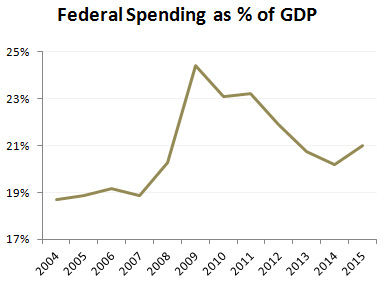
    Sequestration is the reason why in recent years we’ve reduced federal spending substantially in GDP terms, from about 25 percent to about 20 percent. It is the main reason that we have reduced the federal deficit in GDP terms. Democrat-supporting welfare entrepreneurs hated it, and Republican-supporting military contractors hated it. Ordinary Americans did not have much in the way of strong views on the matter, which often is the case when a policy actually does what it is supposed to. Effective government rarely is dramatic government.
    No argument with the first sentence. Sequestration was specifically designed to be so unlikable that neither party would ever support it. The fact that it took effect anyway is a testament to the dysfunction of the federal government, not to the budget-capping wonders of sequestration.

    But let’s review that last paragraph. Is sequestration really the “main” reason we’ve reduced federal spending from 25 percent of GDP to 20 percent? Hmmm:

    • Spending hit 24.4 percent of GDP during the recession year of 2009. It was already down to 21.9 percent of GDP by 2012 and hit 21 percent in 2015.
    • Sequestration started in 2013, so at most it could be responsible for 0.9 out of 3.4 points of that reduced spending.
    • Was it? It theoretically reduced spending by $200 billion or so.
    • That’s about 1 percent of GDP.
    • In reality, CBO estimates that adjustments—primarily to fund overseas wars—ate into half of that. This means that sequestration lowered actual spending by about 0.5 percent of GDP.
    • The rest of the decline from 21.9 percent to 21 percent comes from the fact that GDP recovered.
    • So: of the spending reduction Williamson cites, about 0.5 percentage points was due to sequestration.

    Now, I suppose that any kind of spending cut is a good cut to a conservative. But sequestration is responsible for only about a seventh of the spending reduction since 2009. The rest is due to (a) the end of stimulus spending, (b) reduced safety net spending as the recession eased, (c) the 2011 budget deal, and (d) the recovery of GDP growth, which automatically reduces spending as a percent of GDP.

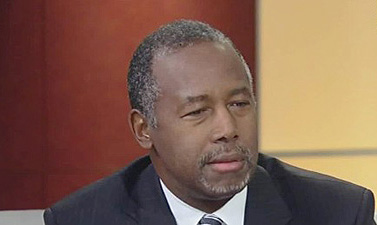
  • Ben Carson’s Babysitter Attacks Press for Allowing Ben Carson on TV


    Steve Benen points me to Jake Tapper, who interviewed Ben Carson recently about his opposition to “wealth redistribution”:

    TAPPER: I want to ask you about comments you made year to Politico about education funding, in which you said—quote—“Wouldn’t it make more sense to put the money in a pot and redistribute it throughout the country so that public schools are equal, whether you’re in a poor area or a wealthy area?”

    CARSON: Well, that’s a different concept altogether…

    TAPPER: But isn’t it redistribution of wealth? It’s redistribution of education wealth, but it’s redistribution, right?

    …CARSON: I think that’s very different than a situation where someone is working hard, is making, you know, a lot of money, is providing a lot of jobs and is contributing to the fabric of America and then us going along and saying, well, he’s got too much. And this guy over here, he has too little, so let’s just take this one and give it to that one. That’s much more arbitrary.

    TAPPER: Well, you’re talking about doing it on an individual level. But when it’s school districts, if it’s funded from local taxes, so isn’t it the same principle at stake?

    CARSON: No, it’s not the same principle at stake because we are talking about the entire nation and we’re talking about what makes us competitive in the world, and the great divide between the haves and the have-nots is education. That’s very different than redistributing funding because you feel that that’s the social thing to do.

    After a while you start to run out of things to say about this. We’ve already been through this dance once before, posting all the idiotic things Donald Trump said and then shaking our virtual heads over them. That finally got boring, so now it’s Ben Carson’s turn. But it’s weirdly different. Trump used bluster to hide his ignorance, but at least that suggests he knew he was ignorant. Carson doesn’t even seem to know. He tosses out his flaky ideas and then earnestly defends them. In this interview, he didn’t take the easy route of saying he’d misspoken, or was taken out of context, or has since changed his mind. He just went ahead and defended himself. Massive redistribution in education funding isn’t real redistribution that’s done because “you feel that’s the social thing to do.”

    In other words, it’s okay if your motives are pure. I guess. Anyway, one of Carson’s minders quickly covered for his boss, saying “Dr. Carson [does not] support the national pooling of property tax receipts. That is a falsehood.” So I guess we’re redefining “falsehood” too. Now it means something Carson actually said that turns out to be sort of inconvenient.

    I can only assume Carson is a smart man. How can a smart man who’s running for president know less about policy than the average Joe in a construction yard? It is a mystery.

  • Kansas Is Still the Land of Make-Believe


    Kansas governor Sam Brownback has been leading an epic battle to turn his state into a supply-side nirvana. So how’s it going? A new poll—possibly the greatest poll in American history—suggests that Kansans are a wee bit confused:

    When it comes to Brownback’s tax policy, which has featured heavy cuts in income taxes and taxes on businesses, three-fifths (61 percent) of respondents felt the policy had been “a failure” or “a tremendous failure” in terms of economic growth. About one-third of respondents said it was “neither a success nor failure” and 7 percent said they felt it was at least “a success.” Only 0.2 percent agreed it was “a tremendous success.”

    But at the same time, 61 percent of respondents favor “somewhat lower” or “much lower” taxes and spending in Kansas. And yet…about 63 percent of respondents felt taxes on top income earners should be increased while 6 percent felt they should be decreased.

    What does this mean? That tax cuts have been a failure, but maybe they’ll work if we just cut them more? That tax cuts have been a failure, but Kansans just want low taxes anyway? That Kansans don’t really care if their economy is any good?

    I do not know.

  • Stop Blaming Suburbia for Killing Off Friendships


    Dave Roberts is unhappy with the fact that we struggle to make new friends after college:

    I read a study many years ago that I have thought about many times since, though hours of effort have failed to track it down. The gist was this: The key ingredient for the formation of friendships is repeated spontaneous contact. That’s why we make friends in college: because we are, by virtue of where we live and our daily activities, forced into regular contact with the same people. It is the natural soil out of which friendship grows.

    ….But when we marry and start a family, we are pushed, by custom, policy, and expectation, to move into our own houses. And when we have kids, we find ourselves tied to those houses. Many if not most neighborhoods these days are not safe for unsupervised kid frolicking. In lower-income areas there are no sidewalks; in higher-income areas there are wide streets abutted by large garages. In both cases, the neighborhoods are made for cars, not kids. So kids stay inside playing Xbox, and families don’t leave except to drive somewhere.

    This is a common critique, but I don’t think it holds water. For starters, read The Organization Man. As William Whyte reports, spontaneous new friendships were quite common in 1950s suburbia—which was architecturally quite similar to today’s suburbia. This was certainly true of my stucco tract house neighborhood when I was growing up. Second, New Urbanists have been trying for a long time to create communities that encourage spontaneous friendships, and they routinely fail. Build houses with stoops, and everyone stays inside anyway.

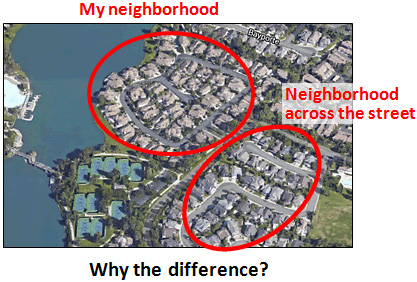
    Or take my current suburban neighborhood. It’s pretty typical. Everyone is friendly, and we know our near neighbors. Some close friendships have developed, but that’s about it. Across the street there’s a nearly identical neighborhood, but this one is far more close-knit, throwing Halloween parties and July 4th bashes and just generally socializing in a way that mine doesn’t. Why?

    I’m not entirely convinced that the nature of friendships has actually changed all that much during the past few centuries of civilization. Some people are sociable and some aren’t. But if I’m wrong, I still don’t think it’s primarily because of changes in the built environment. Maybe it’s due to the fact that women don’t routinely stay home during the day and socialize with neighbors. Maybe it’s because of air conditioning and TV. Maybe we all figured out that picking friends by random location (i.e., living next door) didn’t make much sense once we had other options. Or maybe it’s just that smart verbal types tend to be a little introverted, and we hear from them more often than anyone else.

    And stop blaming graduation from college! Half the country never went to college, but I’ll bet they have as many (or more) friends than the rest of us. How do they manage that if they skipped college and live in the same kinds of places as us overeducated types?

    Anyway, consider this is a challenge. Do modern Americans really have fewer close friends than in the past? Establish that before you go any further. If it turns out to be true, why? I don’t think the evidence really supports the idea that it’s mostly due to the nature of suburban living. (Do apartment dwellers have more friends than homeowners?) This becomes a much more interesting question when we get over our obsession with the evils of suburbia.

  • Reading and Math Scores Changed Barely At All This Year


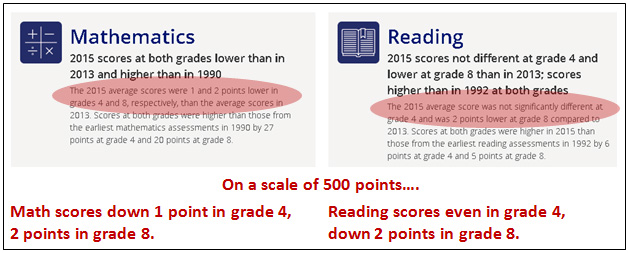
    New NAEP test scores are out for grades 4 and 8. Because the NAEP is such a trusted low-stakes test, you’re going to hear a lot about what these new scores “mean.” Maybe even from me! But here’s the one thing you need to know before you read anyone telling you that these scores prove that standardized tests are good (or bad) or that Arne Duncan is an idiot (or a hero) or that teachers unions are a mess (or a godsend): the change in test scores was tiny.

    Over the long term, NAEP scores in both math and reading have increased steadily and substantially. However, they’ve always bounced around by a few points both up and down in every cycle. This isn’t to say that the 2015 scores are meaningless, but you should pay no attention to any sensational declarations from any side in the ed wars. This year’s scores are a downward blip, something we’ve seen before. It will be many years before we know for sure if they’re anything more than that.

  • A Quick Guide to Interpreting Everything You Hear About Obamacare Rate Increases


    How much are health care premiums on the Obamacare exchanges set to rise in 2016? That depends. Here are a few possible answers:

    • If everyone keeps the coverage they currently have, Charles Gaba estimates that the weighted average increase—that is, weighting states with bigger populations more heavily—will be about 12-13 percent.
    • If everyone shops around and chooses the second-lowest price silver plan, the federal government estimates that the weighted average on federal exchanges will go up 7.5 percent.
    • It depends on the state. If you live in California, you can figure on about a 4 percent increase. Texas? 5.1 percent. Oklahoma? 35.7 percent.
    • If you live in a big city and you shop around, Kaiser estimates that the weighted average will go down 0.7 percent if you account for the average size of the federal subsidy. In some cities, the decrease is even larger.

    In other words, depending on how scary you feel like being, you can accurately cite the increase as 35.7 percent, 12-13 percent, 7.5 percent, or negative 0.7 percent. For example:

    • Obama: “In my hometown of Chicago, rates are going down by 5 percent.”
    • Democratic think tank: “If you shop around for the best rate, HHS estimates an average increase of 7.5 percent on the federal exchanges.”
    • Republican think tank: “Liberal analyst Charles Gaba estimates an average increase of 13 percent, with 18 states seeing increases of 20 percent or more.”
    • Trump: “Some people tell me their rates are going up by 25, even 35 percent!”

    Every one of these is an accurate citation. So which one is the fairest? I’d say (a) you should count the tax credit since that affects what people actually pay, (b) some people will shop around and some won’t, and (c) you should usually cite a broad national estimate, not a state or local number.1 With all that taken into account, my prediction is that the average person using Obamacare will see an increase of about 6-7 percent.

    1Obviously there are exceptions to all of these. If the Los Angeles Times wants to report on average increases in Los Angeles, then it should use the Los Angeles number. If you’re reporting on how well insurance companies are doing at estimating the premiums they need to charge, you should use raw numbers that don’t count the tax credit. Etc.

    But if you do a telephone survey of Obamacare users next year and simply ask them, “How much more are you paying for health insurance than last year,” I think we’re going to end up around 6-7 percent.

  • President Obama Stares Down the Chinese


    President Obama recently decided to send the guided-missile destroyer USS Lassen to one of those little islands China is building in the South China Sea, and which China claims as part of its territorial waters. So how did the Chinese react?

    The decision…angered China, which said last month it would “never allow any country” to violate what it considers to be its territorial waters and airspace around the islands. The U.S. vessel entered Chinese waters “illegally and without the Chinese government’s permission,” Foreign Ministry spokesman Lu Kang said in a statement, adding that Chinese authorities had monitored and warned it as it passed.

    “The action by the U.S. warship has threatened China’s sovereignty and security interests, endangered the safety of personnel and facilities on the islands and damaged regional peace and stability,” he said, urging the United States to “correct its wrongdoing immediately” and not take further “dangerous and provocative actions.” Hours later, China’s vice foreign minister, Zhang Yesui, summoned U.S. Ambassador Max Baucus to deliver a formal protest.

    Oooh. After saying they would “never allow” such a thing, the Chinese….issued a statement and then called in our ambassador to protest. Scary.

    Seriously, though: can you imagine the ballistic outrage if Obama had reacted like this to a Chinese sail-by? Republicans would practically be ready to start impeachment hearings. It would be yet another sign of the weakened world standing of the United States under Democratic leadership.

    But when it’s the other way around, is it a sign of plummeting Chinese leadership? Or Obama’s steely-eyed projection of American power? Judging by the non-reaction, I guess not. Go figure.

  • Can a Bit of Kabuki Theater Save the Republican Party?


    The Republican kabuki going on right now is a marvel of the age. Apparently pretty much everyone in Washington, DC—Democrats, Republicans, tea partiers, House Freedom lunatics—has agreed to keep mum about John Boehner’s lipstick-on-a-pig budget deal with the president. Everyone, that is, except the presumptive new speaker, Paul Ryan:

    “I think the process stinks,” said Ryan, who is expected to be elected speaker on Thursday. The Wisconsin Republican added that he hadn’t gone through the details of the agreement, which was released Monday night.

    “This is not the way to do the people’s business,” Ryan said. “And under new management we are not going to do the people’s business this way. We are up against a deadline—that’s unfortunate. But going forward we can’t do the people’s business. As a conference we should’ve been meeting months ago to discuss these things to have a unified strategy going forward.”

    This is so staged it makes Dame Edna look serious. Ryan has basically been given permission to blast the deal in order to verify his conservative bona fides, and everyone else understands this is just an act. Even the ultras have apparently made the following, fairly obvious calculation:

    So the deal was struck. Everyone eats the shit sandwich. Paul Ryan pretends to oppose it. A battered, bruised, but slightly less slapstick Republican Party moves forward.

